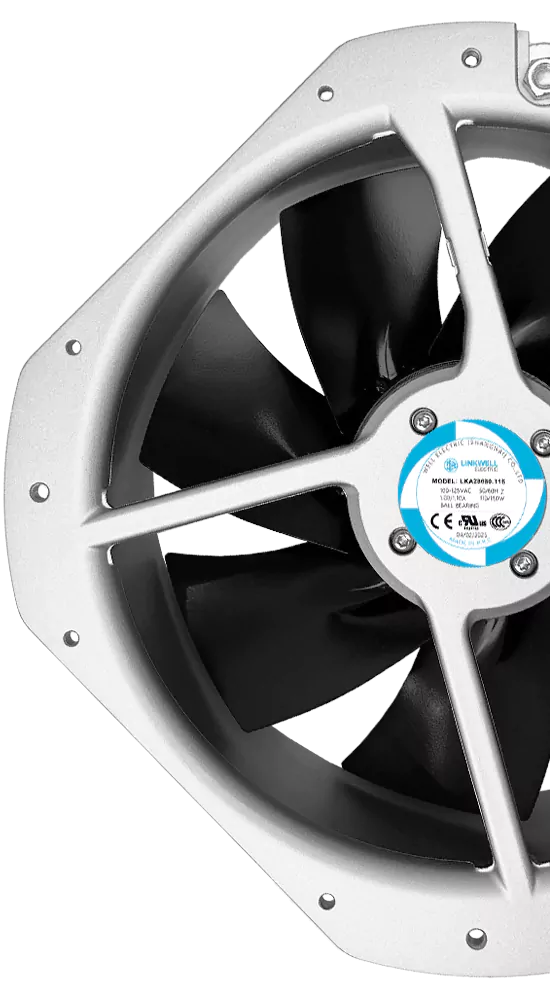
In modern industrial environments, efficient heat management is no longer optional—it is essential for protecting sensitive components, maintaining operational continuity, and ensuring the long-term reliability of equipment. Whether in electrical enclosures, telecom cabinets, automation systems or renewable energy equipment, heat buildup can quickly lead to reduced performance, premature component failure, or costly downtime.
Among the many cooling methods available today, the AC fan (Alternating Current Fan) remains one of the most widely used and trusted solutions. Known for its durability, stable airflow output, and cost-effective operation, the AC fan is particularly suitable for applications requiring continuous 24/7 operation and strong airflow.
What Is the AC Fan?
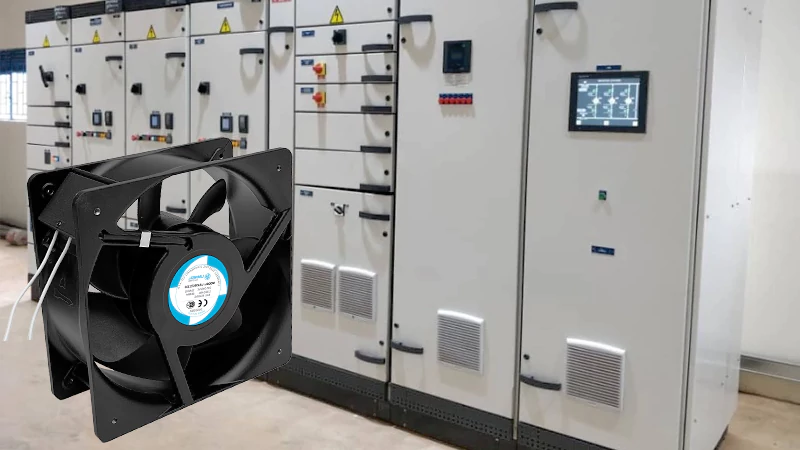
An AC fan is an electrical cooling device that operates on alternating current to generate consistent airflow. Its primary job is to remove heat from components or enclosed spaces, helping equipment maintain a stable operating temperature. Because of its simple construction and reliable performance, the AC fan has become one of the most widely used cooling solutions across many sectors—from electrical enclosures and telecom cabinets to industrial machinery, HVAC systems, and household appliances.
Structurally, an AC fan is straightforward, usually consisting of a motor, fan blades, and a protective housing. This simplicity keeps manufacturing efficient and cost-effective while still delivering strong airflow output. Despite not being the most advanced type of fan, AC fans offer dependable cooling with relatively low noise, making them suitable for environments where stable ventilation is required. They are commonly found in factories, warehouses, commercial buildings, retail equipment, and various residential applications where durability and steady airflow matter more than speed control features.
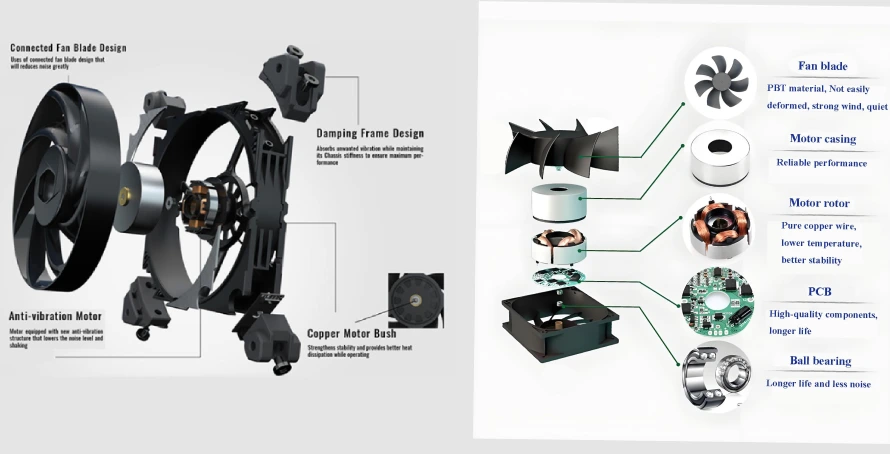
Key Components of a Typical AC Fan:
- Stator: The stationary outer part containing the stator windings. When energized with AC power, it creates a rotating magnetic field.
- Rotor: The central rotating part. In the most common induction motors, the rotor is typically a “squirrel cage” design—a cylinder of laminated iron cores with aluminum or copper conductors. The stator’s rotating magnetic field induces a current in these conductors, creating its own magnetic field that causes rotation.
- Bearings: Support the rotor shaft, minimizing friction. Common types include sleeve bearings (quieter) and ball bearings (longer life, better for high-temp or horizontal mounting).
- Capacitor (for Single-Phase Motors): A critical component for single-phase AC fans. It creates a phase shift to generate the initial starting torque, allowing the motor to self-start.
- Housing/Frame: The structural chassis that protects internal components, provides mounting points, and often defines the airflow path.
- Blades/Impeller: Attached to the rotor shaft. Their aerodynamic design converts rotational motion into directional airflow (axial or centrifugal).
Key Parameters Explained
| Parameter | Description | Why It Matters |
|---|---|---|
| Voltage & Frequency | Single-Phase: 100-120V / 200-240V Three-Phase: 380-415V / 200-240V (depending on region) Frequency: 50Hz or 60Hz | Must match your local power grid specifications. Mismatched voltage/frequency can cause immediate motor failure, overheating, or significantly reduced performance and lifespan. |
| Motor Type | Induction (Asynchronous): Most common, cost-effective, robust. Synchronous: Higher efficiency, precise speed, often used with permanent magnets. Shaded-Pole: Simple, low torque, low cost for small applications. | Determines starting torque, speed regulation, efficiency profile, and cost. Induction motors dominate general-purpose applications, while synchronous motors are chosen for precision and efficiency-critical uses. |
| Number of Poles | 2-Pole: ~3000 RPM (sync speed at 50Hz) 4-Pole: ~1500 RPM (sync speed at 50Hz) 6-Pole: ~1000 RPM, etc. | Directly determines the motor’s synchronous speed (RPM = (120 * Frequency) / Number of Poles). Lower pole count = higher speed; higher pole count = lower speed, often with higher torque. |
| Insulation Class | Class B (130°C), Class F (155°C), Class H (180°C) | Indicates the thermal endurance of the motor’s winding insulation. A higher class (e.g., Class F or H) allows the motor to withstand higher operating temperatures, directly correlating to longer service life, especially in demanding or high-ambient environments. |
| Ingress Protection (IP) Rating | IP54: Dust protected, water splashing. IP55: Dust protected, low-pressure water jets. IP68: Dust-tight, prolonged immersion. | Defines the level of protection against solid particles (first digit) and liquids (second digit). Critical for determining suitability for outdoor, washdown, corrosive, or dusty environments. |
| Capacitor Type (Single-Phase Motors) | Start Capacitor: High value, used briefly only during motor start. Run Capacitor: Lower value, remains in circuit during operation. Start-Run Capacitor: Combines both functions. | Essential for creating the phase shift needed to start a single-phase motor. The correct capacitor (µF rating & voltage) is crucial for achieving rated starting torque, efficiency, and preventing motor damage. |
| Current & Power (Input) | Rated in Amps (A) and Watts (W) or Horsepower (HP). | Determines electrical load, wire sizing, and circuit breaker requirements. Input power correlates with airflow output and operational cost. |
| Airflow & Static Pressure | Airflow (CFM / m³/h): Volume of air moved. Static Pressure (in. H₂O / Pa): Fan’s ability to overcome resistance. | The core performance metrics. Always reference the fan’s Performance Curve (PQ Curve). Select a fan where your required airflow and system pressure intersect near the peak efficiency point on its curve. |
| Noise Level | Measured in decibels (dBA) at a specified distance and operating point. | Critical for occupied spaces like offices, hospitals, or residential applications. Lower dBA = quieter operation. Consider fans with aerodynamic blade designs and balanced rotors for noise-sensitive installations. |
| Bearing Type | Sleeve/Bushing: Quiet, lower cost, limited life in high-temp or horizontal mounts. Ball Bearing: Longer life, handles higher loads/temperatures, suitable for all orientations. | Bearing life often defines the fan’s service life. Ball bearings are recommended for continuous operation, higher temperatures (>60°C), or horizontal mounting positions. |
How Does an AC Fan Work?
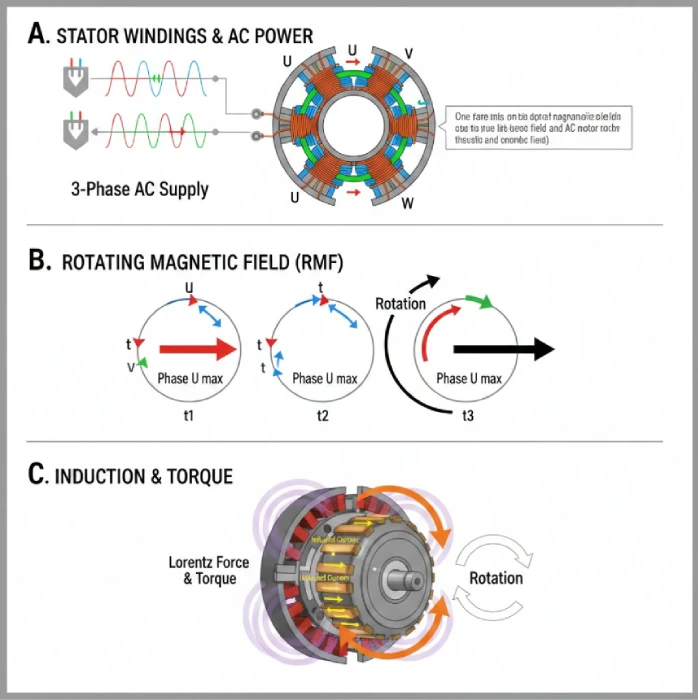
An AC fan operates using an AC induction motor, a type of motor that converts alternating electrical energy into mechanical rotation through electromagnetic induction. When AC voltage is supplied, it generates an alternating magnetic field in the stator. This field then induces a magnetic force in the rotor, causing it to spin. The fan blades attached to the rotor move air across the device, delivering cooling airflow or ventilation.
Most AC fans operate at a fixed speed determined by the input frequency (50 Hz or 60 Hz). Because the rotational speed of the induction motor is directly related to the frequency of the AC supply, an AC fan connected to a 60 Hz supply typically spins faster than one connected to 50 Hz. This explains why airflow performance specifications often vary between 50 Hz and 60 Hz ratings.
Structure-wise, a typical AC fan consists of:
- Stator – stationary coil that generates electromagnetic fields
- Rotor – rotating assembly that turns the blades
- Impeller or fan blades – push the air
- Frame or housing – protects the internal components
- Bearings – ball or sleeve bearings that support rotor rotation
The simplicity of this design is one reason AC fans are valued for durability. Fewer electronic components mean fewer potential failure points, making AC fans highly suitable for heavy-duty industrial systems.
The heart of an AC fan’s operation is the creation of a Rotating Magnetic Field (RMF) within the stator.
Simplified Process:
- AC Power Supply: The fan is connected to an AC power source (e.g., 120V/60Hz or 230V/50Hz). The voltage and current direction reverse cyclically (50 or 60 times per second).
- Stator Activation: This alternating current flows through multiple sets of windings (phases) arranged around the stator core at specific angles.
- Creation of RMF: Due to the alternating nature of the current and the spatial arrangement of the windings, the combined magnetic field produced does not merely pulse but effectively rotates around the stator. (For a single-phase motor, the starting capacitor is essential to simulate this effect initially).
- Induction in the Rotor (For Induction Motors): The rotating magnetic field cuts across the conductive bars of the stationary squirrel-cage rotor. According to Faraday’s Law of Induction, this changing magnetic field induces an electrical current in the rotor bars.
- Torque Generation: The induced current in the rotor creates its own magnetic field. The interaction between the stator’s RMF and the rotor’s induced magnetic field generates a force (Lorentz force), resulting in rotational torque.
- Rotation & Slip: The rotor begins to spin, chasing the rotating magnetic field. It never quite catches up (synchronous speed); this speed difference is called “slip” and is essential for torque induction in an induction motor.
- Air Movement: The rotating rotor shaft drives the fan blades, which push air through the housing, creating cooling or ventilation.
Types of AC Cooling Fans
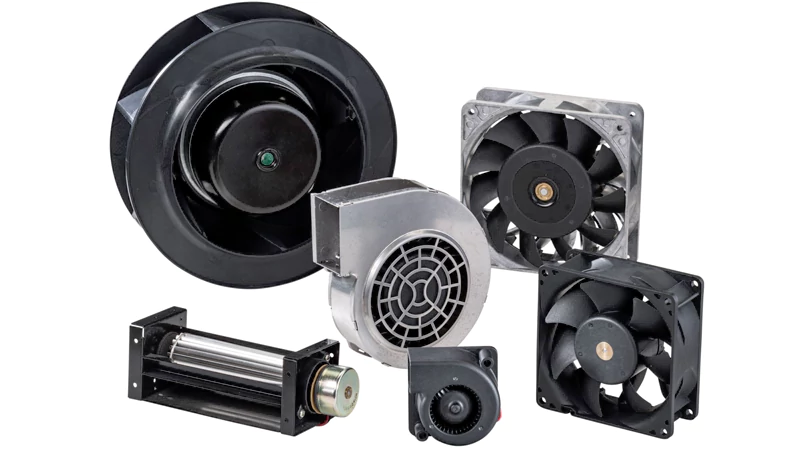
AC fans are available in several configurations, each suited to a specific type of airflow requirement. The three major types include:
Axial AC Fans
Axial AC fans move air in a direction parallel to the fan shaft, allowing them to deliver high airflow with relatively low pressure. Because of their simple structure and efficient performance, axial fans are the most widely used AC fan type in industrial and commercial cooling.
They are commonly installed in electrical enclosures, telecom cabinets, power distribution boxes, and electronic devices that require constant ventilation. Their compact design, lightweight construction, and cost-effective operation make them ideal for moving large volumes of air across components. Axial AC fans are preferred in open-space cooling applications where airflow volume matters more than air pressure.
Centrifugal AC Fans
Centrifugal AC fans move air perpendicular to the air intake, using a centrifugal impeller to generate significantly higher static pressure than axial fans. This design makes them highly effective in ducted systems, air filtration equipment, cooling units with airflow resistance, and environments requiring controlled or directed ventilation.
Although centrifugal fans typically deliver lower airflow volume than axial fans, they excel in applications where air needs to be pushed through narrow channels or long ducts. Their stable pressure output, durable structure, and consistent performance make them a dependable choice for industrial machinery, HVAC systems, and equipment cooling that demands stronger pressure management.
Cross-Flow AC Fans
Cross-flow AC fans have a unique hybrid structure that combines characteristics of both axial and centrifugal fans. Their long, cylindrical blade design allows air to move in a smooth and consistent direction across the entire length of the fan.
This design helps generate a wide and uniform airflow pattern, making cross-flow fans especially useful in systems where even air distribution is important.
They offer a balanced performance by providing good airflow volume, moderate static pressure, and low-to-medium noise levels. Because of these advantages, cross-flow AC fans are widely used in HVAC units, air curtains, display coolers, heaters, and various industrial ventilation applications.
Key Features and Advantages of AC Fans
Stable and Strong Airflow Delivery
AC fans deliver stable airflow, making them ideal for continuous operation. Their powerful motors generate significant static pressure and high airflow volume. For example, LinkWell’s 280mm axial fan models can generate over 1050 CFM (Cubic Feet per Minute), providing robust cooling for densely packed electrical enclosures.
Higher Durability for Harsh Industrial Environments
AC fans are known for their robust construction. For instance, Linkwell’s AC fans are typically rated for 50,000 to 60,000 hours (L10 at 40°C), ensuring long operational life. They are workhorses built to withstand harsh environments, with many models featuring IP44-rated enclosures to protect against dust and water ingress.
Low Maintenance Requirements
Because AC fans rely on inductive motor principles rather than complex electronic drivers, they typically require less maintenance. Bearings are often the only components that may need replacement over time, especially in high-temperature or high-humidity environments. Industries that need predictable maintenance costs often choose AC fans as a safer long-term solution.
Cost-Effective Cooling Performance
AC fans offer a good balance between performance and cost. They provide strong airflow at low initial cost and deliver dependable cooling without the need for additional controllers or electronic speed drivers. For large-scale industrial deployments, using AC fans can significantly reduce upfront investment.
Suitable for High-Power Applications
Unlike DC and EC fans, AC fans handle higher voltage and generate stronger static pressure, making them suitable for heavy-duty systems like industrial automation cabinets, power supplies, solar inverter systems, and commercial refrigeration units.
Applications of AC Fans
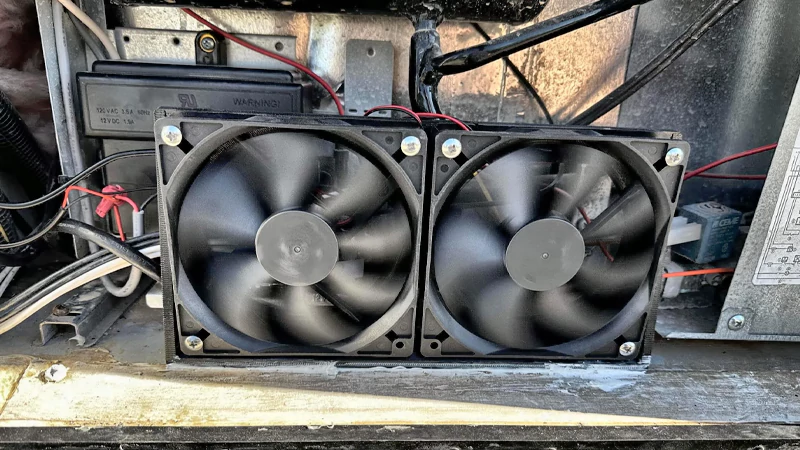
Electronics Cooling
AC fans play an essential role in electronics cooling by providing steady and reliable airflow to prevent components from overheating. They are commonly used in power supplies, control boards, UPS systems, telecom equipment, and inverter cabinets.
Because AC fans deliver consistent airflow at a fixed speed, they help maintain stable operating temperatures, extend equipment lifespan, and reduce failure risks. Their durability and long service life make them suitable for electronic environments that require continuous, around-the-clock ventilation without performance fluctuations.
Industrial Ventilation
AC fans play an important role in industrial ventilation by supporting air movement in environments with dust, fumes, or heat-producing processes. They are widely used in workshops, manufacturing lines, metal processing areas, and dust-collection systems. These fans help remove contaminants, control humidity, and maintain safe air quality for workers.
In addition, AC fans support heat transfer in production equipment and help supply oxygen to combustion chambers, improving the efficiency and stability of related heating processes. Their durability makes them ideal for continuous industrial operation.
Agricultural Applications
AC fans are also used in agricultural settings where stable airflow and temperature control are crucial. They help ventilate greenhouses, livestock barns, seed storage rooms, and irrigation control systems. By maintaining proper air circulation, AC fans support plant growth, reduce humidity, and prevent heat-related stress in animals.
Their dependable performance and low maintenance needs make them suitable for long hours of operation in rural or remote environments. Farmers and agricultural facilities often choose AC fans for their durability, simple structure, and cost-effective cooling benefits.
AC Fans vs. DC Fans: Key Differences
A primary consideration for many engineers and system designers is choosing between AC and DC fan technology. While both serve the same purpose, their underlying designs impact everything from power consumption and speed control to operational noise and initial cost. The following table provides a clear, side-by-side comparison to help you select the right technology for your application.
| Feature | AC Fans (Alternating Current) | DC Fans (Direct Current) |
| Power Source | AC Voltage (e.g., 110V/230V) | DC Voltage (e.g., 12V/24V/48V) |
| Speed Control | Fixed speed (requires VFD) | Easy (Variable via PWM or Voltage) |
| Energy Efficiency | Standard | High (Often 30-50% more efficient) |
| Noise Level | Medium to High | Very Low (Especially at low RPMs) |
| Initial Cost | Lower | Higher (More complex circuitry) |
| Best For | High airflow, constant operation, cost-sensitive | Variable speed, low noise, energy-saving |
| Motor Lifespan | Very Long (Simple motor design) | Long (Brushless motor design) |
How to Choose the Right AC Fan
Selecting the right AC fan requires evaluating airflow needs, environmental conditions, and installation requirements. Key factors include:
- Airflow and Static Pressure Requirements
Understand whether your enclosure or device requires high airflow (CFM) or high pressure to overcome resistance. Axial fans suit open-airflow systems, while centrifugal fans suit restricted or ducted systems. - Fan Size
Standard sizes like 80mm, 120mm, 172mm, and 254mm correspond to different airflow outputs. Larger fans offer stronger airflow at lower noise levels. - Voltage Options
Choose from 110V/115V or 220V/230V depending on your regional power standard. - Bearing Type
Ball bearings offer longer lifespan and better high-temperature performance than sleeve bearings. - IP Rating and Environmental Protection
Outdoor cabinets, dusty factories, and humid environments may require higher IP-rated fans. - Noise Level Considerations
Applications such as medical devices or indoor equipment may require quieter models. - Quality and Manufacturer Expertise
Partnering with experienced fan manufacturers ensures better performance consistency. Leading manufacturers like LinkWell provide AC, DC, and EC fans designed for reliability in demanding industrial environments.
Conclusion
AC fans remain one of the most dependable, cost-effective, and widely used cooling solutions in modern industrial environments. Their durability, stable airflow output, and ability to operate continuously under harsh conditions make them ideal for applications such as electrical enclosures, automation systems, renewable energy equipment, and telecom cabinets. While DC and EC fans offer more advanced control and efficiency, AC fans continue to deliver unmatched reliability for fixed-speed, heavy-duty industrial cooling needs.
Incorporating insights from experienced manufacturers such as LinkWell, you can make informed decisions when selecting the right AC fan for their equipment. By understanding how AC fans work, their advantages, and their application suitability, businesses can significantly improve equipment longevity, minimize thermal risks, and maintain stable operating conditions across diverse environments.