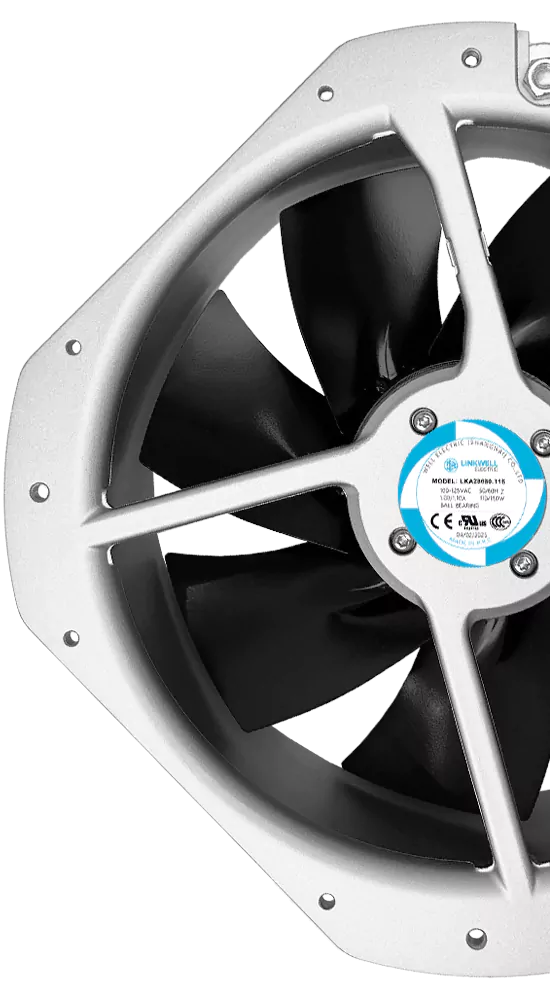
Fan flow measures how much air a fan moves in a set time. You need to get this right if you want your cooling system to work well. In factories or server rooms, fan cooling keeps equipment safe from overheating. If you choose the wrong fan or miscalculate fan flow, your forced air cooling might use more energy and cool less effectively. This can cost you money and hurt your equipment. That’s why so many people trust fanacdc for reliable fans and smart cooling solutions.
Key Takeaways
- Understand fan flow to ensure your cooling system works efficiently. Measure air flow in CFM to determine if your fan meets your cooling needs.
- Use accurate tools like anemometers and flow hoods to measure air flow. Proper measurements help avoid energy waste and ensure effective cooling.
- Follow the standard formulas for calculating flow rate. Knowing how changes in speed or size affect flow helps you select the right fan.
- Regular maintenance is key to fan performance. Clean filters and check for leaks to keep your system running smoothly and efficiently.
- Choose the right fan type based on your application. AC, DC, EC, and centrifugal fans each have unique benefits that suit different cooling needs.
Fan Flow Basics and Air Flow Importance
What Is Fan Flow?
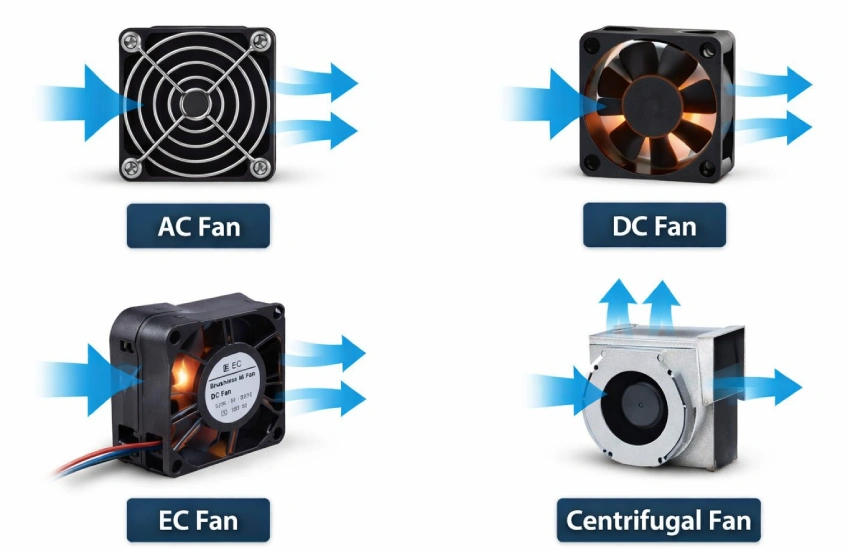
Let’s start with the basics. Fan flow tells you how much air a fan moves in a certain amount of time. You’ll see this measured in cubic feet per minute, or CFM. When you look at a fan, you want to know how much air it can push or pull through your system. This number helps you figure out if your equipment will stay cool or if you need a bigger or smaller fan. If you want your cooling setup to work well, you need to understand fan flow.
Air Flow Units and Measurement
You’ll run into a few common units when you measure air flow. The most popular is CFM, which stands for cubic feet per minute. Sometimes, you might see liters per second (L/s) or cubic meters per hour (m³/h). These units all tell you the same thing—how much air moves through the fan. To measure air flow, you can use tools like an anemometer or a flow hood. These tools help you check the actual air flow in your system, not just what the label says.
When you pick a fan, think about where you’ll use it. Here’s why air flow measurement matters:
- Static pressure fans work best in tight spaces with lots of resistance. They stay quiet and keep things cool, even when air can’t move freely.
- Ventilation fans shine in open areas. They move a lot of air and boost circulation, but they can get noisy and struggle if there’s too much resistance.
Why Fan Flow Matters for Fan Cooling
You want your equipment to last and run smoothly. That’s where air flow comes in. If you get the right fan, you’ll keep temperatures down and avoid overheating. Too little air flow means hot spots and possible damage. Too much air flow can waste energy and make things noisy. Always check the actual air flow in your setup. This way, you know your cooling system does its job, and you get the most out of your fan.
Fan Flow Rate Calculation Methods
Standard Formula for Flow Rate
You want to figure out how much air your fan moves. The standard formulas make this easy. These formulas help you predict how changes in speed or size affect the flow rate, pressure, and power. You can use them for any type of fan, whether it’s AC, DC, EC, or centrifugal.
Here’s a quick table to show you the most common formulas:
| Variable Condition | Formula | Description |
|---|---|---|
| Impeller Speed (n) | Q2 = Q1 (n2/n1) | Flow rate changes directly with speed ratio. |
| System Pressure | p2 = p1 (n2/n1)² | Pressure changes with the square of speed ratio. |
| Power Usage | HP2 = HP1 (n2/n1)³ | Power changes with the cube of speed ratio. |
| Impeller Diameter (D) | Q2 = Q1 (D2/D1)³ | Flow rate changes with the cube of diameter ratio. |
| Pressure by Diameter | p2 = p1 (D2/D1)² | Pressure changes with the square of diameter ratio. |
| Power by Diameter | HP2 = HP1 (D2/D1)⁵ | Power changes with the fifth power of diameter ratio. |
| Density | p2 = p1 (p2/p1) | Pressure changes with air density ratio. |
You can also remember the three main fan laws:
- Air flow is directly proportional to fan speed.
- Pressure is proportional to the square of fan speed.
- Power usage is proportional to the cube of fan speed.
Let’s say your fan delivers 10,000 CFM at 1,000 RPM. If you increase the speed to 1,200 RPM, the new flow rate will be 12,000 CFM. You just multiply the original air flow by the ratio of the new speed to the old speed.
Measuring Parameters for Accurate Air Flow
You need to measure a few key things to get the actual air flow right. Here’s what matters most:
- Air flow is measured in cubic feet per minute (CFM) or cubic meters per minute (m³/min).
- Static pressure is measured in Pascals (Pa) or inches of water (inH2O).
- Airflow velocity tells you how fast the air moves through the fan.
- Modern anemometers can give you accuracy above 95%. These tools help you check the real output of your fan.
- Advanced sensors like thermal dispersion sensors and digital manometers can help you measure air flow and static pressure with high precision.
If you don’t measure air flow correctly, you might miss slow spots that need more ventilation. Too much air flow can waste energy. Bad measurements can lead to wrong system adjustments and poor cooling.
You can use different tools for measuring air flow:
- Rotating vane anemometer (good for mid-range air flow)
- Pitot tube and digital manometer (works for full-range air flow)
- Velocity stick (hot wire anemometer, best for low to mid air flow)
- Flow hood (captures air flow from vents)
- RPM and manufacturer’s fan curve (estimate flow rate based on speed)
- TRUEFlow® grid (measures pressure drop for air flow estimates)
In HVAC systems, you usually design for about 400 CFM per ton of cooling. The right tool depends on your system size and how accurate you need to be.
Step-by-Step Fan Flow Calculation
Ready to calculate flow rate for your fan? Follow these steps to get it right every time:
- Select Desired Air Volume (CFM): Figure out how much air flow your application needs. For example, electronics cooling might need a lower flow rate than a large HVAC system.
- Determine Static Pressure Requirements: Check how much resistance your system has. This tells you the static pressure your fan must overcome.
- Find the Operating Point on the CFM vs. Static Pressure Curve: Look at the fan’s performance curve. Find where your needed air flow and static pressure meet.
- Calculate Brake Horsepower from the CFM vs. Brake Horsepower Curve: Use the operating point to see how much power your fan will use.
Tip: Always use the manufacturer’s fan curve for the most accurate results. Fanacdc tests every fan for noise, air flow output, and static pressure in the lab. You can trust their data to match real-world performance.
Fanacdc’s products make this process easier. Their high-efficiency brushless motors deliver strong air flow with low power use. The aerodynamic blade design keeps things quiet, even in sensitive environments. Smart speed control and monitoring features like PWM, tachometer, and alarms let you fine-tune your fan for the best flow rate. Every fan goes through environmental testing, so you know it will work in tough conditions.
If you want reliable cooling, always check the actual air flow in your setup. Use the right formulas, measure with accurate tools, and pick fans that meet your needs. Fanacdc’s AC, DC, EC, and centrifugal fans all follow strict measurement standards, so you get consistent performance every time.
Fan Flow Calculation by Type: AC, DC, EC, Centrifugal
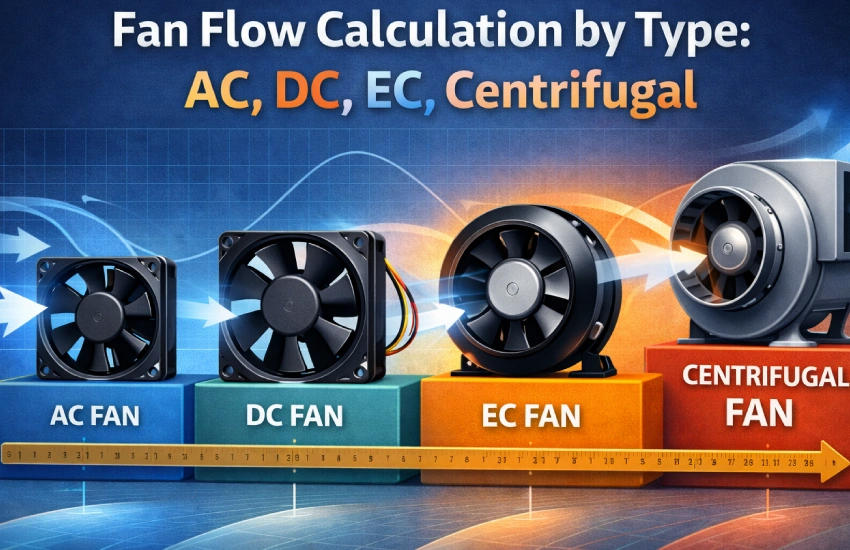
AC Fans: Air Flow and Flow Rate Calculation
When you work with AC fans, you want to get the most reliable air flow for your system. These fans shine in industrial and commercial spaces where you need stable performance and long service life. To calculate flow rate for an AC fan, you can follow a few simple steps:
- Measure the total pressure at the fan inlet using a manometer.
- Calculate the dynamic pressure using the formula: P_dynamic = 0.5 × air density × (airflow velocity)².
- Subtract the dynamic pressure from the total pressure to find static pressure.
You can use the fan laws to predict how changes in speed or size affect air flow and flow rate:
- CFM changes directly with RPM.
- Static pressure changes with the square of RPM.
- Power changes with the cube of RPM.
If you want to design an effective ventilation system, remember that the relationship between flow rate and static pressure is exponential. As you increase flow rate, static pressure rises quickly. This is why you need to check both values on the fan curve. For example, if you double the speed, you double the air flow, but static pressure goes up four times.
Tip: Always match your required air flow and static pressure to the fan’s performance curve. This helps you avoid picking a fan that can’t handle your system’s resistance.
Fanacdc’s AC fans deliver stable air flow, low maintenance, and cost-effective operation. They’re rated for 50,000 to 60,000 hours and work well in high-power applications. You can trust them for continuous cooling in control cabinets, automation, and telecom systems.
DC Fans: Fan Flow and Cooling Performance
DC fans give you precise speed control and energy savings. You can adjust the flow rate using PWM signals, which makes these fans perfect for electronics and automation. The fan affinity laws apply here, too. If you triple the RPM, you triple the air flow and increase static pressure by nine times.
At low air flows, static pressure reaches its peak. As you increase flow rate, static pressure drops. For example, at zero CFM, you get maximum static pressure. At 80-100 CFM, static pressure falls to nearly zero. If you run your DC fan at 60Hz, you’ll see better performance—about forty CFM at four mmH2O static pressure—compared to 50Hz.
Changing the speed affects not just air flow, but also air pressure, power use, and noise. You need to pick the right speed for your cooling needs. Too much flow rate can waste energy and create noise, while too little can cause overheating.
Fanacdc’s DC fans feature brushless motors, smart speed control, and low power consumption. They’re ideal for electronics cooling, telecom equipment, and any application where you need accurate air flow and quiet operation.
EC Fans: Efficient Air Flow and Flow Rate
EC fans combine the best of AC and DC technology. They use electronic commutation to deliver high energy efficiency and intelligent speed regulation. You can automatically adjust air flow based on system needs, which saves power and reduces operating costs.
When you evaluate EC fans, look at these efficiency metrics:
| Metric | Description |
|---|---|
| Ventilation Rate | Measured in cubic feet per minute (CFM) |
| Static Pressure | Pressure exerted by the fan at a given flow rate |
| Overall Efficiency (%) | Ratio of useful output power to input power |
| Fan Energy Index (FEI) | Metric for evaluating energy performance |
You want to check the flow rate and static pressure at different speeds. EC fans let you fine-tune performance for maximum air flow or maximum static pressure, depending on your application. They’re great for HVAC, data centers, and energy-saving projects.
Fanacdc’s EC fans meet strict energy-efficiency standards. They offer intelligent fan control, adapting to changing thermal loads and reducing noise when possible. You get reliable air flow and lower energy bills.
Centrifugal Fans: High Static Pressure and Fan Flow
Centrifugal fans stand out when you need to move air through tight spaces, ducts, or filters. They generate high static pressure, which is key for overcoming system resistance. Unlike axial fans, centrifugal fans throw air perpendicular to the spin direction, boosting their ability to handle complex airflow paths.
Here’s what you should know about centrifugal fan flow rate calculation:
- Centrifugal fans push air through restrictions, making them perfect for environments with limited air flow, like video cards or HVAC ducts.
- The static pressure rating tells you how well the fan performs when airflow is restricted.
- You need to match the fan’s maximum static pressure to your system’s resistance to get the actual air flow you want.
Note: Always check the fan’s static pressure characteristics on the performance curve. This helps you avoid picking a fan that can’t deliver enough air flow under real-world conditions.
Fanacdc’s centrifugal fans offer high static pressure, stable air flow, and long service life. They’re built with durable materials to handle harsh environments and are ideal for HVAC, refrigeration, and power systems.
When you select a fan, consider these factors:
| Consideration Factor | Description |
|---|---|
| Airflow Requirements | Know the heat to be dissipated and the change in air temperature needed. |
| System Impedance | Calculate resistance along the air path to define the fan operating point. |
| Fan Type | Choose between axial and centrifugal fans based on pressure conditions. |
| Power Options | Decide between AC, DC, or EC fans for flexibility and performance. |
| Noise and Life Expectancy | Important for long-term operation and comfort. |
| EMI/RFI Interference | Minimize interference in sensitive electronic applications. |
| Intelligent Fan Control | Use fans that adapt to changing loads for better efficiency. |
Environmental factors also play a role. High temperatures, humidity, or corrosive substances can affect fan materials and performance. Fanacdc’s fans use corrosion-resistant materials and withstand high temperatures, so you get reliable air flow even in tough conditions.
Advances in fan design, like blade profiling and optimized outlet angles, improve the accuracy of flow rate calculations. You get more reliable performance and better heat transfer for your system.
If you want the best results, always match your fan’s flow rate and static pressure to your system’s needs. Use the manufacturer’s data, measure actual air flow, and pick a fan that fits your application. Fanacdc offers AC, DC, EC, and centrifugal fans with proven performance, so you can power cooling innovation in any industry.
Practical Tips and Comparison Table for Fan Cooling
Tools for Measuring Fan Flow Rate
You want accurate numbers when you measure fan flow. The right tool makes all the difference. In industrial and commercial settings, you can use several advanced devices. Here’s a quick look at the most reliable options:
| Tool Type | Description |
|---|---|
| Pitot Averaging | Measures true velocity pressure at multiple points. You get high accuracy without worrying about correction factors for different Reynolds numbers. |
| Differential Pressure | Calculates fluid velocity by measuring pressure differences. This tool works for a wide range of applications, including ultra-low flow measurements. |
| Thermal Mass Flow Meters | Delivers precise readings across many flow rates. You can optimize your process and spot system inefficiencies quickly. |
If you want the best results, always calibrate your tools and follow the manufacturer’s instructions.
Common Mistakes in Air Flow Calculation
You can avoid a lot of headaches by watching out for common mistakes. Here are the issues that trip up most people:
- Dirty or clogged filters restrict airflow and make your fan work harder.
- Leaky ducts let air escape, which lowers system efficiency and reduces static pressure.
- Improper ductwork installation, like too many turns, disturbs airflow and affects static pressure.
- Blocked vents or registers prevent proper airflow and can throw off your calculations.
- Oversized HVAC units cycle too often, disrupting airflow and static pressure balance.
- Malfunctioning dampeners or blowers can reduce airflow and change static pressure characteristics.
- Dirty coils make it harder for your system to release heat, hurting cooling and heat transfer.
Tip: Regular maintenance and system checks help you catch these problems early.
Fanacdc Product Comparison Table
You want to pick the right fan for your job. Here’s a quick reference table to help you compare fanacdc’s main options and their fan flow and static pressure features:
| Fan Type | Air Flow Range (CFM) | Static Pressure Range (Pa) | Speed Control | Best For | Key Feature |
|---|---|---|---|---|---|
| AC Fan | 16 – 300 | Up to 120 | Basic (external) | Industrial, telecom, automation | Long service life |
| DC Fan | 10 – 400 | Up to 150 | PWM, tachometer | Electronics, automation, telecom | Precise speed control |
| EC Fan | 20 – 500 | Up to 180 | Intelligent (auto) | HVAC, data centers, energy-saving projects | High energy efficiency |
| Centrifugal Fan | 159 – 1735 | Up to 300 | VFD, external | HVAC, refrigeration, power systems | High static pressure |
You can see that AC fans offer steady performance, DC fans give you control, EC fans save energy, and centrifugal fans handle high static pressure. Always match your fan’s static pressure characteristics to your system’s needs for the best cooling and heat transfer.
Core Components of a Cooling Fan Structure
Understanding Fan Anatomy Before Performance Evaluation
Before analyzing airflow, pressure, or efficiency curves, it is essential to first understand the basic physical structure of a cooling fan. While fan designs vary across applications and manufacturers, nearly all cooling fans—whether axial or centrifugal—are built around four fundamental structural elements. These components work together to determine how effectively a fan moves air, how long it lasts, and how quietly it operates.
Blades / Impeller: Where Air Movement Begins
The impeller is the heart of any cooling fan. It consists of multiple blades arranged around a rotating center, and its sole purpose is to transfer energy from the motor to the surrounding air.
Blade geometry has a direct influence on:
- Airflow volume
- Static pressure capability
- Noise generation
- Energy efficiency
Factors such as blade shape, count, curvature, pitch angle, and material selection all play a role. Well-designed blades are the result of aerodynamic optimization, ensuring air is accelerated smoothly with minimal turbulence or loss. In essence, blade design is applied fluid dynamics in motion.
Hub: The Structural and Mechanical Anchor
The hub sits at the center of the fan and serves as the mounting point for the blades. It also houses or connects directly to the motor shaft.
Beyond simply holding components together, the hub impacts performance through its hub-to-tip ratio—the relationship between the hub diameter and the overall blade diameter. A larger hub reduces the effective airflow area but can improve mechanical strength, while a smaller hub increases airflow potential but may compromise rigidity. Striking the right balance is key to efficient fan operation.
Frame and Casing: Guiding and Containing the Air
The frame (for axial fans) or casing (for centrifugal fans) is the stationary structure that surrounds the impeller and motor. Its functions go well beyond protection.
A well-designed housing:
- Directs airflow efficiently into and out of the fan
- Helps convert air velocity into usable static pressure
- Reduces vibration and mechanical resonance
- Provides mounting stability
Structural stiffness is especially important. A weak or poorly designed frame can amplify vibration, increase noise, and shorten service life—even if the impeller itself is well engineered.
Motor and Bearings: The Power and Longevity Factors
The motor converts electrical energy into rotational motion, driving the impeller. Motor selection—AC, DC, brushless DC, or EC—affects:
- Energy efficiency
- Speed control
- Noise levels
- System integration
Bearings support the rotating shaft and are a critical determinant of fan lifespan. Sleeve bearings offer quiet operation at low cost, while ball bearings provide superior durability and stability, particularly in higher-temperature or variable-orientation environments. Bearing quality directly influences long-term noise behavior and reliability.
How Fan Structure Determines Airflow Direction
Axial vs. Centrifugal Design Principles
The most defining structural difference between fan types lies in how air travels through the fan. This distinction divides cooling fans into two primary categories: axial fans and centrifugal fans.
Axial Fan Structure and Airflow Behavior
In an axial fan, air enters and exits parallel to the axis of rotation. The airflow moves straight through the fan, much like air passing through a propeller.
Structural Characteristics
- Airfoil-shaped blades
- Straight-through airflow path
- Compact, typically square or circular frame
Performance Profile
- High airflow volume (CFM)
- Limited static pressure capability
- Best suited for low-resistance systems
Typical Applications
Axial fans are ideal where air encounters minimal obstruction, such as:
- Open electronic enclosures
- General ventilation
- Appliance cooling
- Low-density heat sinks
Centrifugal Fan Structure and Airflow Behavior
Centrifugal fans, often referred to as blowers, operate using a different airflow path. Air enters axially at the center and is then expelled radially at a right angle due to centrifugal force.
Structural Characteristics
- Squirrel-cage-style impeller
- Scroll or volute-shaped housing
- Controlled outlet geometry
Performance Profile
- Lower airflow volume compared to axial fans
- Significantly higher static pressure
- Designed to overcome airflow resistance
Typical Applications
Centrifugal fans excel in environments where air must be forced through restrictions, including:
- Dense heat sinks and fin stacks
- Server racks and networking equipment
- HVAC duct systems
- Compact, enclosed cooling paths
Axial vs. Centrifugal Fan Comparison
| Feature | Axial Fan | Centrifugal Fan |
|---|---|---|
| Airflow Direction | Parallel to rotation axis | 90° to rotation axis |
| Strength | High airflow volume | High static pressure |
| System Resistance | Low | Medium to high |
| Common Uses | Ventilation, open cooling | Servers, ducts, compact systems |
| Physical Form | Slim, flat profile | Bulkier, scroll housing |
Beyond Structure: How Blade Design Shapes Performance
Once the airflow path is chosen, blade design becomes the primary tuning mechanism for performance and acoustics.
Blade Count
- Fewer, wider blades typically move more air but may generate stronger tonal noise
- More, thinner blades increase pressure stability and produce smoother sound profiles
Blade Pitch and Curvature
Steeper blade angles can increase airflow and pressure but also raise motor load and noise. Engineers carefully balance pitch to avoid airflow separation or stall while maintaining efficiency.
Edge Geometry
Advanced designs may incorporate serrated trailing edges or curved blade tips. These features disrupt coherent airflow vortices, spreading noise across frequencies and making the sound less noticeable to the human ear. Some fans also include guide vanes to straighten airflow and improve pressure recovery.
Interpreting the P–Q Curve: Where Structure Meets Performance
The Pressure–Flow (P–Q) curve is the graphical representation of how a fan behaves under varying conditions. It plots static pressure against airflow volume.
Key points on the curve:
- Zero airflow: maximum static pressure
- Zero static pressure: maximum airflow
The actual operating point occurs where the fan curve intersects the system resistance curve. This intersection determines real-world performance. Importantly, the shape of the P–Q curve is a direct outcome of fan structure. Axial and centrifugal fans exhibit distinctly different curve profiles.
Structural Weaknesses and Common Fan Failures
Many fan failures trace back to design or material shortcomings rather than random defects.
Noise Issues
Unbalanced impellers, flexible frames, or poor bearing alignment can introduce vibration, leading to increasing noise over time.
Performance Loss
Inferior blade materials may deform under heat and mechanical stress. This slow shape change alters airflow characteristics and permanently reduces efficiency.
Airflow Stall
When system resistance exceeds the fan’s pressure capability, airflow can reverse locally on the blades. This stall condition causes sudden performance drops and sharp noise increases—often a sign that the fan type does not match the application.
Conclusion
You’ve learned how to understand and calculate fan flow for AC, DC, EC, and centrifugal fans. Now, you can make smarter choices for your cooling systems. When you follow the right steps, you keep your equipment safe and your energy bills low.
Let’s recap the best ways to get reliable cooling:
- Assess your system’s airflow needs and check the environment.
- Pick the right fan type for your application, especially if you need high pressure.
- Install your fan with care, making sure everything lines up and stays secure.
- Always follow the manufacturer’s instructions for wiring and safety.
- Test your fan after installation to confirm it meets your cooling goals.
If you want your cooling system to run smoothly, regular maintenance helps a lot. Clean the blades, check the bearings, and keep an eye on the motor. These simple steps boost efficiency and extend the life of your fan.
Here’s how fanacdc’s solutions make your job easier:
| Feature | Benefit |
|---|---|
| Motor energy-efficiency enhancements | Increases overall system reliability and reduces operational costs. |
| Advanced airflow and blade optimization | Improves airflow measurement accuracy and cooling efficiency. |
| Noise and vibration reduction engineering | Enhances operational reliability by minimizing disturbances. |
Smart control strategies, like variable speed drives and EC technology, let your fan adjust to real-time cooling needs. You save energy and get better temperature control. If you manage airflow well, you avoid waste and keep your system running at its best.
Watch out for things that can hurt efficiency. Uneven flow, blocked air paths, and nearby obstacles can lower cooling performance. Careful design and regular checks help you avoid these problems.
You’re ready to apply these tips and methods for better fan selection and system performance. With fanacdc, you get reliable cooling and accurate airflow measurement every time.
You now know how to figure out air flow and pick the right fan for your setup. Just follow the steps, check your numbers, and use the tools we discussed. If you want reliable cooling, try fanacdc’s solutions. You’ll get accurate results and peace of mind. Apply these tips, and your system will run smoother and last longer.
FAQ
How do you know which fan size fits your cooling needs?
You should check your equipment’s heat output and space. Look at the manufacturer’s airflow charts. Match the airflow and static pressure to your system. If you feel unsure, ask for help from a cooling expert.
Can you measure airflow without special tools?
Yes, you can estimate airflow using RPM and the fan’s performance curve. For more accuracy, use an anemometer or flow hood. These tools give you real numbers and help you spot problems early.
Why does static pressure matter in fan selection?
Static pressure shows how well your fan pushes air through obstacles. If your system has filters or tight ducts, you need higher static pressure. Always check this value before you buy a fan.
What’s the best way to keep your fan running smoothly?
Clean the blades and check for dust. Listen for strange noises. Make sure the motor stays cool. Regular maintenance helps your fan last longer and keeps your cooling system working well.
Do you need a different fan for high-temperature environments?
Yes, you should pick a fan built for high temperatures. Look for models with special materials and high-temperature ratings. These fans work better and last longer in tough conditions.