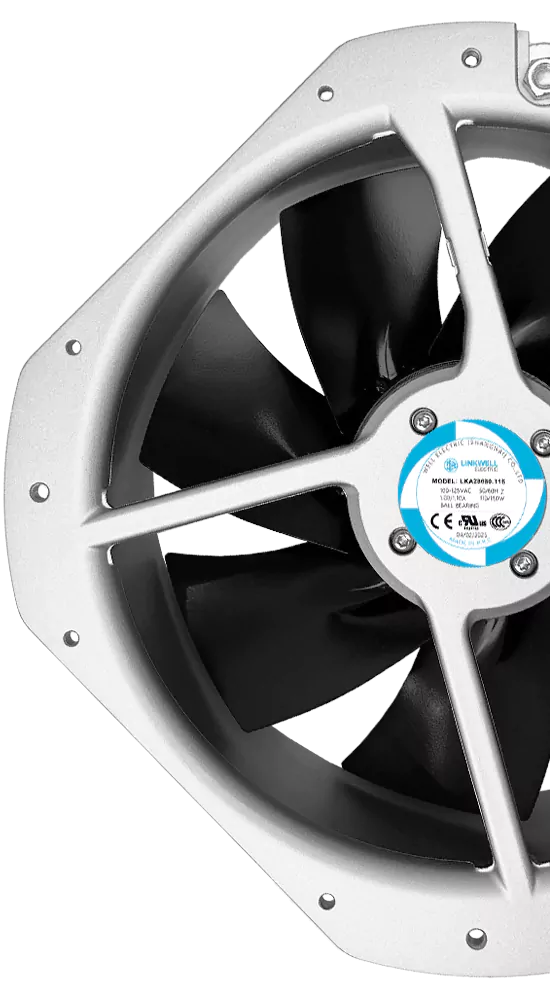
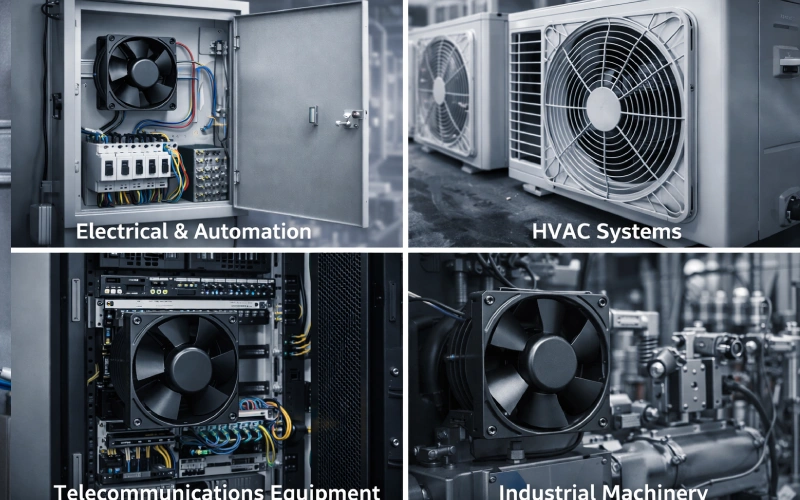
You see AC axial fans everywhere—inside electrical cabinets, cooling machinery, and keeping PCs running smoothly. When these fans run at a fixed speed, problems pop up fast. Overheating can damage sensitive components. Wasted energy drives up costs. Noise becomes a real headache, especially in quiet workspaces.
- Noise often gets worse if fans are not mounted securely.
- Vibration pads or isolators help reduce noise and extend fan life.
- Regular maintenance keeps everything running smoothly.
Ac Axial Fan Speed Control gives you the flexibility to tackle these challenges. If you need reliable cooling solutions for industrial or commercial use, fanacdc has you covered.
Key Takeaways
- Control AC axial fan speed to prevent overheating and reduce energy costs. Choose the right method for your needs.
- Voltage regulation is a simple and low-cost option for basic cooling needs. It works well in small setups.
- SCR/Triac dimming offers a wider speed range, making it suitable for industrial applications needing flexibility.
- Variable Frequency Drives (VFDs) provide precise control and energy savings, ideal for large machinery and demanding environments.
- Built-in electronic controls allow for smart and stable operation, perfect for modern systems requiring intelligent temperature management.
What is an AC Axial Fan
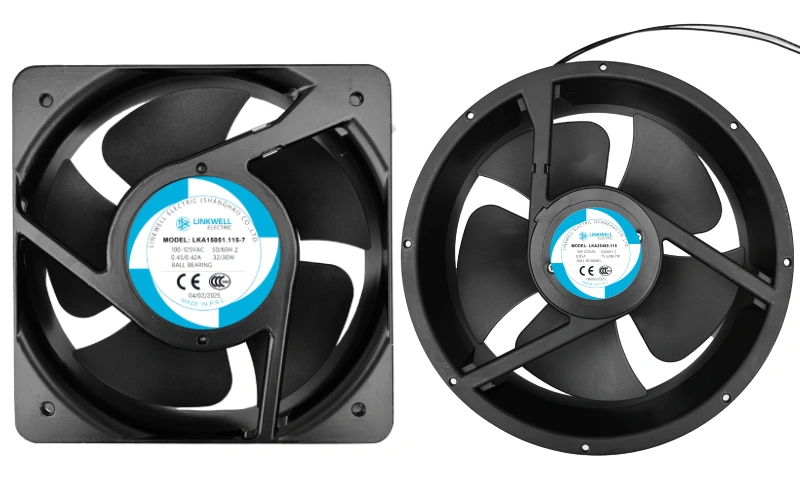
AC axial fans play a key role in keeping your equipment cool and your workspace comfortable. You see them in control cabinets, server racks, industrial machinery, and even inside your PC. These fans move air in a straight line, parallel to the axis of rotation. That design makes them perfect for high-volume ventilation and cooling.
Type
You’ll find several types of AC axial fans, each built for specific tasks:
- Propeller Fans: Great for air circulation and exhaust in open spaces.
- Tube Axial Fans: Focused airflow, ideal for short duct runs or exhausting hot air from enclosures.
- Vane Axial Fans: Most efficient, handling high volumes and moderate pressure.
- Panel Fans: Wall-mounted, used for intake or exhaust.
- Air Circulators: Designed for moving air around large rooms or work areas.
Here’s a quick look at how axial fans compare to radial (centrifugal) fans:
| Feature | Axial Fans | Radial Fans (Centrifugal) |
|---|---|---|
| Airflow Direction | Parallel to the axis of rotation | Outward from the center |
| Pressure | Low pressure, suitable for high airflow | High pressure, suitable for targeted airflow |
| Applications | Cooling and ventilation | Heavy industry, ductwork applications |
| Energy Efficiency | Generally quieter and uses less energy | Stronger, durable, handles dust better |
Most AC axial fans include these main components:
- Motor
- Ball bearings
- Blades and impeller
- Housing or enclosure
- Safety guard or grille
When air enters the fan, the blades accelerate it along the axis. Guide vanes may straighten the flow, and the air exits in the same direction, making these fans ideal for high-volume cooling.
Application
You’ll spot AC axial fans in a wide range of industries and scenarios:
| Industry | Application Scenario |
|---|---|
| Data Centers | Cooling and maintaining optimal temperatures for equipment |
| Office Buildings | Ventilation and air quality improvement |
| Manufacturing Facilities | Ventilation and cooling for machinery and workers |
| Heavy Machinery Cooling | Cooling components to prevent overheating |
| Automotive Engineering | Cooling for high-performance engines |
| Agricultural Equipment | Cooling systems to manage heat in farming tools |
AC axial fans handle everything from keeping your server room cool to ventilating large manufacturing floors. They’re also found in control cabinets, telecom equipment, and renewable energy systems.
Practical Methods for Ac Axial Fan Speed Control
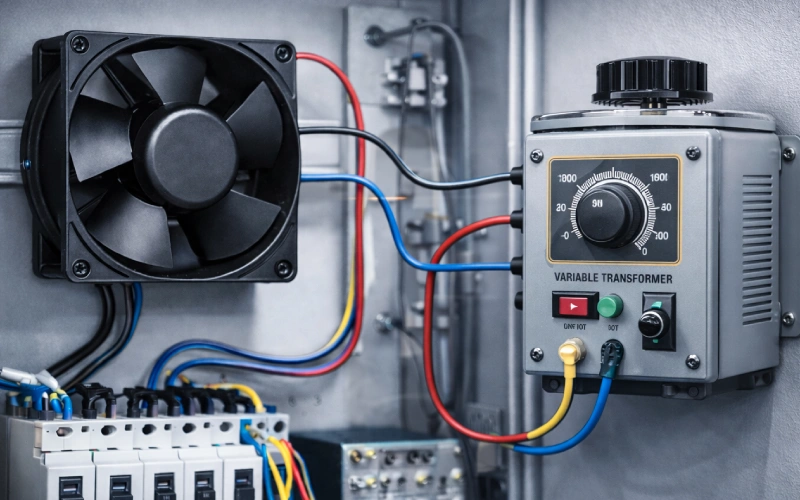
You might need to adjust fan speed for quieter operation, energy savings, or better temperature control. Let’s break down four practical methods for Ac Axial Fan Speed Control, so you can pick the best fit for your setup.
1. Voltage Regulation
This method changes the input voltage to control fan speed. Lower voltage means slower speed.
How it works:
- Install a variable transformer or voltage regulator.
- Connect the fan to the regulator.
- Adjust the voltage to set your desired speed.
Pros:
- Simple setup
- Low cost
Cons:
- Limited speed range (usually 50%-100%)
- Low voltage can reduce torque and efficiency
Best for:
PC cooling, small control cabinets, or any application where precise speed control isn’t critical.
2. SCR/Triac Dimming
SCR (Silicon Controlled Rectifier) or Triac dimmers adjust the average voltage by cutting the AC waveform.
How it works:
- Install an SCR or Triac dimmer in the fan’s power line.
- Set the dimmer to control the fan speed.
Pros:
- Wider speed range than voltage regulation
- Mature technology
Cons:
- Can cause electromagnetic interference (EMI)
- May increase noise or vibration
Best for:
Industrial fans, retrofitting lighting dimmers for fan control, or scenarios needing flexible speed adjustment.
3. Variable Frequency Drive (VFD)
VFDs change both the frequency and voltage supplied to the fan motor, offering precise speed control.
How it works:
- Connect the VFD to your fan motor.
- Configure the VFD settings for your load.
- Monitor and adjust as needed.
Pros:
- Wide speed range
- Precise control
- Energy savings
- Soft start protects the motor
Cons:
- Higher cost
- More complex installation
Best for:
Large industrial fans, machinery cooling, water pumps, or any high-power application needing advanced control.
4. Built-in Electronic Control
Some AC fans come with integrated speed control electronics, like 4-wire PWM (Pulse Width Modulation).
How it works:
- Connect the fan to a compatible controller or motherboard.
- Use software or hardware to send PWM signals.
- Adjust fan speed digitally.
Pros:
- Precise, stable speed control
- Simple signal interface
- Compatible with modern control systems
Cons:
- Requires specific controller support
- Slightly higher fan cost
Best for:
Server racks, high-end network equipment, smart electrical cabinets, or any scenario needing intelligent temperature management.
Tip: If you want to learn more about 4-wire AC fans and their advanced control features, check out the fanacdc Knowledge Center.
Comparison Table
Here’s a quick comparison of the four main Ac Axial Fan Speed Control methods:
| Method | Principle | Pros | Cons | Typical Applications |
|---|---|---|---|---|
| Voltage Regulation | Adjust input voltage | Simple, low cost | Limited range, low torque at low speed | PC fans, basic cabinets |
| SCR/Triac Dimming | AC waveform phase cutting | Wide range, mature tech | EMI, possible noise/vibration | Industrial fans, retrofits |
| Variable Frequency Drive | Change frequency & voltage | Precise, energy saving, soft start | Cost, complexity | Large machinery, pumps |
| Built-in Electronic Ctrl | Integrated PWM or digital control | Precise, stable, smart system ready | Needs controller, higher fan cost | Servers, smart cabinets |
Visual Chart: Airflow and Pressure by Fan Size
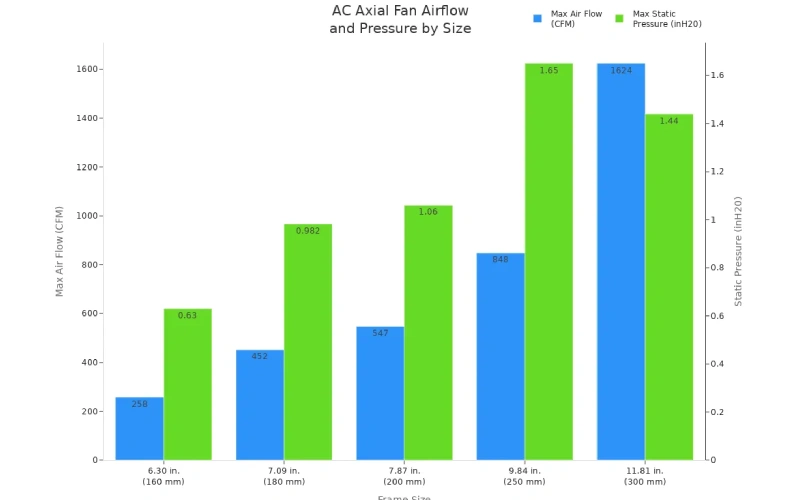
You can see how different fan sizes deliver varying airflow and pressure. Choosing the right speed control method helps you match cooling performance to your needs.
Note: fanacdc AC Fans are designed to work with all these speed control methods. You get reliable performance, long service life, and flexible options for industrial and commercial cooling.
Choosing the Right Method for Your Application
Decision Factors
Picking the best way to control your AC axial fan speed depends on several things. You want to match the method to your equipment, budget, and cooling needs. Here’s what you should look at before making a choice:
- Power Requirements: High-power setups, like server rooms or industrial machinery, need efficient fan control to keep energy use in check. High-end servers can use up to 25% of their total power just for cooling. Choosing high-efficiency fans helps you save on system costs and keeps your power supply smaller.
- Budget Constraints: Think about both the upfront cost and the long-term savings. Some methods cost more to install but save money over time by using less energy.
- Precision Needs: If you need to fine-tune airflow or keep noise low, look for intelligent control systems. Fans with multiple speed settings or continuous speed control let you adjust airflow exactly how you want.
- Noise and Reliability: Sensitive environments, like offices or labs, need quiet fans. Reliable motors mean less downtime and fewer repairs.
- Installation Complexity: Some speed control methods are plug-and-play. Others need extra wiring or controllers.
Tip: Variable speed control lets you adjust fan speed based on real demand. You can save energy during off-peak hours and keep noise down when full power isn’t needed.
Here’s a quick table to help you see how these factors influence your choice:
| Factor | Influence on Selection |
|---|---|
| Power Requirements | Efficient control keeps energy use low in high-power setups. |
| Budget Constraints | Weigh initial costs against long-term energy savings. |
| Precision Needs | Smart controls help you fine-tune cooling and noise levels. |
| Noise & Reliability | Choose quiet, durable fans for sensitive or mission-critical environments. |
| Installation Complexity | Simple methods work for basic needs; advanced controls suit complex systems. |
If you want a step-by-step guide, try this checklist:
- Figure out your cooling power needs.
- Decide how much you want to spend upfront.
- Think about how quiet and reliable your system must be.
- Choose a control method that matches your installation skills.
Why Choose fanacdc AC Fans
Product Advantages
When you need cooling that lasts, fanacdc AC Fans deliver. You get fans built for tough environments, with features that keep your systems running smoothly. Take a look at how fanacdc stands out:
| Feature | Description |
|---|---|
| Maintenance-free operation | You don’t have to worry about regular upkeep. These fans keep working without constant checks. |
| Long service life | Some models run up to 1,000,000 hours. You avoid downtime and keep your equipment safe. |
| Advanced protection features | IP68 ratings shield your fans from dust and water. You can use them in harsh industrial spaces. |
You can rely on fanacdc AC Fans for consistent airflow, strong build quality, and quiet operation. These fans handle vibration, heat, and heavy use. You get peace of mind knowing your cooling solution won’t let you down.
Custom Solutions & Support
Every project has unique cooling needs. fanacdc makes it easy to get the right fit for your application. You can choose from a wide range of options:
| Customization Aspect | Details |
|---|---|
| Voltage | Pick 110V or 220V AC input to match your system. |
| Diameter | Select from many sizes and mounting styles. |
| Airflow Curve | Tune airflow for your space and thermal load. |
| Control Features | Use advanced interfaces like PWM, FG, and RD for smart Ac Axial Fan Speed Control. |
| Applications | Find solutions for commercial refrigeration, automation, and more. |
You also get support every step of the way:
- Work with experts who listen to your cooling challenges.
- Get help with design, engineering, and prototyping.
- Enjoy fast sampling and short lead times.
- Scale up production with strict quality checks.
- Request custom branding and packaging.
Need a fan that fits your exact requirements? Reach out to the fanacdc technical team for a free consultation or visit the fanacdc AC Fan page to explore more options.
You don’t have to settle for off-the-shelf solutions. fanacdc helps you build a cooling system that matches your needs, whether you run a control cabinet, server rack, or industrial machine.
FAQ
How do you determine which speed control method fits your application?
To select the correct speed control method, you should evaluate your required airflow range, operating environment, noise limits, and budget. Simple voltage controllers may suit basic ventilation, while variable frequency drives (VFDs) are better for precise control and energy efficiency. Always consider fan motor type, load conditions, and long-term reliability when making your decision.
Can you use a variable frequency drive (VFD) with any AC axial fan?
Not all AC axial fans are suitable for VFD operation. Most industrial fans with induction motors can work with VFDs, but voltage range, frequency limits, insulation class, and cooling design must be compatible. You should always verify the fan’s electrical specifications and follow the manufacturer’s guidelines before connecting a VFD to avoid overheating or motor damage.
Will speed control affect the lifespan of an AC axial fan?
When applied correctly, speed control can actually extend fan lifespan. Operating at reduced speeds lowers mechanical stress, bearing wear, vibration, and noise levels. However, improper control methods or incompatible devices may cause motor overheating or unstable operation. Using approved controllers and maintaining proper airflow ensures long-term reliability and consistent performance.
What is the main difference between AC and DC fan speed control?
AC axial fan speed control is typically achieved by adjusting voltage, phase angle, or frequency, which affects motor speed indirectly. DC fans use electronic control signals such as PWM for highly precise speed regulation. While DC control offers finer adjustment, AC fans remain preferred in industrial settings due to durability, simplicity, and high-power capability.
Can fanacdc provide customized AC axial fans with speed control options?
Yes, fanacdc offers customization services to meet specific cooling and control requirements. You can request tailored fan sizes, operating voltages, airflow characteristics, mounting styles, and compatible speed control solutions. By working directly with the engineering team, you ensure optimal performance, system compatibility, and long-term operational efficiency for your application.
Conclusion
You now know how to control AC axial fan speed using four practical methods. Each method has its own strengths. Voltage regulation works well for simple setups. SCR/Triac dimming gives you more flexibility. Variable frequency drives offer precise control for demanding environments. Built-in electronic controls make smart cooling easy.
Let’s recap the key points:
- Voltage Regulation: Simple and affordable. Best for basic cooling needs.
- SCR/Triac Dimming: Wide speed range. Good for industrial upgrades.
- Variable Frequency Drive: Advanced control. Perfect for large machinery.
- Built-in Electronic Control: Smart and stable. Ideal for intelligent systems.
Tip: Always match your speed control method to your application. Think about power, budget, noise, and installation.
Choosing the right fan and control method helps you save energy, reduce noise, and protect your equipment. You get better performance and longer system life. If you want reliable cooling, fanacdc AC Fans give you strong airflow, long service life, and flexible options for any scenario.
Ready to upgrade your cooling system? Visit the fanacdc AC Fan page for more details. You can also contact the fanacdc technical team for expert advice or a custom solution. Don’t let overheating or wasted energy slow you down. Get the right fan for your needs and keep your equipment running smoothly.
You have several ways to control AC axial fan speed. Each method offers unique benefits for energy savings, noise reduction, and airflow customization. Check out this quick overview:
| Method | Key Advantage | Best Use Case |
|---|---|---|
| Voltage Regulation | Simple, low cost | Basic cooling needs |
| SCR/Triac Dimming | Flexible speed adjustment | Industrial upgrades |
| VFD | Precise, efficient control | Large machinery |
| Built-in Control | Smart, stable operation | Intelligent systems |
High-quality AC fans from fanacdc deliver long life and lower maintenance costs. Want expert advice or a custom solution?