On paper, a 60mm fan can look surprisingly powerful. You’ll see numbers like 30 CFM, even close to 40 CFM, and it’s easy to assume that kind of airflow will translate directly into strong cooling performance.
But once that same fan is installed inside a control panel, a power supply, or a compact enclosure, the story often changes.
Airflow drops. Noise behaves differently. And the “spec sheet performance” starts to feel disconnected from reality.
So instead of asking only how fast a 60mm fan can blow air, the more useful question is:
The Difference Between Spec Sheet and Reality
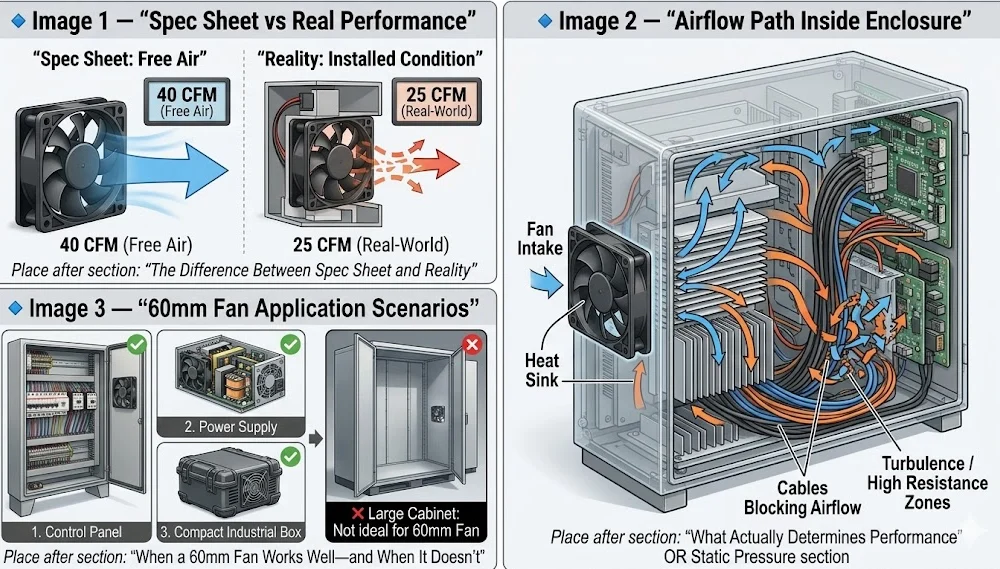
Under ideal test conditions—what manufacturers call free air—a high-performance 60mm fan can reach around:
- 35–40 CFM (≈60–70 m³/h)
- Up to 7000–8000 RPM
That’s the maximum capability. No obstacles, no resistance, nothing in the way.
But that’s not how fans are used in real life.
The moment you mount the fan into an enclosure, several things start working against it:
- Air has to pass through grills or vents
- Internal components block or redirect flow
- Cables disrupt the air path
- Heat sinks create resistance
What you end up with is often only 60–70% of the rated airflow, sometimes even less in dense systems.
This is why two systems using the same fan can perform completely differently.
So How Fast Is the Air, Really?
If you think in terms of “wind speed,” a 60mm fan typically produces air velocity in the range of:
- ~2 to 6 meters per second
Close to the fan, the airflow feels concentrated and strong. But it doesn’t travel far before dispersing, especially in open space.
In compact systems, that concentrated airflow is actually useful. A 60mm fan isn’t designed to move large volumes of air across long distances—it’s designed to target specific hot spots.
That’s an important distinction.
Why Small Fans Hit Their Limits
There’s a reason 60mm fans are used in specific scenarios and not others. It comes down to basic physical limits.
A smaller fan simply has:
- Less blade area
- Less air displacement per rotation
- Less capacity to maintain airflow under resistance
To compensate, manufacturers increase speed. That’s why many 60mm fans run at high RPM.
But higher speed introduces trade-offs:
- Noise increases quickly
- Mechanical stress rises
- Efficiency drops at extremes
At some point, pushing a 60mm fan harder stops being practical.
What Actually Determines Performance
Once you move beyond the spec sheet, airflow performance becomes a combination of several factors working together.
Motor Type Matters More Than It Seems
DC fans are the most common choice because they’re easy to control and integrate. AC fans, on the other hand, are often used in industrial environments where continuous operation matters more than flexibility.
EC fans sit somewhere in between—more efficient, more controllable, but typically used in more advanced systems.
The Hidden Role of Static Pressure
This is where many selections go wrong.
Airflow numbers alone don’t tell you how the fan behaves when it meets resistance.
That’s where static pressure comes in.
If your system includes:
- Filters
- Heat sinks
- Narrow airflow paths
then a fan with higher static pressure will maintain airflow more effectively.
Without it, even a high-CFM fan can struggle.
Blade Design Is Not Just Detail—It’s Core Performance
Two fans with similar sizes and speeds can perform very differently depending on blade design.
Subtle differences in:
- Blade angle
- Curvature
- Number of blades
can affect:
- Airflow stability
- Noise levels
- Efficiency
This is one of the less visible but most important parts of fan engineering.
Bearings Define Lifespan and Stability
In industrial use, this becomes critical.
Ball bearing fans tend to:
- Last significantly longer
- Handle higher temperatures
- Maintain performance over time
Sleeve bearing fans may be quieter initially, but they degrade faster, especially in demanding environments.
Noise: The Trade-Off You Can’t Avoid
There’s no way around it—more airflow usually means more noise.
A typical 60mm fan might range from:
- ~20 dBA (low speed)
- ~40 dBA or more (high speed)
In industrial settings, this may not matter much.
But in office equipment, medical devices, or consumer electronics, it becomes a constraint.
This is where PWM control becomes useful. Instead of running at full speed all the time, the fan can adjust based on cooling demand.
When a 60mm Fan Works Well—and When It Doesn’t
A 60mm fan performs best when:
- Space is limited
- Cooling is localized
- Airflow paths are relatively short
That’s why you often see them in:
- Control panels
- Power supplies
- Compact industrial equipment
But there are clear limits.
If your system involves:
- High heat loads
- Dense internal layouts
- Continuous heavy-duty operation
then a larger fan—80mm, 120mm, or beyond—usually becomes a more effective solution.
Not because the 60mm fan is inadequate, but because the application demands more airflow than its size can realistically provide.
Choosing the Right 60mm Fan (Without Overthinking It)
In practice, selecting a fan becomes much simpler when you focus on a few key questions:
- Is airflow restricted or open?
- Is noise a concern?
- Will the fan run continuously?
- What is the expected lifespan?
From there:
- Restricted systems → prioritize static pressure
- Continuous operation → choose ball bearings
- Noise-sensitive environments → consider PWM control
What matters most is not finding the “strongest” fan, but the most appropriate one for the system it will operate in.
A Note on Manufacturing and Consistency
For buyers, especially at scale, performance is not just about specifications—it’s about consistency.
A fan that performs well in testing but varies between batches creates problems:
- Unstable system performance
- Increased maintenance
- Customer complaints
This is where working with a manufacturer that can provide:
- Stable production quality
- Consistent airflow characteristics
- Custom configurations
becomes more important than chasing peak numbers.
Manufacturers offering a full range—from 60mm to 300mm, across AC, DC, and EC fans—are typically better positioned to support different applications and scaling requirements.
Is a 60mm fan powerful enough for industrial cooling?
A 60mm fan can be effective for localized cooling in compact enclosures, but it is not suitable for high heat loads. Its performance depends heavily on airflow resistance, internal layout, and whether static pressure is sufficient for the application.
Why does my 60mm fan feel weak after installation?
Once installed, airflow is restricted by grills, components, and cables. This reduces effective airflow to around 60–70% of the rated CFM, making the fan feel less powerful compared to free-air test conditions.
What is more important: CFM or static pressure?
CFM matters in open environments, but static pressure is critical in real systems. If airflow paths are restricted, a fan with higher static pressure will maintain better performance than a high-CFM fan with low pressure capability.
How long can a 60mm fan typically last?
Lifespan depends on bearing type and environment. Ball bearing fans can exceed 50,000 hours, while sleeve bearing fans may last significantly less, especially in high-temperature or continuous operation conditions.
Can I reduce noise without losing too much cooling?
Yes. Using PWM control allows the fan to adjust speed based on temperature. This reduces noise during low-load conditions while still providing full cooling performance when needed.
Final Thoughts
So, how fast can a 60mm fan blow air?
Under ideal conditions, it can reach close to 40 CFM, with air moving at several meters per second.
But in real applications, what matters is not the maximum number—it’s how the fan performs once installed inside your system.
Airflow, pressure, noise, and system design all interact.
And the best results come from understanding that interaction, not just reading a spec sheet.
In the end, a 60mm fan does exactly what it’s designed to do:
deliver focused, reliable cooling in compact spaces—when matched correctly to the application.