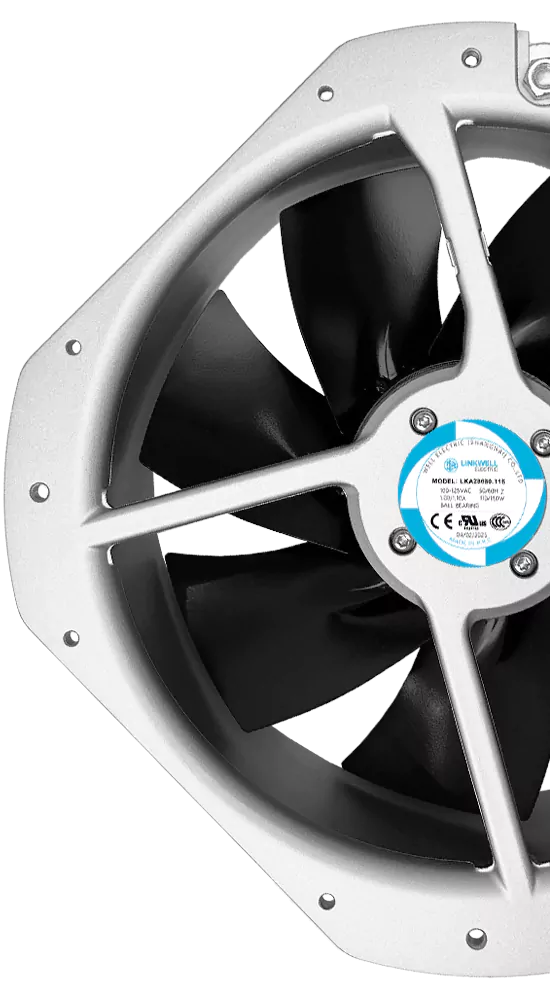
Electrical cabinets often contain heat-generating components in a relatively enclosed space. If heat is not removed effectively, the internal temperature can rise quickly and affect equipment stability, service life, and overall system reliability.
In many cabinet cooling projects, choosing the right fan is not only about size or voltage. It also depends on airflow resistance, installation constraints, filter design, operating temperature, and the internal layout of the cabinet.
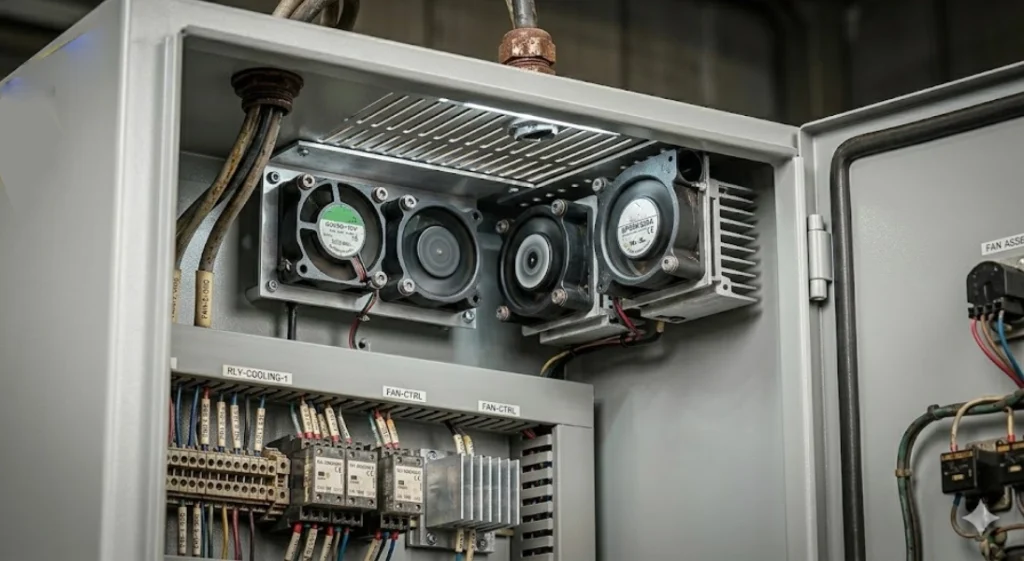
This guide explains how to choose a centrifugal fan for electrical cabinet cooling and what factors should be checked before making a final selection.
Why Centrifugal Fans Are Often Used in Electrical Cabinets
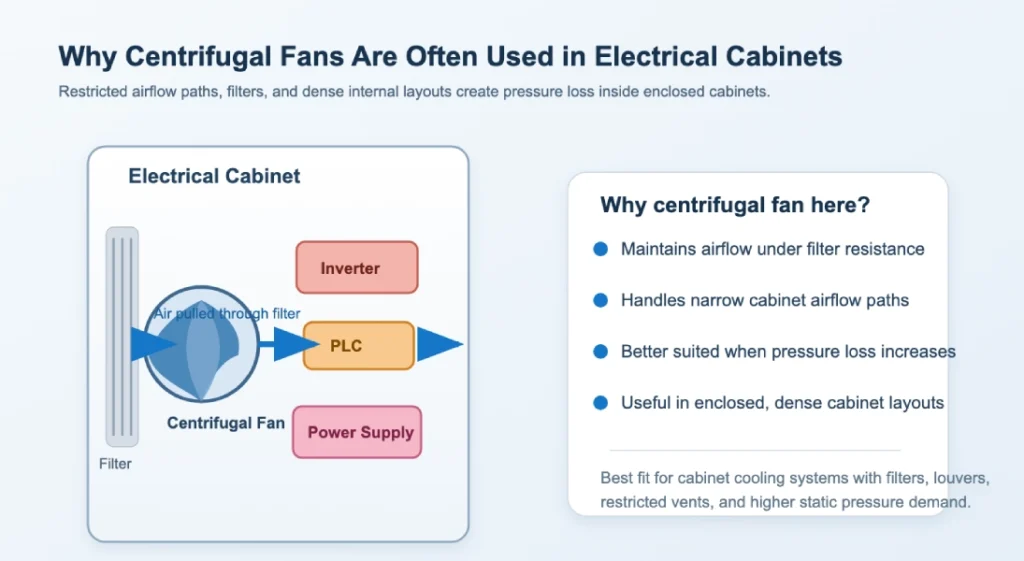
In many electrical cabinets, the airflow path is not completely open. Air may need to pass through filters, louvers, finger guards, heat-generating components, or narrow internal channels before it can remove heat effectively. These restrictions create pressure loss.
This is one reason centrifugal fans are often used in electrical cabinet cooling. Compared with axial fans, centrifugal fans are generally better suited to applications where airflow resistance is higher. They can maintain more stable airflow when the cabinet design includes filters or a more restrictive internal structure.
Not every cabinet requires a centrifugal fan. In some low-resistance layouts, an axial fan may be sufficient. But when the airflow path becomes more complex, a centrifugal fan is often the safer choice.
Step 1. Identify the Cabinet Cooling Challenge
Before choosing a fan, the first step is to understand what the cabinet is trying to cool.
Electrical cabinets may contain components such as:
- Inverters
- Power supplies
- PLCs
- Contactors
- Transformers
- Communication modules
- Drive systems
These components do not all generate the same amount of heat, and they are not always positioned in a way that allows heat to escape evenly. In some cabinets, one section may become much hotter than the rest, creating localized hot spots.
The cabinet environment also matters. A clean indoor control cabinet has different cooling requirements from an outdoor enclosure exposed to high ambient temperature, dust, or moisture. Before fan selection, it is important to understand:
- Which components generate the most heat
- How the components are arranged
- Whether the cabinet is indoor or outdoor
- Whether the environment is dusty or humid
- Whether the fan will run continuously or only part of the time
A cabinet cooling fan should be selected based on the real thermal challenge, not only on cabinet size.
Step 2. Estimate the Required Airflow
Once the cooling challenge is understood, the next step is to estimate the required airflow.
Airflow is usually expressed in CFM or m3/h. The required airflow depends on several factors, including:
- Total heat load inside the cabinet
- Allowable temperature rise
- Cabinet dimensions
- Internal airflow path
- Ventilation opening design
In cabinet cooling, buyers often compare fans based only on the airflow listed in the datasheet. However, this value is usually measured under free-air conditions. In actual installation, the airflow can be lower because the cabinet itself creates resistance.
It is also important to remember that good cabinet cooling is not only about total airflow volume. Air must move through the right path and reach the components that need cooling most. A cabinet may have a fan with a high nominal airflow value and still suffer from poor cooling if the air does not circulate effectively through the enclosure.
Step 3. Check Static Pressure and Filter Resistance
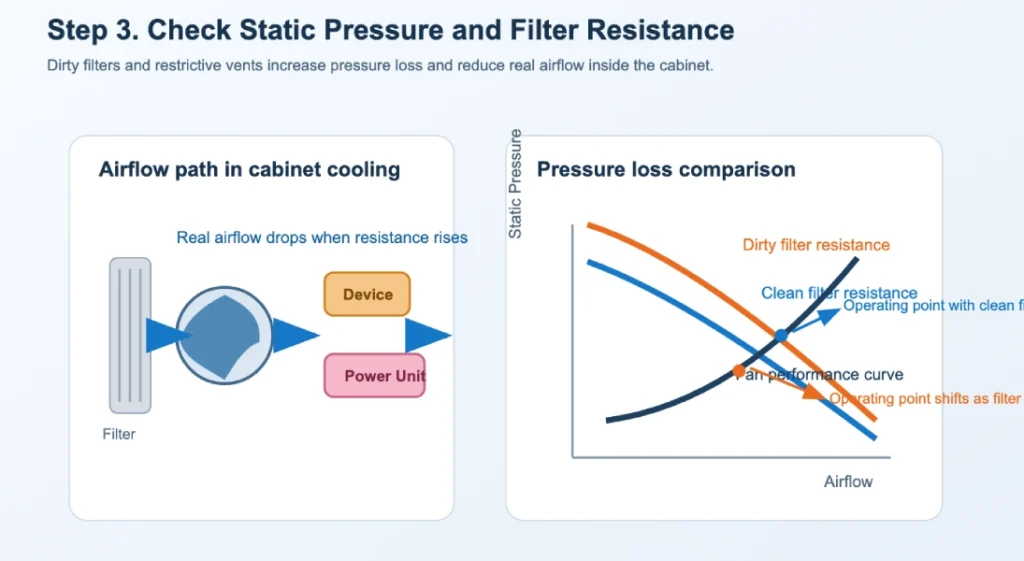
This is one of the most important parts of fan selection for electrical cabinets.
Many cabinets use:
- Filter assemblies
- Vent covers
- Protective guards
- Narrow vent openings
- Internal partitions
All of these reduce airflow and increase pressure loss. As filters collect dust, resistance can increase even more over time.
This is why static pressure matters. A fan that performs well in free air may not provide enough cooling once it is installed behind a filter or in a cabinet with a restrictive airflow path. In these situations, a centrifugal fan is often preferred because it can handle higher resistance more effectively than an axial fan.
One of the most common selection mistakes is ignoring dirty-filter conditions. A fan may appear adequate when the filter is clean, but the airflow can drop after dust builds up. For cabinet cooling, it is better to consider not only the initial condition, but also how the system performs over time.
Step 4. Review Installation Space and Airflow Direction
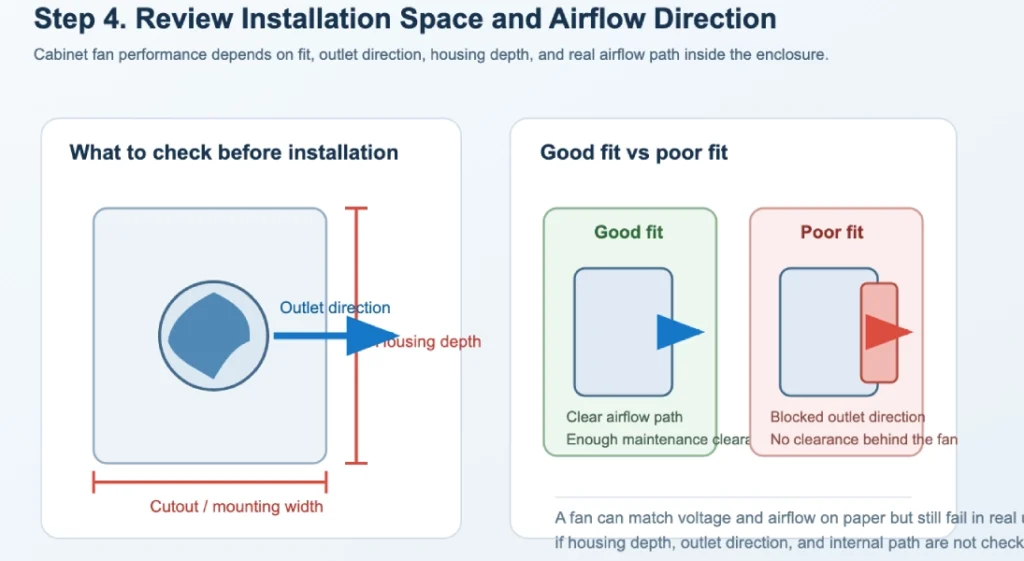
A fan that meets the thermal requirement may still be the wrong choice if it does not fit the cabinet properly.
Before selection, the following mechanical points should be checked:
- Available mounting area
- Cutout size
- Housing depth
- Outlet direction
- Wiring direction
- Air inlet clearance
- Maintenance access
Electrical cabinets often have limited internal space, especially when components are densely packed. In some cases, the depth of the fan housing is a more critical limitation than the front dimensions. The discharge direction is also important. If the airflow exits in the wrong direction, cooling performance may be reduced even if the fan itself is correctly sized.
This is especially important in retrofit projects. A replacement fan must not only match the electrical rating, but also fit the existing mounting position and airflow path.
Step 5. Choose the Right Voltage and Control Method
The fan voltage should match the cabinet design and the available power system.
Common options include AC, DC, and EC fans.
AC fans are often used when the cabinet already has mains power available and the cooling design is relatively simple. They are widely used in standard industrial cabinet applications.
DC fans are often selected when the system uses low-voltage power or requires better integration with control electronics. They may be more suitable in cabinets with dedicated low-voltage power architecture.
EC fans are usually considered when energy efficiency, lower operating cost, or variable speed control is important. In some cabinet applications, EC fans can provide more flexible speed adjustment and better long-term efficiency.
The right choice depends on:
- Available power supply
- Control requirements
- Energy efficiency goals
- Integration with the cabinet system
If speed control or monitoring is needed, it is also important to check whether the fan must support functions such as PWM control or speed signal feedback.
Step 6. Consider the Operating Environment
Electrical cabinet fans should be selected for the actual working environment, not just for ideal indoor conditions.
Important environmental factors include:
- Ambient temperature
- Dust level
- Moisture exposure
- Indoor or outdoor installation
- Continuous operating time
- Maintenance frequency
For example, an outdoor cabinet may face high summer temperature, humidity, and dust. In these conditions, fan life can be affected not only by airflow demand, but also by the overall environmental stress.
Bearing type and expected service life also matter. In industrial cabinets, fan failure can lead to overheating, nuisance alarms, shutdowns, or reduced equipment life. For that reason, buyers should consider durability and long-term reliability from the beginning of the selection process.
Centrifugal Fan vs Axial Fan for Cabinet Cooling
Both centrifugal fans and axial fans are used in cabinet cooling, but they are not interchangeable in every case.
An axial fan is often suitable when:
- The airflow path is relatively open
- Resistance is low
- The cooling structure is simple
- Cost sensitivity is high
A centrifugal fan is often better when:
- The cabinet uses filters
- The airflow path is restricted
- Pressure loss is significant
- Internal layout is dense
- More stable performance under resistance is needed
The correct choice should be based on the real airflow path inside the cabinet, not only on fan dimensions or free-air airflow values.
Common Mistakes in Cabinet Fan Selection
Several mistakes appear repeatedly in cabinet cooling projects.
Choosing by Fan Size Only
A fan that matches the mounting dimensions may still be the wrong thermal solution. Size alone does not show whether airflow and pressure are sufficient.
Using Free-Air Airflow as the Only Reference
The airflow listed on the datasheet may not reflect actual cabinet performance once filters, guards, and internal restrictions are added.
Ignoring Dirty-Filter Conditions
Filter resistance changes over time. A fan selected only for clean-filter conditions may not maintain proper cooling after dust buildup.
Forgetting Outlet Direction
If the fan discharges air in a direction that does not match the cabinet layout, the cooling result may be poor even when the fan itself is suitable.
Overlooking Installation Depth
Depth limitations are common in electrical cabinets. A fan may match the cutout size but still not fit the internal space.
Not Understanding the Cabinet Airflow Path
Without understanding where air enters, where it exits, and which components need cooling most, it is difficult to choose the right fan.
What Information to Send for Faster Model Recommendation
If you want a supplier to recommend a suitable centrifugal fan quickly, it helps to prepare the main project details in advance.
Useful information includes:
- Cabinet dimensions
- Main heat-generating components
- Required voltage
- Available fan mounting space
- Filter or vent structure
- Indoor or outdoor use
- Ambient temperature
- Noise expectations
- Duty cycle
- Any special requirements such as connector type or wire length
With this information, a supplier can better evaluate airflow demand, pressure conditions, and installation limitations.
Conclusion
Choosing a centrifugal fan for electrical cabinet cooling is not only about voltage or fan size. A suitable fan must match the cabinet’s heat load, airflow resistance, installation space, operating environment, and control method.
In many cabinet cooling systems, centrifugal fans are preferred because they perform better when filters, louvers, and restrictive airflow paths create pressure loss. But the best model still depends on the actual cabinet design and working conditions.
The more complete the project information is, the easier it becomes to select a fan that delivers stable cooling and reliable long-term performance.
Need Help Choosing a Centrifugal Fan for Your Electrical Cabinet?
Send us your cabinet size, voltage, filter structure, and cooling requirement. We can recommend suitable models and provide datasheets for review.
FAQ
Why is a centrifugal fan often used in an electrical cabinet?
A centrifugal fan is often used because many electrical cabinets have filters, vent covers, and restricted airflow paths that create pressure loss. Under these conditions, a centrifugal fan can usually maintain airflow more effectively than an axial fan.
How do filters affect cabinet fan performance?
Filters create resistance and reduce actual airflow. As they collect dust, the resistance increases further. This is why filter condition should be considered during fan selection.
Can an axial fan replace a centrifugal fan in cabinet cooling?
Sometimes, but not always. If the cabinet has a low-resistance airflow path, an axial fan may be suitable. If the system has filters or higher resistance, a centrifugal fan may still be the better choice.
What information is needed to select a cabinet cooling fan?
It helps to provide cabinet dimensions, heat sources, voltage, installation space, ambient temperature, and information about filters or vent structures.
How does cabinet layout affect cooling performance?
Cabinet layout affects how air moves through the enclosure and whether the airflow reaches the hottest components effectively. Even a fan with adequate nominal airflow may cool poorly if the internal airflow path is not suitable.