The centrifugal blower market is attracting more attention for a simple reason: cooling jobs are getting harder.
Across industrial equipment, airflow is no longer just about moving a large volume of air from one side of a machine to the other. Equipment is more compact than it used to be, internal layouts are tighter, and heat loads are rising in places where space is limited. In many of those situations, a standard axial fan is no longer enough. Buyers need a blower that can maintain airflow through resistance, fit into confined structures, and run reliably over long service cycles. That is where centrifugal blowers continue to gain ground.
This shift is visible in several sectors at once. HVAC systems are being asked to work more efficiently. Electrical cabinets carry denser power electronics. Telecom equipment and network enclosures need stable thermal control in smaller footprints. Battery systems, automation hardware, and commercial refrigeration all place more pressure on airflow design than they did a few years ago. The market is growing, but the more useful observation is why it is growing: system designers are looking for more controlled airflow, more predictable static pressure, and more reliable integration.
For OEM buyers, that changes the purchasing conversation. The question is not simply whether centrifugal blowers are becoming more popular. The real question is whether a blower can meet the demands of a specific application without creating new problems in noise, power compatibility, installation space, or long-term maintenance. That is where market interest turns into engineering reality.
What Is Driving the Centrifugal Blower Market?
A large part of current demand comes from the way modern equipment is built. Compact systems tend to generate concentrated heat, and once that happens, airflow needs to be delivered more precisely. Open ventilation is often not enough. Air has to pass through internal channels, around components, across heat sinks, or through filters and ducted paths. In those conditions, centrifugal blowers become more attractive because they are better suited to controlled, pressure-dependent airflow.
Energy efficiency is another driver, though not always in the simplistic sense of “lower power is better.” Buyers are paying more attention to the full operating cost of cooling hardware. That includes energy use, but it also includes downtime, maintenance intervals, and the effect of unstable cooling on the rest of the system. A blower that fits the application correctly can reduce those risks far more effectively than a mismatched low-cost unit.
Automation and electrification are also changing the market. As more equipment relies on power electronics, compact drives, battery systems, and digital controls, thermal management becomes part of overall system reliability. In many industrial applications, the cooling component is inexpensive compared with the system it protects. That imbalance tends to favor better blower selection rather than the cheapest possible part.
There is also a regional dimension. Mature industrial markets continue to upgrade legacy equipment, while fast-growing manufacturing regions are adding new cooling demand through factory construction, telecom expansion, commercial building development, and distributed energy infrastructure. That combination keeps the market active at both the replacement and OEM levels.
Real example: A manufacturer of compact industrial drives kept getting field failures related to overheating. Their original design used an axial fan rated for high free-air CFM. But inside the actual enclosure — with a heat sink, a filter, and two circuit boards in the path — measured airflow was less than 40% of the fan’s rated performance. Switching to a centrifugal blower with similar free-air CFM but much higher static pressure capability solved the problem completely. The drives now run within spec, and the failure rate dropped to near zero.
Where Demand Is Growing Fastest
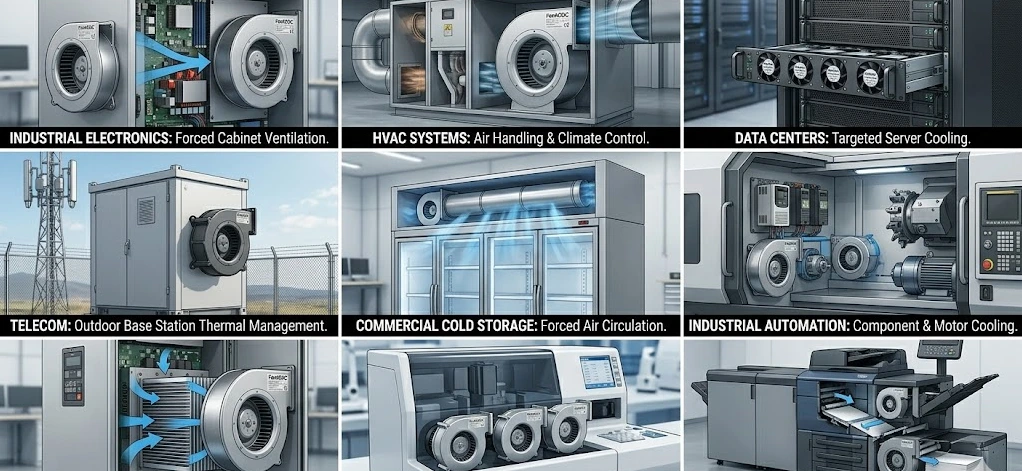
The centrifugal blower market is not being driven by one industry alone. It is expanding because multiple sectors now need a similar kind of airflow performance, even when the end equipment looks very different.
HVAC and Air Handling
HVAC remains one of the most familiar application areas. In air handling and ventilation systems, centrifugal blowers are used where airflow must be pushed through filters, coils, ducts, and internal resistance. Quiet operation, pressure stability, and predictable airflow curves are all valuable here. In compact HVAC modules, blower design often has a direct effect on efficiency and noise performance.
Electrical Cabinets and Control Panels
Control cabinets are no longer simple boxes with a few components inside. Many now contain drives, relays, power supplies, PLCs, communication hardware, and other heat-generating electronics arranged in tight layouts. In these environments, airflow has to be delivered with purpose. A centrifugal blower is often selected when the internal path is too restrictive for an axial fan to perform consistently.
Telecommunications and Network Equipment
Telecom shelters, base station hardware, and network enclosures place a premium on reliable thermal management. These systems may operate continuously and often have limited room for large open-air cooling layouts. Compact blower solutions are well suited to the kind of focused airflow needed in electronics-heavy enclosures, especially where uptime matters more than the cost of the cooling component.
Industrial Automation and Power Systems
Automation equipment, inverters, compact controllers, and power conversion assemblies all contribute to a broader pattern: more thermal density in smaller industrial systems. Blowers are increasingly used where air must be directed across one critical area rather than loosely circulated through an enclosure. This is particularly common in designs where cooling performance has to remain stable under variable operating loads.
Commercial Refrigeration and Process Cooling
Commercial refrigeration systems and other process-cooling equipment also rely on controlled airflow. Here the issue is not just heat removal, but dependable thermal behavior over long operating hours. Blow-through performance, motor durability, and resistance to demanding environments all become more important than generic airflow numbers.
What OEM Buyers Care About More Than Market Size
A market article can spend pages on growth projections, but that is rarely what determines a purchase. OEM buyers usually narrow their decision around integration, operating reliability, and fit for purpose.
The table below captures the issues that matter most in real projects:
| Buyer Concern | Why It Matters |
|---|---|
| Airflow | Determines whether the blower can deliver enough cooling volume for the target system |
| Static pressure | Critical when air must pass through ducts, filters, heat sinks, or compact pathways |
| Voltage and power input | Must match the machine architecture and regional electrical standard |
| Installation size | Affects whether the blower fits the housing without redesign |
| Noise | Important in indoor equipment, medical systems, telecom, and customer-facing environments |
| Service life | Impacts maintenance cycles, warranty expectations, and long-term operating cost |
| Environmental resistance | Dust, humidity, and temperature conditions can limit blower suitability |
| Compliance expectations | Relevant for export projects, quality audits, and regulated industries |
This is why broad market growth does not automatically help every product. Buyers are not simply looking for “a centrifugal blower.” They are looking for one that fits a narrow set of conditions without introducing design compromises elsewhere.
AC, DC, and EC Demand Are Not Growing in the Same Way
One useful way to understand the market is to separate blower demand by power architecture rather than treating all centrifugal products as one category.
AC centrifugal blowers remain common in mains-powered industrial systems. They are familiar, practical, and well suited to applications such as electrical cabinets, industrial ventilation, and HVAC-related equipment. Buyers often prefer them where simplicity and easy replacement are priorities.
DC centrifugal blowers are increasingly relevant in compact electronics, low-voltage systems, telecom hardware, and equipment where integration space is limited. They fit applications that need lower-voltage compatibility and more compact thermal layouts.
EC centrifugal blowers attract attention where energy efficiency and speed control carry more weight. In projects that require more flexible airflow management or closer control of operating behavior, EC options can be appealing, particularly in systems where efficiency targets are becoming stricter.
The important point is that growth is application-led. Demand does not move evenly across AC, DC, and EC categories. It follows the design logic of the equipment being built.
How FanACDC’s Centrifugal Fan Range Fits Current Demand
The practical trends in this market line up closely with what OEM buyers ask for every day: compact size ranges, voltage flexibility, useful airflow, and service life that supports long equipment cycles.
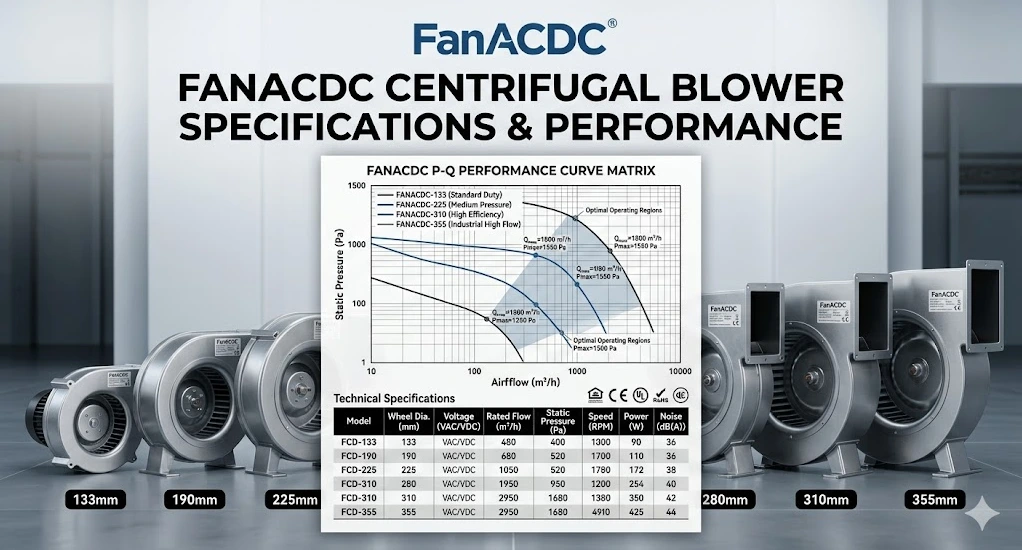
FanACDC’s centrifugal fan range is built around those needs. The current lineup covers sizes from 133 mm to 355 mm, with voltage options from 115V to 240V, airflow from 159 CFM to 1735 CFM, and service life up to 60,000 hours. That range makes it possible to support both compact cooling tasks and higher-airflow industrial applications without forcing every project into the same frame size.
Several series fit naturally into different parts of the market:
| Series | Size | Voltage | Airflow Range | Typical Fit |
|---|---|---|---|---|
| 133.41 | 133 x 41 mm | 115V-240V | 159-177 CFM | Compact electronics, smaller enclosures |
| 175.42 | 175 x 42 mm | 115V-240V | Mid-range airflow | Air handling, automation assemblies |
| 190.45 | 190 x 45 mm | 115V-240V | 182-366 CFM | Cabinet cooling, power systems |
| 220.44 | 220 x 44 mm | 115V-240V | Mid-to-higher airflow | Industrial ventilation |
| 225.63 | 225 x 63 mm | 115V-240V | 419-791 CFM | HVAC support, larger airflow demand |
| 250.56 | 250 x 56 mm | 115V-240V | Higher airflow range | Process cooling, equipment ventilation |
| 280.51 | 280 x 51 mm | 115V-240V | 649-1245 CFM | Data, energy, and larger enclosure systems |
| 315.101 | 316 x 102 mm | 115V-240V | 826-1390 CFM | High-airflow OEM use |
| 355.60 / 355.95 | 355 mm class | 115V-240V | Up to 1735 CFM | Heavy-duty ventilation |
What matters here is not just the number of models. It is the way those models align with actual project types. Smaller series support tight housings and electronics cooling. Mid-size units fit common enclosure and automation work. Larger series are better suited to broader industrial airflow and ventilation loads. That kind of coverage is useful because real market demand does not cluster around one standard size.
Choosing the Right Centrifugal Blower for an OEM Project
Market growth can help point to opportunity, but selection still happens one application at a time. A blower that performs well in one project may be completely wrong in another if the electrical design, airflow path, or space constraints are different.
For OEM projects, these are the points worth checking first:
| Selection Factor | Why It Should Be Confirmed Early |
|---|---|
| Installation space | Determines the maximum housing and impeller size available |
| Voltage and frequency | Must fit the equipment’s electrical architecture |
| Airflow target | Sets the cooling requirement in practical terms |
| Static pressure requirement | Shows whether the blower can overcome the system’s resistance |
| Operating environment | Affects material choice and protection expectations |
| Noise limit | Important where acoustic performance matters |
| Service life target | Helps align fan choice with equipment maintenance cycles |
| Quantity and customization needs | Determines whether a stock solution is enough or OEM adaptation is needed |
A common mistake is to start with free-air airflow and treat everything else as secondary. In compact cooling systems, that often leads to problems. Static pressure, installation geometry, and operating conditions usually tell you more about the correct blower than a single airflow figure alone.
This is also where customization matters. OEM buyers are often not looking for a fan in isolation. They need a part that fits the assembly, works with the chosen voltage, supports the expected operating life, and matches the mechanical layout without adding avoidable complexity.
What the Market Outlook Really Means
The centrifugal blower market will likely continue to grow because system cooling is becoming more specialized, not less. More applications now require focused airflow, controlled pressure, compact integration, and long-term reliability. In that environment, blowers become more important wherever airflow must do real work rather than simply circulate through open space.
For buyers, the larger lesson is straightforward. Market demand may be rising, but successful blower selection still depends on matching the fan to the application in front of you. Growth trends help explain why centrifugal blowers are seeing stronger interest. They do not replace the need for careful specification.
FAQ
What is a centrifugal blower used for?
A centrifugal blower is used where air needs to be delivered with more control and pressure than a standard open-air fan can usually provide. Common uses include HVAC systems, electrical cabinets, telecom enclosures, automation equipment, commercial refrigeration, and compact industrial cooling systems.
Which industries need centrifugal blowers most?
The strongest demand comes from HVAC, electrical control systems, telecom, automation, power electronics, energy storage, and refrigeration-related applications. These sectors often require stable airflow through restricted or more demanding thermal layouts.
Are centrifugal blowers better for high static pressure?
In many applications, yes. Centrifugal blowers are typically better suited to systems where air must pass through filters, ducts, heat sinks, or narrow airflow paths. They are often chosen when pressure stability matters more than simple open-air airflow.
How do I choose the right centrifugal blower size?
Start with the available installation space, then match the blower to the required airflow, voltage, static pressure, and operating conditions. Physical size alone is not enough. The right blower must also fit the thermal load and the resistance of the airflow path.
What voltage options are common in centrifugal blowers?
Common voltage options depend on the application. Many industrial centrifugal blowers are available in AC ranges such as 115V to 240V, while DC and EC configurations may also be used in compact or low-voltage systems.
Conclusion
The centrifugal blower market is growing because cooling requirements are becoming more demanding across modern equipment. Compact layouts, higher thermal density, and the need for more controlled airflow are pushing buyers toward blower solutions that can deliver pressure, stability, and reliable integration.
For OEM buyers, the most useful way to read the market is not as a list of growth numbers, but as a shift in application needs. The better question is not whether the market is expanding. It is whether the blower fits the electrical system, airflow path, installation space, and reliability target of the equipment being built.
FanACDC’s centrifugal fan range is designed around those real selection needs, with multiple size classes, practical voltage coverage, and airflow options suitable for industrial cooling projects. Buyers who want to compare models in more detail can move directly to the FanACDC centrifugal fan page or contact the team for OEM selection support.