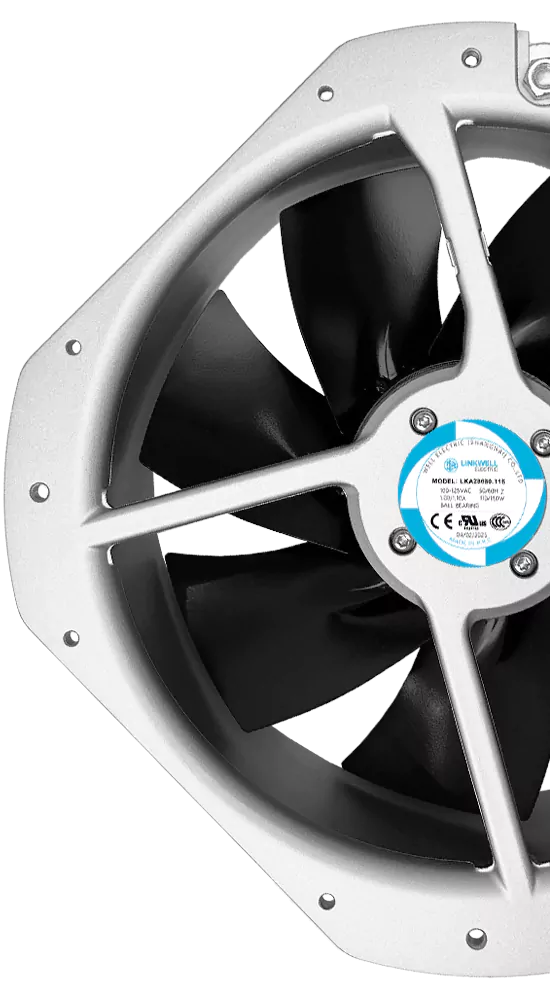
If you are replacing a blower or designing an OEM cooling system, direct drive is often worth reviewing before selecting a model.
A direct drive centrifugal fan is often the preferred choice when an industrial cooling system needs stable airflow, compact installation, and low maintenance over a long service cycle. In this design, the motor is connected directly to the impeller, so there are no belts, pulleys, or separate transmission components between the power source and the blower wheel.
That sounds like a small mechanical detail, but in practice it affects almost everything that matters to an OEM buyer or equipment engineer. It changes how much space the fan takes up, how often it needs service, how much mechanical loss occurs during operation, and how predictable its long-term performance will be.
This is why direct drive centrifugal fans appear so often in electrical cabinets, telecom enclosures, HVAC modules, industrial electronics, battery systems, and other compact cooling applications. Where access is limited and airflow has to stay consistent, simplicity becomes a real advantage.
At the same time, direct drive is not automatically the best answer for every blower application. There are situations where belt drive still makes sense, especially in larger systems where adjustable speed ratios or field modifications are more important than compactness.
The useful question is not whether direct drive is universally better. The real question is whether it fits the airflow path, service expectations, and operating conditions of the equipment being built.
What Is a Direct Drive Centrifugal Fan?
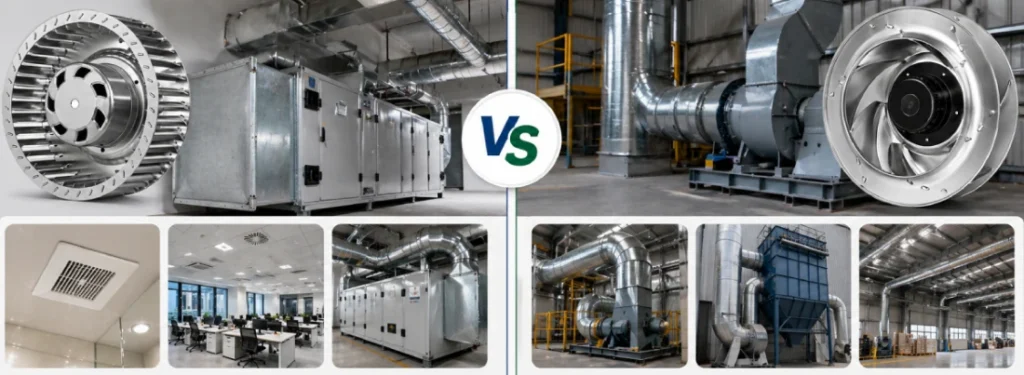
For buyers, the value is simpler installation, fewer maintenance points, and easier integration into compact equipment.
A direct drive centrifugal fan uses a motor whose shaft is connected directly to the blower wheel. When the motor turns, the impeller turns at the same time, without any intermediate transmission system. That differs from a belt-driven arrangement, where the motor drives a pulley, the pulley drives a belt, and the belt transfers motion to the fan shaft.
This direct connection reduces mechanical complexity. There are fewer parts to align, fewer parts to inspect, and fewer parts that can wear out over time. It also allows a more compact mechanical structure, which is one reason direct drive designs are common in enclosed industrial equipment.
In practical cooling systems, these fans are often used where air must move through a housing, across a heat source, or through a restricted path. That includes cabinet ventilation, telecom cooling, compact HVAC support, industrial electronics, and equipment where thermal stability matters but available space is limited.
Contact us to customize a Direct Drive Centrifugal Fan tailored to your project’s specific needs.
Why Direct Drive Is Often Preferred
The appeal of a direct drive centrifugal fan comes from the way it simplifies the system.
A belt-driven blower can work very well, but it adds mechanical elements that need attention. Belt tension has to remain correct. Alignment matters. Over time, belts wear, pulleys can drift, and service requirements increase. In a large air handling installation with regular maintenance access, that may be acceptable. In a sealed enclosure or OEM assembly, it is often less attractive.
Direct drive reduces that burden. Without belts or pulleys, there is less routine adjustment and less chance that airflow performance will gradually change because of transmission wear. That is especially useful in installations where the fan is not meant to be serviced frequently or where the cooling unit is integrated deep inside the equipment.
The compact structure also helps. In many industrial cooling projects, the airflow path is not the only limitation. Mechanical layout is just as restrictive. Electrical cabinets, battery enclosures, and telecom systems often leave very little room for bulky transmission hardware. A direct drive blower fits more easily into those spaces.
Noise can also improve, though this depends on the total design rather than the drive type alone. Removing belt-related motion eliminates one possible source of vibration and mechanical noise. That does not guarantee a quiet system by itself, but it gives the engineer one less variable to manage.
Direct Drive vs Belt Drive
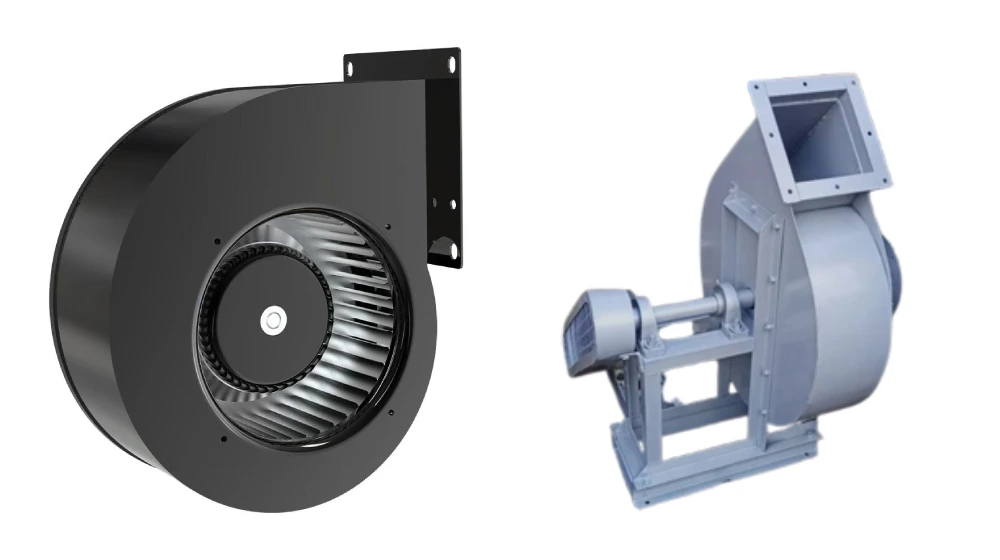
The difference between direct drive and belt drive is not just mechanical layout. It shapes maintenance planning, installation space, and the way the blower fits into the larger system.
| Factor | Direct Drive Centrifugal Fan | Belt Drive Centrifugal Fan |
|---|---|---|
| Power transmission | Motor directly drives impeller | Motor drives impeller through belt and pulley |
| Maintenance | Lower routine maintenance | Higher maintenance demand |
| Speed adjustment | Less flexible | More flexible in some field setups |
| Space requirement | More compact | Usually larger overall assembly |
| Mechanical complexity | Lower | Higher |
| Common use | Compact OEM equipment, enclosed cooling systems | Larger ventilation systems, field-adjustable installations |
If your project is compact, fixed-speed, and difficult to service, the direct drive option is usually the first one to evaluate.
A belt-driven fan still has advantages in certain situations. If a system needs a different speed ratio without changing the motor, belt drive can offer more adjustment flexibility. It may also make sense in larger air movement systems where space is less restricted and maintenance access is expected as part of normal operation.
Direct drive is usually the better fit where the cooling design is compact, fixed, and expected to operate for long periods without regular mechanical adjustment.
Maintenance, Reliability, and Service Life
For many buyers, this is the deciding category.
Industrial cooling systems are often judged less by their first-day performance and more by how little trouble they cause after installation. A fan that performs well in the lab but demands frequent maintenance in the field becomes expensive very quickly.
This is where direct drive becomes attractive. With fewer moving parts in the transmission path, there are fewer mechanical wear points that require inspection or correction. There is no belt tension to manage and no pulley alignment to re-check after long use. That can reduce downtime and simplify maintenance planning, especially in installations where fan access is inconvenient.
Reliability also improves when the cooling system is mechanically straightforward. That does not mean every direct drive blower is automatically long-life. Motor quality, bearing design, operating temperature, and housing layout still matter a great deal. But all else being equal, a simpler drive structure usually gives fewer opportunities for mechanical drift or transmission-related failure.
For OEM applications, predictable service life is especially important. Equipment builders often need cooling components that will behave consistently across many units, not just one installation. Direct drive supports that goal because it reduces the number of setup variables that can change from unit to unit.
Efficiency and Operating Stability
Direct drive systems often reduce the transmission losses that can occur in belt-driven systems. Because the motor is directly connected to the blower wheel, power transfer is more straightforward and there is less opportunity for loss through belt friction or slippage.
That does not mean efficiency should be reduced to a slogan. The actual result still depends on the complete fan design, including the impeller, housing, motor, and airflow path. A poorly matched direct drive fan will not outperform a properly selected belt-driven system simply because of the drive style. But in compact industrial cooling equipment, direct drive usually gives a cleaner and more predictable starting point.
Operating stability is another advantage. Where a blower needs to run at a fixed performance level for long hours, fewer transmission variables often means more stable behavior over time. That matters in systems where airflow consistency is tied directly to thermal protection.
A Practical Test Example
To make the difference clearer, consider a compact electrical control cabinet used in a factory automation line. The cabinet contains a PLC, a drive, and two power modules that together generate a concentrated thermal load. Space is limited, and the airflow path includes a filter and a short internal channel before air reaches the hottest components.
In a simple comparison trial, two blower arrangements are evaluated under the same heat load and ambient conditions. One uses a compact direct drive centrifugal fan. The other uses a small belt-driven layout adapted for the same cabinet class. The test is not meant to prove that one concept is universally superior, but to show what buyers often care about in real cabinet cooling.
The evaluation focuses on four points: installation fit, airflow stability, maintenance burden, and operating noise.
The direct drive unit fits the cabinet more easily because the overall mechanical package is tighter. It also reaches stable airflow more quickly and requires no transmission adjustment after installation. During extended operation, the airflow curve remains more consistent because there is no belt system gradually changing the power transfer characteristics. Mechanical noise is also easier to manage because there is no belt-related vibration source in the assembly.
The belt-driven version remains workable, but it occupies more space and introduces extra mechanical elements that must be aligned correctly. In a larger ventilated structure, that may not be a problem. In a compact cabinet, it adds complexity that offers little benefit because the system does not need field-adjustable speed ratios.
This kind of test result explains why direct drive is often preferred in compact OEM cooling designs. The advantage is not that the concept is newer or more fashionable. The advantage is that it reduces complication in an environment where simplicity improves reliability.
When a Direct Drive Centrifugal Fan Makes the Most Sense
A direct drive centrifugal fan is usually a strong choice when the cooling system has a fixed design and the buyer wants stable performance without frequent service attention.
That is common in electrical cabinets, telecom equipment, automation enclosures, industrial electronics, and compact HVAC-related modules. These systems often have three things in common: limited installation space, predictable operating conditions, and a preference for low-maintenance airflow hardware.
It is also a good fit where the fan is built into the product and not expected to be tuned later in the field. In those situations, the simplicity of direct drive is more valuable than the flexibility of a belt-driven layout.
Belt drive remains relevant in larger ventilation systems or installations where the operator expects to adjust drive ratios or maintain the blower as part of routine facility service. For OEM cooling systems with compact mechanical constraints, however, direct drive is usually the more natural direction.
What to Check Before Selecting One
The right direct drive blower is chosen by application fit, not by drive type alone.
| What to Confirm | Why It Matters |
|---|---|
| Voltage and frequency | Must match the available power input |
| Installation space | Confirms whether the blower can fit inside the equipment |
| Airflow target | Determines whether the blower can deliver the required cooling volume |
| Static pressure requirement | Shows whether the blower can overcome the system’s airflow resistance |
| Noise limit | Important in indoor, telecom, or sensitive equipment environments |
| Operating temperature | Affects motor loading and bearing life |
| Service access | Helps confirm whether low-maintenance design is a real advantage |
Send us your voltage, size, airflow, and static pressure requirement if you need model matching support.
Contact us
The selection process is usually more reliable when airflow path and thermal load are reviewed together. Free-air airflow numbers are not enough if the blower must push through filters, compact channels, or internal obstacles. In direct drive applications, the mechanical simplicity helps, but the blower still has to be matched correctly to the system resistance.
Need Help Selecting a Direct Drive Centrifugal Fan?
For many OEM buyers, the difficult part is not understanding the drive structure. It is matching the blower to the real application. Installation space, voltage, airflow target, static pressure, noise limit, and service life all need to line up before the model is approved.
FanACDC can help review these details before sample selection. If you are replacing an existing blower or designing a new cooling system, share the frame size, voltage, airflow requirement, and operating environment. Our team can recommend a suitable centrifugal fan series for cabinet cooling, telecom equipment, HVAC modules, or industrial automation projects.
How FanACDC’s Centrifugal Fan Range Fits Direct Drive Applications
FanACDC’s centrifugal fan range is designed for OEM buyers who need compact structure, stable airflow, and practical voltage coverage. The product range covers sizes from 133 mm to 355 mm, voltage options from 115V to 240V, airflow from 159 CFM to 1735 CFM, and service life up to 60,000 hours.
For compact cabinet cooling, smaller series such as 133 mm, 175 mm, and 190 mm are often easier to integrate into limited spaces. For equipment ventilation, telecom enclosures, and automation systems, mid-size options such as 220 mm, 225 mm, 250 mm, and 280 mm provide stronger airflow coverage. Larger 315 mm and 355 mm series can support higher airflow industrial projects where space allows.
This gives OEM buyers a practical starting point: select by installation space first, then confirm voltage, airflow, static pressure, and operating environment before ordering samples.
FAQ
What is a Direct Drive Centrifugal Fan?
A direct drive centrifugal fan is a blower design in which the motor is directly connected to the impeller, without belts or pulleys. This structure reduces mechanical complexity and is commonly used in compact industrial cooling systems.
Is a Direct Drive Centrifugal Fan better than a Belt Drive Fan?
It depends on the application. A direct drive centrifugal fan is usually better for compact OEM equipment, cabinet cooling, and low-maintenance industrial systems. A belt drive fan may still be useful in larger ventilation systems where field-adjustable speed is important.
Does a Direct Drive Centrifugal Fan require less maintenance?
Yes. Because there are no belts or pulleys to inspect, align, or replace, a direct drive centrifugal fan usually requires less routine maintenance than a belt-driven design.
Where is a Direct Drive Centrifugal Fan commonly used?
Direct drive centrifugal fans are commonly used in electrical cabinets, telecom enclosures, HVAC modules, industrial electronics, automation equipment, cabinet cooling, telecom, HVAC modules, automation equipmentand other compact cooling applications where stable airflow and limited service access are important.
How do I choose the right Direct Drive Centrifugal Fan?
Start by confirming voltage, frequency, installation space, airflow target, static pressure, operating temperature, and noise requirements. For OEM projects, it is also important to review service life and integration needs before selecting a fan model.
Conclusion
A direct drive centrifugal fan is often the better choice when an industrial cooling system needs compact structure, stable airflow, and lower maintenance over time. By connecting the motor directly to the impeller, it removes belts and pulleys from the system, which helps reduce mechanical complexity and simplifies long-term operation.
That advantage is especially clear in cabinet cooling, telecom enclosures, automation systems, industrial electronics, and other OEM applications where space is tight and service access is limited. Belt drive still has its place, especially in larger systems that need more field flexibility, but direct drive remains the more practical solution in many compact industrial blower applications.
For buyers evaluating a real project, the most useful approach is to compare airflow needs, static pressure, installation space, noise expectations, and operating conditions before choosing the blower type. Where those priorities point toward low maintenance and predictable performance, direct drive centrifugal fans are often the right fit. FanACDC’s centrifugal fan range can be used as a practical reference point for that selection process in OEM and industrial cooling work.