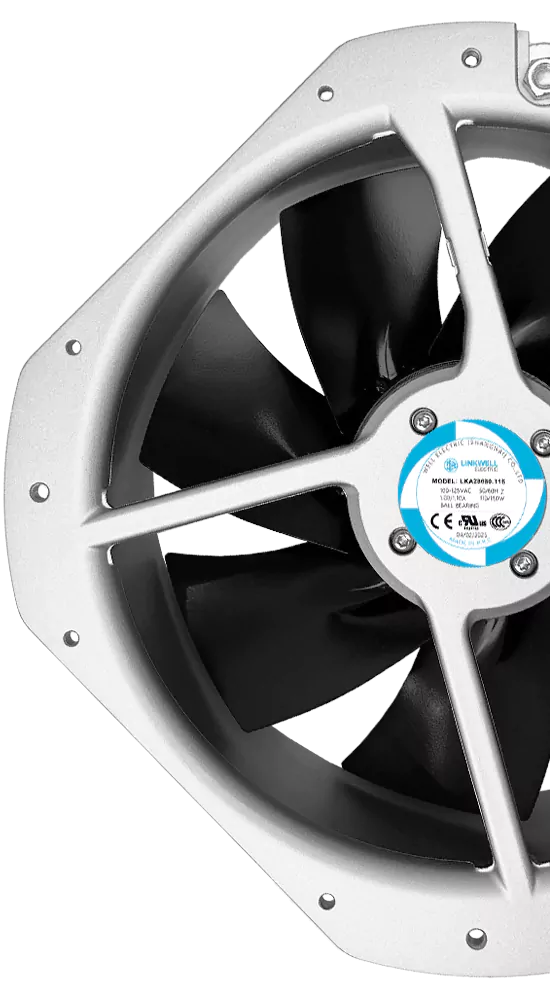
Standard cooling fans solve a lot of everyday ventilation problems. In open or lightly restricted systems, a catalog fan with the right size and voltage may be all that is needed. That is why standard axial and centrifugal fans remain the first choice in many industrial applications.
The problem begins when the system is no longer simple. Once airflow has to move through narrow internal paths, filters, heatsinks, dense wiring, or sealed enclosures, the fan is no longer working in free air. At that point, a fan that looks correct on paper can still fall short in operation. Overheating continues, airflow becomes uneven, or the equipment behaves differently under summer load, dust buildup, or continuous duty.
This is where many buyers lose time. The first response is often to replace the fan with the same frame size, or to move to a larger standard model. Sometimes that helps. Often it does not, because the real problem is not the existence of a fan, but the mismatch between the fan and the thermal environment.
For industrial OEMs and equipment engineers, the useful question is not whether standard fans are good or bad. The useful question is when a standard fan stops being enough, and when a custom thermal solution becomes the more reliable path.
Quick Answer
Standard cooling fans are often not enough when the equipment has restricted airflow paths, high static pressure, dense electronics, unusual voltage requirements, tight integration limits, or environmental protection demands that fall outside a normal catalog setup.
In those situations, the issue is rarely solved by force-fitting a generic replacement. A custom thermal solution is usually more effective because it matches the fan type, voltage, airflow behavior, protection level, and mechanical integration to the actual system rather than to a nominal fan size alone.
Why Standard Fans Work in Some Systems but Fail in Others
Standard fans are built around common dimensions, familiar voltages, and typical operating assumptions. They are effective when the airflow path is relatively open, the installation space is predictable, and the fan can operate close to its intended performance curve. In many cabinet ventilation or general equipment cooling tasks, that is perfectly acceptable.
Industrial systems become more difficult when those assumptions stop holding. The enclosure may be compact. The heat sources may be concentrated in one area. The airflow path may be interrupted by filters, internal structures, or wiring. The power architecture may require a specific voltage or control method. The environment may demand dust protection, moisture resistance, or long service life in a particular mounting orientation.
Under those conditions, the fan may still run, but running is not the same as cooling effectively. A standard model may deliver less useful airflow than expected, create hot spots inside the enclosure, or operate outside the conditions that support stable long-term performance.
Common Signs a Standard Cooling Fan Is Not Enough
One of the most common signs is cabinet overheating that continues even after the fan has been replaced. This often happens when the original selection focused on frame size or nominal airflow, while the real issue was internal resistance or poor airflow direction.
Another warning sign is a restricted airflow path inside the equipment. If air must move through narrow vents, filters, heatsinks, or crowded internal geometry, the system may require more pressure capability than a standard open-air fan can provide.
Dense electronics create a similar problem. Power supplies, PLCs, drives, communication modules, and battery components can generate concentrated heat in a very small area. In those cases, airflow needs to be controlled, not just present.
Mechanical mismatch is another practical indicator. The fan may be electrically close but not correct in connector type, cable length, voltage, mounting structure, or operating orientation. These problems are easy to dismiss at the sourcing stage and expensive to ignore later.
Environmental demands also matter. Outdoor enclosures, dusty workshops, and moisture-prone systems may require higher IP protection than a standard model offers. Seasonal instability can reveal the same issue from another angle. A system that appears acceptable in mild conditions may begin to fail when ambient temperature rises or duty cycle increases.
When Standard Cooling Fans Fail: The Real Problem Is Often Not Fan Size
A large number of cooling decisions begin with the visible specification: fan diameter, frame size, or rated airflow. Those numbers are useful, but they do not tell the whole story.
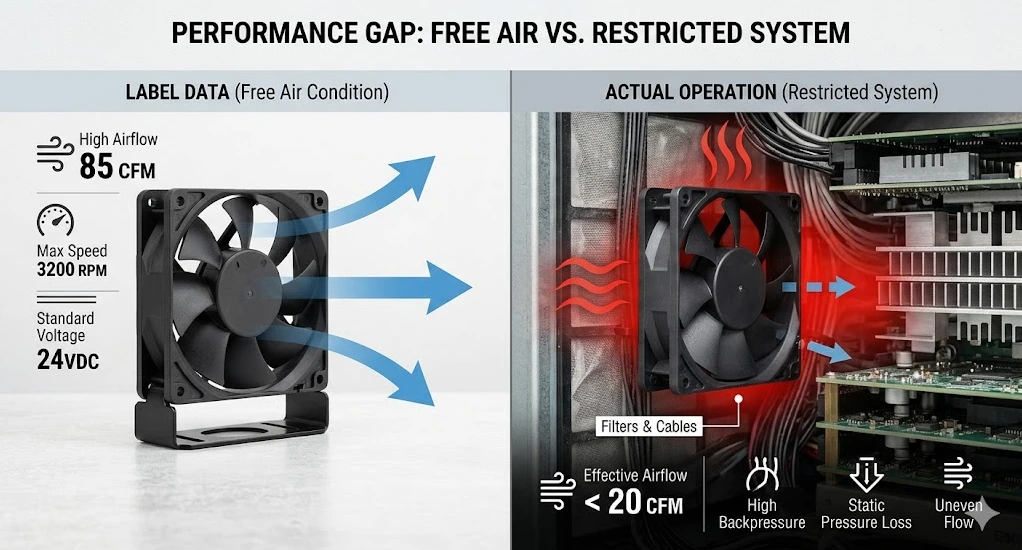
In real equipment, airflow is shaped by resistance. Internal layout, filter media, vent geometry, heatsinks, cable bundles, and component placement can all reduce the amount of useful air that actually reaches the hot area. A fan with a strong free-air rating can lose much of its practical value once it is installed in a restricted system.
That is why replacing a fan with a larger standard model does not always fix the problem. The issue may not be the amount of air the fan can move in theory. It may be the fan’s ability to maintain effective airflow under pressure, in a confined path, with the required electrical and mechanical fit.
| What Buyers Often Check First | What Actually Causes the Problem |
|---|---|
| Fan size | Airflow restriction |
| Rated CFM | Static pressure loss |
| Voltage only | Full electrical and integration matching |
| Replacement dimensions | Real thermal performance inside the enclosure |
Typical Industrial Situations That Need Custom Thermal Solutions
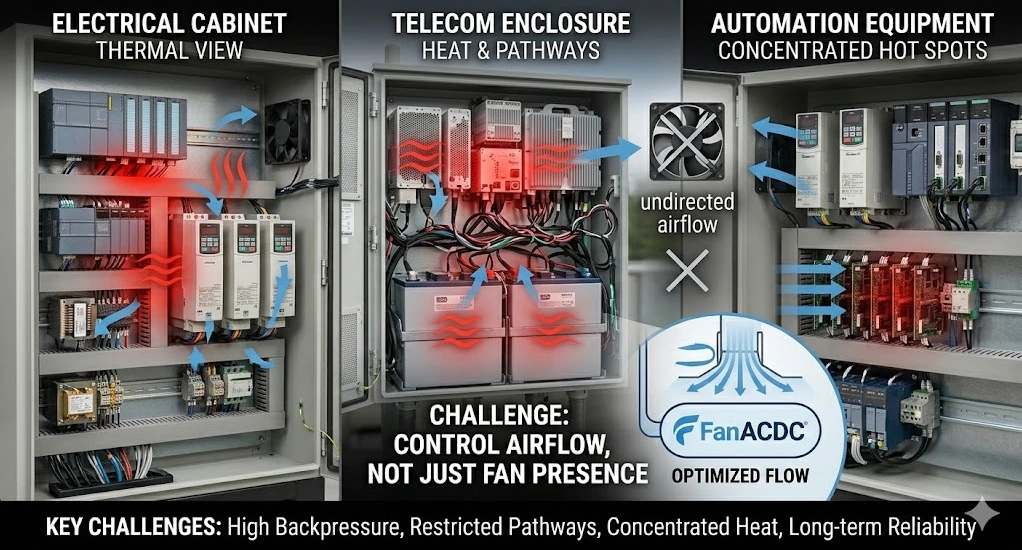
Electrical cabinets and control panels are among the most common examples. Internal temperatures rise when drives, relays, PLCs, and power components are packed into a limited space, especially when airflow must pass through filters or internal barriers before reaching the hottest section.
Telecom enclosures create a different version of the same problem. They often operate continuously, carry dense electronics, and may be exposed to outdoor temperature swings. In that environment, broad undirected airflow is not always enough. Cooling needs to be stable, focused, and compatible with the enclosure’s protection requirements.
Automation equipment and PLC systems also benefit from custom matching when thermal loads are concentrated around a few sensitive components. Standard fans may keep air moving in general terms while still allowing a local hotspot to remain around the drive or control section.
Battery enclosures and power electronics present another challenge. Heat is not always distributed evenly, and a small difference in airflow path can create a larger difference in cell or module temperature. In those systems, airflow uniformity matters as much as total volume.
Compact industrial electronics and embedded systems often look simple from the outside and difficult from the inside. Installation space is limited, mounting options are narrow, and airflow must often move through very specific internal paths. A generic fan may fit physically while still being the wrong thermal choice.
What a Custom Thermal Solution Can Change
A custom thermal solution changes the selection logic from catalog convenience to application fit.
That may begin with voltage and control matching. A system may require a specific AC or DC range, PWM control, alarm output, or a connector format that works with the existing assembly. It may also require a fan platform that performs better under pressure, such as a centrifugal blower where an axial fan would lose too much useful airflow.
Mechanical integration is often just as important. Mounting pattern, cable direction, bracket support, and available space all influence whether a cooling design works cleanly in production. Environmental protection can also shift the selection. If the application requires higher IP resistance, orientation-sensitive bearing choices, or more stable long-term operation in a difficult environment, those factors need to be matched deliberately rather than assumed.
In some projects, noise also becomes part of the answer. In others, the most important improvement is not quieter operation but more stable airflow under load. The point is that the cooling solution becomes specific to the equipment instead of asking the equipment to adapt to a standard part.
Standard Fan vs Custom Thermal Solution
| Comparison Item | Standard Fan | Custom Thermal Solution |
|---|---|---|
| Voltage options | Fixed catalog choices | Matched to the application |
| Airflow path fit | General-purpose | Application-based |
| Static pressure support | Limited | Evaluated and matched |
| Connector / cable | Standard | Customized |
| IP protection | Basic options | Project-specific |
| Mounting | Standard frame only | Adapted to the product structure |
| Engineering support | Usually none | Included |
How FanACDC Supports Industrial Thermal Matching
From a manufacturing standpoint, custom thermal work only becomes useful when it leads to a practical selection path. That means looking at the system as a whole rather than offering a fan in isolation.
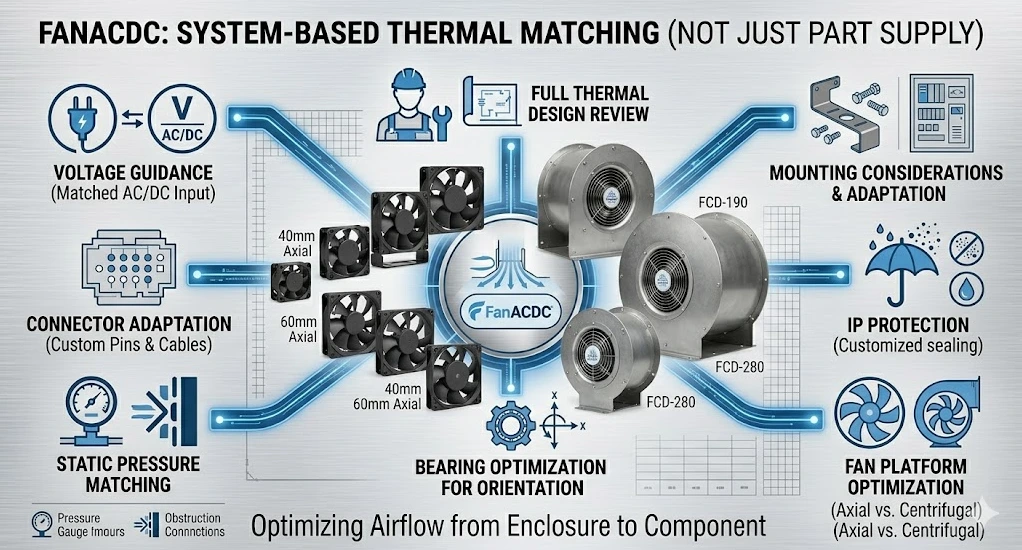
FanACDC supports axial, centrifugal, AC, DC, and EC cooling platforms because different airflow paths require different fan behavior. An open cabinet, a restricted telecom enclosure, a compact automation module, and a battery housing do not ask the same thing from the cooling hardware, even if all of them appear to need “a fan.”
In OEM projects, support often starts with airflow review and pressure matching. From there, the details become more specific: voltage guidance, connector and cable adaptation, mounting considerations, protection level, bearing selection, and platform choice. The goal is not simply to fulfill a fan order. The goal is to reduce thermal mismatch before the project reaches repeated production or field replacement.
When to Move From a Standard Fan to a Custom Project
A custom project becomes worth considering when overheating continues after ordinary replacement, when airflow distribution is poor, or when the system performs differently from one operating condition to another.
It also becomes the better route when the equipment has non-standard voltage requirements, connector limitations, unusual mounting constraints, or environmental protection needs that fall outside normal catalog options. The same is true when installation space is tight enough that a nominally correct fan cannot be integrated cleanly.
In practice, the decision often comes down to repetition. If the same thermal problem keeps returning, the cost of staying with a standard part can quickly become higher than the cost of solving the cooling design properly.
FAQ
When is a standard cooling fan not enough?
A standard cooling fan is often not enough when the system has restricted airflow, high static pressure, dense electronics, unusual voltage needs, tight installation space, or protection requirements that a catalog model does not address well.
Does a larger standard fan always solve overheating?
No. A larger fan may still perform poorly if the real issue is airflow resistance, poor internal distribution, or mismatch between the fan platform and the enclosure design.
What is the difference between a standard fan and a custom thermal solution?
A standard fan is selected from fixed catalog parameters. A custom thermal solution is matched to the real application, including airflow path, pressure resistance, voltage, mounting, connector requirements, and environmental conditions.
Can custom cooling improve static pressure performance?
Yes. In many restricted systems, the correct solution is not just more airflow on paper but better airflow under resistance. That may involve a different fan platform, adjusted performance, or more suitable integration.
Do you support OEM thermal projects?
Yes. FanACDC supports OEM cooling projects for cabinets, telecom systems, automation equipment, battery enclosures, and compact industrial electronics with application-based selection and customization support.
Conclusion
Standard cooling fans remain useful in a large number of industrial systems. They are proven, practical, and often the right first choice when the airflow path is simple and the integration conditions are straightforward.
But they are not universal. Once airflow resistance, enclosure structure, voltage requirements, mounting limits, or environmental demands become more complex, a standard fan may stop being the right answer even if it appears close on paper. That is when custom thermal matching becomes the safer and more effective approach.
For OEM and industrial applications, the real value is not in changing parts repeatedly until something works. It is in matching the cooling solution to the equipment before thermal problems become production problems. FanACDC supports that process with application-based fan selection, customization, and engineering-oriented thermal matching for industrial equipment.