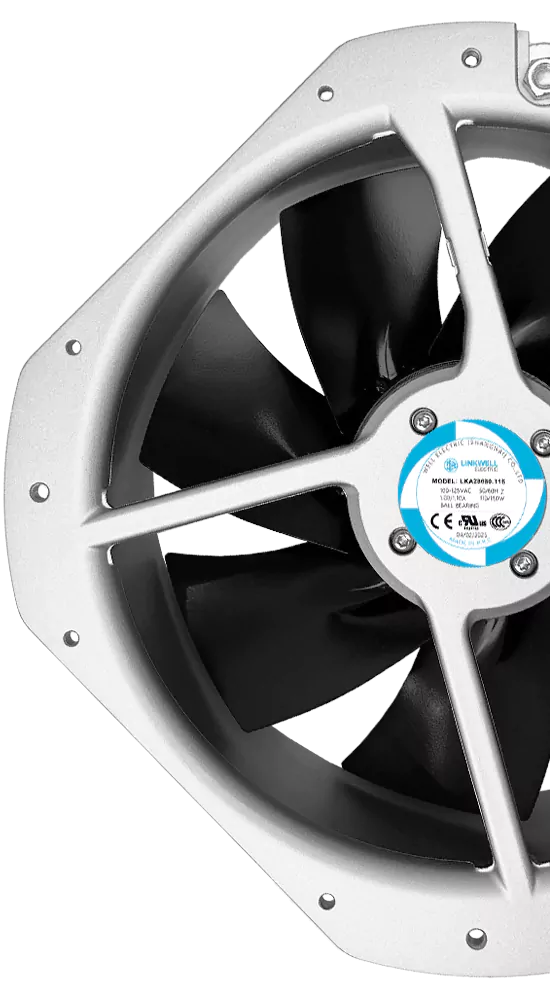
A cooling fan usually gets blamed last.
First, people blame the power supply. Then the PCB. Then the software. Only after the cabinet keeps overheating does someone finally look at the fan.
I’m an applications engineer at Linkwell. We manufacture AC, DC, and EC compact axial fans. This article is based on what I tell customers on the phone every week.
We’ve seen this happen more times than I can count.
One customer replaced an entire control module before realizing the real problem was simple: the fan they picked couldn’t maintain airflow once the filter got dusty. The fan worked fine in open air. Inside the cabinet? Completely different story.
That’s the problem with compact axial fan selection. Catalog numbers look great. Real installations don’t always behave the same way.
Here’s the actual process we use when helping customers choose fans for industrial cabinets, telecom gear, energy storage, power equipment, and automation machines. Not theory. Field experience.
Step 1 – Measure the Space First. Seriously.
A surprising number of projects start with this sentence: “We need the highest airflow possible.”
Okay. How much installation depth do you have?
Silence. This happens all the time. People measure length and width. They forget thickness. That’s a mistake.
Compact axial fans are standardized in frame sizes: 60×60, 80×80, 92×92, 120×120, 172×150, and up to 280×280mm. But here’s what actually matters: thickness changes everything.
An 80×80×25mm fan and an 80×80×38mm fan are not “basically the same.” Not even close. Our 80×38 DC model can reach over 100 CFM. The 25mm version? Around 44 CFM. More than double the airflow from the same frame size.
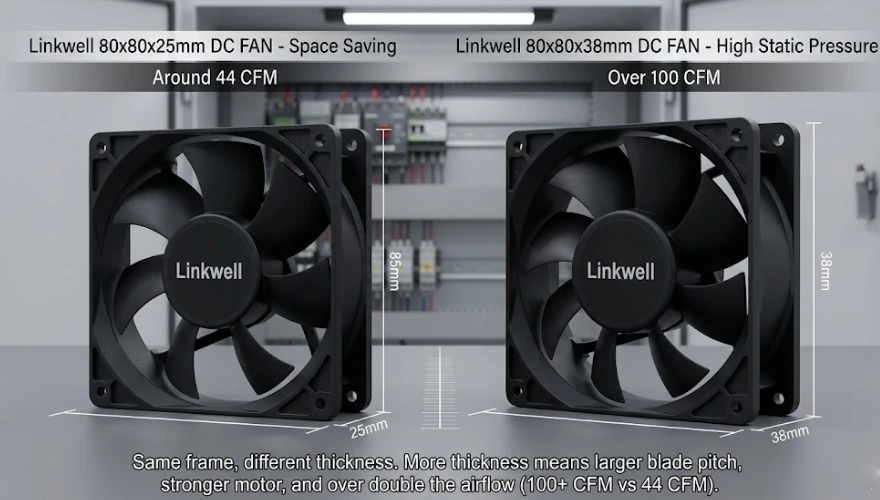
Why? Thicker fans allow larger blade geometry, stronger motors, higher static pressure, and more stable airflow under resistance.
Here’s what we see all the time: customers pick the thinner model first because it looks cleaner on paper and fits more easily. Then summer hits, the cabinet starts overheating, and suddenly that extra 13mm of thickness doesn’t seem so negotiable anymore.
So before picking anything: measure length, width, and maximum allowable thickness. Don’t estimate. Actually measure it.
If your cabinet depth is already tight, don’t wait until production to discover the door won’t close. Sounds obvious. Still happens all the time. Especially on retrofit projects.
Step 2 – Calculate Airflow. Don’t Just “Pick a Big Fan.”
A bigger fan doesn’t automatically mean better cooling. Sometimes it just means more noise and more power consumption.
You need enough airflow for the actual heat load. Here’s a simple estimation formula that works well enough for a first pass:
CFM ≈ Heat Load (Watts) ÷ (1.76 × ΔT)
Where ΔT is your allowable temperature rise in °C.
Example: a control cabinet generates 500W of heat, and you want to keep temperature rise under 15°C. Estimated airflow: 500 ÷ (1.76 × 15) ≈ 19 CFM.
At first glance, 19 CFM doesn’t sound like much. But here’s where people get fooled. That number assumes ideal airflow conditions. Real cabinets are messy. You add filters, wiring bundles, heat sinks, terminal blocks, protective grills — and actual airflow drops fast.
We normally recommend increasing calculated airflow by at least 30–50%. A calculated 20 CFM becomes 30 CFM. A calculated 100 CFM becomes 130–150 CFM.
Will that always solve the problem? Not always. But in our experience, it prevents about 80% of the field failures we get called about. Good enough for a starting point.
One mistake we see constantly: customers compare fans using only CFM. Higher CFM wins. But once airflow resistance appears, that comparison becomes almost meaningless. A lower-CFM fan with high static pressure will often outperform a “high airflow” fan inside a real cabinet.
Installed airflow matters more than free-air airflow. Always.
Step 3 – Static Pressure: The Spec Most People Ignore
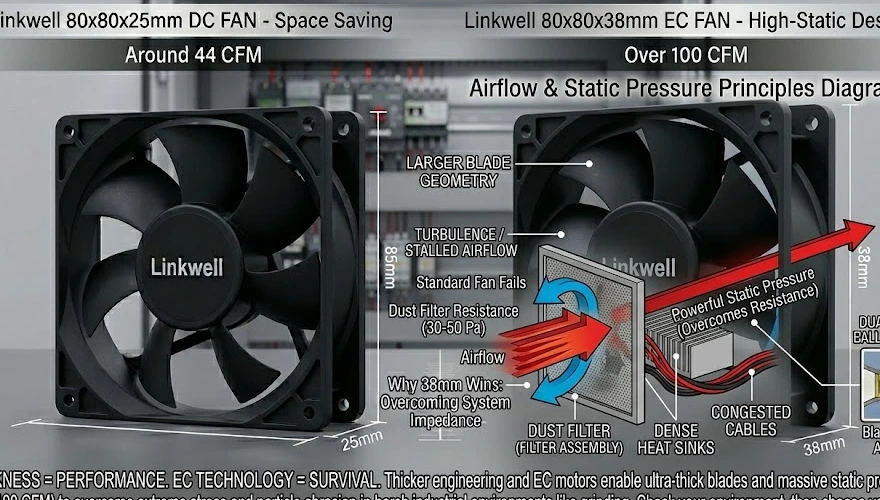
This is where many projects fail. The fan looks powerful on paper. After installation? Barely any airflow. Why? Because resistance kills airflow.
Every industrial cabinet creates resistance: dust filters (adds 30–50 Pa), heat sinks, narrow vents, cable congestion, protective mesh, airflow turns. All of these consume static pressure. And compact thin fans struggle badly once resistance increases.
Let me tell you about one that went wrong.
A customer used an 80×25 DC fan in a filtered control cabinet. Catalog airflow rating: 55 CFM. Looked fine.
After installation, actual airflow dropped below 20 CFM. I asked them: “Put your hand near the vent. Feel anything?” “Barely.”
That’s not a bad filter. That’s the wrong fan.
The cabinet overheated during summer. Their maintenance team blamed the filter first. Then the ambient temperature. Then the power supply. The real problem? Wrong fan selection.
They later switched to our 80×38 high-static-pressure model, which is rated up to 300 Pa. Same cabinet. Same filter. Completely different result. The customer’s exact words: “Now I can actually feel the air moving.”
That extra 13mm of thickness changed everything.
To be honest, static pressure specs aren’t perfect either. Lab conditions versus real cabinets — there’s always a gap. But we’ve learned to add a 20–30% buffer on pressure too. Better safe than sorry.
If your application has filters or tight spaces, here’s a rule we’ve learned from dozens of failed projects: start with 38mm thick. You can always go thinner later if testing proves it works. Starting too thin usually means rework.
Step 4 – Choose the Right Voltage Type
This part is simpler than people think. You basically have three choices:
AC fans run directly on 110V or 220V. Simple, durable, lower initial cost. Good for 24/7 fixed-speed operation. Nothing wrong with that.
DC fans run on 12V, 24V, or 48V. They give you PWM speed control, tachometer output (FG), and fault alarms (RD). Better for telecom, servers, battery systems, and anywhere you need intelligent thermal management.
EC fans take AC input (110–240V) but use a DC motor inside. They’re extremely efficient — typically 50–75% less power than AC. Popular in refrigeration, data centers, HVAC, and energy-saving projects.
At Linkwell, we make all three types — AC, DC, EC. No agenda. We’ll tell you which one fits your actual operating cost.
Here’s a trap we see often: customers pick AC fans because they’re cheap upfront. Then later they realize they need speed control or monitoring. So they add external controllers, inverters, or alarm modules. Suddenly the “cheap solution” isn’t cheap anymore.
If you need PWM control or speed feedback, start with DC. Don’t try to retrofit AC.
EC fans have a higher upfront cost but often pay for themselves within 1–2 years in continuous-run applications. We can run a quick payback calculation if you send us your local electricity rate and expected runtime.
Step 5 – Environment Changes Fan Lifespan More Than Specs Do
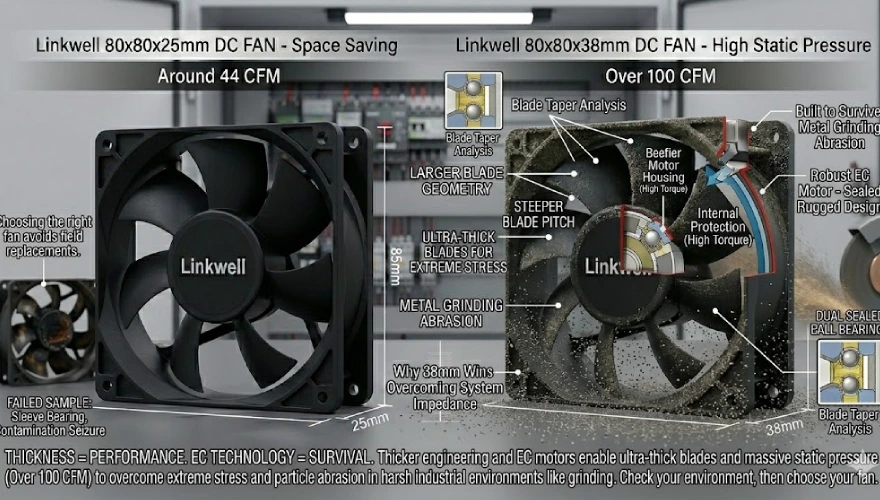
We once opened a failed fan that supposedly had a 50,000-hour lifespan. Actual service life? About 8 months.
Inside the bearing housing, the grease looked burned. Completely dried out. The customer later admitted the cabinet temperature regularly exceeded 70°C during summer afternoons. At that point, the failure wasn’t surprising.
Industrial environments are brutal compared to laboratory testing conditions.
Here are the real-world problems we see regularly, with rough failure risk estimates based on our return data:
| Environment | Failure Risk |
|---|---|
| High heat (70°C+ constant) | Grease breakdown, bearing seizure |
| Metal dust (grinding, machining shops) | Bearing wear, blade imbalance |
| Oil mist (machine shops, cutting fluid) | Blade contamination, motor insulation damage |
| Salt air (coastal factories, outdoor gear) | Corrosion on housing and electronics |
| Heavy vibration (vehicles, compressors) | Mechanical fatigue, bearing damage |
For harsh conditions, we recommend these countermeasures:
- High temperature → high-temp grease (rated to 120°C) + dual ball bearings
- Dust or oil mist → sealed bearings + IP54 or IP68 protection
- Salt air or humidity → anti-corrosion coating + stainless steel guard
- Vibration → dynamic balancing (ISO 1940 G6.3) + rubber isolation mounts
We had a customer in a metalworking plant go through three fans in one year. The workshop air was full of fine metal dust. Their old fans used sleeve bearings. The dust got in, mixed with the grease, and turned into grinding paste. We replaced them with dual sealed ball bearings and added a better filter. That was two years ago. Same fans. Still running.
If your environment has any of these conditions, tell your supplier up front. Not after you’ve already installed 50 fans.
Still Not Sure? That’s Normal.
Honestly, many cooling projects are not straightforward. Especially when customers are retrofitting older equipment.
Sometimes the issue is airflow direction. Sometimes it’s cabinet layout. Sometimes the fan is oversized. Sometimes undersized. And sometimes the fan is fine — the airflow path is terrible.
We document these field failures internally at Linkwell. Every time a fan fails unexpectedly, we ask why. That’s how we built these guidelines — from real returns, not from white papers.
You can send us:
- available installation space (L×W×thickness)
- cabinet dimensions
- heat load (watts, or equipment type)
- voltage preference (AC/DC/EC)
- operating temperature range
- whether filters are installed
Our engineers will recommend a compact axial fan based on your actual application. Not just catalog numbers.
Conclusion
Most cooling failures are not caused by “bad fans.” They’re caused by bad selection.
Wrong thickness. Not enough static pressure. Ignoring filters. Ignoring temperature. Choosing the wrong control type.
A compact axial fan that performs well in open-air testing may fail completely inside a real industrial cabinet. That’s why real application conditions matter more than catalog airflow alone.
Measure the actual space. Understand the resistance. Think about the environment six months from now — not just the first week after installation.
That’s how you avoid overheating problems before they become expensive.
FAQ
What thickness is best for compact axial fans?
For industrial cabinets with filters or restricted airflow, 38mm-thick fans usually perform much better than 25mm models because they generate higher static pressure. Test if you’re unsure.
Are DC fans better than AC fans?
Depends on the application. DC fans are better for PWM control, speed monitoring, and intelligent cooling. AC fans remain reliable for simple fixed-speed operation. EC fans win on energy efficiency for continuous running.
Why does airflow drop after installation?
Because real systems create resistance. Filters, wiring, heat sinks, and protective grills all reduce actual airflow compared to open-air testing. We’ve seen drops of 60% or more.
When should I choose a high static pressure fan?
If your application includes filters, dense heat sinks, narrow airflow paths, or outdoor enclosures — static pressure matters more than free-air CFM.
How long should an industrial compact axial fan last?
A quality dual-ball-bearing fan can typically reach 50,000–70,000 hours under proper conditions. High temperature, dust, and vibration will shorten that significantly.
Can I replace an AC fan with a DC fan?
Sometimes yes. But you need compatible voltage, mounting size, and control systems. DC fans may also require a separate power supply or PWM controller.