“Axial or centrifugal?”
That’s one of the most common questions we get from engineers. Two different principles. Two completely different sets of strengths.
Pick wrong, and you end up with either a fan that screams like a jet engine, or a cabinet that still overheats because there’s barely any airflow.
I’m an applications engineer at Linkwell. We manufacture both types — axial and centrifugal. No agenda. But I’ve seen enough failed projects to know that most people pick the wrong one simply because they don’t understand how each behaves under real resistance.
Let me walk you through what actually works in the field.
The Simple Visual Difference
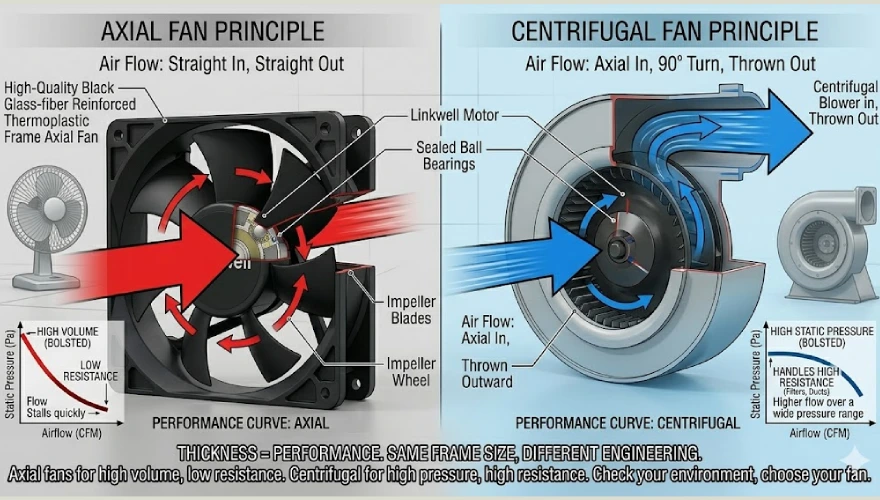
Axial fan — air goes straight in, straight out. Think of a desk fan. Low resistance, high volume.
Centrifugal fan — air comes in axially, then takes a 90° turn and gets thrown outward. Think of a blower. Higher pressure, more focused airflow.
That 90° turn is the key difference. It allows the centrifugal fan to build pressure, but it also makes the housing thicker. You can’t cheat physics.
Comparison Table – What Actually Matters
Here’s how they stack up in real installations, not just datasheets:
| Factor | Compact Axial Fan | Centrifugal Fan |
|---|---|---|
| Airflow direction | Straight through | 90° turn |
| Static pressure | Moderate. Good for open cabinets with little resistance | High. Handles filters, long ducts, and bends well |
| Airflow volume at same size | Higher | Lower, but more concentrated |
| Noise character | Broad airflow sound | Higher-pitched, blade-pass frequency |
| Installed thickness | Thin (25–38mm typical) | Thick (needs volute housing depth) |
| Works in tight depth | ✅ Yes, good | ❌ Usually requires 60mm+ |
If you’re trying to fit a fan into a shallow cabinet door — 40mm or less — axial is really your only practical option.
If you have depth to spare but need to push air through a HEPA filter or a long duct, centrifugal starts to make more sense.
Decision Flow – Ask Yourself These Four Questions
In our experience, answering these four questions gets you 90% of the way to the right choice.
Question 1: How much installation depth do you actually have?
If your available depth is less than 45mm, stop. Go axial. Centrifugal fans need room for the volute housing. You can’t squeeze that into a shallow panel.
We’ve had customers insist on centrifugal for a 40mm-deep control cabinet door. They eventually had to add an external mounting box. Cost went up. Timeline slipped.
Start with what fits.
Question 2: Do you need to push air through a high-resistance path?
Here’s where centrifugal fans shine. If your system has a HEPA or high-efficiency filter, long ductwork, multiple sharp bends, or a heat exchanger core — you need static pressure.
Axial fans lose airflow quickly once resistance increases. We’ve measured axial fans drop from 100+ CFM in free air to under 30 CFM behind a clean filter. A centrifugal fan might start with lower free-air CFM, but it holds onto much more of that airflow under load.
Question 3: Are you cooling a large cabinet with open airflow?
If you have a control cabinet or an equipment rack with plenty of ventilation openings and no dense obstructions, axial fans work well. They move high volumes of air at low pressure. That’s exactly what you want for uniform cooling across a large area.
Question 4: Do you have a noise constraint and enough depth?
This one is tricky. Axial fans produce broad-spectrum airflow noise. Centrifugal fans often produce higher-pitched tones from blade-pass frequency, which some people find more annoying.
If noise is critical and you have depth to spare, a backward-curved centrifugal fan can run at lower speeds while still maintaining pressure. But they cost more. Much more.
Two Real Cases – What We Actually Recommended
Case A: 5G telecom outdoor cabinet
The customer had a cabinet depth of only 38mm. No room for a centrifugal fan. They needed uniform cooling across multiple radio units. The cabinet also had a basic mesh filter for dust protection.
We recommended a 120×38mm DC axial fan with PWM control.
Why axial? Because it fit. Simple as that. A centrifugal fan wasn’t an option at 38mm depth.
We used a high-static-pressure axial version — 38mm thick instead of 25mm. The 38mm axial has a steeper blade angle and a stronger motor. It handles the filter resistance much better than a thin axial would.
The customer tested both a generic 25mm axial and our 38mm axial inside the same cabinet. The 25mm version dropped from 80 CFM free air to less than 25 CFM installed. The 38mm version held 55 CFM. Same filter. Same cabinet.
That’s the difference thickness makes.
Case B: Medical device with a HEPA filter
This was a completely different problem. The device had a HEPA filter at the air intake. The filter resistance was high — about 150 Pa when clean, higher as it loaded.
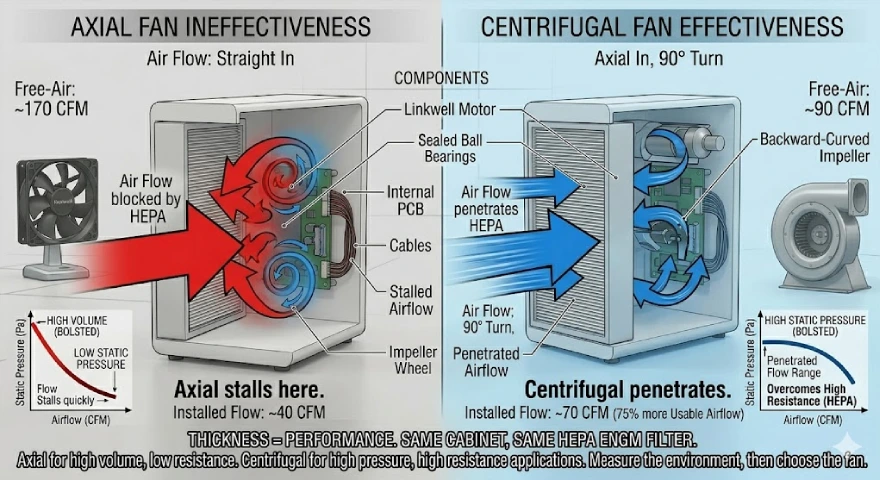
The customer originally tried a 120×38mm axial fan. Free-air CFM looked good on paper: 170 CFM.
Installed behind the HEPA? Measured airflow barely hit 40 CFM. The axial fan simply couldn’t generate enough static pressure.
We switched them to a backward-curved centrifugal fan with a custom housing. The centrifugal fan only delivered 90 CFM in free air — much less than the axial. But installed behind the same HEPA filter, it held 70 CFM consistently.
That’s 75% more usable airflow than the axial fan in that specific application.
The customer had to redesign the mounting plate to fit the deeper centrifugal housing. That added two weeks to the project. But they had no choice — the axial fan wasn’t going to work.
What About Noise? This Surprises Most People
Most engineers assume centrifugal fans are always louder. Not necessarily.
A high-speed thin axial fan spinning at 4000+ RPM can be very noisy — especially if it’s mounted directly to a thin panel that resonates.
A larger, slower centrifugal fan running at 1800 RPM can be significantly quieter, even though it’s a centrifugal type. The noise character is different, but the overall dBA can be lower.
We did a comparison for a lab instrument customer:
- 92×25mm DC axial at 4500 RPM: 48 dBA
- Small backward-curved centrifugal at 2500 RPM: 41 dBA
The centrifugal was quieter. But it required 65mm of mounting depth, while the axial only needed 25mm.
Everything is a trade-off.
One More Thing – Mixed Solutions Are Underrated
Sometimes the best answer isn’t “axial OR centrifugal.” It’s “both.”
We designed a cooling solution for an energy storage cabinet a few years ago:
- Two centrifugal fans at the bottom intake to push air through a thick filter and up through the battery stacks
- Two large axial fans at the top exhaust to pull the warm air out of the cabinet
Centrifugal handled the resistance. Axial moved the high volume. Together, they worked better than either type alone.
If you have both a high-resistance intake path and a large open cabinet volume, don’t force yourself into one technology.
Still Not Sure? Send Us Your Numbers.
Look, I’ve been doing this long enough to know that every application has its own quirks. What worked for one customer might not work for you — even if the equipment looks similar on paper.
Send us:
- Available mounting depth
- Whether you have filters, ductwork, or bends
- Approximate cabinet volume
- Heat load (watts, or equipment type)
- Noise constraints if any
We’ll recommend axial, centrifugal, or a hybrid solution based on real numbers. Not guesswork.
At Linkwell, we manufacture both types. I don’t care which one you buy as long as it works. A failed fan project doesn’t help you, and it doesn’t help us either.
FAQ
When should I choose axial over centrifugal?
When your mounting depth is under 45mm, you have low to moderate airflow resistance, and you need to move high volumes of air.
When should I choose centrifugal over axial?
When you have high resistance — filters, long ducts, multiple bends — and you have enough depth to fit the housing.
Can a centrifugal fan fit in a shallow control cabinet door?
Usually no. Most centrifugal fans need 60mm or more of depth. Axial fans are better for thin panels.
Which type is more energy efficient?
It depends. A well-matched centrifugal running at lower speed can be efficient. So can a high-quality axial. EC technology helps both types. Judge by the application, not the fan type alone.
Do you make both types?
Yes. We manufacture AC, DC, and EC versions of both axial and centrifugal compact fans. No bias. We just want the right fan for your specific equipment.