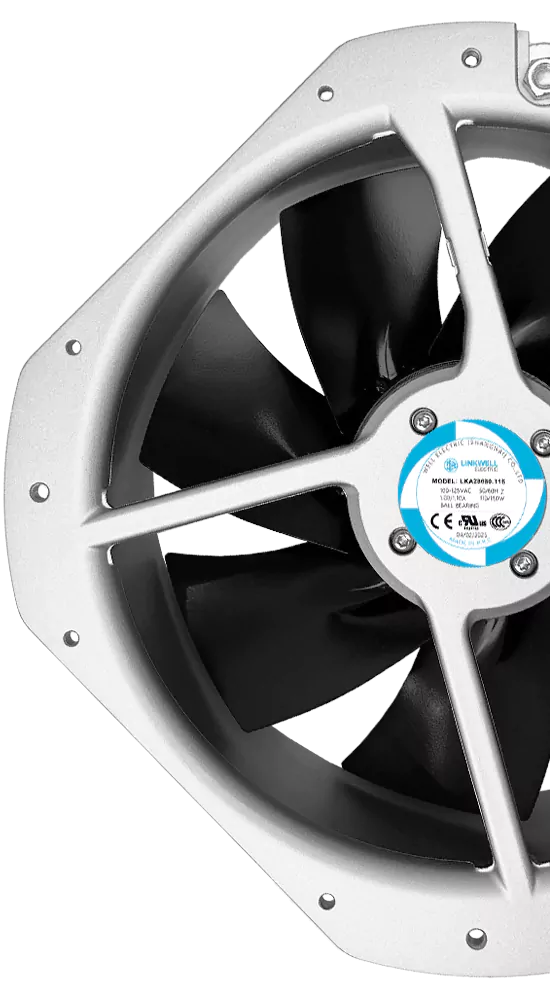
Control cabinet cooling looks simple.
Open a vent. Mount a fan. Push hot air out.
But in the field? It fails more often than people think.
We’ve seen cabinets where the top was 15°C hotter than the bottom. Fans that died in six months because the filter was clogged. And someone once mounted the intake and exhaust on the same panel – 10cm apart. Air never even made it inside.
This isn’t theory. This is what we see.
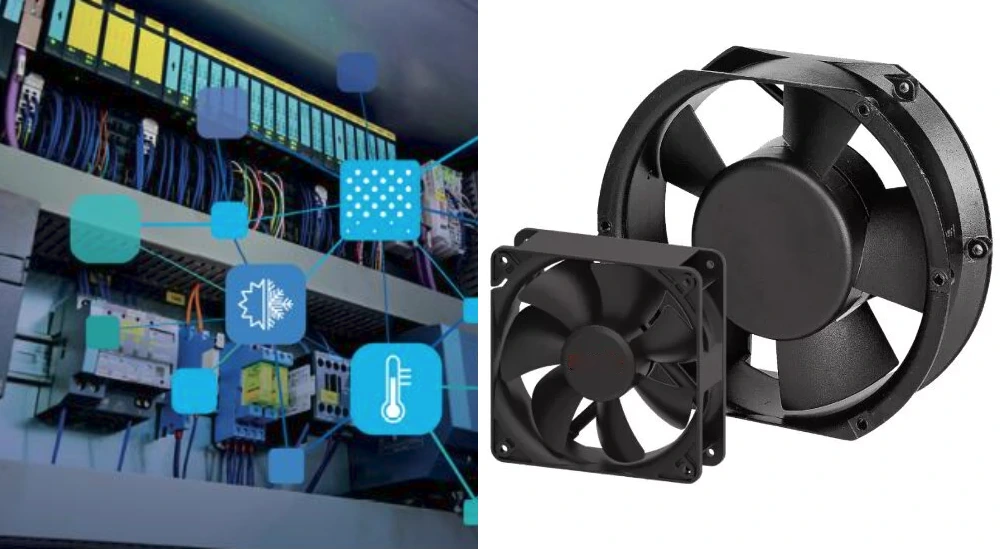
Heat Rises. The Top Gets Cooked.
VFDs, servo drives, power supplies – they all make heat.
Hot air goes up.
Without forced circulation, the top of the cabinet can be 10–15°C hotter than the bottom.
Where are the sensitive components? Switches. Capacitors. Power supplies. Often at the top.
High heat cuts their lifespan in half.
We had a customer once. Their cabinets kept tripping overnight. Not during the day – at night. Took us a while to figure it out. The fans were mounted at the top, pulling air out. But there was no intake at the bottom. The cabinet was basically a partial vacuum. Airflow? Almost nothing.
Fixed the placement. Problem went away.
Filters Are Necessary. But They Kill Airflow.
A dust filter is not optional in most factories. Without it, conductive dust finds its way onto live PCBs. Short circuits follow.
So you add a filter.
Now the problem: a standard filter adds 30–50 Pa of resistance.
A thin, low-static-pressure fan might work fine in open air. Put it behind a filter? Airflow drops. Sometimes by 50–60%. We’ve measured it.
On paper, the fan looks fine. Installed? Barely moving air.
That’s why CFM alone is a trap.
24/7 Operation? Lab Numbers Don’t Mean Much.
An Compact Axial Fans might say “50,000 hours” on the datasheet. About 5.7 years.
That’s in a lab. Clean air. Constant temperature.
Real cabinets are not labs.
We opened a failed fan once. Rated for 50,000 hours. Died in 18 months. The grease inside the bearings was baked solid. The customer later admitted the cabinet regularly saw 70°C in summer afternoons.
The lab didn’t have that problem.
AC vs DC – Most People Miss This
Here’s a question we get all the time:
“For a control cabinet, AC or DC?”
DC + PWM.
Reason one: speed control.
Heat load changes. Daytime production, high heat. Nighttime idle, low heat.
An AC fan doesn’t know the difference. Full speed 24/7. Wastes energy. Creates noise. Pushes dust through the filter faster.
A DC fan with PWM can ramp up and down. Hot day? Full speed. Cool night? Slow down to 40%. Noise drops. Filter lasts longer. Fan lives longer.
Reason two: static pressure.
Our DC 80×38 hits 300 Pa. Same size AC? Under 200 Pa.
If you have a filter – and you should – that difference matters. The DC fan pushes through. The AC fan struggles.
Reason three: feedback.
DC fans can tell your PLC how fast they’re spinning (FG). They can tell you if they’ve stopped (RD).
AC can’t. Not without expensive external relays.
When does AC still make sense?
Three situations:
- Budget is extremely tight (AC is 30–40% cheaper upfront)
- 24/7 constant heat load – no need for speed control
- Only 220V AC available – no low-voltage DC supply
Otherwise, DC + PWM.
A Real Factory Cabinet. Dusty. Fans Dying Every Few Months.
A manufacturing plant. Moderate dust. Nothing extreme.
But fans kept dying. Every 4–6 months.
Not a crisis. But annoying. And it added up.
Their maintenance guy called us: “Can someone look at cabinet #47? We just replaced the fan three months ago. Thermal camera is already showing hot spots again.”
We went out.
Opened the cabinet. Filter was partially clogged – not terrible, but not clean. Pulled the fan. AC 120×38. Rated 50,000 hours.
Spun the blade by hand. Bearings felt rough. Fine dust everywhere.
Here’s what was actually happening: AC fans have decent starting torque. But they’re not great at maintaining airflow under resistance once dust starts building up. The fan was spinning. But actual airflow had dropped maybe 50–60%.
The maintenance team kept blaming the filter.
Filter wasn’t the root cause.
We swapped it for a DC 120×38 high-static-pressure fan. 300 Pa vs the AC’s ~180 Pa rating. Added a simple PWM controller tied to cabinet temperature. Same washable filter – just a clean one.
Results:
- Measured airflow at the filter went from ~45 CFM to ~110 CFM
- That same fan? Still running. Been over two years.
- Hot spots? Gone.
- Noise? Drops at night when the cabinet cools down.
Their guy a year later: “We haven’t touched that cabinet since you swapped it. The other cabinets are still on the old schedule. We should probably just change all of them.”
Why did this work?
Higher static pressure pushed through the filter – even when it was partially dirty. PWM meant the fan wasn’t screaming full speed when the cabinet was cool. And the tachometer output gave them confidence it was actually running – they wired it to a panel light.
The lesson: don’t assume a working fan means enough airflow. If you have filters, static pressure matters more than free-air CFM.
EC Fans – When the Electricity Bill Matters
EC fans take AC input (110–240V) but use a DC motor inside. Easy wiring of AC. Efficiency of DC.
When do you need EC?
- 24/7 continuous operation
- Electricity cost is a real number on your P&L
- You have large cabinets with multiple fans
Simple math: two 172×150mm fans, 24/7, €0.20/kWh.
| Fan Type | Annual Power | Annual Cost | 5-Year Cost |
|---|---|---|---|
| AC | ~400 kWh | €80 | €400 |
| EC | ~100 kWh | €20 | €100 |
That’s €300 saved. For two fans.
Fifty cabinets? You do the math.
For large cabinets (1000×800mm or bigger) with continuous operation, EC pays for itself in 1–2 years. For small to medium cabinets, DC + PWM is usually the sweet spot.
Installation. This Is Where Things Go Wrong.
One mistake we see constantly: intake and exhaust on the same side.
Air comes in. Immediately gets pulled out. The rest of the cabinet never sees airflow.
We’ve seen this dozens of times.
Do this instead: Intake at bottom side wall. Exhaust at top opposite corner. Air travels diagonal across the cabinet.
If you only have one fan, mount it at the bottom side as intake. Let natural convection pull air out the top.
Filter Management. Don’t Blame the Fan First.
A clogged filter cuts airflow by 50% or more.
If the cabinet is running hot, check the filter first. Don’t assume the fan died.
We recommend:
- Washable filters for dusty environments
- Change schedule: every 3–6 months depending on conditions
- For critical cabinets, add a differential pressure gauge – it tells you exactly when to change the filter
Wiring DC Fans. Cheap Power Supplies Cost More.
DC fans need a clean power supply.
Cheap power supplies have high ripple voltage. That kills the fan’s internal electronics. Sometimes in less than a year.
Spend an extra $20–30 on a quality supply (Mean Well, TDK-Lambda, or similar). It pays for itself in fewer fan replacements.
PWM setup is simple. Most customers use a basic curve:
- Below 30°C: 40% speed
- 30–50°C: ramp to 100%
- Above 50°C: 100% speed
Monitoring. Know Before the Cabinet Overheats.
If your cabinet is remote or critical, use DC fans with FG (tachometer) and RD (alarm) signals.
FG tells you the fan is spinning at the expected speed. RD tells you if it’s stopped completely.
Wire these to your PLC. You’ll know about a failure immediately – not three days later when the cabinet overheats.
We Also Supply the Rest of the Kit
Sometimes you need more than just a fan.
- Fans – AC, DC, EC, all sizes
- Filter fan assemblies – with dust screens and IP ratings
- Finger guards
- Thermostats – 40°C on, 25°C off
- Junction boxes for DC power supplies
- PWM controllers – standalone, temperature-based
One request to us. One complete solution. No hunting across three suppliers.
Still Not Sure? Send Us the Cabinet Details.
Every cabinet is different.
Send us:
- Dimensions (L × W × H)
- What’s inside – VFDs, servos, PLCs? Heat load if you know it.
- Environment – dusty? hot? oily? outdoors?
- Current fan model if replacing
- Voltage available – 220V AC? 24V DC?
- Special requirements – noise limit? IP rating? remote monitoring?
Engineers respond in 24 hours. Specific recommendations. No charge. No obligation.
A failed cooling project doesn’t help you. Doesn’t help us either.
FAQ
What thickness is best for control cabinet fans?
38mm thick fans perform much better than 25mm when filters are installed. Start with 38mm unless your cabinet depth is extremely tight.
Do I really need PWM speed control?
If your cabinet has varying heat load (most do), yes. It saves energy, reduces noise, and extends filter and fan life. If the cabinet runs 24/7 at full heat load with no variation, fixed-speed AC can work fine.
Can I replace an AC fan with DC without changing wiring?
No. DC fans need a low-voltage power supply (12V, 24V, or 48V). You can’t just connect them to 220V AC. Plan for a power supply.
How often should I clean or replace filters?
Depends on your environment. Clean offices or control rooms: every 6–12 months. Factory floor with dust: every 1–3 months. When airflow drops noticeably or the cabinet runs warmer – that’s the signal.
What’s the typical lifespan of a quality control cabinet fan?
A dual-ball-bearing DC fan properly sized for the environment: 50,000–70,000 hours. In harsh conditions (high heat, dust, vibration), lower your expectations. Check bearings annually.
Do you make both AC and DC fans?
Yes. Linkwell manufactures AC, DC, and EC compact axial fans. We don’t push one technology. We’ll recommend what fits your actual cabinet conditions.