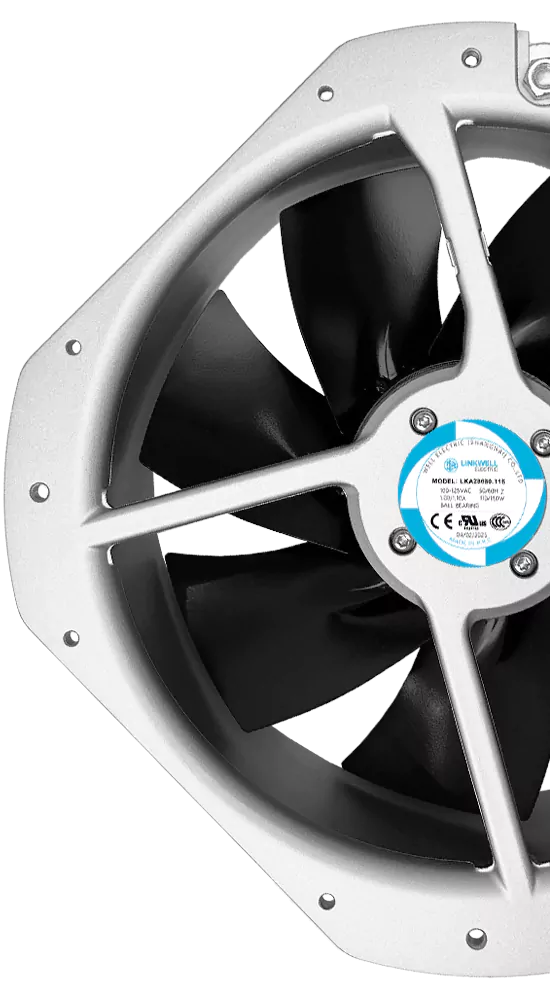
Selecting a fan for an Fan Selection for HVAC Modules and Airflow Units. In compact air handling units, cabinet ventilation modules, filtered airflow systems, and OEM cooling assemblies, the fan also has to match static pressure, voltage, noise limits, installation space, and long-term operating conditions.
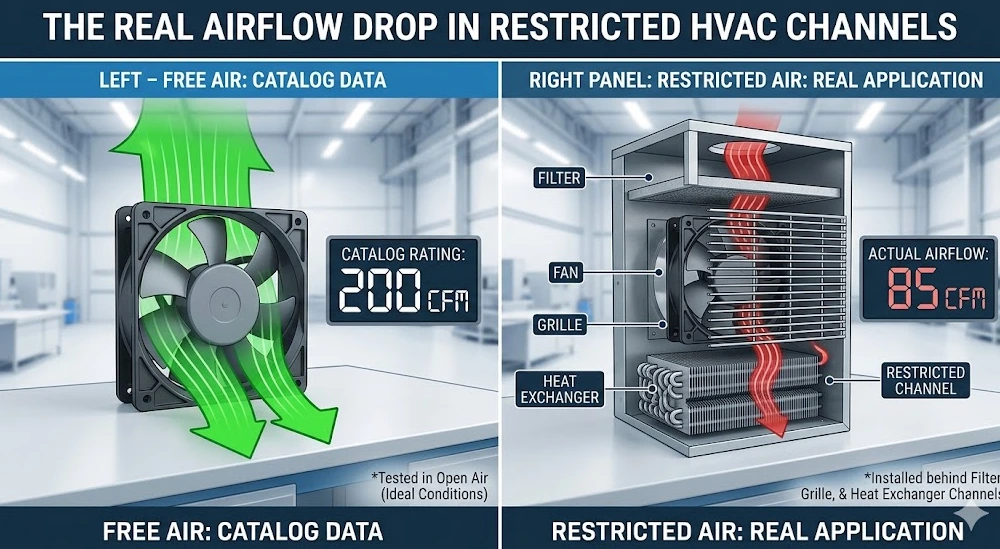
At FanACDC, we often see the same problem: a fan looks suitable from its free-air airflow rating, but once it is installed behind filters, ducts, grilles, heat exchangers, or compact internal channels, the real airflow drops sharply. That is why HVAC module fan selection should start with the actual system, not just the fan catalog.
This guide explains how to choose the right fan for HVAC modules and airflow units, and how AC, DC, EC, axial, and centrifugal fans fit different industrial cooling designs.
Fan Selection for HVAC Modules and Airflow Units Quick Answer
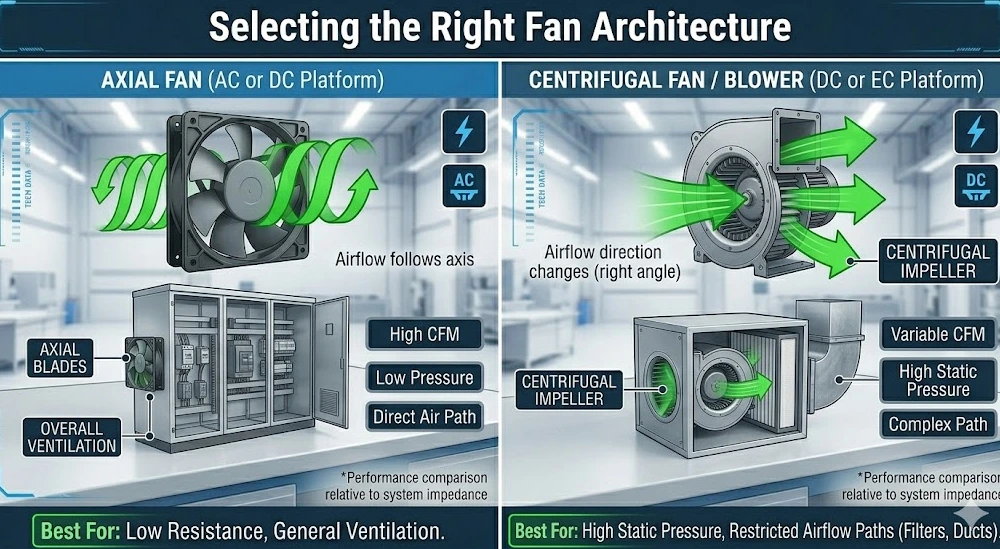
For simple airflow movement with low resistance, an axial fan is usually the first option. For restricted airflow paths, filters, compact ducts, or higher static pressure, a centrifugal fan or blower is often the better choice. If the system needs energy-saving speed control, EC or DC fan platforms may provide better long-term performance than a fixed-speed AC fan.
The right selection depends on six main factors:
- Required airflow
- Static pressure
- Available voltage
- Installation space
- Noise limit
- Control and integration needs
For OEM projects, the best fan is not always the strongest fan. It is the fan that delivers stable airflow after it is installed inside the real module.
What Counts as an HVAC Module or Airflow Unit?
In this article, HVAC modules do not mean large building HVAC systems, rooftop units, or full air-conditioning equipment. That is not FanACDC’s core product direction.
Here, HVAC modules and airflow units refer to compact or medium-sized air movement assemblies used inside industrial and commercial equipment. These may include:
- Cabinet ventilation modules
- Compact air handling units
- Filter fan units
- Control panel cooling modules
- Power supply ventilation systems
- Telecom airflow units
- Automation equipment cooling assemblies
- Battery enclosure ventilation modules
- Small HVAC-related OEM airflow systems
These systems usually need reliable airflow in a limited space. Many also run for long hours, sometimes continuously. In that kind of equipment, fan selection has a direct effect on temperature stability, noise, service life, and maintenance cost.
Why Fan Selection Is Different in Compact HVAC Modules
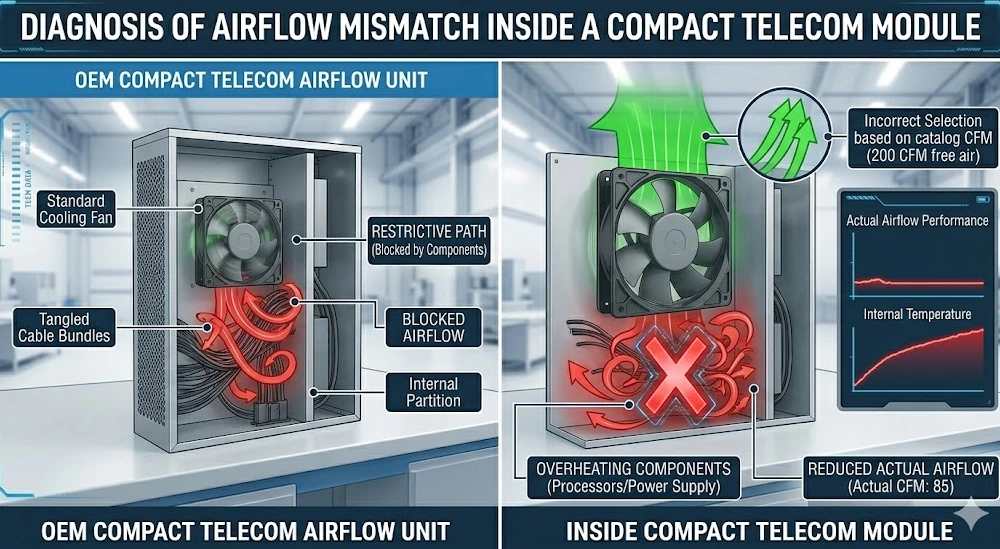
A fan that works well in open air may perform poorly inside an HVAC module. The reason is simple: the module creates resistance.
Air may need to pass through a filter, turn around internal components, move through a narrow duct, or push across a heat-generating area. Each of these details reduces usable airflow. If the fan cannot handle that resistance, the airflow number printed on the datasheet becomes much less useful.
This is where many selection mistakes happen. A buyer may choose a fan by size and rated CFM only. The fan arrives, fits into the module, and spins normally. But the cooling result is still poor because the actual airflow path was never considered.
For OEM equipment, this can become expensive. A weak airflow design may pass a simple bench test but fail during summer operation, full-load testing, or field use. Replacing the fan later can affect tooling, wiring, approvals, and production schedules.
That is why FanACDC treats HVAC module fan selection as an airflow matching problem, not just a fan model recommendation.
Airflow Is Only the Starting Point
Airflow matters, but it should not be read alone.
Most fan datasheets show airflow under free-air conditions. That means the fan is tested without the same resistance it will face inside the final equipment. In a real HVAC module, airflow may be reduced by:
- Filters
- Grilles
- Heat sinks
- Compact ducts
- Cable bundles
- Internal partitions
- Narrow inlet or outlet openings
- Poor spacing near the fan
If a module has very little resistance, an axial cooling fan can be a practical and cost-effective choice. Axial fans move air in a straight path and are often used where the goal is general ventilation or heat removal from an open enclosure.
If the module has higher resistance, the selection changes. A centrifugal fan can often maintain better airflow under pressure because it is designed to push air through more restrictive paths.
This is why two fans with similar free-air airflow ratings can perform very differently after installation.
Static Pressure: The Detail Buyers Often Miss
Static pressure is one of the most important factors in HVAC module fan selection.
If airflow is the amount of air the fan can move, static pressure is the fan’s ability to move that air against resistance. In compact modules, static pressure often decides whether cooling works or fails.
A low-pressure axial fan may be fine for open ventilation. But if the airflow must pass through a filter, a duct, or a dense internal layout, the fan may lose much of its effective output. The result is common: the fan is running, but the equipment still overheats.
Centrifugal fans and blowers are often preferred when the system has:
- Filter resistance
- Narrow airflow channels
- Directional airflow requirements
- High-density electronics
- Heat concentrated in one area
- Limited inlet or outlet space
For FanACDC customers, this is a common reason to move from a standard axial fan to a centrifugal blower or a custom thermal solution.
AC, DC, EC, or Centrifugal Fan: Which One Fits?
Different HVAC modules need different fan platforms. There is no single fan type that fits every system.
| Fan Type | Best Fit | Main Advantage |
|---|---|---|
| AC Axial Fan | Mains-powered ventilation modules | Simple, stable, cost-effective |
| DC Axial Fan | Low-voltage compact airflow units | Easy integration and speed control |
| EC Fan | Energy-saving HVAC modules | High efficiency and variable speed |
| Centrifugal Fan / Blower | Restricted airflow paths | Better static pressure performance |
AC Fans
AC fans are often used in equipment connected directly to mains power. They are practical for stable ventilation systems where speed control is not the main requirement. For many industrial HVAC modules, AC axial fans remain a reliable and economical option.
FanACDC supports common AC voltage requirements for industrial applications, including 110V, 115V, 220V, 230V, and 240V options depending on the product series.
DC Fans
DC fans are common in compact equipment, control systems, electronics, telecom modules, and low-voltage airflow units. They are easier to integrate with electronic controls and can support features such as PWM speed control, FG signal, RD signal, or alarm output.
For OEM buyers, DC fans are often attractive because voltage, cable, connector, and control functions can be matched to the product design.
EC Fans
EC fans are a strong option when efficiency and controllability matter. In HVAC modules that run for long hours, energy use becomes part of the total cost. EC fan solutions can help reduce power consumption while allowing more flexible speed control.
They are especially useful when airflow demand changes under different operating conditions.
Centrifugal Fans
Centrifugal fans are often the better answer when airflow resistance is high. In compact HVAC modules with filters, ducts, or limited internal space, a centrifugal blower may deliver more stable cooling than an axial fan with a similar free-air rating.
For cabinet cooling, telecom enclosures, power systems, and compact air handling units, this can make a real difference.
Noise Matters, But It Cannot Be Chosen Separately
Many HVAC modules are installed near people. Some are used in offices, labs, medical-related equipment, telecom rooms, control rooms, or indoor industrial spaces. In these cases, fan noise becomes part of the product experience.
But a low-noise fan is not simply a fan with a low dB number. Noise depends on the fan speed, blade design, bearing type, mounting method, airflow restriction, and enclosure resonance.
A fan may sound quiet in open air but become noisy after installation because the inlet is too close to a panel or the outlet creates turbulence. Another fan may have a higher rated sound level but perform better in the real module because it does not need to work as hard against pressure.
For this reason, FanACDC normally recommends evaluating noise together with airflow and pressure. A quieter design is often achieved by selecting the correct fan size, speed range, bearing structure, and airflow path rather than simply choosing the lowest dB value in a table.
Voltage and Control Options
Voltage selection is another area where mistakes happen.
HVAC modules may use AC mains power, DC control power, or an internal auxiliary circuit. A module installed in a 230V region does not always use a 230V fan internally. Some systems step down to 24V or 48V DC for control and cooling.
Before selecting a fan, buyers should confirm:
- Input voltage
- Frequency for AC fans
- Required current range
- Control method
- Connector type
- Cable length
- Signal requirements
For OEM applications, control functions can be just as important as airflow. PWM speed control, FG speed feedback, RD rotation detection, and alarm output can help the equipment monitor fan performance and respond before overheating becomes serious.
FanACDC supports these integration requirements for suitable DC and EC fan projects.
Installation Space and Mechanical Fit
In compact HVAC modules, mechanical fit is often just as important as performance.
A fan may meet the airflow target but still fail the project because the frame is too thick, the mounting hole position does not match, the cable exits in the wrong direction, or the connector interferes with another part of the assembly.
For OEM buyers, these details affect production. A fan should not only cool the equipment. It should also fit smoothly into the product structure.
Important mechanical details include:
- Frame size
- Thickness
- Mounting hole position
- Air inlet clearance
- Air outlet clearance
- Cable direction
- Connector position
- Bracket or housing design
- Service access
When standard mounting does not fit, FanACDC can support customization depending on project requirements. This may include cable length, connector type, mounting adaptation, or fan platform selection.
Case Example: Filtered Airflow Module With Unstable Cooling
One OEM customer had a compact airflow module used inside an industrial control system. The original design used a standard axial fan because the free-air airflow rating looked sufficient during early selection.
During testing, the module passed at normal room temperature but became unstable under higher ambient conditions. The fan was running, but airflow after the filter and internal channel was much lower than expected. The hottest area was near a power module behind the main airflow path.
The issue was not the fan size. The problem was system resistance.
After reviewing the airflow path, the solution moved toward a higher-static-pressure centrifugal fan configuration. The fan was matched to the restricted channel, and the cable length was adjusted for the customer’s assembly layout.
The result was more stable airflow through the filter section and better cooling around the power module. The customer did not need to redesign the entire product housing, which helped keep the project moving toward production.
This type of case is common. When a fan fails inside an HVAC module, the cause is often not poor fan quality. It is usually a mismatch between the fan and the real airflow path.
What to Check Before Choosing a Fan
A reliable selection process should start with the equipment, not only the fan.
| What to Confirm | Why It Matters |
|---|---|
| Airflow target | Determines required cooling capacity |
| Static pressure | Shows whether the fan can overcome resistance |
| Voltage | Must match the equipment power system |
| Fan type | Axial, centrifugal, AC, DC, or EC must fit the application |
| Installation space | Confirms frame, thickness, and mounting fit |
| Noise limit | Important for indoor or operator-facing equipment |
| Operating temperature | Affects bearing life and motor performance |
| Control signal | Supports speed control or fault monitoring |
| Cable and connector | Affects OEM assembly and service |
| IP protection | Important for dusty or outdoor-related environments |
For purchasing teams, this checklist reduces the risk of ordering a fan that looks correct but fails during integration.
For engineers, it makes communication with the manufacturer faster and more practical.
How FanACDC Supports HVAC Module Fan Selection
FanACDC is not positioned as a supplier of large building HVAC fans or household air-conditioning parts. Our focus is industrial cooling fans for OEM equipment, compact airflow systems, electrical enclosures, telecom equipment, automation systems, power electronics, and related thermal applications.
For HVAC modules and airflow units, we can support selection across:
- AC axial fans
- DC axial fans
- EC fans
- Centrifugal fans and blowers
- Low-noise cooling options
- High-static-pressure airflow solutions
- Custom cable and connector requirements
- Voltage matching
- OEM sample evaluation
The goal is simple: help the fan perform correctly in the real equipment.
A catalog model is useful only if it fits the airflow path, voltage, space, noise limit, and service expectations of the final product. When those details are unclear, our engineering support can help narrow the selection before sampling.
When to Contact FanACDC
It is worth contacting us early if your project has any of these conditions:
- The airflow path includes filters or compact ducts
- A standard axial fan is not cooling enough
- The module has repeated overheating during testing
- The equipment needs lower noise without losing airflow
- The fan must match a fixed cable or connector layout
- The design requires 12V, 24V, 48V, 115V, 220V, or 230V options
- The buyer needs stable supply for OEM production
- The project needs a centrifugal blower but space is limited
Fan selection becomes much easier when the thermal problem is shared before the design is locked.
FAQ
What type of fan is best for HVAC modules?
It depends on the airflow path. Axial fans are suitable for open ventilation and low-resistance airflow. Centrifugal fans are better when the module has filters, ducts, tight channels, or higher static pressure.
Can an axial fan be used in an HVAC airflow unit?
Yes. Axial fans are often used in compact airflow units when resistance is low and the goal is general ventilation. If airflow drops after installation, static pressure should be checked.
When should I choose a centrifugal fan for an HVAC module?
Choose a centrifugal fan when the system needs stronger pressure performance, directional airflow, or stable cooling through filters, grilles, or compact internal passages.
Are EC fans better for HVAC modules?
EC fans are a good choice when energy efficiency, variable speed, and long operating hours matter. They are especially useful in systems where airflow demand changes during operation.
Can FanACDC customize fans for OEM HVAC modules?
Yes. FanACDC can support voltage selection, cable length, connector type, PWM/FG/RD signal options, mounting adaptation, and fan platform matching for OEM cooling projects.
What information should I send for fan selection?
Send the required voltage, available space, airflow target, static pressure if known, operating temperature, noise limit, application type, and any cable or connector requirements.
Conclusion
Fan selection for HVAC modules and airflow units should not be based on fan size or free-air airflow alone. In real equipment, filters, ducts, compact layouts, voltage requirements, and noise limits all affect whether the fan will perform correctly.
For low-resistance ventilation, an AC or DC axial fan may be the right choice. For restricted airflow or higher static pressure, a centrifugal fan or blower can be more reliable. For long-running systems that need better efficiency and speed control, EC fan solutions are worth considering.
FanACDC supports industrial and OEM buyers with AC, DC, EC, axial, and centrifugal cooling fan solutions for compact HVAC modules, cabinet ventilation, telecom enclosures, automation systems, and power electronics. If your airflow unit needs more than a standard catalog fan, send us your voltage, size, airflow path, and application requirements. We can help you select a fan that fits the equipment, not just the datasheet.