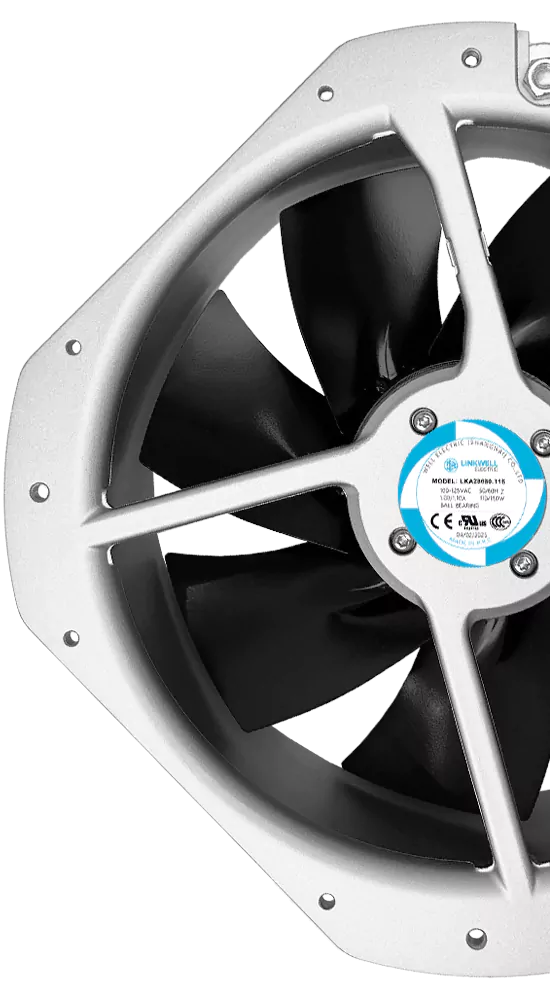
Cooling fan power consumption looks like a simple specification, but it is easy to read the wrong number. A buyer may compare voltage, current, airflow, and wattage from several fan catalogs and still not know which fan will use less electricity in the final machine.
The reason is straightforward: a fan does not work in open air once it is installed. Filters, heat sinks, grilles, ducts, and tight cabinet layouts create resistance. That resistance changes the operating point and can also change the fan’s current, speed, and actual input power.
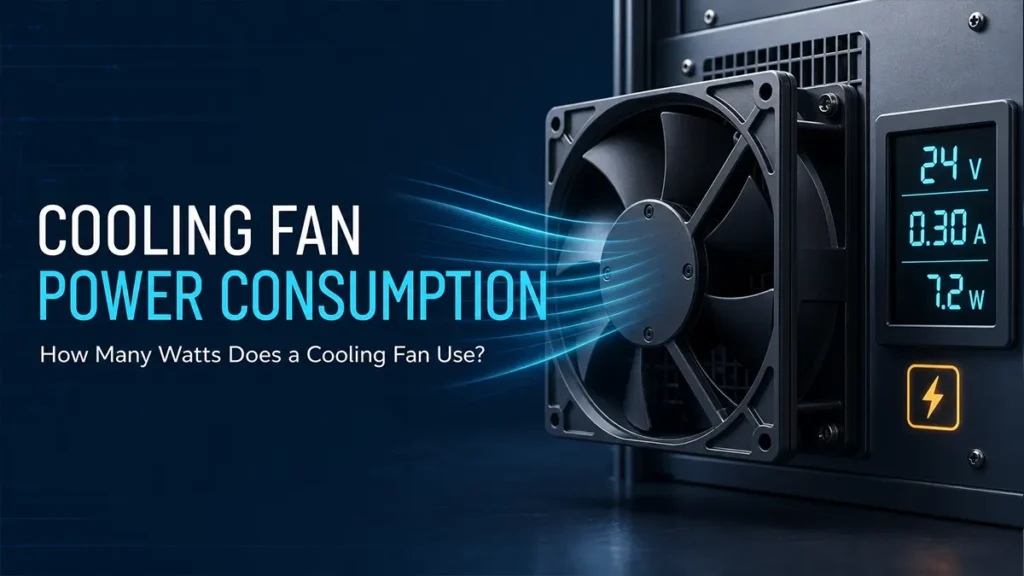
This guide explains how to calculate cooling fan power consumption, estimate annual energy cost, compare AC, DC, and EC fans, and avoid the common mistakes that lead to poor cooling or an oversized power supply.
Quick Answer: How Much Power Does a Cooling Fan Use?
There is no single wattage for every cooling fan. Compact equipment fans may use only a few watts, while larger industrial fans can use tens or hundreds of watts. The correct number is the rated input power shown on the product label or datasheet for the required voltage, frequency, speed, and operating condition.
- For a DC fan, a useful first estimate is voltage multiplied by current.
- For an AC fan, voltage multiplied by current gives apparent power, not necessarily real watts; use the listed input wattage or a true wattmeter.
- For a variable-speed DC or EC fan, power changes with speed and load, so compare fans at the airflow and static pressure your system actually needs.
- For annual cost, convert watts to kilowatt-hours and multiply by your electricity rate.
What Cooling Fan Power Consumption Actually Means
Electrical Input Power
Electrical input power is the power the fan takes from the supply. It runs the motor and control electronics, and it also covers losses in the windings, bearings, driver circuit, and aerodynamics. This is normally the figure you use for power-supply sizing and energy-cost estimates.
Air Power and Fan Efficiency
Only part of the electrical input becomes useful air power. A fan is doing useful work when it delivers airflow against pressure. Two fans can have the same electrical wattage but produce different results at the required operating point. That is why watts alone are not an efficiency rating.
Rated Power Versus Actual Power
Rated power is a declared value under specified conditions. Actual power can differ because of supply tolerance, airflow restriction, fan speed, temperature, control mode, and manufacturing tolerance. Use the rated value for a safe design estimate, then measure a prototype if energy use or power-supply margin is important.
How to Calculate Cooling Fan Power Consumption
DC Cooling Fan Formula
For a basic DC fan estimate, multiply the supply voltage by the input current. Make sure the current is in amperes, not milliamperes.
Power (W) = Voltage (V) × Current (A)
Example: a 24 VDC fan with a rated current of 0.30 A has an estimated input power of 7.2 W.
24 V × 0.30 A = 7.2 W
If the label shows 300 mA, convert it to 0.30 A before calculating. For PWM-controlled fans, the simple rated-voltage calculation still helps with maximum-load sizing, but average power at a lower speed should be taken from the manufacturer’s data or measured.
AC Cooling Fan Formula
For a single-phase AC fan, real input power depends on power factor as well as voltage and current. A simplified estimate is:
Real power (W) ≈ Voltage (V) × Current (A) × Power factor
For example, 230 V × 0.12 A × 0.65 gives about 17.9 W. However, a small fan motor may have a non-sinusoidal current waveform, so this is only an estimate. If the datasheet already lists watts, use that value. If you need an accurate field measurement, use a true-power meter rather than calculating from current alone.
Energy Use and Annual Electricity Cost
Power tells you the rate of energy use. To estimate energy over time, convert watts to kilowatts and multiply by operating hours.
Energy (kWh) = Power (W) ÷ 1,000 × Operating hours
Electricity cost = Energy (kWh) × Electricity rate
An 18 W fan running continuously uses about 157.68 kWh per year. At an illustrative electricity rate of $0.15 per kWh, that is about $23.65 per year. Use your local tariff for a real cost estimate.
18 ÷ 1,000 × 24 × 365 = 157.68 kWh/year
What Determines a Cooling Fan’s Power Consumption?
Fan Size, Motor Design, and Blade Geometry
A larger fan is not automatically less efficient, and a smaller fan is not automatically more economical. A larger diameter fan may meet the same airflow target at a lower speed, while a compact high-speed fan may need more pressure capability. Motor efficiency and blade design matter just as much as frame size.
Fan Speed
Speed has a strong effect on fan power. Under the fan affinity laws, airflow changes roughly in proportion to speed, pressure changes with the square of speed, and power changes approximately with the cube of speed. Real small-fan performance will not follow the equations perfectly, but the relationship explains why modest speed reduction can save substantial energy.
Static Pressure and the Operating Point
A fan’s installed airflow is set by the intersection of its fan curve and the system resistance curve. The maximum airflow in a catalog is measured near zero static pressure, so it is not the airflow you should expect behind a filter or heat exchanger. See static pressure vs airflow for a practical explanation of this relationship.
Filters, Grilles, and Internal Layout
A clogged filter, small inlet, dense finger guard, sharp duct bend, or crowded component layout increases resistance. The fan moves to a different point on its curve. Depending on the motor and fan design, input power may rise or fall, so do not assume that blocking a fan always reduces power. Check the manufacturer’s power curve or measure the installed fan.
Supply Voltage and Frequency
The fan must match the actual supply. A conventional AC fan may have different speed, airflow, current, and power at 50 Hz and 60 Hz. A DC fan requires the correct regulated voltage. Running outside the rated range can affect starting, noise, temperature, and life as well as power consumption.
Temperature and Air Density
Air density changes with temperature and altitude. Motor losses and bearing friction also change with operating temperature. For most cabinet-cooling estimates, datasheet values are a good starting point, but high-altitude or high-temperature equipment should be validated under the real environment.
Cooling Fan Power Consumption by Fan Type
The table below is a selection guide, not a universal wattage chart. Power varies widely within every fan category, so compare product data at your required duty point.
| Fan type | Power input | What affects energy use | Best comparison method |
| AC axial fan | AC mains | Voltage, frequency, motor design, size, and operating point | Use listed watts for the correct voltage and frequency; verify with a wattmeter if needed |
| DC brushless fan | Low-voltage DC | Voltage, current, speed command, driver efficiency, and pressure | Compare voltage × current and the P-Q curve at the required operating point |
| EC or ACDC fan | AC input with electronic commutation | Electronic drive, motor efficiency, control signal, and part-load operation | Compare real input watts at the same airflow and static pressure |
| Centrifugal fan | AC, DC, or EC | Higher pressure duty, impeller design, speed, and system resistance | Use the full performance curve, including power, at the target duty point |
A Practical Product Comparison Example
Suppose an enclosure needs 75 CFM after the filter and grille are installed. Fan A is rated at 18 W and delivers the target airflow at the required pressure. Fan B is rated at 30 W and shows more free-air CFM, but both fans deliver nearly the same airflow in the enclosure. In this case, the extra free-air number does not improve cooling; it mainly adds power, noise, and cost. LINKWELL’s AC fan range lists power, speed, and airflow by model, but the final choice should still be checked against the pressure requirement.
Now change the enclosure to a denser heat exchanger. Fan A may no longer reach 75 CFM, while Fan B may hold the required airflow because it has more pressure capability. The lower-watt fan is no longer the lower-cost choice if the equipment overheats. A fair comparison always uses the same airflow, static pressure, voltage, and operating conditions.
Does Lower Power Always Mean Better Efficiency?
No. Low input power is useful only when the fan still performs the required cooling work. A fan that uses 6 W but misses the temperature target is not efficient for the application. A 10 W fan that meets the same duty point as a 16 W fan may be the better design.
When data is available, compare fan input power at the required airflow and pressure. Also consider controller losses, power-supply losses, noise, service life, and maintenance. For equipment that runs all year, a small wattage difference multiplied across many units can become meaningful.
How to Reduce Cooling Fan Power Consumption
1. Select the Fan at the Real Operating Point
Start with the required airflow and estimated system resistance. Use the fan curve rather than choosing from maximum CFM alone. A well-matched fan usually needs less speed and less safety margin.
2. Reduce Unnecessary System Resistance
Open up restrictive vents, increase grille free area, provide adequate inlet clearance, smooth sharp airflow turns, and avoid placing components directly against the fan. Reducing pressure loss often saves more energy than simply buying a higher-output fan.
3. Use Temperature-Based Speed Control
Many systems do not need maximum cooling at all times. A PWM-controlled DC fan or speed-controllable EC fan can reduce airflow, noise, and power during light thermal load. Confirm the allowed control method and minimum reliable speed with the fan manufacturer.
4. Keep Filters and Heat Exchangers Clean
A dirty system needs more pressure to deliver the same airflow. Use a maintenance interval based on the real dust load, and consider a pressure switch or airflow alarm where blocked cooling could damage equipment.
5. Avoid Excessive Design Margin
Some margin is sensible for filter loading, voltage tolerance, aging, and environmental changes. Too much margin creates needless power and noise. Define the worst credible condition, then validate it with a temperature test instead of adding airflow without a limit.
How to Measure Actual Fan Power
Measuring a DC Fan
Measure supply voltage at the fan and current in series with the fan, or use a suitable DC power analyzer. Capture startup current as well as steady-state current if the power supply is tightly sized. For a PWM fan, test the duty cycles and temperatures the equipment will actually use.
Measuring an AC Fan
Use an AC wattmeter or power analyzer that reports real watts. A clamp meter that shows only amperes cannot account for power factor. Observe electrical safety procedures and use qualified personnel when working with mains voltage.
Test the Installed System
Measure after the fan, filter, guard, duct, and enclosure are assembled. Record input watts, speed, temperatures, noise, and—if possible—airflow or pressure. The installed result is more useful than a free-air bench test.
Common Mistakes to Avoid
- Using voltage × current as exact AC wattage without considering power factor.
- Comparing maximum airflow when the fans operate at different static pressures.
- Assuming the highest-RPM fan is automatically the most efficient choice.
- Sizing a power supply from average current while ignoring startup current and control electronics.
- Treating PWM duty cycle as an exact percentage of fan power without checking the fan’s control curve.
- Assuming a blocked inlet always makes every fan draw less power.
- Calculating annual cost from nameplate watts but forgetting duty cycle, standby mode, and maintenance condition.
Conclusion
Cooling fan power consumption is easy to estimate once the right inputs are clear. For DC fans, start with voltage and current. For AC fans, use listed real watts or a power meter. For every fan type, make the final comparison at the installed operating point rather than at maximum free-air CFM.
If you are selecting an AC fan, DC fan, EC fan, or centrifugal fan for industrial equipment, send LINKWELL your voltage, size limit, target airflow, estimated static pressure, ambient temperature, and control requirements. Those details make it possible to compare power and cooling performance on the same basis.
Cooling Fan Power Consumption FAQ
How many watts does a cooling fan use?
It depends on fan size, motor type, voltage, speed, and pressure duty. Check the exact model’s input-power specification. Compact equipment fans may use a few watts, while larger industrial cooling fans can use tens or hundreds of watts.
How much power does a 24 V DC fan use?
Multiply 24 V by the rated current in amperes. A 24 V, 0.25 A fan is approximately 6 W. Use the datasheet or a measurement for a more accurate value, especially at variable speed.
Does a cooling fan use more power when airflow is blocked?
Not always. The input-power response depends on fan type, motor control, and the shape of the power curve. Some fans draw less, some may draw more, and electronically controlled fans may react differently. Use manufacturer data or measure the installed fan.
Are EC fans more energy efficient than AC fans?
EC fans often offer efficient motors and better variable-speed control, especially at part load. However, the fair test is real input watts at the same airflow and static pressure. A product label alone does not prove which model is best for your operating point.
Does PWM control reduce fan power consumption?
Usually, yes, when PWM control reduces fan speed and the system needs less airflow. The exact saving depends on the fan’s electronics, minimum speed, system curve, and operating schedule. Use the manufacturer’s PWM-versus-speed data and verify temperatures at the lower speed.
How do I calculate the annual electricity cost of a fan?
Multiply watts by annual operating hours, divide by 1,000 to get kWh, and multiply by the electricity rate. If the fan changes speed or cycles on and off, calculate each operating mode separately and add the results.
Should I choose the fan with the lowest wattage?
Choose the lowest practical input power among fans that meet the required airflow, static pressure, temperature, noise, life, and environmental specifications. A low-watt fan that cannot maintain safe equipment temperature is a false economy.