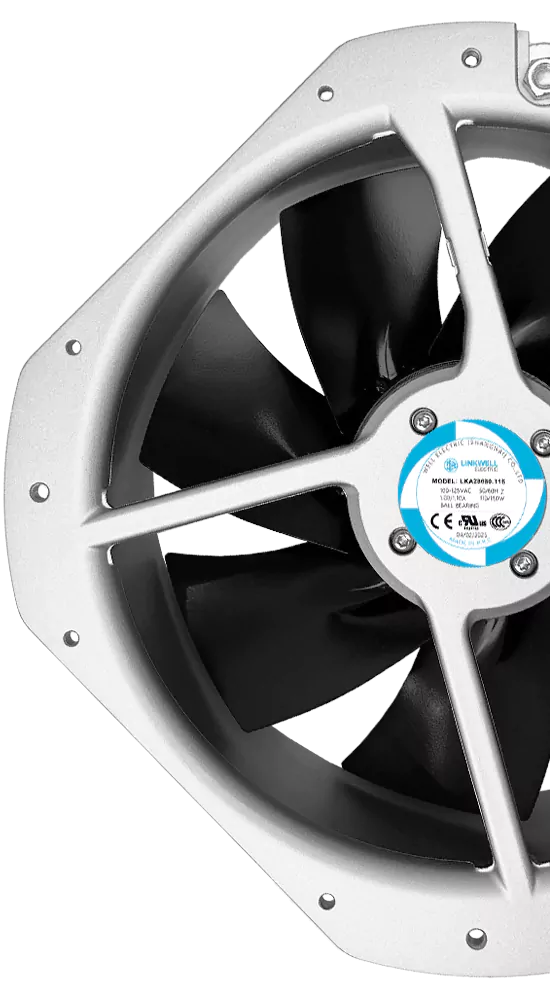
An 80×80×38 mm AC axial fan is an 80 mm square, 38 mm-deep cooling fan that runs from an AC supply and moves air parallel to its shaft. It is a practical size when your equipment has limited panel space but still needs stronger airflow than many thinner compact fans can provide.
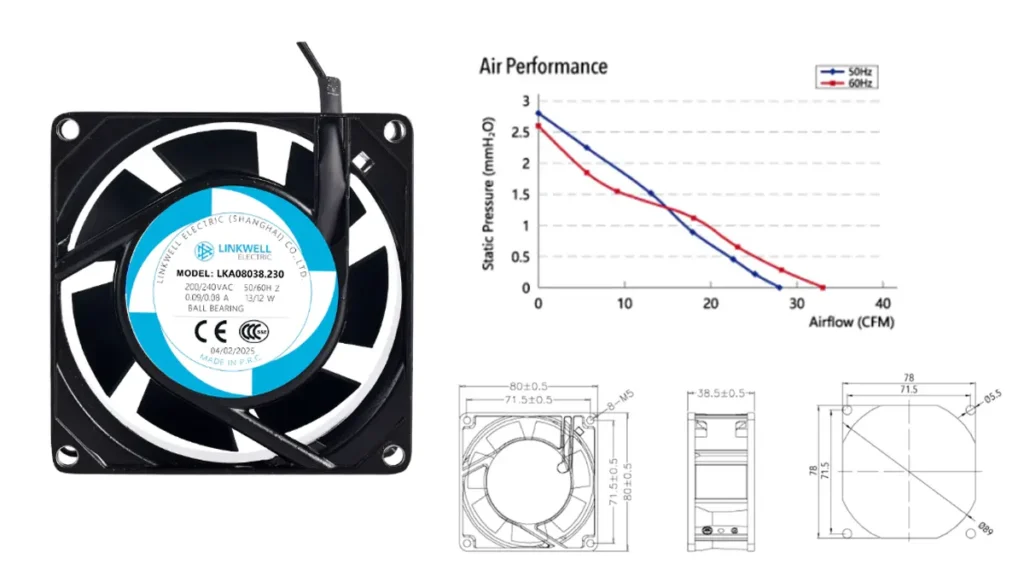
For a concrete reference, the LINKWELL LKA08038 AC axial fan is available for 100–125 VAC and 200–240 VAC systems. Its published performance is 28 CFM at 50 Hz and 33 CFM at 60 Hz. Those numbers make it suitable for many compact control cabinets, power supplies, inverters, automation devices, and similar enclosures—but size and free-air CFM alone are not enough to confirm a match.
Key Takeaways
- 80×80×38 mm describes the frame, not the complete performance. You still need to check voltage, frequency, airflow, static pressure, noise, connection, and operating environment.
- The final 38 mm is the installation depth. An 8038 fan is not automatically a drop-in replacement for an 8025 fan, even when the mounting face is the same size.
- Use the correct AC version. A 115 V-class fan and a 230 V-class fan are different products; the wrong supply can prevent operation or damage the motor.
- Free-air CFM is only a starting point. Filters, guards, vents, heat sinks, and crowded wiring add resistance and reduce installed airflow.
- For the LINKWELL LKA08038, frequency changes performance. The listed speed rises from 2,300 RPM at 50 Hz to 2,500 RPM at 60 Hz, with corresponding changes in airflow and noise.
What Does 80×80×38 mm Mean?
The first two numbers describe the square frame: 80 mm wide and 80 mm high. The third number is the depth from the inlet face to the outlet face. You may also see the same format written as 80x80x38mm, 80 mm × 80 mm × 38 mm, 8038, or simply an 80 mm AC fan.
That last number causes more replacement problems than the other two. An 80×80×25 mm fan and an 80×80×38 mm fan can appear compatible from the front, yet the thicker fan needs another 13 mm of internal clearance. A cabinet door, terminal block, wire duct, heat sink, or finger guard may occupy that space. Measure the available depth with the guard, connector, cable bend, and maintenance access included—not just the fan body.
“Axial” describes the airflow direction. Air enters one side of the frame and leaves the other in roughly the same direction as the motor shaft. That makes an axial fan well suited to moving a useful volume of air through a relatively short, open path. If your system has a dense filter, long duct, restrictive heat exchanger, or several sharp turns, a compact centrifugal fan may maintain airflow more effectively.
How an Industrial AC Axial Fan Works
An AC axial fan converts alternating-current electrical power into shaft rotation. The impeller then accelerates air through the frame. In the LKA08038, a shaded-pole motor provides a simple, robust drive arrangement for fixed-speed industrial cooling. You do not need a separate DC power supply, but you do need a supply that matches the fan’s rated voltage and frequency.
“Industrial” does not mean the fan will tolerate every industrial environment. It means the fan is intended to be integrated into equipment rather than used as a room-comfort appliance. Dust, water, oil mist, salt spray, vibration, and high ambient temperature still need separate consideration. If your enclosure faces any of these conditions, confirm the required protection and material options before ordering.
LINKWELL LKA08038 Specifications
The following figures come from LINKWELL’s current LKA08038 product data. Slash-separated values correspond to 50 Hz and 60 Hz operation respectively.
| Specification | LKA08038-115 | LKA08038-230 |
|---|---|---|
| Frame size | 80×80×38 mm | 80×80×38 mm |
| Rated voltage range | 100–125 VAC | 200–240 VAC |
| Frequency | 50/60 Hz | 50/60 Hz |
| Rated current | 0.16/0.14 A | 0.10/0.08 A |
| Input power | 13/12 W | 13/12 W |
| Speed | 2,300/2,500 RPM | 2,300/2,500 RPM |
| Air volume | 47.6/56.1 m³/h | 47.6/56.1 m³/h |
| Maximum airflow | 28/33 CFM | 28/33 CFM |
| Noise | 28/33 dB | 28/33 dB |
| Motor structure | Shaded-pole motor | Shaded-pole motor |
| Bearing | Ball bearing | Ball bearing |
| Impeller | PBT, 7 blades | PBT, 7 blades |
| Insulation class | Class A | Class A |
| Listed motor life | 50,000 hours | 50,000 hours |
The 115 V-class and 230 V-class versions have the same published airflow, speed, and noise figures. Their current ratings differ because they are wound for different supply ranges. That is why voltage should be treated as a compatibility requirement, not as a shortcut for predicting airflow.
The 50,000-hour figure is a rated product value, not a promise that every installed fan will reach the same age. Bearing load, ambient temperature, dust buildup, vibration, start-stop cycles, and voltage quality all affect actual service life.
Does a 38 mm-Thick Fan Perform Better Than a 25 mm Fan?
Sometimes—but thickness alone does not settle the question. A 38 mm frame gives the designer more room for the motor, hub, and blade geometry. That can help a fan sustain airflow when the system has moderate resistance. It may also allow more airflow from the same 80 mm mounting footprint.
Still, you should not assume that every 8038 fan outperforms every 8025 fan. Motor design, blade shape, RPM, clearance, and the operating point on the pressure–airflow curve matter more than the size code by itself. Compare the actual curves and test data for the models under consideration.
| Selection Point | 80×80×25 mm | 80×80×38 mm |
|---|---|---|
| Installation depth | Better when clearance is tight | Needs 13 mm more depth |
| Potential airflow/pressure | Depends on model and system resistance | Often chosen when more robust airflow is needed from the same face size |
| Weight and power | Often lower, but verify the datasheet | May be higher because of the deeper motor and frame |
| Replacement risk | May fit shallow equipment | Can interfere with guards, wiring, doors, or nearby components |
Why Free-Air CFM Is Not Your Installed Airflow
Free-air CFM is measured with little or no external resistance. Your enclosure is different. Air may need to pass through a finger guard, filter, punched vent, narrow gap, heat sink, or crowded component layout. Every restriction adds pressure loss, and the fan delivers less airflow as the required static pressure rises.
The fan’s pressure–airflow curve and your system-resistance curve meet at the real operating point. That point—not the catalog’s maximum CFM—is the airflow your components receive. Standardized fan testing, such as ANSI/AMCA Standard 210, treats airflow and pressure as separate performance quantities for this reason.
If your cabinet uses a filter, do not evaluate it only when it is new. Dust raises resistance over time. Leave enough performance margin for the filter’s service interval, or monitor enclosure temperature so you can clean or replace the filter before airflow becomes inadequate.
Where an 80×80×38 mm AC Fan Fits Well
The 8038 format is useful when your design has a compact 80 mm opening, enough depth for the 38 mm body, and access to a suitable AC supply. It is especially practical in equipment that needs steady ventilation without a separate low-voltage fan circuit.
Electrical control cabinets. An 8038 fan can draw cooler ambient air into a small cabinet or exhaust hot air near drives, relays, power supplies, and control electronics. If the site is dusty, combine the intake with an appropriate filter and account for its pressure loss. LINKWELL’s electrical enclosure cooling solutions show how compact fans fit into broader cabinet thermal management.
Power supplies, UPS systems, and inverters. These products often have concentrated heat sources and limited panel area. A deeper 80 mm fan can be useful when the airflow path is short and reasonably open. Position it so air crosses the hot components instead of bypassing them.
Industrial automation equipment. Controllers, machine interfaces, test equipment, and compact automation modules may run for long shifts in warm factory environments. Here, bearing life, temperature rating, vibration, and ease of replacement can matter as much as maximum airflow.
Telecom and network equipment. An 80 mm frame suits some compact racks and communication enclosures, but acoustics and redundancy may become more important. Check the real noise limit and whether your system needs fan-speed or failure feedback—functions a basic fixed-speed AC fan may not provide.
HVAC and refrigeration controls. The fan can ventilate electrical sections, control boxes, and other compact assemblies. It should not be confused with a large air-moving fan intended for the main HVAC or refrigeration air circuit.
How to Select the Right 80×80×38 mm AC Axial Fan
1. Confirm the Mechanical Envelope
Measure the opening, mounting-hole pattern, usable depth, and cable exit. Then add the thickness of the guard, filter, gasket, connector, and any required finger clearance. A replacement can match the 80 mm face and still fail because its depth or terminal arrangement is different.
2. Match Voltage and Frequency
Read the fan label and equipment supply specification. For the LKA08038, choose the 100–125 VAC version for a 115/120 V-class supply or the 200–240 VAC version for a 220/230 V-class supply. Do not connect the low-voltage winding to the higher supply. Also confirm that the selected model is rated for the site’s 50 Hz or 60 Hz frequency.
If you are designing equipment for export, voltage and frequency need to be part of the model configuration. LINKWELL’s AC fan voltage guide explains the common supply ranges used across different markets.
3. Calculate the Airflow You Actually Need
Start with the total heat dissipated inside the enclosure and the maximum allowable temperature rise above ambient. That gives you a minimum airflow target. Then consider leakage, altitude, recirculation, aging filters, and unusual heat peaks.
Do not size a fan from cabinet volume alone when the heat load is known. A small enclosure containing a high-power inverter may need more airflow than a physically larger cabinet with low-power controls. For a fuller calculation method, use LINKWELL’s enclosure ventilation and airflow guide.
4. Check Static Pressure and the Air Path
Sketch the route from inlet to outlet. Look for fine filters, small louvers, wire bundles, heat sinks, and abrupt turns. If resistance is significant, use the fan curve rather than the maximum-CFM value. If the required operating point sits near the end of the curve, choose a fan with more pressure capability or reduce the restriction.
5. Decide Between Intake and Exhaust
An intake arrangement can create slight positive pressure and helps keep dust out when all incoming air passes through a filter. An exhaust fan removes hot air directly but may draw unfiltered air through panel gaps. The better choice depends on the enclosure seal, contaminant level, and location of the heat sources.
Whichever direction you use, give the air a clear exit on the opposite side. A fan mounted beside a blocked vent mostly recirculates warm air and wastes its rated capacity.
6. Review Environment, Bearing, and Noise
A ball-bearing fan is a sensible choice for continuous duty, higher temperatures, and installations where mounting orientation varies. Still, confirm the operating-temperature range and environmental protection for the actual project. The standard LKA08038 specification should not be treated as waterproof or corrosion-proof unless the ordered configuration explicitly states that protection.
The published noise for the LKA08038 rises from 28 dB at 50 Hz to 33 dB at 60 Hz. Installed noise can be higher because guards, vents, panel resonance, and turbulent inlet conditions add sound. A rigid mounting surface and unobstructed inlet usually help more than simply choosing a lower catalog number.
7. Confirm Connection and Safety Requirements
Check whether your assembly needs lead wires, terminals, a protective earth arrangement, a finger guard, strain relief, or a specific connector. AC mains work should be performed by qualified personnel under the applicable electrical rules. Before servicing equipment, isolate hazardous energy and follow your facility’s lockout/tagout procedure; the OSHA hazardous-energy guidance provides the U.S. regulatory starting point.
Quick Selection Table
| Your Requirement | What to Verify | Reason |
|---|---|---|
| Replace an existing 80 mm fan | All three dimensions, mounting pattern, terminals, airflow direction, voltage, and frequency | “80 mm” alone does not establish interchangeability |
| Cool a filtered cabinet | Fan curve and dirty-filter pressure drop | Installed airflow will be lower than free-air CFM |
| Use the fan in North America | 100–125 VAC model and 60 Hz performance | Prevents voltage mismatch and gives the correct operating data |
| Use the fan on a 220/230 V system | 200–240 VAC model and local frequency | Current rating and winding must match the supply |
| Install in a quiet enclosure | Fan noise, guard turbulence, and panel resonance | System noise can exceed the datasheet value |
| Operate in dust or moisture | Filter arrangement, IP requirement, coating, and maintenance interval | The standard size code does not indicate environmental protection |
| Need variable-speed control or alarms | Control method and feedback signals | A basic fixed-speed AC fan may not provide the required functions |
Common 8038 Fan Selection Mistakes
Ordering from the size code alone. Two 8038 fans can have different voltage ranges, frequency ratings, airflow, pressure capability, bearings, terminals, and approvals. The dimensions help you build a shortlist; they do not complete the selection.
Treating 33 CFM as guaranteed cabinet airflow. That is the LKA08038’s maximum published airflow at 60 Hz. A filter or restrictive grille can move the operating point to a much lower flow. Use the pressure–airflow curve when resistance matters.
Replacing an 8025 without measuring depth. The extra 13 mm may seem small on paper. Inside a crowded control box, it can put the motor against a wire duct or make the guard interfere with the door.
Assuming a 115 V fan and a 230 V fan are interchangeable. They may share the same frame and performance table, but their windings and current ratings are not the same. Match the ordered model to the actual supply.
Using 50 Hz data for a 60 Hz installation. Frequency affects speed, airflow, and noise. Check the correct side of the paired specification instead of quoting one value for both conditions.
Assuming “industrial” means sealed. Protection against dust, moisture, or corrosion must be stated in the specification. If the IP rating or coating is not listed, do not invent it from the application name.
When Should You Choose a Different Fan?
An 80×80×38 mm AC axial fan is not the right answer when the mechanical depth is limited to 25 mm, when your equipment has no suitable AC supply, or when you need built-in PWM control, speed feedback, or a locked-rotor alarm. A DC cooling fan or EC fan may give you more control options in those cases.
A centrifugal fan may be the better choice when air must pass through a dense heat exchanger, long duct, or other high-resistance path. If the enclosure must remain sealed against outdoor air, consider an air-to-air heat exchanger or enclosure air conditioner rather than an open-loop ventilation fan.
Also remember the physical limit of ventilation: a fan cannot cool an enclosure below the temperature of the incoming air. If ambient temperature is already above the allowable internal temperature, increasing CFM will not solve the problem by itself.
Replacement and Installation Checklist
- Photograph the existing fan label and wiring before removal.
- Record width, height, depth, mounting-hole pattern, connector, and airflow direction.
- Confirm the supply voltage and frequency with a reliable equipment specification.
- Compare airflow and static-pressure requirements, not just frame size.
- Check clearance for the fan, guard, filter, terminals, and cable bend.
- Keep the inlet and outlet clear of wiring and structural obstructions.
- Follow applicable guarding, grounding, isolation, and lockout/tagout procedures.
- After installation, verify rotation, airflow direction, vibration, noise, and enclosure temperature under normal load.
Conclusion
An 80×80×38 mm AC axial fan is a strong option when you need compact, fixed-speed industrial airflow and have enough depth for the 38 mm frame. For the LINKWELL LKA08038, you can choose a 100–125 VAC or 200–240 VAC version and obtain up to 33 CFM at 60 Hz. The right choice still depends on the actual operating point, installation clearance, voltage, frequency, environment, and noise limit.
LINKWELL manufactures industrial AC axial fans in multiple frame sizes and voltage configurations. If you send us your heat load, available space, supply voltage, frequency, airflow path, environmental conditions, and expected quantity, our team can check whether the LKA08038 fits or recommend another configuration. Use the contact form to request a datasheet, sample, or OEM quotation.
FAQ
What does 8038 mean on a cooling fan?
8038 is a compact size code for an 80 mm × 80 mm frame with a 38 mm depth. It does not specify the voltage, airflow, bearing, connection, or environmental protection.
Is an 80×80×38 mm fan the same as an 80 mm fan?
It is one type of 80 mm fan. “80 mm fan” usually identifies only the square face size. The fan could be 15, 20, 25, 32, or 38 mm thick, so you need the third dimension before confirming fit.
Can an 80×80×38 mm fan replace an 80×80×25 mm fan?
Only if your equipment has at least 13 mm of additional depth and the mounting pattern, voltage, frequency, connection, airflow direction, and performance are compatible. Measure the complete assembly before ordering.
Should you choose a 115 V or 230 V AC axial fan?
Choose the version that matches your equipment supply. For the LKA08038, use the 100–125 VAC model on a 115/120 V-class supply and the 200–240 VAC model on a 220/230 V-class supply. Do not select voltage based on airflow; both versions have the same published airflow figures.
Can the LKA08038 run on both 50 Hz and 60 Hz?
Yes. LINKWELL lists the LKA08038 for both 50 Hz and 60 Hz. Its published speed, airflow, current, input power, and noise differ between the two frequencies, so use the figures for your actual supply.
How much air does an 80×80×38 mm AC fan move?
There is no universal airflow for the size. The LINKWELL LKA08038 is rated at a maximum of 28 CFM at 50 Hz and 33 CFM at 60 Hz. Other 8038 models may differ, and installed airflow will fall when the system adds resistance.
Is an 80×80×38 mm AC axial fan suitable for an electrical cabinet?
It can be, especially for a compact cabinet with a short and relatively open airflow path. Confirm the required airflow from the heat load, then check the fan curve against filters and vents. If the cabinet is sealed, highly restrictive, or exposed to harsh conditions, another cooling method may be more appropriate.
Which side of an axial fan is the exhaust?
Air normally leaves on the side with the support struts and motor label, but you should follow the airflow arrow on the fan housing whenever it is present. Verify direction after installation because the cabinet’s intake and exhaust arrangement determines the final airflow path.