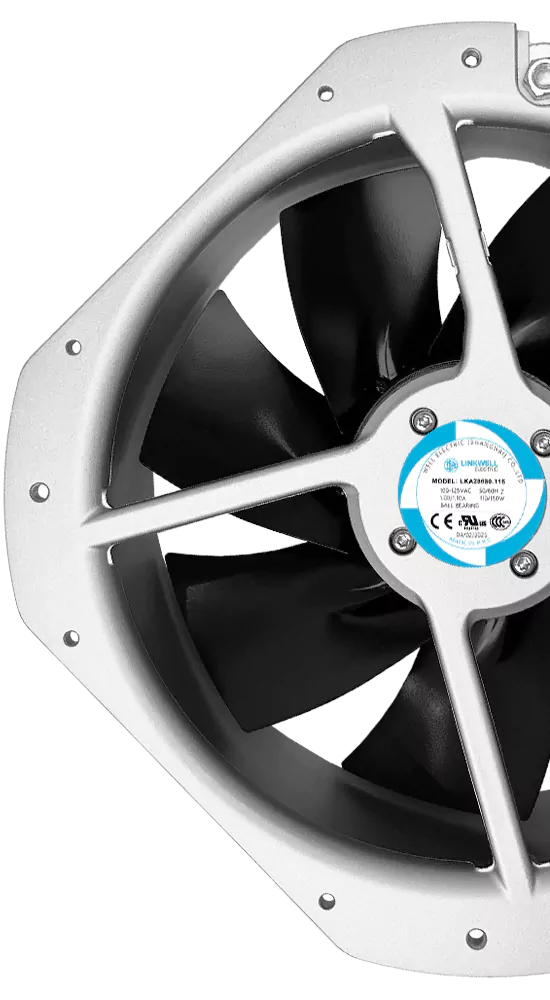
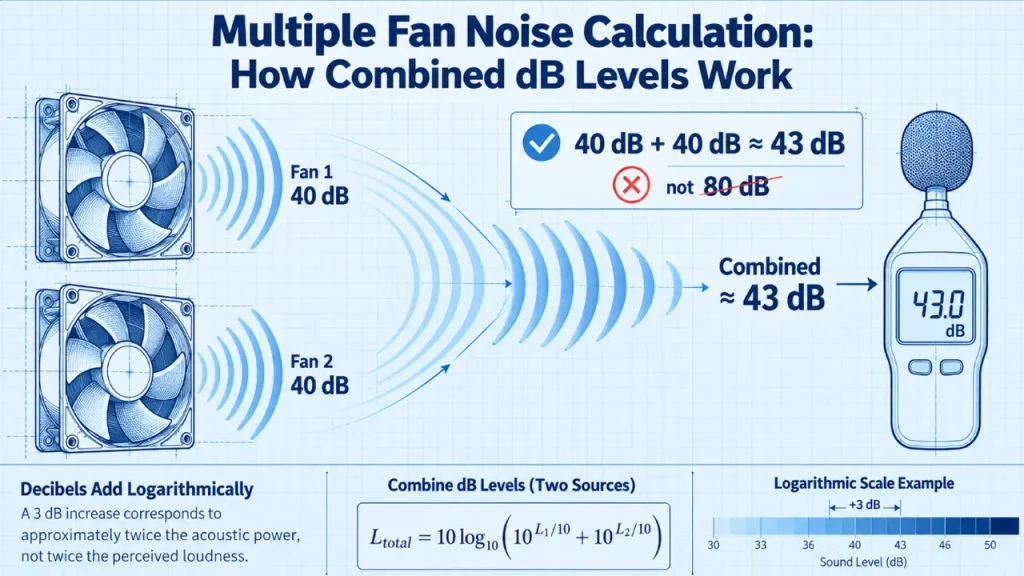
Two fans rated at 40 dB do not produce 80 dB. The decibel scale is logarithmic, so equal independent sources add 3 dB: the simple estimate is 43 dB. That answer is useful, but only when both ratings describe the same acoustic quantity under comparable conditions.
In an enclosure, installation effects, tones, vibration and operating-point changes can make the measured result different from the arithmetic prediction. Use the calculation to plan, then confirm the complete equipment.
Why Fan Noise Levels Cannot Be Added Directly
Decibels represent a ratio on a logarithmic scale. A 3 dB increase corresponds to approximately twice the acoustic power, not twice the perceived loudness. That is why two 40 dB sources combine to about 43 dB rather than 80 dB.
The same logarithmic rule can combine sound power levels or independent sound pressure levels measured at the same receiver under the same conditions. Do not mix a sound power rating from one fan with a sound pressure rating from another.
The OSHA technical manual on noise explains that decibel levels cannot be added arithmetically and gives the logarithmic summation method.
Formula for Identical Fans
For identical independent fans with the same sound level:
Ltotal = Lsingle + 10 x log10(n)
Lsingle is the sound level of one fan, n is the number of fans, and Ltotal is the calculated combined level. All values must use the same weighting, bandwidth and reference condition.
| Number of equal fans | Add to one-fan level | Example if one fan is 40 dB |
|---|---|---|
| 1 | 0 dB | 40.0 dB |
| 2 | 3.0 dB | 43.0 dB |
| 3 | 4.8 dB | 44.8 dB |
| 4 | 6.0 dB | 46.0 dB |
| 8 | 9.0 dB | 49.0 dB |
| 10 | 10.0 dB | 50.0 dB |
These are energy sums. They do not mean that the equipment will sound exactly twice as loud when the calculated level rises by a specific amount, because perceived loudness depends on frequency, duration and the listener.
Formula for Fans with Different Noise Levels
When individual levels differ, convert each level to a linear energy term, add the terms and convert the result back to decibels:
Ltotal = 10 x log10(10^(L1/10) + 10^(L2/10) + …)
For example, combining 40 dB and 35 dB gives about 41.2 dB. The quieter source still contributes, but the louder source dominates the total.
| Difference between two sources | Add to the higher level |
|---|---|
| 0 dB | 3.0 dB |
| 1 dB | About 2.5 dB |
| 3 dB | About 1.8 dB |
| 5 dB | About 1.2 dB |
| 10 dB | About 0.4 dB |
If one fan is more than about 10 dB louder than the others at the receiver, reducing the quiet fans further will have little effect until the dominant source is addressed.
Tip: Rank fans and other noise sources by measured level at the same operating condition. Work on the dominant source first instead of treating every fan as equally important.
Sound Power vs Sound Pressure
Sound power is a property of the source and does not depend on measurement distance. Sound pressure is what a microphone measures at a location; it changes with distance, reflections, barriers and room absorption. Product pages sometimes report only “dBA” without clearly identifying which quantity was measured.
For equipment prediction, sound power data are usually more transferable. If only sound pressure is available, compare ratings made at the same distance, direction and test environment. A one-meter free-field reading and a reading taken close to a grille cannot be combined as if they were equivalent.
When the Simple Multiple-Fan Calculation Is Valid
The equation is a reasonable estimate when the sources are independent, the ratings use the same acoustic quantity and frequency weighting, and all fans operate at the stated voltage, speed and airflow condition. The receiver geometry also needs to be comparable.
For octave-band design, add each frequency band separately. A single overall dBA total can hide a tonal problem. Two fan systems with the same overall number may sound very different if one contains a strong blade-pass tone.
Why the Installed Result Can Be Higher or Lower
A panel can amplify vibration like a loudspeaker. Guards, filters and close obstructions can create turbulence or tones. Multiple fans mounted in a common plenum may not operate at the same point as one free-air fan, so their speed and aerodynamic noise change.
Small RPM differences can create beating: a slow rise and fall in sound as nearby tonal frequencies interfere. Conversely, barriers and enclosure absorption may reduce the level at a particular receiver. These effects are why a calculated energy sum is a baseline, not a compliance test.
Are More Fans at Lower Speed Quieter?
Sometimes, but not automatically. Lowering speed can reduce aerodynamic noise substantially, while adding sources increases the total logarithmically. The outcome depends on how much each fan can slow down while still meeting airflow and pressure requirements.
Four slower fans may be quieter than two fast fans in a low-resistance system, but they require more openings, can add tonal interactions, and may create extra guard or filter losses. Use actual fan curves and acoustic data at the proposed speed. Do not scale one rated dBA number without checking the model’s control range.
The guide to axial fan noise reduction covers installation measures such as clearance, vibration control and avoiding unnecessary restriction.
A Practical Noise Prediction and Test Plan
- Confirm whether each rating is sound power or sound pressure.
- Use the same A-weighting or the same octave bands for every source.
- Calculate the logarithmic sum at the intended operating speed.
- Add other equipment sources such as pumps, transformers and airflow through grilles.
- Build the production-intent panel with guards, filters and gaskets.
- Measure at defined receiver positions and background-noise conditions.
- Check for tones, beating and structure-borne vibration, not only overall dBA.
When discussing a LINKWELL fan array, provide the number of fans, operating point, speed-control plan, enclosure geometry and acoustic target. Model-level data are needed; frame size alone cannot predict the result.
Frequently Asked Questions
How loud are two 40 dB fans?
About 43 dB if they are equal, independent sources measured under the same conditions.
How much noise do four identical fans add?
Four equal sources add about 6 dB to the one-fan level.
Can I add fan dBA ratings from different datasheets?
Only if the ratings use compatible quantities and test conditions. Check sound power versus sound pressure, distance, weighting, voltage, speed and operating point.
Why is my four-fan enclosure louder than the calculation?
Panel resonance, restrictive grilles, turbulence, tonal interaction, a changed operating point or inconsistent test conditions can raise the installed result.
Does a 3 dB increase sound twice as loud?
No. It represents about twice the acoustic power. Perceived loudness is a separate psychoacoustic response.