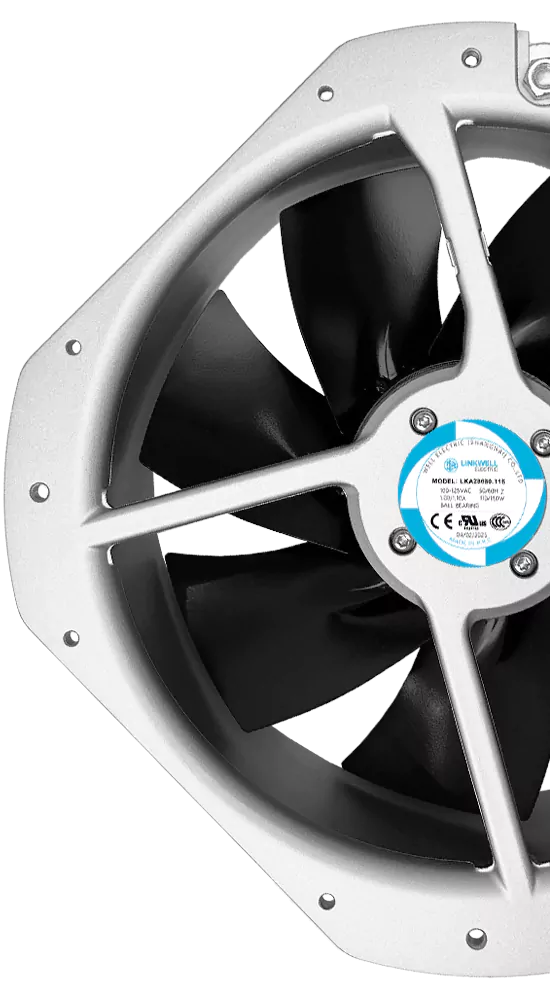
Industrial cooling systems are not just about airflow—they are fundamentally about motor performance, efficiency, and long-term reliability. Whether you are designing an electrical control cabinet, optimizing a 3D printer cooling system, or managing ventilation for outdoor signal enclosures, the choice between an AC vs DC fan motor directly impacts system stability and operating cost.
In many real-world cases, overheating, excessive energy consumption, or premature equipment failure can be traced back to one root cause: improper fan motor selection. This is why understanding the differences between AC and DC fan motors is critical—not just at a product level, but at a system level.
This guide breaks down how each motor works, compares their technical characteristics, and helps you choose the right solution based on industrial applications.
What Is an AC Fan Motor in Industrial Applications
AC fan motors are widely used in industrial environments due to their simple structure and proven reliability. These motors operate directly on alternating current (AC) power, typically without requiring complex internal electronics.
Most industrial AC fans use induction motors, which are known for their durability and ability to handle continuous operation under demanding conditions. Because of their straightforward design, AC motors are less sensitive to environmental factors such as dust, humidity, and voltage fluctuations.
In practical applications, AC fan motors are often found in:
- Electrical control cabinets
- Industrial ventilation panels
- Large airflow systems requiring continuous operation
From a procurement perspective, AC motors are attractive because they offer lower upfront cost and easy integration into existing power systems. However, their simplicity also comes with limitations—particularly in efficiency and speed control.
What Is a DC Fan Motor in Modern Cooling Systems
DC fan motors, especially brushless DC (BLDC) motors, represent a more advanced approach to industrial cooling. Unlike AC motors, DC fan motors require internal electronics to convert incoming AC power into direct current and manage motor operation.
This additional control layer allows DC motors to deliver precise speed regulation, higher efficiency, and quieter performance.
In industrial scenarios, DC fan motors are commonly used in:
- 3D printing equipment
- Telecom and network cabinets
- Precision electronic systems
- Compact or sealed enclosures
One of the biggest advantages of DC motors is their ability to adjust speed dynamically based on cooling demand. Instead of running at full speed continuously, they can operate only as needed, reducing both energy consumption and system noise.
For engineers and system designers, this level of control opens the door to smarter thermal management strategies.
AC vs DC Fan Motor: Core Technical Differences
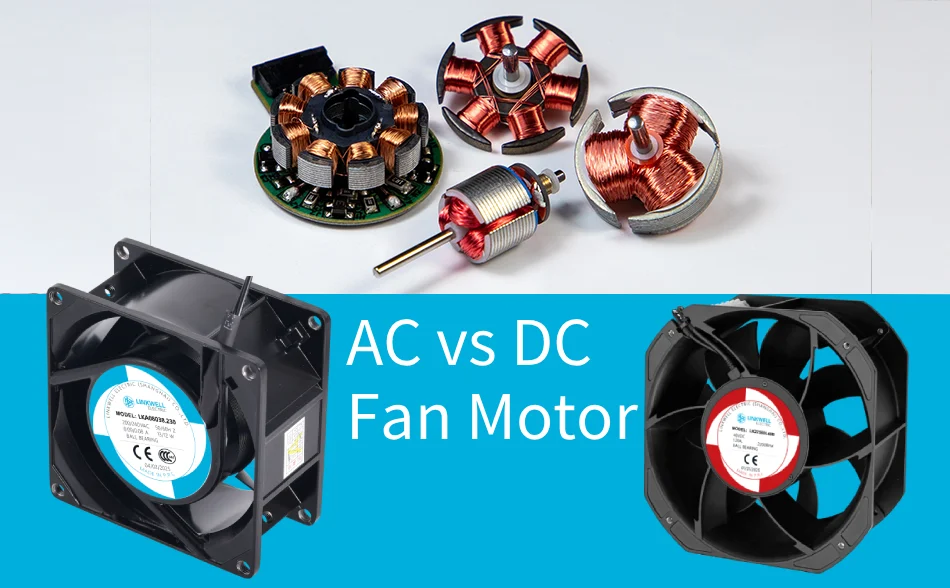
Understanding the fundamental differences between AC and DC fan motors helps you make better decisions during system design or procurement.
| Parameter | AC Fan Motor | DC Fan Motor |
|---|---|---|
| Power Input | Direct AC | AC converted to DC internally |
| Efficiency | Moderate | High, especially at variable speeds |
| Speed Control | Limited | Precise (PWM or voltage control) |
| Energy Consumption | Higher | Lower |
| Noise Level | Moderate to high | Low |
| Lifespan | Long, simple structure | Long, reduced mechanical wear |
| Initial Cost | Lower | Higher |
| Control Integration | Basic | Advanced (smart systems compatible) |
From this comparison, it becomes clear that AC motors prioritize simplicity and cost, while DC motors focus on efficiency and controllability.
Energy Efficiency and Heat Generation
In industrial cooling systems, energy efficiency is not just about saving electricity—it also directly affects heat generation inside the system.
AC fan motors typically run at a fixed speed, regardless of actual cooling demand. This means they often consume more power than necessary, especially during partial load conditions. The excess energy is ultimately converted into heat, which can increase the internal temperature of electrical enclosures.
DC fan motors, on the other hand, can modulate their speed based on real-time cooling requirements. By reducing unnecessary energy consumption, they minimize heat generation and help maintain a more stable internal environment.
In enclosed systems such as electrical cabinets or telecom enclosures, this difference becomes critical. An inefficient motor not only wastes energy but also adds to the cooling burden, potentially requiring larger or more expensive cooling solutions.
How Fan Motor Selection Affects Cabinet Temperature
In industrial cooling systems, fan motor selection does not only influence energy consumption—it directly impacts internal temperature stability. In enclosed electrical cabinets, inefficient motors generate additional heat while operating at fixed speeds, which can lead to localized hotspots and uneven airflow distribution.
For example, AC fan motors running continuously at full speed may create unnecessary thermal load, especially during partial demand conditions. In contrast, DC fan motors adjust airflow based on real-time requirements, reducing both energy waste and internal heat buildup. This becomes particularly critical in high-density systems such as control panels or telecom enclosures, where even small temperature increases can significantly reduce component lifespan.
By optimizing motor efficiency and airflow control, engineers can reduce cooling demand, improve reliability, and extend the service life of sensitive electrical components.
Speed Control and System Integration
Speed control is one of the most important distinctions between AC and DC fan motors, especially in modern industrial systems.
AC motors typically operate in a simple on/off mode, with limited speed adjustment unless an external frequency inverter is added. This adds complexity and cost to the system.
DC motors, however, are designed for integrated control. They support:
- PWM (pulse-width modulation) speed control
- Voltage-based speed adjustment
- Integration with temperature sensors and control systems
This makes DC fan motors ideal for automated and intelligent cooling systems, where airflow needs to respond dynamically to changing conditions.
For applications like 3D printers or precision electronics, where temperature stability is critical, DC motors provide a level of control that AC motors cannot easily match.
Reliability in Industrial Environments
Reliability is always a key concern in industrial applications, particularly in harsh environments.
AC fan motors have an advantage in terms of structural simplicity. With fewer electronic components, they are generally more resistant to:
- Dust and debris
- Voltage fluctuations
- High-temperature environments
This makes them a solid choice for outdoor cabinets, heavy industrial settings, and basic ventilation systems.
DC fan motors, while more advanced, rely on internal electronics that can be sensitive to extreme conditions. However, they compensate for this with:
- Reduced mechanical wear (no brushes in BLDC motors)
- Lower operating temperatures
- More controlled operation
In controlled environments, DC motors often achieve longer effective service life due to their optimized performance.
Real Application Scenarios
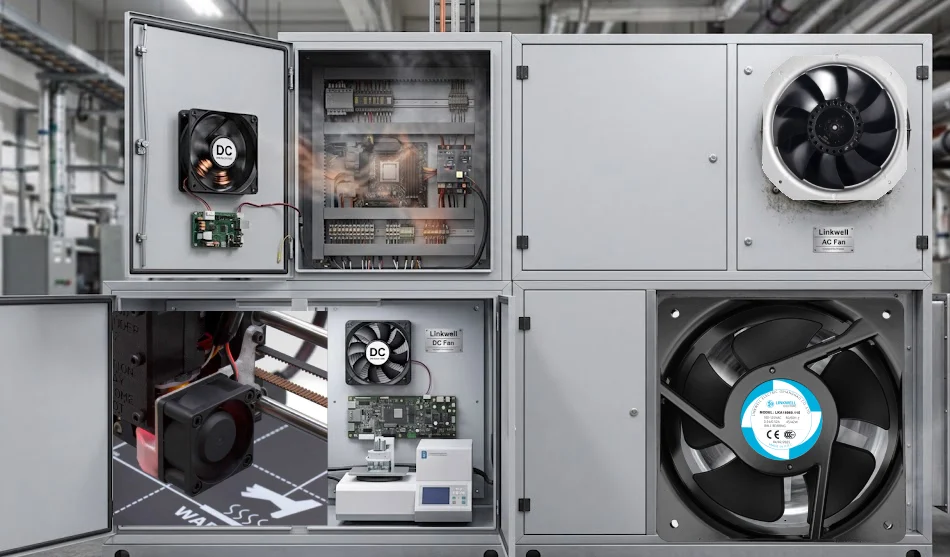
Choosing between AC and DC fan motors becomes much clearer when you look at real-world applications.
Electrical Control Cabinets
These systems often operate continuously in enclosed spaces with moderate heat loads.
- DC motor: Ideal for energy efficiency and precise cooling
- AC motor: Suitable for cost-sensitive projects
Outdoor Telecom and Signal Cabinets
These environments face high ambient temperatures and unstable power conditions.
- AC motor: More robust and tolerant of harsh conditions
- DC motor: Better for smart, temperature-controlled systems
3D Printers and Precision Equipment
These applications require quiet operation and accurate airflow control.
- DC motor: Clearly the better choice due to low noise and adjustable speed
Industrial Ventilation Systems
Large-scale systems prioritize airflow volume and continuous operation.
- AC motor: Cost-effective for high airflow applications
- DC or EC motor: Better for energy optimization projects
Fan Motor Selection Based on Cooling Demand (Practical Example)
In real industrial applications, selecting a fan motor should always be based on actual cooling demand rather than general preference.
Consider a typical electrical cabinet system:
- Total internal heat load: 300W
- Enclosed cabinet with limited natural ventilation
- Ambient temperature: 30–35°C
In this case, using a fixed-speed AC fan motor may provide sufficient airflow, but it will operate continuously at full capacity, consuming more energy and generating additional heat inside the enclosure.
A DC fan motor, however, can adjust its speed dynamically based on temperature conditions. During lower load periods, it reduces power consumption while maintaining stable airflow, helping to keep internal temperatures within a safe range without unnecessary energy use.
For higher heat loads—for example, 800W or more in compact enclosures—motor selection becomes even more critical. AC motors may struggle to provide efficient cooling without increasing airflow significantly, while DC or EC motors can optimize performance through controlled speed and improved efficiency.
Quick Selection Guide
| System Condition | Recommended Motor Type |
|---|---|
| Low heat load (<100W) | AC motor (cost-effective) |
| Medium heat load (100–500W) | DC motor (balanced efficiency) |
| High heat load (>500W) | DC or EC motor (optimized cooling) |
| Smart / automated systems | DC or EC motor |
| Harsh environments | AC motor |
AC vs DC Fan Motor Cost Analysis
Cost is always a factor, but it should be evaluated over the entire lifecycle, not just initial purchase.
AC fan motors:
- Lower upfront cost
- Higher long-term energy consumption
DC fan motors:
- Higher upfront investment
- Lower operating cost due to energy savings
In large-scale deployments, especially in facilities running 24/7, the energy savings from DC motors can quickly offset the initial cost difference. For procurement teams, this makes DC motors a strong candidate for long-term optimization.
How to Choose the Right Fan Motor
Selecting the right motor depends on your specific application requirements.
| Requirement | Recommended Motor |
|---|---|
| Low initial cost | AC motor |
| High energy efficiency | DC motor |
| Smart control system | DC motor |
| Harsh environment | AC motor |
| Low noise operation | DC motor |
| Continuous industrial use | Depends on system design |
Instead of focusing only on price or specifications, it’s important to evaluate how the motor will perform within your complete system.
AC, DC, and EC Fan Motors: What’s the Difference?
In modern industrial applications, you may also encounter EC (Electronically Commutated) motors.
EC motors combine the advantages of both AC and DC technologies:
- Operate on AC power input
- Use DC internal control for efficiency
- Offer high efficiency and smart control
They are often used in high-end industrial cooling systems, where both energy efficiency and performance are critical.
Common Mistakes When Choosing AC or DC Fan Motors
Selecting the wrong fan motor is one of the most common causes of inefficient cooling and system instability. Many decisions are made based on initial cost alone, without considering long-term performance.
One common mistake is choosing AC fan motors for enclosed systems that require precise thermal control. While AC motors are cost-effective, their fixed-speed operation can lead to unnecessary energy consumption and inconsistent cooling performance.
Another frequent issue is overlooking environmental conditions. DC fan motors offer advanced control, but in extremely harsh environments with dust or unstable power supply, a simpler AC motor may provide better reliability.
Engineers also often underestimate the importance of airflow management. Even with a high-performance motor, poor placement or blocked airflow paths can result in hotspots and reduced cooling efficiency.
Avoiding these mistakes ensures that the selected fan motor not only meets immediate requirements but also supports long-term system stability.
FAQ
What is the main difference between AC and DC fan motors?
AC fan motors run on alternating current and are simple, durable, and cost-effective. DC fan motors use direct current, offering higher efficiency, adjustable speed, and precise airflow control—ideal for energy-conscious or automated industrial applications.
Which fan motor is better for electrical cabinets?
For standard cabinets in harsh conditions, AC motors are robust and reliable. For cabinets requiring precise temperature control or dynamic cooling, DC motors provide adjustable airflow, reduced energy use, and better internal temperature management.
Can AC fan motors be speed-controlled?
AC motors can be controlled with external frequency inverters, but they lack built-in precision control. DC fan motors naturally allow speed modulation via voltage adjustment or PWM, offering smoother airflow and better energy efficiency.
Are DC fan motors suitable for outdoor enclosures?
Yes, but only if the enclosure protects the motor’s electronics. In extreme conditions with dust or unstable voltage, AC fan motors are often more reliable, though DC motors excel in controlled, automated systems.
How do EC motors differ from AC and DC motors?
EC (Electronically Commutated) motors combine AC input with DC control, offering high efficiency, adjustable speed, and smart integration. They are ideal for modern industrial cooling where both energy savings and precise airflow are required.
Which motor type saves more energy in 24/7 industrial use?
DC and EC motors typically consume less power than AC motors because they adjust speed based on cooling demand, minimizing unnecessary energy use while maintaining optimal temperatures in enclosed or sensitive systems.
Can using the wrong fan motor cause equipment failure?
Yes. AC motors running continuously may overheat sensitive components in enclosed systems, while DC motors improperly installed in harsh environments may fail if electronics are exposed. Proper selection ensures cooling efficiency and equipment longevity.
Conclusion
Choosing between AC and DC fan motors is not just a technical comparison—it is a system-level decision that affects efficiency, thermal performance, and long-term operating cost.
AC fan motors remain a reliable solution for harsh environments and cost-sensitive projects, offering durability and simplicity. DC fan motors, on the other hand, provide higher efficiency, precise control, and better performance in applications where temperature stability and energy optimization are critical.
For modern industrial systems such as electrical cabinets, telecom enclosures, and precision equipment, selecting the right motor technology can significantly reduce heat buildup, improve airflow control, and extend component lifespan.
When evaluating your cooling solution, focus not only on airflow, but on how the motor performs within your complete system. The right choice will deliver both immediate reliability and long-term efficiency.