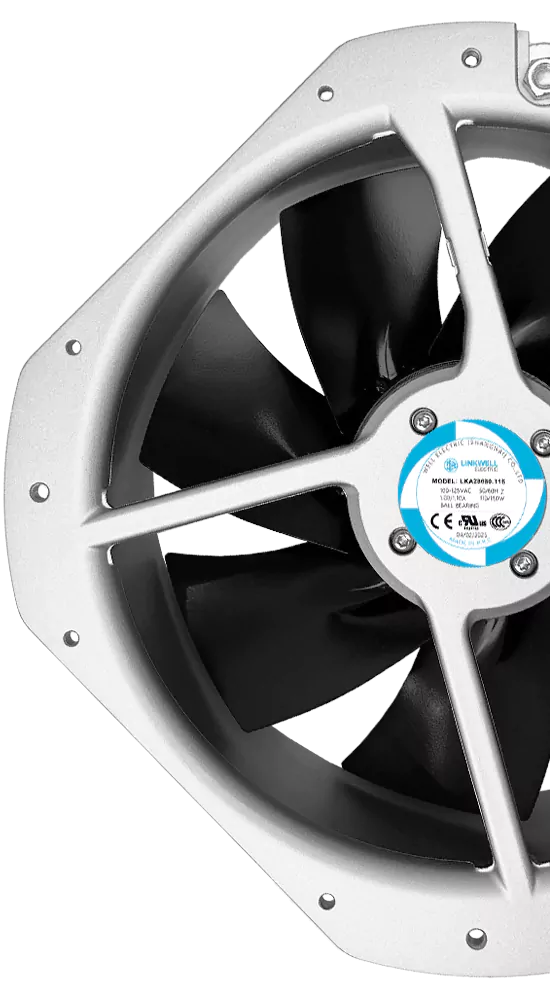
Choosing between an axial fan and a centrifugal fan is not only about airflow volume. In real industrial cooling projects, system resistance, installation space, and airflow direction often determine which fan type performs better. In this guide, LINKWELL compares axial and centrifugal fans from a practical application perspective and helps buyers understand which option is more suitable for cabinet cooling, inverter systems, and industrial equipment.
In industrial cooling, buyers often compare fan types by airflow first. That seems reasonable until the fan is installed and the actual result no longer matches the datasheet expectation. This is where many projects go wrong. The issue is not always the fan quality. More often, the wrong fan type was chosen for the resistance level of the real system.
At LINKWELL, we see this regularly in electrical cabinets, telecom enclosures, inverter cooling systems, and industrial equipment. A buyer selects an axial fan because the free-air airflow looks strong, but once the fan has to work through filters, guards, louvers, or a restricted internal layout, the useful airflow drops much faster than expected. In these cases, the problem is not simply airflow volume. The problem is fan type and static pressure capability.
That is why the comparison between axial fans and centrifugal fans matters. They are not just two shapes of fan. They behave differently under system resistance, they fit differently into equipment, and they solve different cooling problems. This article explains the real difference and how to choose the right type for industrial cooling applications.
What Is an Axial Fan?
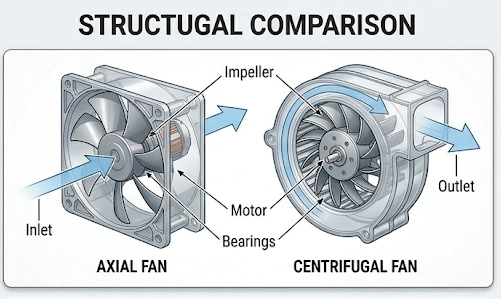
An axial fan moves air in a direction parallel to the shaft. It is widely used because the structure is relatively simple, compact, and cost-effective. In many cooling systems, that simplicity is an advantage.
Axial fans are often a good fit when the airflow path is open and the system does not create much resistance. If the air can move directly in and out with minimal obstruction, an axial fan can provide effective cooling with a straightforward installation approach. This is why they are commonly used in general ventilation, simple cabinet cooling, and equipment with lower airflow resistance.
From a physical design point of view, axial fans are also often thinner than centrifugal fans. That makes them easier to mount directly on panels or flat ventilation openings where installation depth is limited.
What Is a Centrifugal Fan?
A centrifugal fan moves air outward through the rotating impeller and redirects it through the fan housing. This structure gives it a different airflow behavior from an axial fan and usually a stronger ability to work against system resistance.
In industrial cooling, this matters whenever the fan must push or pull air through a more restrictive path. Filters, louvers, dense component layouts, and narrow internal channels all increase static pressure demand. Under these conditions, a centrifugal fan often provides a more dependable result because it can maintain useful airflow more effectively as resistance rises.
Centrifugal fans are also structurally different from axial fans in terms of airflow direction. Many centrifugal designs can support a 90 degree change in airflow direction, which can be extremely useful in compact cabinets or equipment layouts where straight-through airflow is not practical.
The Real Difference Is in Static Pressure Capability
The most important difference between an axial fan and a centrifugal fan is not simply the airflow direction. It is how each fan behaves when static pressure rises inside the system.
An axial fan is often very effective in low-resistance conditions. But when static pressure increases, its performance can drop more sharply than many buyers expect. A centrifugal fan is usually more stable under these conditions because it is better suited to pressure-related airflow tasks.
This is why axial fans are often preferred for open or low-impedance ventilation, while centrifugal fans are often selected for enclosed or higher-resistance cooling systems. If the system includes filters, guards, ducts, vent covers, or dense internal thermal structure, static pressure capability becomes one of the most important selection factors.
In practical terms, the stronger fan is not the one with the biggest free-air number. It is the one that can still deliver useful airflow once the real system starts resisting that airflow.
Why the P-Q Curve Matters
This is where the comparison becomes more engineering-driven.
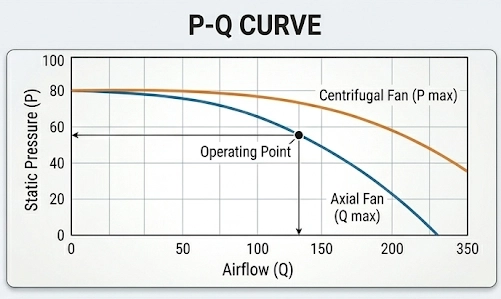
A fan does not operate in isolation. It operates at the intersection between its own pressure-flow curve and the resistance curve of the system. This is usually described through the P-Q curve, where pressure and airflow are viewed together instead of as separate values.
In low-resistance conditions, an axial fan may appear very attractive because its free-air airflow can be high. But as system static pressure increases, the axial fan curve usually loses useful airflow more quickly. In many applications, the curve behaves more like a flatter response under rising resistance, meaning a relatively small increase in resistance can lead to a large drop in actual airflow.
A centrifugal fan usually behaves differently. Its curve is often better suited to maintaining airflow under higher static pressure. This is why centrifugal fans are commonly chosen in applications where the airflow path is restrictive from the beginning.
This distinction matters more than many buyers realize. On paper, an axial fan may look stronger by airflow alone. On the actual P-Q operating point of the system, the centrifugal fan may deliver more useful cooling.
Why Free-Air Airflow Misleads So Many Buyers
One of the most common mistakes in fan selection is relying too heavily on free-air airflow data.
Free-air data is not useless, but it becomes misleading when it is treated as the final answer. A fan installed in an electrical cabinet, inverter housing, or telecom enclosure is not working in free air. It is working inside a structure that creates resistance and shifts the operating point.
This is why buyers sometimes feel disappointed after installation even when the datasheet looked good. They were comparing nominal airflow instead of comparing how the fan would behave under the real static pressure of the system. In many of these situations, the axial fan did exactly what its curve predicted. The buyer simply matched it to the wrong kind of application.
That is why fan selection should always move beyond headline airflow. The real question is how much useful airflow remains once the system starts resisting it.
When an Axial Fan Is the Better Choice
Axial fans remain the right choice in many industrial applications. They should not be treated as the weaker option. They are simply better suited to systems where airflow resistance is relatively low and installation simplicity matters.
An axial fan is often the better choice when the airflow path is open, the static pressure requirement is low, and the fan can be mounted directly on a panel or ventilation opening without requiring deep installation space. In these conditions, the thinner structure of the axial fan is often a practical advantage.
This makes axial fans a good fit for simpler cabinet ventilation, general equipment cooling, and systems where air can move straight through the enclosure without fighting heavy resistance. In cost-sensitive applications, they also remain attractive because they often provide a simpler and more economical solution.
When a Centrifugal Fan Is the Better Choice
A centrifugal fan becomes the better choice when the cooling path is more restrictive and the system needs stronger static pressure capability.
This often happens in electrical cabinets with filters, telecom enclosures, inverter cooling systems, power supply equipment, control units, and enclosed industrial machines. In these applications, the fan is not just moving air through open space. It is pushing or pulling air through resistance.
This is also where the physical structure of the centrifugal fan can create practical value. Although many centrifugal fans are bulkier than axial fans, they can support more controlled airflow paths and 90 degree discharge layouts. In compact equipment, that can be a major advantage. A slightly larger fan that fits the airflow path correctly often performs better than a thinner fan that loses most of its usefulness once resistance rises.
In these situations, a centrifugal fan is often not just an alternative. It is the more realistic engineering solution.
Axial vs Centrifugal Fan for Electrical Cabinet Cooling
Electrical cabinet cooling is one of the clearest examples of why this comparison matters in real projects.
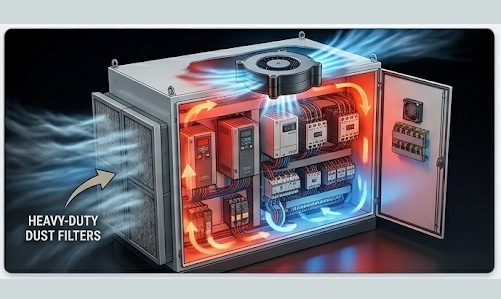
On the surface, cabinet cooling looks simple. In practice, cabinets often include high-density filters, louvers, internal wiring, power supplies, relays, and tightly arranged components. All of this creates resistance. Once those resistance sources are present, free-air airflow alone becomes much less meaningful.
If the cabinet has a relatively open structure and low resistance, an axial fan may still perform well. But if the system includes dense filters or a more restrictive internal airflow path, centrifugal fans often hold their useful performance better because their static pressure capability is more suitable for that environment.
This is why many cabinet cooling failures are not caused by choosing a fan that is too small. They are caused by choosing a fan that is wrong for the system impedance.
Axial vs Centrifugal Fan for Inverter and Equipment Cooling
The same logic appears in inverter cooling and industrial equipment ventilation.
Inverter and power electronics systems often generate concentrated heat inside compact housings. The air may need to move through narrow channels or around dense thermal components before it can exit the system. Under these conditions, airflow direction and pressure behavior matter much more than simple free-air volume.
If the equipment structure is open and the path is uncomplicated, an axial fan may still be the best answer. But if the cooling path is tight and static pressure demand is real, a centrifugal fan often becomes the more dependable choice.
This is one reason industrial fan selection should never be based only on habit. The fan type should be chosen according to how the equipment actually handles air.
Common Selection Mistakes
One common mistake is assuming that axial fans are enough for every cabinet or equipment cooling job because they are familiar and easy to source. Another is assuming that centrifugal fans are always superior because they sound more industrial. Both assumptions can lead to the wrong choice.
The more serious mistakes usually involve ignoring static pressure, comparing only airflow values, overlooking installation depth, or forgetting that airflow direction also affects system fit. In compact projects, the ability of a centrifugal fan to redirect airflow may be just as important as its pressure performance. In other applications, the shallow profile of an axial fan may be the deciding factor.
Good selection usually comes from understanding the system first and the fan second.
How to Choose the Right Fan for Your Application
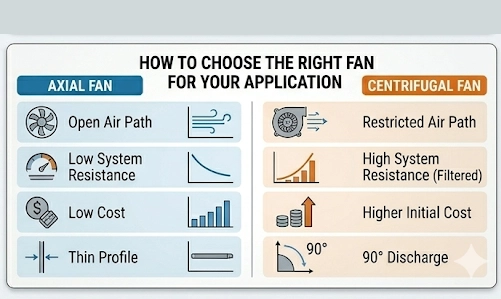
The best way to choose between an axial fan and a centrifugal fan is to begin with the airflow path. If the path is open and the system resistance is low, an axial fan may be the cleaner and more economical option. If the path is restrictive and the fan must work against static pressure, a centrifugal fan usually deserves stronger consideration.
After that, review installation space, discharge direction, operating temperature, duty cycle, voltage, and whether the system will benefit from a more controlled airflow path. In many projects, the right answer becomes obvious once these factors are considered honestly.
At LINKWELL, we always recommend looking at the real system instead of trying to choose the fan type from a product label alone. Once the application details are clear, the selection becomes much easier and much more reliable.
How LINKWELL Helps Buyers Choose the Right Fan
We support OEM buyers and equipment manufacturers by reviewing the real cooling conditions of the project, not just the fan category. That means checking the voltage, installation size, airflow target, resistance level, and how air actually moves through the equipment.
In some projects, the best answer is an axial fan because the system is open and simple. In others, a centrifugal fan is the better fit because the system needs stronger static pressure capability and more controlled airflow direction. Our role is to help identify that difference early, before the buyer loses time and money on the wrong selection.
Conclusion
Axial fans and centrifugal fans solve different cooling problems. The better choice depends less on which fan looks stronger in free air and more on how the system behaves under real operating resistance.
Axial fans are often better for open low-resistance airflow paths where compact depth and lower cost matter. Centrifugal fans are often better for enclosed or restrictive systems where static pressure capability and controlled discharge direction are more important.
For industrial cooling, the wrong fan type can waste both energy and project time. The right fan type usually becomes clear once the system static pressure, installation space, and airflow path are understood correctly.
If you are comparing axial and centrifugal fans for a real industrial application, we can help review your project and recommend a more suitable solution.
FAQ
1. What is the main difference between an axial fan and a centrifugal fan
An axial fan moves air in a straight direction and is usually better for open airflow paths. A centrifugal fan is better suited to systems with higher static pressure and restricted airflow paths.
2. When should I choose a centrifugal fan instead of an axial fan
You should usually choose a centrifugal fan when the system includes filters louvers ducts or dense internal layouts that increase static pressure and reduce useful airflow.
3. Which fan is better for electrical cabinet cooling
That depends on the cabinet structure. If the airflow path is open an axial fan may work well. If the cabinet has filters or higher resistance a centrifugal fan is often the better choice.
4. Are centrifugal fans more efficient than axial fans
Not always. Efficiency depends on the application operating point and system resistance. In restrictive airflow systems centrifugal fans often deliver better practical performance.
5. Can LINKWELL help recommend the right fan type
Yes. LINKWELL helps buyers compare axial and centrifugal fan options based on airflow static pressure installation size voltage and real application conditions.