In industrial cooling, fan selection often starts with the wrong question. Buyers compare airflow, size, and voltage, then assume the model with the stronger-looking specification will deliver the better result. In real projects, that is rarely how it works.
A centrifugal fan can look excellent on paper and still waste energy once it enters a system with filters, louvers, restricted duct paths, crowded cabinet layouts, or poorly estimated pressure loss. This is where efficiency stops being a catalogue word and becomes a real engineering issue. In high-impedance cooling systems, the gap between what the fan should do and what it actually does is often where most energy is lost.
At LINKWELL, we see this problem often in cabinet cooling, inverter ventilation, telecom enclosures, and other industrial applications. The issue is not always that the fan is too small or too weak. More often, the fan is simply operating at the wrong point on its curve, under higher resistance than expected, or inside a system that was never matched properly in the first place.
This article explains what centrifugal fan efficiency really means in industrial cooling, what affects it most, where real-world losses come from, and how to choose a more efficient fan for demanding industrial applications.
Centrifugal Fan Efficiency Is Not Just a Datasheet Number
In technical terms, fan efficiency is the relationship between useful air power and input power. A simplified way to express it is:
Efficiency = Useful Air Power / Input Power
That definition is correct, but for industrial buyers it is still too abstract on its own. The more practical point is this: efficiency tells you how much of the electrical power going into the fan is actually becoming useful airflow and pressure, instead of being lost through motor inefficiency, aerodynamic loss, turbulence, heat, or bad system matching.
This is why two fans with similar airflow ratings can perform very differently in real projects. One may operate close to its efficient range under actual resistance. The other may look impressive in free air, then waste energy once it faces restrictive filters, pressure drop, and installation losses.
So when we talk about centrifugal fan efficiency, we are not talking only about a laboratory condition. We are talking about how well the fan converts power into useful cooling performance at the real operating point of the system.
Why Efficiency Matters More in Industrial Cooling Than Many Buyers Expect
In small intermittent applications, efficiency may not be the first concern. In industrial cooling, that is different. Fans often run for long hours, sometimes continuously, and sometimes inside systems that already carry significant electrical and thermal load. Under those conditions, poor efficiency does not stay small for long.
A less efficient fan does more than raise power consumption. It can increase wasted heat inside the motor, create unnecessary operating cost, and force the system to work harder than needed. In some cases, it also contributes to louder operation and less stable thermal control because the airflow is no longer matching the equipment requirement in a clean and predictable way.
This matters in electrical cabinets, inverter systems, telecom cooling, HVAC control systems, and other equipment where airflow is not optional. If the fan runs every day and the cooling demand is part of normal operation, efficiency becomes a commercial issue as much as a technical one.
Where Efficiency Is Really Won or Lost
Many articles reduce centrifugal fan efficiency to motor quality alone. That is incomplete. A better motor helps, but it is only one part of the picture.
In industrial cooling, efficiency is usually won or lost in four places: blade design, operating point, system resistance, and installation conditions.
Blade design matters because not all centrifugal fans behave the same under load. Motor type matters because electrical losses and speed behavior influence how much power is turned into useful airflow. But the bigger mistakes usually happen at the system level. If resistance is underestimated, if the fan is selected too far away from its efficient zone, or if the airflow path is poorly designed, the project can lose a large part of its theoretical efficiency before the equipment even enters full operation.
This is one reason experienced buyers stop trusting simple airflow claims very quickly. A fan does not cool a system in free air. It cools a system under resistance.
Static Pressure and Total Pressure Are Not Small Details
For centrifugal fan applications, pressure is where many efficiency discussions become more serious.
In a real industrial system, airflow usually meets resistance from filters, guards, louvers, bends, narrow channels, heat sinks, or crowded internal structures. The fan must generate pressure to overcome those losses. This is why static pressure and total pressure matter so much when discussing efficiency.
In many high-resistance applications, a large share of wasted energy appears in the gap between what the system demands and where the fan is actually operating. If the fan is selected without enough attention to pressure conditions, it may still move air, but it may do so inefficiently. The result is higher energy use for less useful cooling.
This is also where the fan curve becomes important. A centrifugal fan should not be judged only by its nominal airflow. It should be judged by how it performs at the intersection between the fan curve and the system resistance curve. That operating point tells the real story. If the fan is forced too far from its efficient zone, energy is spent but not well converted into useful thermal performance.
Backward Curved vs Forward Curved: Why the Difference Matters
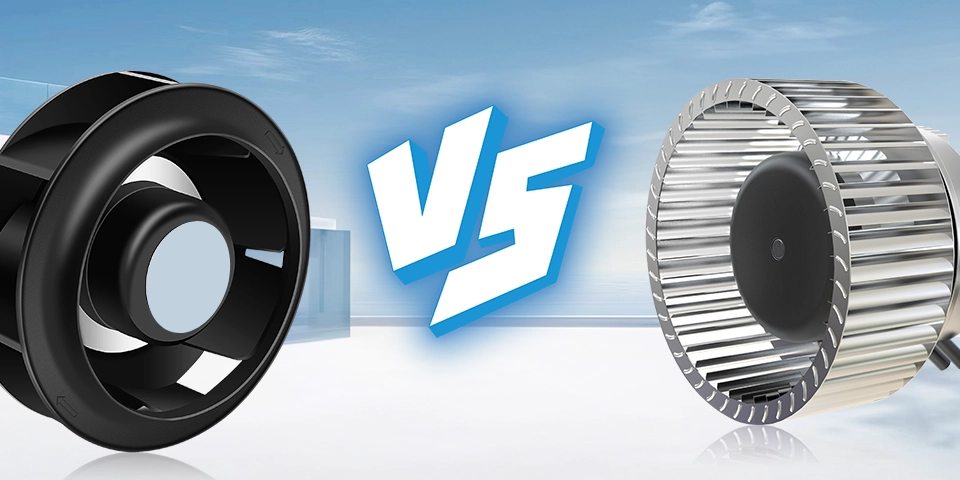
When buyers want better centrifugal fan efficiency, blade design deserves more attention than it usually gets.
Backward curved centrifugal fans are often preferred in efficiency-focused industrial applications because they generally offer better aerodynamic performance and stronger efficiency under many operating conditions. They are especially relevant where pressure performance and long-term operating economics both matter.
Forward curved fans still have valid uses. In compact systems or cost-sensitive applications, they can remain a practical option. But if the project puts serious weight on energy efficiency, pressure behavior, and long-duration operation, backward curved designs often deserve closer evaluation.
This is not a small design difference. In systems with filters, higher resistance, or long running hours, the choice between forward curved and backward curved can directly affect operating cost and usable performance over time.
Why Real-World Efficiency Drops After Installation
This is where factory-side experience often matters more than generic theory.
A fan may be selected well on paper and still lose efficiency after installation. Filters load up with dust. Cabinet airflow paths are tighter than expected. Duct turns are sharper than the original estimate. Internal obstructions create turbulence. Mounting conditions disturb discharge flow. All of these things move the fan away from the working point where it was supposed to perform best.
This is why real-world efficiency is often lower than expected. The fan itself may not be defective at all. The system around it simply changes the conditions.
A common example is electrical cabinet cooling with high-density filters. On the drawing, the pressure loss may look manageable. In operation, once the filters begin collecting dust, resistance rises quickly. At that point, the pressure recovery behavior of the fan becomes much more important than a free-air airflow number. In those situations, a backward curved centrifugal fan often holds its practical value better than a buyer initially expects.
A Better Fan Does Not Always Mean a More Efficient Cooling System
This is one of the most important points in the whole discussion.
Many traders and low-detail product pages sell fan efficiency like a simple ranking. They imply that the fan with the strongest technical label is automatically the best choice. Real projects do not work that way.
An efficient centrifugal fan can still create a poor result inside a badly matched system. On the other hand, a more modest fan chosen correctly for the actual pressure, operating hours, and airflow path can perform more efficiently in practice.
That is why we usually tell customers not to chase “best efficiency” in the abstract. Instead, they should ask which fan will operate most efficiently under the actual conditions of their project. That is a more useful question and usually leads to a better buying decision.
What We Look for in a High-Efficiency Centrifugal Fan
This is also where not all products are equal, even when the brochure language looks similar.
A high-efficiency centrifugal fan should not only have a good curve on paper. It should also be built with the internal quality to maintain that performance in real industrial conditions. That includes motor stability, bearing quality, blade consistency, insulation quality, thermal endurance, and overall structural reliability.
A cheaper fan may still claim strong efficiency, but if internal tolerances are weak, bearings degrade early, or performance shifts under high ambient temperature, the long-term result is not efficient in any meaningful business sense. It may save a little on purchase price and lose much more through instability, service risk, or shortened operating life.
At LINKWELL, when we evaluate a fan for industrial cooling, we do not only ask whether it can reach a number. We ask whether it can keep delivering stable airflow and pressure under the conditions where the customer will actually run it. A fan that performs well for 60,000 hours is more valuable than a fan that looks efficient only in ideal testing.
Where Centrifugal Fan Efficiency Matters Most
Efficiency matters most in applications where running hours are high, resistance is real, and cooling performance affects the reliability of the equipment.
That is especially true in:
- electrical cabinet cooling
- inverter cooling
- telecom cabinet cooling
- HVAC control systems
- enclosed equipment ventilation
- continuous-duty industrial airflow systems
In these applications, the difference between a well-matched and poorly matched fan is not theoretical. It shows up in energy use, temperature stability, maintenance frequency, and long-term operating cost.
The more restrictive the airflow path and the longer the operating hours, the more important the efficiency discussion becomes.
How to Choose a More Efficient Centrifugal Fan
The best way to choose a more efficient centrifugal fan is to stop evaluating the fan in isolation.
Start by defining the real airflow requirement and the actual pressure condition of the system. If pressure is guessed carelessly, efficiency comparisons will be unreliable from the beginning. Then review the fan curve and identify the likely operating point under real resistance, not just under free-air conditions.
After that, evaluate blade design, motor structure, operating hours, and installation layout. In some applications, a backward curved design will make more sense. In others, the system may be simple enough that a lower-cost approach remains reasonable. The important thing is that the fan type, pressure behavior, and application demands are aligned.
Installation matters too. A poorly arranged cabinet or restricted outlet can erase part of the efficiency advantage before the fan even has a chance to do its job properly.
In other words, a more efficient fan is not chosen by adjective. It is chosen by operating condition.
How LINKWELL Supports Better Fan Selection
At LINKWELL, we help buyers evaluate centrifugal fan selection based on real project conditions, not just product labels.
When customers ask us about efficiency, we usually review airflow target, voltage, installation size, operating hours, expected temperature, and most importantly the resistance characteristics of the application. For projects involving filters, restricted enclosures, or demanding airflow paths, this step is especially important.
We also help OEM buyers compare fan structures, review pressure-related performance, and select models that are more likely to perform efficiently in long-term operation. That support matters because a strong fan choice at the beginning can prevent a much more expensive correction later.
Conclusion
Centrifugal fan efficiency is not just about how advanced a product sounds or how impressive a number looks on a datasheet. In industrial cooling, efficiency is shaped by blade design, motor behavior, pressure conditions, operating point, and how well the fan matches the system around it.
That is why real efficiency is often lost not in the catalogue, but in the gap between selection and application. High system resistance, poor matching, and installation losses can quickly turn a theoretically efficient fan into a wasteful one.
For buyers working on electrical cabinets, inverter systems, telecom enclosures, or other industrial cooling projects, the better question is not simply which fan is more efficient in theory. The better question is which fan will operate efficiently in the real system.
If you are evaluating centrifugal fan efficiency for an industrial project, we can help review your requirements and recommend a more suitable solution.
FAQ
What is centrifugal fan efficiency
Centrifugal fan efficiency refers to how effectively the fan converts input power into useful airflow and pressure performance. In industrial cooling, the real efficiency should be judged at the actual operating point, not only by free-air airflow.
What affects centrifugal fan efficiency the most
The main factors include blade design, motor type, system resistance, operating point, and installation conditions. In many projects, poor system matching reduces efficiency more than the fan design itself.
Are backward curved centrifugal fans more efficient than forward curved fans
In many industrial cooling applications, backward curved centrifugal fans are generally more efficient, especially where pressure performance and long-term operating cost matter. Forward curved fans may still be suitable in more compact or cost-sensitive systems.
Why does centrifugal fan efficiency drop after installation
Efficiency often drops because the real system creates more resistance than expected. Dirty filters, narrow airflow paths, poor cabinet layout, and discharge losses can all move the fan away from its efficient working point.
Is higher airflow always equal to higher efficiency
No. A fan can show higher airflow in free-air conditions and still perform inefficiently in a real system if pressure conditions, resistance, and installation losses are not matched properly.
Why do static pressure and total pressure matter so much
In industrial cooling, airflow usually has to overcome system resistance. Static pressure and total pressure show how the fan performs under those conditions. If pressure is not considered correctly, the fan may consume power without delivering useful cooling efficiently.
How can I choose a more efficient centrifugal fan for industrial cooling
You should evaluate airflow requirement, pressure condition, fan curve, blade design, motor type, operating hours, and installation layout together. The best choice is usually the fan that fits the real application, not the one with the strongest isolated claim.
Can LINKWELL help recommend a more efficient centrifugal fan
Yes. We help buyers review application details such as airflow, pressure, voltage, installation size, and operating environment so we can recommend a more suitable centrifugal fan solution and provide technical data for review.
Need Help Choosing a More Efficient Centrifugal Fan
Send us your application, voltage, installation size, airflow target, filter structure, and operating conditions. We can help recommend a centrifugal fan solution that fits your real cooling requirements more accurately.