A cooling fan can operate in humid air without visible water and still face condensation after a temperature change. The important question is not simply the relative humidity value. It is whether the fan, connector or nearby surface can fall below the dew point and become wet.
An IP rating can help describe protection against defined access, dust and water-ingress tests, but it does not automatically prove that a fan will survive repeated condensation, corrosive deposits or every outdoor installation. Humidity, condensation and water ingress need to be evaluated separately.
High Humidity and Condensation Are Not the Same Condition
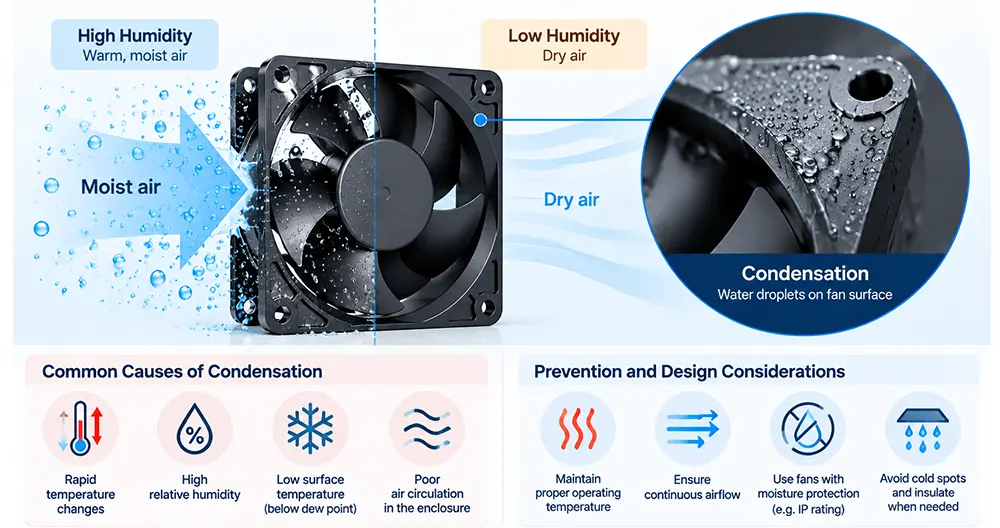
Relative humidity describes how close the air is to saturation at its current temperature. Condensation begins when a surface becomes cold enough for the surrounding air to reach saturation at that surface. That surface temperature is related to the dew point.
This distinction explains why a fan may operate normally in consistently warm, humid air but become wet after a cold night, transport from an air-conditioned room, a refrigeration cycle or equipment shutdown. The moisture appears because temperature changed, not because the relative-humidity number alone crossed a universal fan limit.
| Condition | What happens | Main engineering concern |
|---|---|---|
| High humidity without condensation | Air contains substantial moisture, but fan surfaces remain above the dew point | Material compatibility, corrosion over time and the model’s specified operating range |
| Condensation | Water forms on a surface that is at or below the dew point | Wet electronics, contacts, insulation, deposits and repeated corrosion cycles |
| Direct water ingress | Dripping, splashing, spraying or jets reach the fan | Protection level, orientation, drainage and the completed enclosure |
| Corrosive atmosphere | Moisture combines with salt, chemicals or industrial contaminants | Corrosion resistance of materials, coatings, terminals and bearings |
These conditions can occur together, but they are not interchangeable specifications. A project should define which ones are credible at the installation site.
How Condensation Forms Around a Cooling Fan
Condensation commonly appears when cold equipment is exposed to warmer humid air. An outdoor cabinet may cool overnight and then receive warm morning air. Equipment transported in winter can remain cold after it enters a warm production area. A refrigerated enclosure may draw humid air through an opening when the door is opened or the pressure changes.
Shutdown can also change the risk. While equipment is powered, internal heat may keep the fan and electronics above the dew point. After power is removed, the assembly cools. If humid air enters before the temperatures equalize, water may form on the motor circuit, connector pins, frame or nearby metal surfaces. Restarting while surfaces are wet creates a different electrical condition from running continuously in humid air.
Note: A fan running in warm humid air and the same fan starting after a cold-soak condensation event are not equivalent tests.
What Condensation Can Do to a Cooling Fan
Motor Electronics and PCB
Moisture on an electronic assembly can create leakage paths, alter signal levels and support corrosion. The initial water film may not immediately stop the fan. Repeated wetting and drying can leave deposits, expose damaged coating edges or gradually corrode conductors and component leads.
The risk depends on the circuit design, protection method, contamination and applied voltage. It should not be reduced to a general statement that all humidity damages all fans. The meaningful question is whether the specific fan construction has been evaluated for the intended environment.
Connectors and Lead Wires
Connector contacts can corrode or develop unstable resistance when moisture and contaminants enter the mating interface. Water can also travel along wires or collect where a cable enters the enclosure. A sealed-looking fan body does not protect an unsealed connector mounted in a low point where water accumulates.
Inspect the complete connection: fan lead exit, splice, connector housing, terminals, mating seal, strain relief and cable orientation. Drip loops and drainage can be as important as the connector selection.
Bearings and Lubrication
Condensation near the bearing system can contribute to corrosion or lubricant problems, depending on bearing construction and environmental exposure. It is unsafe to assume that a ball-bearing label alone establishes humidity resistance. Bearing type, seals, lubricant and the fan’s tested conditions all matter.
Mechanical Parts and Fasteners
Metal guards, screws, retaining parts and motor components may corrode even when the plastic frame remains unchanged. Corrosion products can increase friction, change balance or contaminate nearby electronics. In coastal or industrial locations, moisture can combine with salt or chemical deposits and create a more aggressive condition than clean laboratory humidity.
What an IP Rating Actually Tells You
The IP Code classifies degrees of protection provided by an enclosure against access, solid foreign objects and water under defined test arrangements. The official scope is described in IEC 60529.
The first digit relates to access and solid objects; the second relates to water. That information is valuable, but the code does not replace an application review. A rating does not automatically state:
- Resistance to repeated internal condensation
- Performance after salt, oil or chemical contamination
- Corrosion life of every exposed material
- Protection of the mating connector and field wiring
- Protection of the complete cabinet after the fan is installed
- Acceptable operation at every temperature and humidity combination
Read the rating together with the model drawing, mounting orientation, operating-temperature range, connector specification and any environmental test evidence. The existing IP-Rated Fans guide explains the code from a cooling-fan selection perspective.
Why an IP Rating Does Not Automatically Cover Condensation
Water-ingress testing introduces water in a defined way. Condensation is generated by temperature and humidity interaction, often inside an assembly or on hidden cold surfaces. The location, droplet size, duration and electrical state can therefore be different from an external spray or jet test.
IEC addresses cyclic damp heat separately. IEC 60068-2-30, for example, describes a damp-heat cyclic test involving high humidity and temperature changes that can produce condensation on the specimen. This separation is useful for equipment engineers: water ingress and cyclic condensation answer different questions.
Do not interpret that standard as a universal test requirement for every fan. The equipment manufacturer must define the applicable environmental class, severity, operating state, recovery procedure and acceptance criteria. A component-level result also does not automatically certify the final enclosure.
Fan-Level Protection and Equipment-Level Protection
A protected fan can reduce one source of risk, but condensation management belongs to the whole system. Air openings, cabinet seals, thermal mass, heat sources, wiring, drainage and control behavior influence where water forms and where it travels.
For example, a fan may resist water reaching its motor, while condensation forms on a cold heat sink above an unprotected power board. A sealed cabinet may block rain but trap humid air that later condenses. A breather may equalize pressure yet still require careful positioning and environmental validation.
| Design level | Items to review |
|---|---|
| Fan | Model-specific protection, materials, bearing system, lead exit and operating range |
| Connection | Connector seals, terminal materials, wire entry, splices and strain relief |
| Cabinet | Openings, filters, drainage, door seals, pressure differences and cold surfaces |
| Control system | Humidity or temperature sensing, heater control, startup delay and alarm behavior |
| Installation | Orientation, rain path, solar loading, coastal exposure and maintenance access |
How Airflow Can Increase or Reduce Condensation Risk
Airflow does not automatically remove humidity. An open-loop fan can bring moist outside air into a cabinet. If that air contacts a colder surface, condensation may form. The same airflow can help surfaces dry after temperatures equalize, but that benefit depends on the incoming air condition and the location of the wet surfaces.
Positive cabinet pressure can help control unfiltered air entry when the intake is properly filtered, but it does not remove moisture from the supplied air. Negative pressure can draw humid air through uncontrolled gaps. A sealed internal circulation fan redistributes heat and may reduce cold spots, but it cannot remove moisture without another mechanism.
When condensation risk matters, evaluate airflow together with surface temperatures and dew point. The direction of the fan by itself is not an adequate moisture-control strategy.
Ways to Reduce Humidity and Condensation Risk
Keep Critical Surfaces Above the Dew Point
Controlled enclosure heaters, continuous low-level heating or an appropriate startup sequence can keep sensitive surfaces above the dew point. The control logic should use relevant air and surface temperatures rather than assuming one cabinet sensor represents every location.
Limit Uncontrolled Moist Air Entry
Review door seals, cable glands, unused openings, pressure changes and ventilation paths. If outside air is required for cooling, define where it enters and how it leaves. Prevent the fan from pulling air through gaps near vulnerable electronics.
Provide Drainage and Safe Orientation
Water should not collect at the fan hub, connector or cable entry. Use drainage paths and cable routing that direct droplets away from electrical interfaces. Verify performance in the actual mounting orientation; a design that drains when vertical may retain water when horizontal.
Protect Electronics and Connections
Coatings, seals and protected connectors may improve environmental resistance when correctly specified and applied. Their effectiveness depends on coverage, materials, edges, mating surfaces and production control. Ask for evidence relevant to the selected model and do not assume that every fan in a product family uses the same protection.
Control Contamination
Dust combined with moisture can form deposits that retain water or become electrically conductive. Salt and industrial chemicals can accelerate corrosion. Filters, maintenance intervals and material selection should reflect the actual site rather than a clean-humidity laboratory condition.
How to Specify a Fan for a Humid or Condensing Environment
A useful specification describes the environment instead of asking only for a “waterproof fan.” Provide:
- Minimum and maximum operating temperatures
- Expected relative-humidity range
- Whether condensation is permitted, occasional or unavoidable
- Temperature transition or cold-soak conditions
- Direct exposure to dripping, spraying or washdown
- Dust, salt, oil or chemical contamination
- Fan orientation and drainage direction
- Connector and cable-entry requirements
- Whether the fan runs continuously or starts after long shutdowns
- Required equipment-level test and acceptance criteria
Do not rely on a general statement such as “90 percent humidity” without the temperature, duration and condensation condition. The same relative humidity can represent a different moisture content and risk at another temperature.
How to Validate the Finished Equipment
Begin with a documented risk assessment. Identify the coldest surfaces, likely air-entry paths, water collection points and the operating states that create temperature transitions. Instrument those locations rather than measuring only room humidity.
A validation plan may include steady humidity, temperature cycling, damp-heat cycling, direct water exposure, shutdown and restart, and post-test electrical and mechanical checks. The selected tests should match the credible environment and any applicable equipment standard.
Before and after testing, record fan startup, speed, current, noise, vibration, feedback signals and visible condition. Inspect connectors, fasteners, PCB protection and deposits. A fan that still rotates may nevertheless show corrosion or unstable signals that matter to long-term reliability.
Tip: Photograph water paths and inspection points before the environmental test. After the test, compare the same locations instead of relying only on a pass/fail note that the fan still runs.
Common Specification Mistakes
- Treating high relative humidity as proof that condensation will or will not occur
- Using an IP rating as a substitute for damp-heat or condensation evaluation
- Checking the fan body but ignoring the connector and cable entry
- Assuming a sealed enclosure cannot contain humid air
- Testing only while the equipment is warm and powered
- Ignoring dust, salt and chemical contamination
- Applying one model’s environmental evidence to a different fan
- Approving the component without testing the final mounting orientation
Frequently Asked Questions
Can high humidity damage a cooling fan?
It can contribute to corrosion, leakage paths and material degradation, especially when combined with contamination or repeated condensation. The outcome depends on the fan construction, temperature, exposure time and whether surfaces become wet.
What is the difference between humidity and condensation?
Humidity describes water vapor in the air. Condensation is liquid water that forms when a surface reaches or falls below the dew point of the surrounding air.
Does an IP-rated fan resist condensation?
Not automatically. An IP rating describes protection against defined solid-object and water-ingress tests. Repeated internal condensation, corrosive atmospheres and temperature cycling may require separate evaluation.
Can a fan prevent condensation in an electrical enclosure?
A fan may reduce temperature differences or help surfaces dry under suitable air conditions, but it does not remove moisture by itself. Bringing humid outside air over a cold surface can increase condensation risk.
Should a wet fan be powered immediately?
Do not assume that immediate startup is safe. Follow the equipment safety procedure and the fan manufacturer’s guidance. The assembly may need inspection and controlled drying before power is applied.
What information should I provide when selecting a fan for outdoor equipment?
Provide temperature and humidity ranges, condensation conditions, water and dust exposure, contamination, mounting orientation, supply and control requirements, connector details and the equipment-level validation plan.
Final Selection Advice
Choose a cooling fan for the actual moisture mechanism. If the concern is humid air, verify the operating range and materials. If the concern is condensation, define the dew-point event, temperature cycle and restart condition. If the concern is direct water, confirm the applicable ingress protection and installation orientation.
LINKWELL can evaluate fan options for humid, dusty and outdoor equipment when the environmental conditions and required validation are clearly defined. Protection features vary by model, so the final specification should identify the exact fan, connector and test conditions approved for the project.