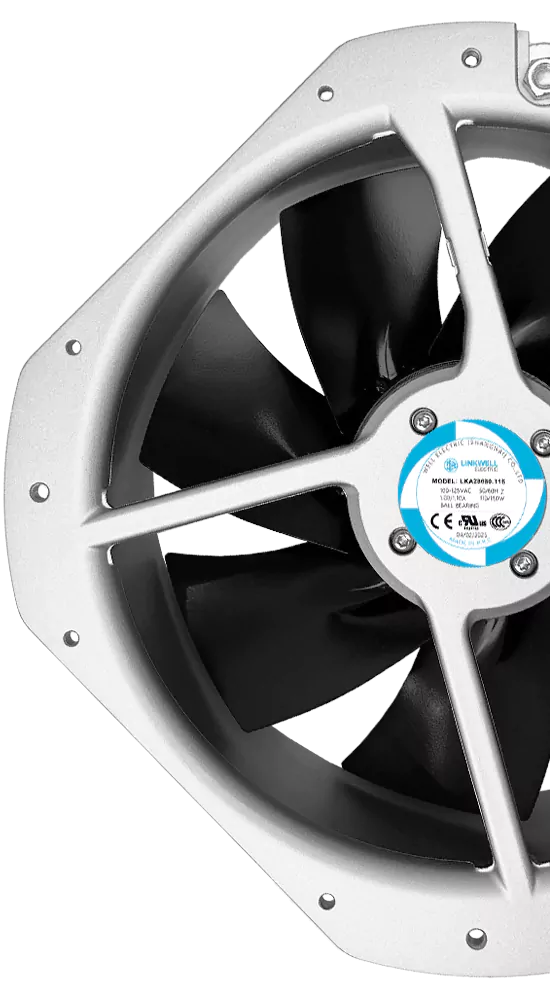
A cooling fan can look correct on a datasheet and still create problems after it is installed inside real equipment. The size may fit. The voltage may match. The airflow value may look strong enough. But once the fan is mounted inside an electrical cabinet, telecom enclosure, automation module, power supply, battery system, or compact HVAC unit, the real operating conditions can change everything.
That is why cooling fan prototype validation matters before mass production.
At FanACDC, we manufacture AC, DC, EC, axial, and centrifugal cooling fans for industrial and OEM applications. For many projects, the prototype stage is where the most valuable problems are found: airflow loss, excessive noise, vibration transfer, wrong cable direction, insufficient static pressure, connector mismatch, or overheating under full-load conditions.
Fixing these issues during prototype validation is much cheaper than discovering them after tooling, purchasing, assembly, or field installation has already started.
Quick Answer
Cooling fan prototype validation is the process of testing a selected fan inside the real equipment or a representative sample before mass production. It checks whether the fan fits mechanically, matches the electrical system, delivers enough airflow, handles system resistance, stays within noise limits, and operates reliably under the expected working environment.
For OEM projects, prototype validation should confirm:
- Mechanical fit
- Voltage and control compatibility
- Airflow performance
- Static pressure suitability
- Noise level
- Vibration behavior
- Cable and connector layout
- Bearing and service life expectations
- Temperature performance under real load
- Whether axial, centrifugal, AC, DC, or EC fan selection is correct
The goal is simple: avoid mass-producing a cooling system that only works on paper.
Why Prototype Validation Is Necessary
In industrial cooling, the fan is usually a small component, but it protects much more expensive equipment. A weak fan selection can lead to overheating, alarms, shutdowns, unstable electronics, shortened component life, and customer complaints.
Prototype validation is necessary because the final equipment environment is different from open-air testing.
A fan datasheet may show airflow under ideal conditions. In the real product, airflow may be reduced by filters, grilles, heat sinks, narrow ducts, cable bundles, internal partitions, or limited inlet clearance. The fan may also be mounted to a thin metal panel that amplifies vibration. A connector may be technically correct but inconvenient for assembly. A cable may be too short for production workers to route cleanly.
These are not small details. In OEM production, they affect cost, reliability, and delivery schedule.
What Should Be Checked During Cooling Fan Prototype Validation?
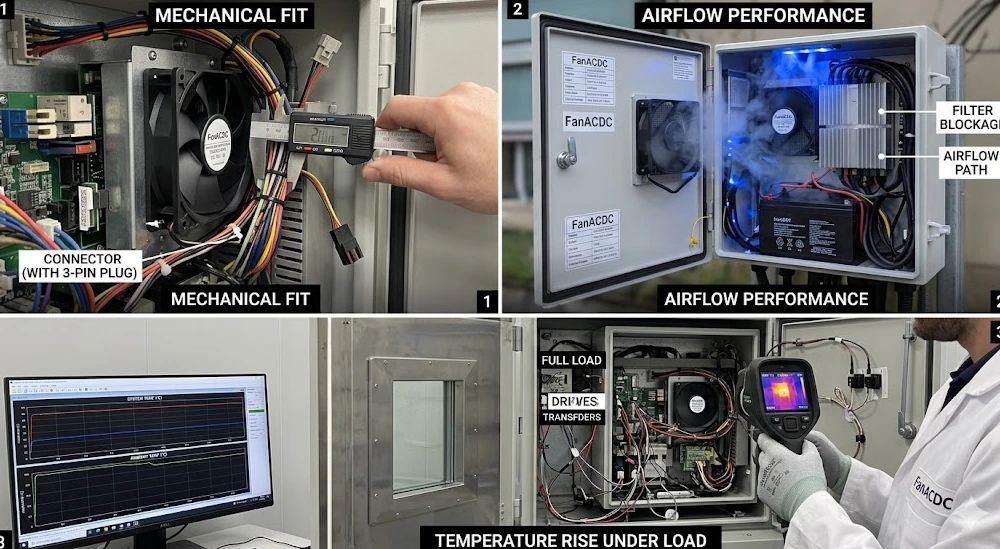
Mechanical Fit
The first test is basic but important: does the fan actually fit?
Check the frame size, thickness, mounting hole distance, screw position, cable exit direction, connector location, and available clearance around the inlet and outlet. For centrifugal fans, also check the outlet size, housing width, mounting structure, and airflow direction.
A fan that fits on a drawing may still interfere with wiring, brackets, covers, ducts, or nearby components after assembly.
For compact equipment, even a few millimeters can matter.
Voltage and Electrical Compatibility
The fan must match the equipment’s real electrical system, not just the country’s power standard.
For AC fans, confirm voltage and frequency. Common industrial options include 110V, 115V, 120V, 220V, 230V, and 240V AC depending on application and region.
For DC fans, confirm whether the system uses 12V, 24V, 48V, or another low-voltage supply. If the fan uses PWM, FG, RD, or alarm output, those signals should be tested with the actual control board.
For EC fans, control input and speed behavior should be checked carefully before approval.
A fan may spin when powered, but that does not mean it is electrically correct for long-term production use.
Airflow Performance Inside the Equipment
Airflow should be tested inside the actual prototype, not only in free air.
This is especially important for electrical cabinets, telecom enclosures, compact HVAC modules, power supplies, and battery systems. These applications often have airflow resistance from filters, ducts, internal channels, or dense electronics.
During validation, check whether air reaches the components that need cooling. A fan can move air strongly near the inlet but still fail to cool a hot area behind a drive, power module, or PCB.
If airflow drops too much after installation, the solution may be a higher-pressure axial fan, a centrifugal blower, a different fan position, or an airflow path adjustment.
Static Pressure Matching
Static pressure is often the difference between a fan that works in the lab and a fan that works in the field.
Axial fans are suitable for open airflow and general ventilation. Centrifugal fans are often better when the air path is restricted. If the prototype includes filters, narrow outlets, or dense internal layouts, static pressure should be reviewed before approval.
For FanACDC projects, this is one of the most common reasons to change from a standard axial fan to a centrifugal blower during prototype testing.
Temperature Rise Under Real Load
A cooling fan should be validated under real heat conditions.
Short power-on tests are not enough. The equipment should be tested under expected load, ambient temperature, and operating time. In some cases, the fan performs well at room temperature but fails during high ambient testing or full-load operation.
Check the temperature around:
- Power modules
- Drives
- Transformers
- PCBs
- Battery cells
- Control components
- Heat sinks
- Enclosure hot spots
The question is not only whether the fan runs. The question is whether the protected equipment stays within its safe temperature range.
Noise and Vibration
Noise and vibration should be checked after installation.
A fan that sounds acceptable on the bench may become louder inside a cabinet or metal housing. Thin panels, hard mounting points, blocked inlets, and airflow turbulence can all increase noise.
Vibration should be checked at startup, full speed, and long operation. If vibration transfers into the enclosure, the solution may involve better fan balance, rubber grommets, anti-vibration pads, a stronger bracket, different bearing selection, or a change in fan type.
For indoor cabinets, telecom equipment, medical-related equipment, and operator-facing industrial systems, this step is especially important.
Cable, Connector, and Assembly Fit
A prototype fan should also be judged by how easily it can be installed in production.
Check whether the cable length is correct, whether the connector matches the assembly process, whether the cable route is clean, and whether the wire position avoids heat sources or moving parts.
For OEM buyers, small integration details can save time during mass production. FanACDC can support cable length, connector type, wire color, pin assignment, and signal options depending on project requirements.
Environmental Protection
If the fan is used in dusty, humid, outdoor, or semi-outdoor equipment, environmental protection should be validated early.
This may include IP-rated fan selection, bearing choice, coating requirements, temperature range, and material suitability. For telecom enclosures, battery systems, industrial cabinets, and outdoor control equipment, environmental stress can shorten fan life if ignored.
Prototype testing should reflect the real working environment as closely as possible.
Prototype Validation Checklist
| Validation Item | What to Check | Why It Matters |
|---|---|---|
| Fan size | Frame, thickness, mounting holes | Prevents installation problems |
| Voltage | AC/DC/EC input and frequency | Avoids electrical mismatch |
| Control signal | PWM, FG, RD, alarm output | Confirms system communication |
| Airflow | Cooling path inside equipment | Confirms real thermal performance |
| Static pressure | Filters, ducts, restrictions | Prevents airflow loss |
| Temperature | Hot spots under load | Validates cooling result |
| Noise | Sound after installation | Important for indoor equipment |
| Vibration | Mounting and panel transfer | Protects reliability and user experience |
| Cable and connector | Length, routing, pinout | Improves OEM assembly |
| Environment | Dust, humidity, temperature | Supports long service life |
Case Example: Prototype Test for an Electrical Cabinet
An OEM customer selected a standard axial fan for a compact electrical cabinet. The fan size and voltage were correct, and the free-air airflow rating looked enough for the heat load.
During prototype validation, the cabinet still showed temperature alarms after several hours of full-load testing. The fan was running normally, but airflow around the drive module was weaker than expected.
After reviewing the cabinet structure, the problem became clear. The airflow path included a filter, a narrow internal passage, and several cable bundles near the inlet. The selected axial fan could move air in open conditions, but it could not maintain enough airflow through the actual resistance.
The solution was to change the fan configuration and evaluate a higher-static-pressure option. The cable route was also adjusted to reduce inlet obstruction. In the next prototype, airflow around the hot area improved, and the cabinet passed the internal thermal test.
This is exactly why prototype validation matters. Without testing inside the real cabinet, the problem would have appeared much later in production or field use.
When Should OEM Buyers Start Fan Validation?
Fan validation should begin before the mechanical design is fully locked.
If the fan location, bracket, connector, and airflow path are already fixed, changes become harder. Early validation gives engineers more options: changing fan type, adjusting mounting, opening the airflow path, adding speed control, or selecting a different voltage platform.
For new OEM projects, the best timing is usually after the first mechanical layout is available but before tooling and mass purchasing begin.
For replacement projects, validation should happen before bulk ordering. Even if the replacement fan has the same size, it may not have the same pressure, speed, bearing life, noise, or connector details.
How FanACDC Supports Prototype Validation
FanACDC supports OEM buyers with AC, DC, EC, axial, and centrifugal fan selection for industrial cooling applications. Our role is not only to provide a fan model, but to help match the fan to the real equipment requirement.
We can support:
- Fan type selection
- Voltage matching
- Airflow and static pressure review
- Centrifugal blower selection for restricted airflow
- Low-noise fan selection
- Bearing and service life review
- Cable and connector customization
- PWM / FG / RD / alarm signal options
- Sample support for OEM projects
- Production-ready fan configuration
For faster evaluation, send the fan size, voltage, airflow target, application, installation photos or drawings, and any thermal, noise, or vibration issue. If available, also send the old fan label or prototype layout.
The more real project information we receive, the more accurate the fan recommendation will be.
What Information Should You Send Before Requesting a Sample?
Before requesting a cooling fan prototype or sample, prepare the following information:
| Information | Example |
|---|---|
| Application | Electrical cabinet, telecom enclosure, battery system |
| Fan type needed | Axial, centrifugal, AC, DC, EC, not sure |
| Voltage | 12V, 24V, 48V, 115V AC, 230V AC |
| Size limit | 120 x 120 x 38 mm, 172 mm, 133 mm blower |
| Airflow target | CFM or m3/h if known |
| Static pressure | Required value or description of restriction |
| Control function | PWM, FG, RD, alarm output |
| Cable/connector | Length, plug type, pin assignment |
| Environment | Indoor, outdoor, dusty, humid, high temperature |
| Main concern | Overheating, noise, vibration, replacement, new design |
If some data is not available, photos and application details are still useful. Many fan selection problems can be identified from the equipment layout.
FAQ
What is cooling fan prototype validation?
Cooling fan prototype validation is the process of testing a selected fan in the real equipment or a representative prototype before mass production. It checks fit, airflow, voltage, noise, vibration, and thermal performance.
Why is prototype validation important for OEM cooling fans?
It helps find problems before mass production, including airflow loss, overheating, vibration, connector mismatch, and wrong fan type selection. This reduces redesign cost and field failure risk.
Should I test the fan in free air or inside the equipment?
Free-air testing is useful, but the most important test is inside the actual equipment. Filters, grilles, ducts, and internal components can reduce airflow after installation.
When should I choose a centrifugal fan during validation?
Choose a centrifugal fan when the prototype has restricted airflow, filters, narrow ducts, or high static pressure. A centrifugal blower often performs better than an axial fan in these conditions.
Can FanACDC customize fan samples for OEM projects?
Yes. FanACDC can support voltage, cable length, connector type, control signals, bearing selection, IP protection, and fan platform selection for OEM projects.
What should I send to FanACDC for sample evaluation?
Send the fan size, voltage, application, installation space, airflow requirement, photos or drawings, connector requirements, and any existing noise, vibration, or overheating issue.
Conclusion
Cooling fan prototype validation is one of the most practical ways to reduce risk before mass production. It confirms whether the selected fan truly fits the equipment, matches the electrical system, delivers enough airflow, handles resistance, and operates with acceptable noise and vibration.
For industrial equipment such as electrical cabinets, telecom enclosures, automation systems, power supplies, battery systems, compact HVAC modules, and embedded electronics, the fan should be validated in the real working environment, not only selected from a datasheet.
FanACDC supports OEM cooling fan projects with AC, DC, EC, axial, and centrifugal fan solutions. If you are preparing a prototype or moving toward mass production, send us your voltage, fan size, airflow path, connector requirements, and application details. We can help review the fan selection before the project becomes expensive to change.