Compact equipment creates a familiar problem in industrial cooling: there is less room for air, but more need for it to do precise work.
As electronics become denser and housings become smaller, airflow is no longer a matter of moving air through open space. It has to pass through narrow channels, around structural barriers, across localized heat sources, and sometimes through filters or protective grilles before it reaches the area that needs cooling most. Under those conditions, the wrong fan can appear to operate normally while the equipment still runs too hot.
This is where high static pressure becomes an engineering issue rather than a catalog term. A fan may have a reasonable airflow rating in free air and still underperform once real resistance is introduced. That mismatch shows up often in telecom systems, compact power electronics, control cabinets, battery enclosures, and embedded industrial equipment.
For manufacturers and OEM buyers, the answer is usually not to search for “more airflow” in isolation. The answer is to match the fan platform and integration design to the actual resistance path inside the equipment.
Custom Fan Cooling Solutions for High Static Pressure Equipment
Quick Answer
High static pressure and compact equipment often need more than a standard open-air fan. When air must move through restricted internal paths, filters, dense layouts, or directional cooling channels, a custom fan cooling solution is usually more effective. In these applications, fan type, pressure capability, installation structure, voltage, and integration details all influence whether the equipment stays thermally stable in real operation.
What High Static Pressure Really Means in Equipment Cooling
High static pressure simply means the fan must work against resistance in order to move air where it needs to go.
In open airflow applications, resistance is low, so a fan can often deliver a large portion of its rated volume. In compact industrial equipment, resistance rises quickly. Filters, louvers, heatsinks, cable bundles, enclosure partitions, and narrow internal clearances all force the fan to work harder. As resistance rises, a fan that performs well in open air may lose effective airflow much faster than expected.
This is one of the main reasons equipment overheating can be confusing in the field. The fan is spinning. Air is moving at the inlet or outlet. Yet the target components still accumulate heat because the system is not maintaining enough useful airflow through the resistance path.
Why Compact Equipment Creates Harder Cooling Problems
Compact equipment is harder to cool because every design constraint overlaps with the next one.
There is less internal space, so airflow paths are narrower. Heat sources are often concentrated rather than spread out. Mounting positions are limited, which means the fan may have to fit around electrical or structural constraints instead of being placed where airflow would naturally work best. Noise expectations may also be tighter because compact equipment is often used indoors or near operators.
In larger systems, some thermal inefficiency can be absorbed by space. In smaller systems, it usually cannot. A minor airflow mistake in a compact enclosure becomes a significant temperature problem very quickly.
Common Applications With High Static Pressure Cooling Demand
Electrical cabinets with filters and dense internal layouts are one common example. A standard fan may exchange air with the enclosure in general terms while still failing to deliver enough cooling across the most restricted internal path.
Telecom enclosures create a similar challenge. They often hold power modules, communication hardware, and control electronics in a compact arrangement where airflow has to be directional rather than diffuse. Outdoor use adds temperature stress and protection requirements on top of that.
Battery enclosures and power conversion systems also tend to produce resistance-heavy cooling paths. Air has to move through a controlled layout, and temperature uniformity often matters almost as much as total airflow.
Industrial electronics, embedded systems, and compact automation equipment round out the pattern. These applications are usually limited by geometry, not by a lack of willingness to install a fan.
Why Standard Axial Fans Often Struggle in These Conditions
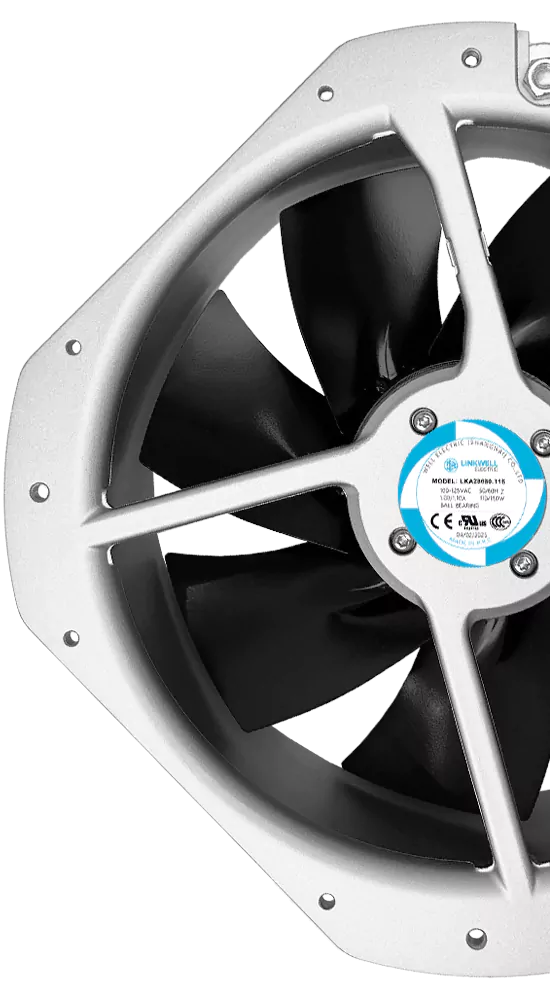
Standard axial fans are efficient and practical in many applications, especially where airflow path resistance remains moderate. They move air effectively when the route is open enough to let that airflow remain useful.
The problem appears when resistance increases. As filters, ducts, narrow channels, or internal obstacles begin to dominate the system, the effective airflow can drop well below what the free-air rating suggests. In compact equipment, this matters more because the cooling requirement is often tied to one constrained path rather than to general enclosure ventilation.
This does not make axial fans unsuitable in general. It means their performance needs to be judged inside the real system rather than from nominal airflow alone.
When Centrifugal Blowers Become the Better Choice
Centrifugal blowers become more attractive when the system needs pressure-supported airflow rather than broad open-air movement.
In compact equipment, this often happens when air has to be pushed through narrow internal channels, around a dense thermal zone, or through a restricted intake and discharge path. Under those conditions, a centrifugal platform usually holds useful airflow more effectively and can support directional cooling more naturally than a standard axial format.
This is why blowers are frequently chosen for cabinet hot spots, telecom modules, electronics cooling paths, and power assemblies where airflow has to overcome real resistance before it reaches the heat source. The advantage is not simply that the blower is different. The advantage is that the airflow behavior better matches the system.
What Makes a Custom Cooling Solution Different
A custom cooling solution starts with the equipment, not with the fan list.
The first step is deciding which platform makes sense under the real resistance conditions. That may mean axial, centrifugal, EC, AC, or DC depending on the application. After that, the solution becomes more specific. Voltage may need to match the system architecture. Mounting structure may need to fit a constrained internal space. Connector type, cable routing, or alarm output may matter for integration. Protection level may need to increase for outdoor or dust-prone use.
In many projects, the most important improvement is simply making the chosen fan behave correctly inside the equipment rather than choosing a nominally stronger standard part. Pressure matching, airflow direction, mounting adaptation, and platform selection all contribute to that result.
Case Analysis: Compact Power Electronics Enclosure With Poor Real-World Cooling
A compact power electronics enclosure recently showed the difference clearly.
The system used a standard axial fan with acceptable nominal airflow, and the initial assumption was that cooling capacity should have been sufficient. In bench conditions, the fan appeared to perform normally. In full assembly, however, thermal behavior deteriorated once the equipment operated under sustained load.
The reason became clear during airflow review. The enclosure forced air through a restricted path before it reached the power components, and the installed fan lost too much useful delivery under that resistance. The airflow number on paper was not the same as the airflow reaching the heat source in the real enclosure.
The final solution used a centrifugal blower matched to the voltage architecture, with a more focused airflow path and integration changes that supported the internal layout. The result was not just more air. It was more useful air at the point where the system needed it.
This is the practical difference between choosing a fan by catalog habit and choosing a cooling solution by application behavior.
What to Check Before Selecting a Fan for Compact High-Resistance Systems
Before choosing a cooling solution for compact equipment, it helps to review the resistance path as carefully as the heat load.
| What to Check | Why It Matters |
|---|---|
| Airflow path | Determines where resistance is created |
| Static pressure requirement | Shows whether the fan can overcome restriction |
| Installation space | Limits fan platform and mounting choices |
| Voltage and control | Must match the system architecture |
| Noise limit | Important in compact enclosed systems |
| Environmental protection | Relevant for dust, humidity, or outdoor use |
These checks are usually more useful than starting with size alone. In compact equipment, the wrong airflow direction or an underestimated resistance path can cancel out the apparent advantage of a larger standard fan.
How FanACDC Supports Compact and High-Pressure Cooling Projects
From a manufacturer’s standpoint, compact high-resistance cooling projects need more careful matching than ordinary ventilation tasks.
FanACDC supports both axial and centrifugal platforms for industrial applications where airflow resistance, space limits, and integration details shape the final selection. That includes projects in cabinets, telecom systems, battery enclosures, power electronics, and compact industrial devices where pressure capability and mechanical fit both matter.
Support can include voltage matching, connector and cable adaptation, mounting changes, protection-level considerations, and platform selection based on the actual airflow path. For OEM projects, that kind of matching is often what separates a cooling system that merely runs from one that performs reliably across production and field use.
FAQ
What is high static pressure in fan cooling?
It refers to the resistance a fan must overcome to move air through a system. In compact equipment, that resistance often comes from filters, narrow channels, heatsinks, and dense internal layouts.
Why is my equipment overheating even though the fan is running?
Because fan operation alone does not guarantee useful airflow at the heat source. The system may have too much resistance, poor airflow direction, or the wrong fan platform for the enclosure.
Are centrifugal blowers better than axial fans for compact equipment?
In many high-resistance compact systems, yes. Centrifugal blowers usually perform better when airflow must be pushed through tighter or more directional paths. But the correct choice still depends on the specific equipment layout.
Can a custom fan solution improve cooling in restricted airflow paths?
Yes. A custom solution can improve platform matching, airflow direction, pressure performance, voltage compatibility, and mechanical integration, all of which affect real cooling results.
Do you support OEM customization for compact industrial equipment?
Yes. FanACDC supports OEM cooling projects with axial, centrifugal, AC, DC, and EC platforms depending on airflow path, system resistance, and integration requirements.
Conclusion
High static pressure and compact equipment expose the limits of simple fan selection. Once airflow has to move through resistance-heavy internal paths, the nominal airflow figure becomes less important than the fan’s ability to deliver useful performance inside the real enclosure.
That is why many compact industrial systems need more than a standard replacement fan. They need a cooling solution matched to the actual pressure path, voltage architecture, installation limits, and integration requirements of the equipment.
For OEMs and industrial buyers, the practical goal is not to install a fan that looks correct in a catalog. It is to build a system that stays thermally stable when the equipment is fully assembled, fully loaded, and running in the conditions it was designed for.