Electrical cabinet cooling looks simple until it fails in the field.
On paper, the selection may appear straightforward: choose a fan, match the voltage, confirm the opening size, and move on. In actual equipment, cabinet cooling is rarely that clean. Air has to pass through filters, cable bundles, structural barriers, drives, relays, power modules, and other heat-generating components arranged inside a limited space. The fan is not working in open air. It is working inside a controlled restriction.
That is why cabinet overheating is often misdiagnosed. Many systems already have a fan installed. Some even have the “correct” replacement size. Yet alarms continue, internal temperatures remain uneven, and performance becomes unstable under higher ambient load or longer duty cycles. In those cases, the problem is not simply that the cabinet needs a fan. The problem is that the cooling solution was not matched closely enough to the real enclosure conditions.
For OEM projects, panel builders, and industrial buyers, a custom thermal solution becomes relevant when the cabinet design, internal resistance, voltage architecture, or environmental requirement goes beyond what a standard catalog fan can handle with confidence.
Quick Answer
The right custom thermal solution for an electrical cabinet starts with the enclosure itself. Airflow path, static pressure, heat source location, voltage, mounting limits, and protection level all matter. A standard fan may be enough for simple ventilation, but cabinets with restricted airflow, dense components, or higher environmental demands usually need a more deliberate match between fan platform and operating conditions.
Why Cabinet Cooling Problems Are Often Misdiagnosed
When a control cabinet runs hot, the first assumption is often that the installed fan is too small or too weak. That may be true, but it is only one possibility.
In many cabinets, the larger issue is poor airflow distribution. Air enters, but it does not reach the hottest components effectively. A drive module may sit behind a cable bundle. A filter may add more resistance than expected. Internal geometry may force the fan to work against a path it was never selected for. Under those conditions, replacing the original fan with another standard model of similar size only repeats the same mistake.
This is one of the reasons cabinet cooling deserves more attention than simple frame matching. The thermal problem usually sits inside the airflow path, not on the fan label.
What Makes Electrical Cabinets and Enclosures Different
Cabinet and enclosure cooling is different because it is always tied to structure.
Unlike an open ventilation application, an enclosure has boundaries. It contains internal heat sources, restricted air passages, and practical installation limits. The cooling fan has to work within those limits while staying compatible with the electrical system and, in many cases, with dust or moisture protection requirements as well.
The challenge becomes greater when the enclosure contains variable frequency drives, switching power supplies, PLCs, communication equipment, or tightly packed control hardware. These components create concentrated heat zones rather than uniform temperature rise. A fan that produces general circulation may still leave a critical hotspot in the wrong place.
Outdoor cabinets add another layer. Once the enclosure is exposed to dust, ambient temperature swings, or moisture risk, the cooling design must consider protection level as well as airflow.
The First Five Things to Check Before Choosing a Cooling Solution
Before choosing a custom cooling setup, it helps to begin with the cabinet as a thermal system rather than as a box that needs a fan.
The first thing to check is the location of the heat sources. If most of the load is concentrated in one corner or around one drive group, the cooling approach may need directional airflow rather than general ventilation.
The second is the actual airflow path inside the cabinet. Openings, louvers, filters, cable routing, and internal panels all influence how much useful air reaches the target components.
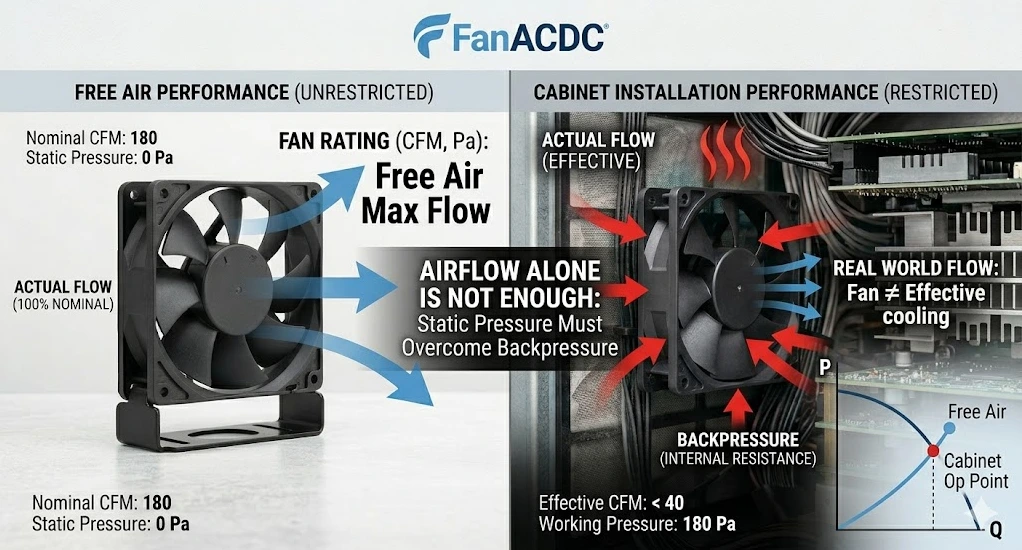
The third is resistance. This is where static pressure becomes important. If the air must pass through filter media or narrow paths before reaching the heat load, a fan that performs well in free air may lose too much practical output after installation.
The fourth is electrical compatibility. Voltage, frequency, control method, and connector requirements all affect whether the fan can be integrated cleanly into the cabinet build.
The fifth is physical installation. Mounting layout, service access, depth limits, and surrounding hardware may rule out otherwise acceptable fan options.
Why Airflow Alone Is Not Enough
Airflow numbers are useful, but they are easy to overvalue in cabinet cooling.
A free-air CFM rating tells you how much air a fan can move without meaningful resistance. Inside a cabinet, that condition rarely exists. Once air has to pass through filters, protective grilles, narrow channels, or tightly arranged components, the fan operates on a different part of its performance curve.
This is why two fans with similar nominal airflow can behave very differently in the same enclosure. One may maintain useful delivery under resistance. The other may lose too much pressure and leave the cabinet with less effective cooling than expected.
| Selection Factor | Why It Matters in Cabinet Cooling |
|---|---|
| Airflow | Determines total cooling volume |
| Static pressure | Helps move air through filters and restricted paths |
| Voltage | Must match the cabinet power system |
| IP protection | Matters in dusty or exposed environments |
| Noise | Relevant in indoor or operator-facing equipment |
| Mounting | Must fit the enclosure structure cleanly |
Choosing Between Axial and Centrifugal Fans for Cabinets
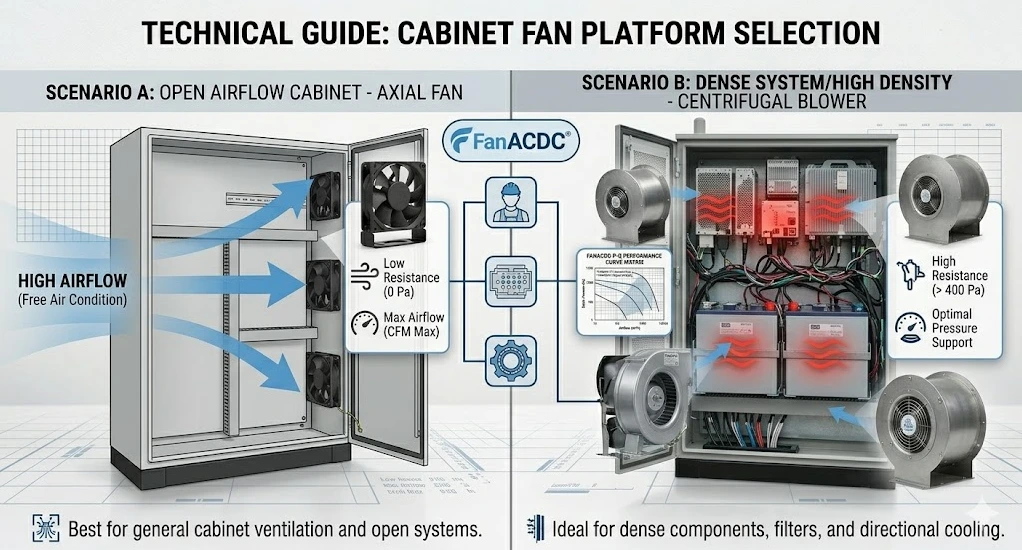
This is one of the most important decisions in cabinet thermal design.
Axial fans are often the right choice when the airflow path is relatively open and the goal is to exchange air through the enclosure with minimal restriction. They are widely used in electrical cabinets for exactly that reason. When selected correctly, they are efficient, simple, and cost-effective.
Centrifugal blowers become more attractive when the cabinet introduces more resistance. If air has to be pushed through a denser path, across a targeted internal zone, or through a restricted section of the enclosure, a blower platform often holds performance more effectively.
There is no universal winner between the two. The cabinet layout decides the better direction. In some projects, the correct answer is not simply switching fan type, but reworking airflow direction, mounting, and internal path management together.
When a Standard Cabinet Fan Is No Longer the Best Option
A standard cabinet fan is no longer the best option when overheating continues after replacement, when internal alarms return under higher seasonal temperature, or when airflow inside the cabinet remains uneven even though the fan is running normally.
The same is true when the project requires non-standard voltage, a specific connector layout, improved IP protection, low-noise operation, or mechanical adaptation for a limited installation space. In these cases, the cost of trying to make a catalog part fit can easily become higher than selecting a better-matched solution from the start.
For OEMs, this point often arrives earlier than expected. Once a cabinet enters repeat production, even a small mismatch becomes a recurring problem across many units.
What Can Be Customized in a Cabinet Thermal Solution
A useful custom solution does not always mean inventing a new fan from zero. More often, it means adjusting the right variables so the cooling system fits the enclosure correctly.
That may include voltage selection, connector type, cable length, and control outputs. In other cases, the key changes are mechanical: mounting pattern, bracket design, airflow direction, or enclosure fit. Environmental protection may also matter, especially in cabinets exposed to dust, humidity, or outdoor conditions.
Performance tuning is another area where customization becomes practical. Airflow and static pressure can be matched more deliberately to the enclosure resistance. Bearing choice may be optimized for installation orientation or continuous operation. Noise may be reduced where cabinet placement makes that important.
What matters is that the cooling solution is shaped by the cabinet rather than by the limitations of a stock configuration.
Case Analysis: VFD Control Cabinet With Repeated Overtemperature Alarms
A recent cabinet project illustrates this well.
The application was a compact VFD control cabinet used in an industrial automation line. The enclosure already had a standard axial fan, and on paper the airflow rating appeared sufficient. In operation, however, the cabinet repeatedly triggered temperature alarms during long shifts, especially in warmer ambient conditions.
A closer review showed that the fan was pulling air through a filter and then into a cabinet layout where cable routing and component placement created a strong resistance path before airflow reached the drive section. The fan was moving air, but not enough useful air was reaching the thermal hotspot.
Instead of replacing it with a larger standard axial unit, the solution moved toward a higher-static-pressure centrifugal blower with adjusted mounting and cable configuration. That change improved airflow delivery through the restricted path and reduced hotspot concentration around the drive module.
The project did not need a more impressive part number. It needed a better fit between the cooling hardware and the enclosure physics.
How FanACDC Supports Electrical Cabinet Cooling Projects
From a manufacturing perspective, cabinet cooling projects work best when the enclosure layout and thermal requirement are reviewed before the fan is locked in.
FanACDC supports cabinet and enclosure cooling with AC, DC, EC, axial, and centrifugal platforms depending on the airflow path and resistance level involved. That support can include voltage matching, pressure-oriented fan selection, connector and cable customization, mounting adaptation, and protection-level considerations for more demanding environments.
For OEM equipment, the value of that process is consistency. A cabinet that cools correctly in one prototype but not in repeated production is not truly solved. The point of thermal matching is to make the cooling behavior reliable across real use conditions and repeated builds.
FAQ
How do I choose the right cooling fan for an electrical cabinet?
Start with the enclosure layout, heat source location, airflow path, and resistance level. Fan size alone is not enough. The right choice depends on how air actually moves inside the cabinet.
Are axial fans or centrifugal blowers better for enclosures?
It depends on the airflow path. Axial fans are often better in more open cabinet ventilation. Centrifugal blowers are usually stronger where resistance is higher or airflow needs to be directed more precisely.
Why does cabinet overheating continue after replacing the fan?
Because the original problem may not be the fan alone. Internal resistance, poor airflow direction, concentrated heat load, or mounting mismatch can all keep the cabinet hot even after replacement.
Can you customize voltage and connectors for cabinet cooling?
Yes. Voltage, connector type, cable length, and other integration details can be matched to the cabinet system in OEM projects.
Do you support IP-rated enclosure cooling solutions?
Yes. Protection requirements can be considered when the enclosure operates in dusty, humid, or more exposed industrial environments.
Conclusion
Electrical cabinet cooling is rarely solved by dimensions alone. Once the enclosure has resistance, concentrated heat, environmental exposure, or integration constraints, the cooling system needs to be selected from the real operating conditions rather than from a standard replacement list.
That is where custom thermal matching becomes useful. The right solution may still use a familiar fan platform, but it is chosen with greater attention to airflow path, static pressure, voltage, mounting, and environmental fit.
For OEM cabinet projects and industrial enclosures, that approach usually leads to fewer recurring alarms, better internal thermal stability, and a more reliable path into production.