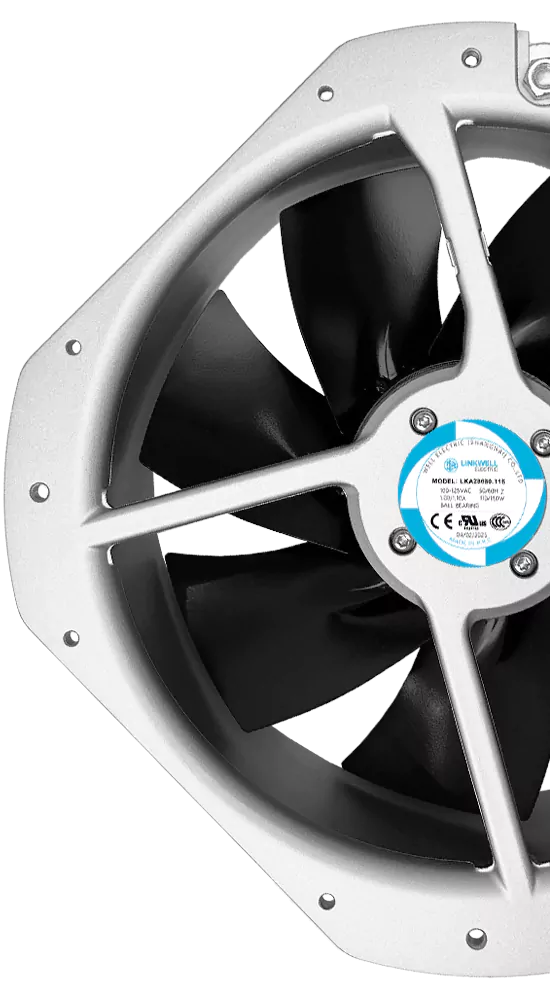
When buyers compare centrifugal fans for industrial cooling, the discussion often turns quickly to efficiency. That is usually where EC centrifugal fans gain attention. They promise smarter control, lower energy consumption, and a more modern motor system. On paper, that sounds like the obvious choice.
In real projects, however, the decision is rarely that simple. Many industrial cooling systems are not designed around advanced speed control or energy optimization. They are designed around reliability, direct AC power, straightforward installation, and cost control. That is exactly why AC centrifugal fans are still widely used in electrical cabinets, control systems, inverters, blowers, and other industrial equipment.
This article compares EC centrifugal fans and AC centrifugal fans from a practical selection point of view. Instead of treating one as universally better, the goal is to explain where each one makes sense and why AC centrifugal fans remain the more realistic option in many standard industrial applications.
What Is an AC Centrifugal Fan?
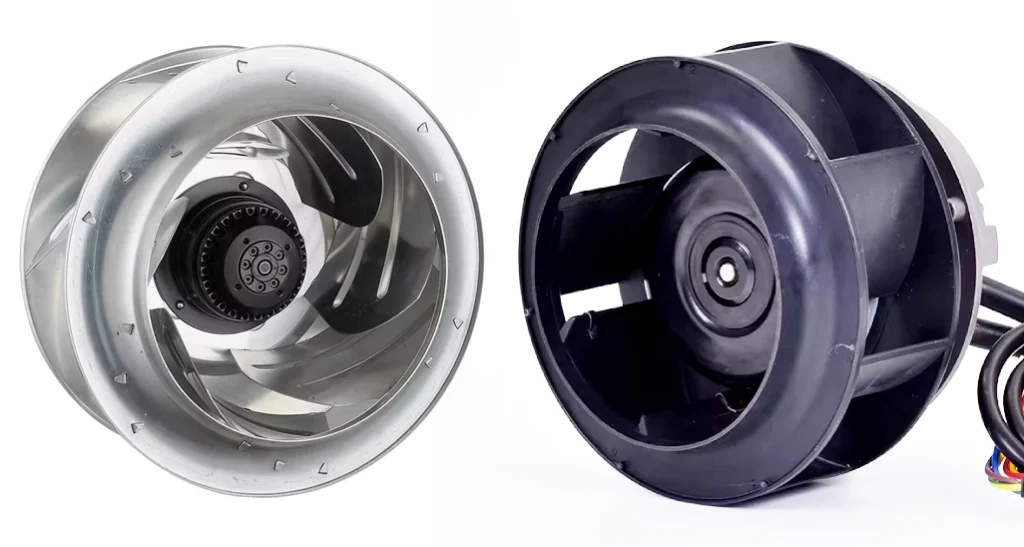
An AC centrifugal fan uses alternating current power and a centrifugal airflow design to move air through a system with more pressure than a typical axial fan can provide. In industrial cooling, that matters because air often has to pass through filters, louvers, guards, narrow channels, or dense internal layouts before it can remove heat effectively.
That is one reason AC centrifugal fans remain common in cabinet cooling and equipment ventilation. They are practical, familiar, and easy to integrate into systems where AC power is already available. In many cases, they do not need a complicated control structure to do their job well. They simply deliver stable airflow in a format that suits a wide range of industrial equipment.
For many buyers, that simplicity is not a weakness. It is part of the value. A fan that is easy to power, easy to replace, and easy to specify can be the better business decision when the application itself does not demand anything more complex.
What Is an EC Centrifugal Fan?
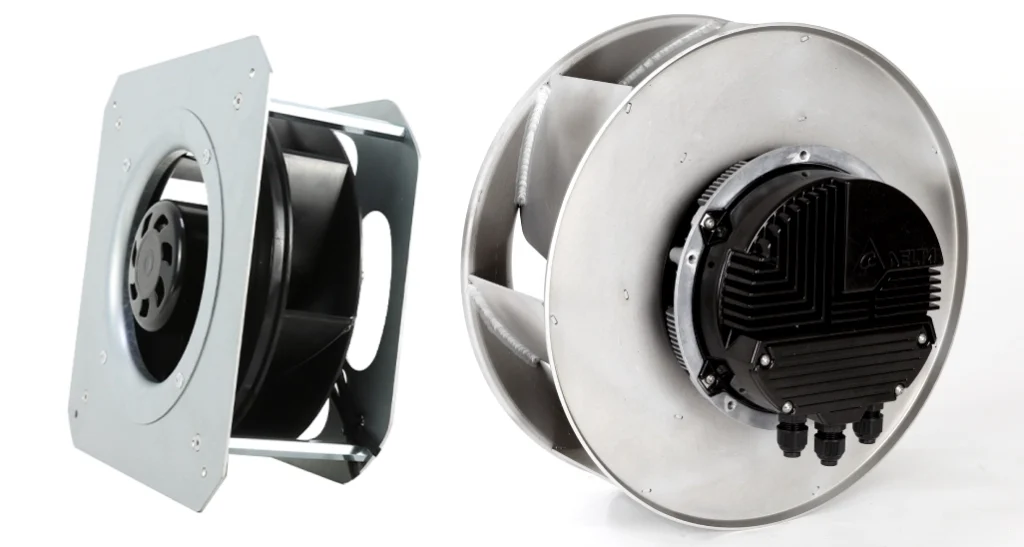
An EC centrifugal fan uses an electronically commutated motor, which combines AC input compatibility with the control advantages of a brushless DC motor system. In practice, this usually means better speed regulation, improved efficiency, and more flexibility for systems that need variable airflow under changing operating conditions.
That makes EC fans attractive in projects where operating hours are long, energy cost matters, and system control is part of the design logic. In those cases, the higher initial cost may be justified by lower long-term power consumption and better controllability.
Still, that does not automatically make an EC centrifugal fan the better choice for every project. A more advanced motor system only creates value when the application can actually use those advantages.
The Main Difference Is Not Just Efficiency
Most comparisons between AC and EC centrifugal fans focus too heavily on efficiency alone. Efficiency matters, but it is not the only factor that determines whether a fan is right for a project.
In industrial cooling, buyers also need to consider the available power supply, installation method, system complexity, maintenance expectations, and how much control the equipment really needs.
An EC centrifugal fan is often stronger when the system requires variable speed operation or tighter airflow control. An AC centrifugal fan, by contrast, is often the more practical choice when the system runs on standard AC power and the goal is reliable airflow without unnecessary complexity.
That distinction is more important than it may seem. In many industrial environments, the best solution is not the one with the most advanced motor technology. It is the one that fits the application cleanly, performs consistently, and stays economical over time.
Why AC Centrifugal Fans Are Still Widely Used
AC centrifugal fans continue to appear in industrial cooling systems for a simple reason: they solve real problems without asking too much from the system around them. Where AC power is already present, they can usually be integrated with less effort. That means fewer control requirements, simpler installation, and a more direct path from specification to operation.
This is especially important in projects such as electrical cabinet cooling, inverter ventilation, and general equipment airflow management. In those environments, buyers are often not chasing maximum control sophistication. They are trying to maintain safe operating temperatures, protect components, and keep the system dependable under continuous use.
AC centrifugal fans also remain attractive from a cost perspective. While they may not always match EC fans in energy efficiency, they often offer a lower upfront investment and a more straightforward replacement path. For many standard industrial projects, that tradeoff is not only acceptable. It is sensible.
Where AC Centrifugal Fans Make the Most Sense
If a project already runs on AC power and does not require advanced speed regulation, an AC centrifugal fan is often the more natural fit. This is common in electrical cabinets, control panels, basic blower systems, transformer cooling, and conventional industrial ventilation structures.
These applications usually value durability, stable pressure performance, and ease of maintenance more than electronic speed optimization. In other words, the fan is expected to work reliably, not to become a complicated subsystem of its own.
That is why AC centrifugal fans are still a strong option in environments where:
- direct AC input is preferred
- airflow must overcome moderate system resistance
- operating conditions are stable rather than highly variable
- replacement simplicity matters
- budget sensitivity is part of the project decision
In many of these cases, choosing an EC fan would add cost and complexity without creating proportional benefit.
Where an EC Centrifugal Fan Can Be Better
There are applications where an EC centrifugal fan genuinely has the advantage. Systems that need variable airflow, lower long-term energy use, or smarter control integration may benefit from EC technology. This is more likely in projects where the fan operates for long hours, airflow demand changes over time, or the equipment is designed around tighter energy targets.
For example, EC centrifugal fans can make sense when a system needs to modulate airflow rather than simply run at a fixed operating point. They may also be a better fit where reduced energy use is part of the product value proposition.
Even so, it is worth being honest about what that means in practice. An EC centrifugal fan is better when the application can use its strengths. If those strengths are not required, the more advanced design can become an unnecessary premium rather than a meaningful improvement.
AC vs EC for Electrical Cabinet Cooling
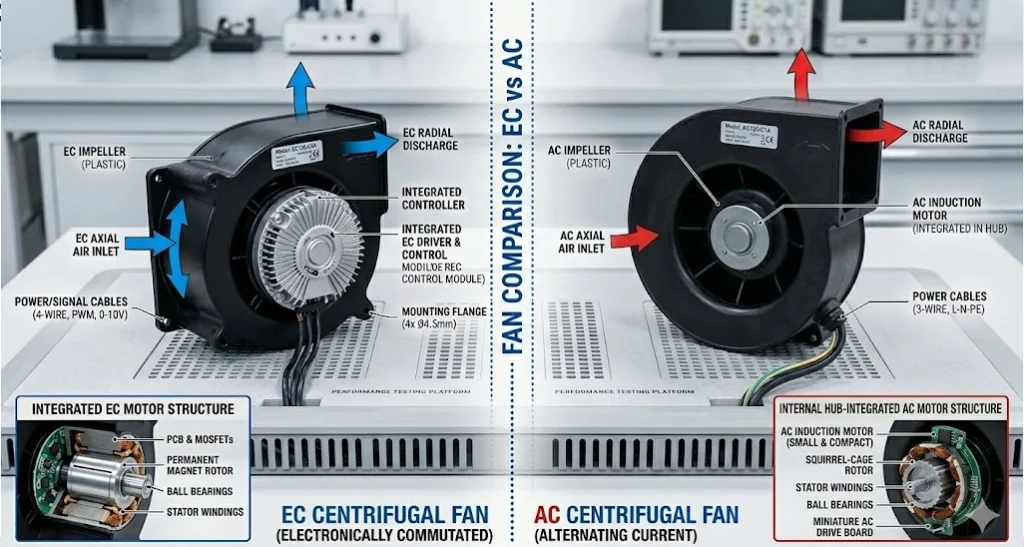
Electrical cabinet cooling is one of the clearest examples of how selection should be driven by application, not by trend. Many cabinets use filters, vent covers, restricted openings, and dense internal layouts. That means static pressure matters, and centrifugal fans are often a better fit than axial fans.
But once the choice has narrowed to centrifugal fans, the next question is whether EC control is truly needed. In a large number of cabinet cooling projects, the answer is no.
If the cabinet has a stable operating profile and an available AC power source, an AC centrifugal fan is often the more practical solution. It is easier to integrate and easier to specify, which reduces friction for both the equipment builder and the maintenance side later on.
An EC centrifugal fan may still be worth considering if the cabinet is part of a more energy-managed or smart-controlled system. But for many standard industrial cabinets, AC remains the more straightforward and commercially sensible choice.
AC vs EC for Inverter and Equipment Cooling
Inverter cooling and equipment ventilation create a similar decision pattern. These systems often need dependable airflow under heat load, but not always variable speed intelligence. If the system design is relatively fixed and airflow demand does not swing dramatically, AC centrifugal fans usually remain very competitive.
What matters most here is not whether the fan sounds more modern on paper. It is whether the selected fan matches the operating environment, power structure, resistance level, and expected life of the equipment. In many industrial machines, buyers still prioritize robustness, simpler electrical integration, and a proven service path. AC centrifugal fans continue to fit that requirement well.
This is why they remain common across traditional equipment cooling projects even as EC technology becomes more visible in newer energy-conscious systems.
Cost, Complexity, and Long-Term Value
One of the easiest mistakes in fan selection is to compare only technical advantages without looking at system economics. EC centrifugal fans may offer energy savings, but that value becomes meaningful only when the operating pattern is right and the system can benefit from variable control.
An AC centrifugal fan may consume more power in some conditions, but it often reduces upfront cost, simplifies the system design, and lowers replacement difficulty. For buyers working on standard industrial equipment, those advantages carry real weight.
This is why the better question is not, “Which technology is better in theory?” The better question is, “Which fan creates the best balance of reliability, cost, and performance for this application?” In many day-to-day industrial cooling projects, the answer is still AC centrifugal fan.
How to Choose Between AC and EC Centrifugal Fans
The right choice becomes clearer when the project is examined through a few practical filters. Start with the power supply. If the system already runs naturally on AC and there is no strong control requirement, AC centrifugal fans should be considered first. Then look at the airflow demand and whether it changes dynamically over time. If it does not, the value of EC control may be smaller than expected.
Next, review the budget and expected operating hours. If the project is highly cost-sensitive and the system is relatively simple, AC fans often offer the cleaner solution. If the system runs continuously, has strict energy targets, and benefits from variable speed behavior, EC may deserve stronger consideration.
In the end, this is not a debate about old versus new technology. It is a selection decision. Good selection always starts with the application.
Conclusion
EC centrifugal fans and AC centrifugal fans both have their place in industrial cooling, but they are not equally suitable for every project. EC technology offers real benefits in energy-conscious and control-oriented systems. At the same time, AC centrifugal fans remain a practical, dependable, and cost-effective choice for many standard industrial applications.
That is especially true in electrical cabinets, inverter systems, and conventional equipment cooling, where direct AC compatibility, simpler installation, and stable airflow matter more than advanced speed control.
If your project is built around straightforward industrial cooling rather than high-level airflow intelligence, an AC centrifugal fan is often not just the cheaper choice. It is the more appropriate one.
Need Help Choosing the Right Centrifugal Fan?
If you are comparing AC and EC centrifugal fans for cabinet cooling, inverter ventilation, or industrial equipment airflow, send us your application details, voltage, installation size, and cooling requirement. We can help recommend a suitable fan solution and provide product data for review.
FAQ
1. What is the main difference between EC and AC centrifugal fans?
EC centrifugal fans offer better speed control and higher efficiency potential, while AC centrifugal fans are often simpler, more practical, and easier to integrate into standard industrial systems.
2. When should I choose an AC centrifugal fan?
AC centrifugal fans are usually the better choice when your system uses direct AC power, has stable operating conditions, and does not require advanced speed control.
3. When is an EC centrifugal fan worth considering?
EC centrifugal fans are worth considering when energy efficiency, variable speed control, and long operating hours are important to the project.
4. Which fan is better for electrical cabinet cooling?
For many standard electrical cabinet projects, AC centrifugal fans remain a practical choice because they are easier to install, easier to replace, and work well in stable cooling systems.
5. Can LINKWELL help recommend the right centrifugal fan?
Yes. We support OEM buyers with model recommendation, datasheets, and project-based fan selection based on voltage, airflow, installation size, and application conditions.