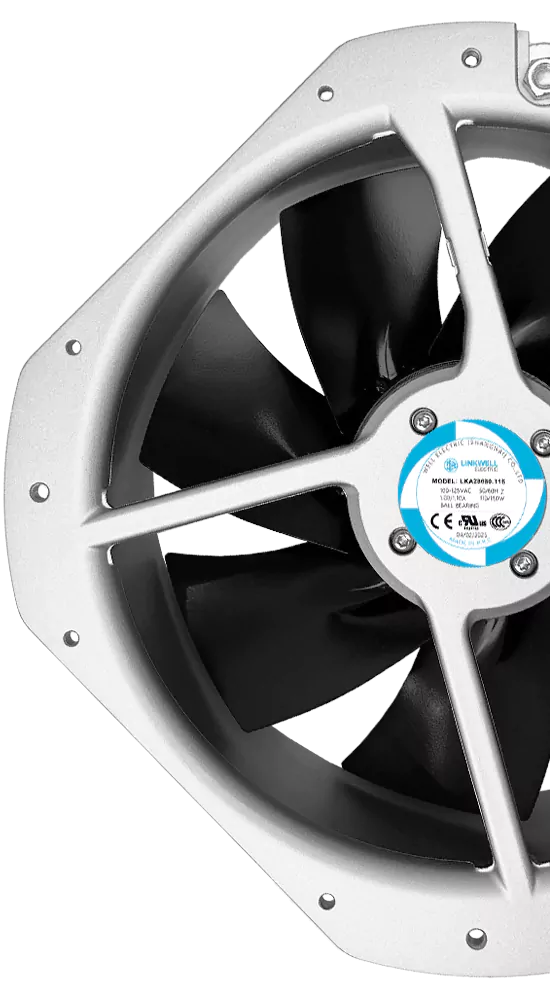
A fan datasheet says 58 dB. Another says 52 dBA at one meter. The smaller number looks quieter, but those two specifications may not describe the same quantity or the same test condition.
Sound power describes the acoustic energy emitted by the fan under a stated operating and installation condition. Sound pressure describes the acoustic level measured at a particular point and changes with distance, room reflections, barriers and background noise. Both use decibels, and both can be A-weighted, so the number and the letters “dBA” are not enough by themselves.
To compare two cooling fans, first identify whether the datasheet gives sound power or sound pressure. Then match the operating point, voltage, speed, installation configuration, measurement distance and acoustic method.
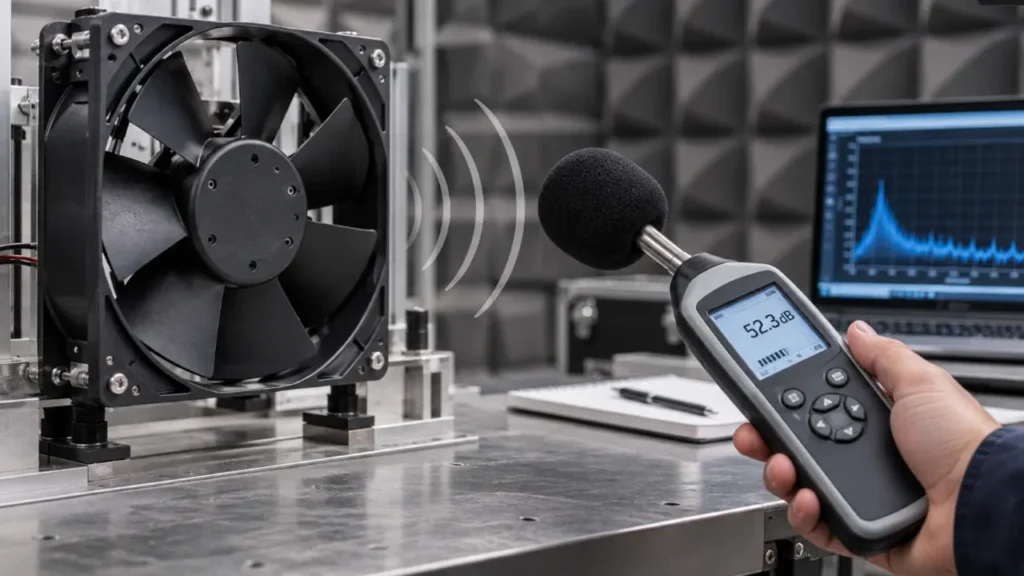
Fan Sound Power vs Sound Pressure: The Quick Difference
| Item | Sound power | Sound pressure |
|---|---|---|
| Common symbol | Lw or LwA | Lp or LpA |
| What it describes | Acoustic output of the source | Acoustic level at a measurement position |
| Changes when the microphone moves | No, if the source and operating condition remain unchanged | Yes |
| Affected by the room | The reported test method accounts for the test environment | Strongly affected by reflections, absorption and barriers |
| Best use | Comparing source emission and performing acoustic calculations | Checking what a listener or microphone receives at a stated location |
Sound power is not measured directly with a simple handheld meter beside the fan. It is determined from controlled measurements and calculations under a defined standard or laboratory method. Sound pressure is what a microphone senses locally.
What Is Fan Sound Power?
Sound power is the rate at which a source emits acoustic energy. It belongs to the fan and its stated operating condition rather than to a particular listener position. If the same fan operates at the same speed, airflow, pressure and installation configuration, moving the microphone does not change the fan’s sound power.
That does not mean a fan has one permanent sound-power value. Acoustic output changes with speed, operating point, inlet turbulence, blade loading and nearby restrictions. A sound rating at free air is not automatically valid behind a dense filter or at a high-pressure operating point.
ANSI/AMCA Standard 301 addresses calculation of fan sound ratings from laboratory data, while ANSI/AMCA Standard 300 provides a reverberation-room method for determining fan sound-power levels. The important purchasing lesson is not the standard number alone: the published value needs a defined fan configuration and duty point.
Inlet, outlet and total sound power
Fan noise can be reported at the inlet, at the outlet or as total sound power for a specified installation. Those are not interchangeable. A compact axial fan mounted in a panel can radiate differently toward the inlet and outlet, and a centrifugal fan connected to ductwork can send acoustic energy along a particular path.
What Is Fan Sound Pressure?
Sound pressure is the local fluctuation in air pressure produced by sound waves. It is the quantity a microphone measures at a position. Move farther from the fan, add an enclosure panel, place the unit beside a reflective wall or measure in a reverberant room, and the reading can change even though the fan itself has not changed.
A useful sound-pressure specification therefore needs context:
- Measurement distance and direction
- Fan inlet or outlet side
- Free-field, anechoic, semi-anechoic or ordinary room condition
- Background-noise level and correction method
- Voltage, speed, airflow and pressure operating point
- Whether guards, filters, panels or ducts were installed
A statement such as “45 dBA” is incomplete. “45 dBA sound pressure at one meter from the inlet, measured at rated voltage in free air under the stated test method” is far more useful.
Tip: When comparing datasheets, circle every noise number that lacks a distance, operating point or quantity label. Those values need clarification before they are used in a selection decision.
Does dBA Mean Sound Pressure?
No. The “A” means that A-weighting has been applied to account for the frequency-dependent sensitivity of human hearing. It does not identify the underlying acoustic quantity.
Sound power can be reported as LwA in dBA. Sound pressure can be reported as LpA in dBA. If a datasheet states only “dBA,” ask whether the value is sound power or sound pressure.
A single A-weighted number also hides the frequency content. Two fans can have similar dBA values but sound noticeably different. One may produce broad airflow noise, while the other has a strong tonal component related to motor excitation or blade-passing frequency. For noise-sensitive equipment, octave-band or one-third-octave-band data provide more diagnostic value than one overall number.
The LINKWELL article on what dBA means explains weighting in more detail.
Can You Convert Sound Power to Sound Pressure?
You can estimate sound pressure from sound power only after defining the acoustic model. Distance, directivity, reflecting surfaces, room absorption, barriers and the number of sources all influence the result. A free-field estimate may be useful early in a project, but it is not a substitute for an installed measurement in a cabinet, machine or room.
For a point-like source in a free field, sound pressure generally decreases as distance increases. A fan installed in a panel is not always a simple point source, and a reflective enclosure can create resonances or direct the sound through vents. Near-field measurements can also behave differently from far-field assumptions.
Do not subtract an arbitrary number of decibels from sound power to claim a sound-pressure value. State the assumed distance, radiation geometry and environment, or keep the quantities separate.
Why the Fan Operating Point Changes Noise
A cooling fan does not generate the same noise everywhere on its curve. Near a stable operating region, flow approaches the blades more uniformly. Move toward a highly restricted or unstable condition and turbulence, separation and pressure fluctuation can increase. Guards, louvers, filters, a wall close to the inlet or an abrupt outlet can add tonal or broadband noise.
Speed is also important, but “lower RPM is quieter” is not the whole design answer. Slowing the fan reduces available airflow and pressure. If the equipment then overheats or a controller repeatedly ramps the fan between low and high speed, the result can be more noticeable than steady operation at a suitable intermediate point.
Use the fan curve and the actual system resistance to select the operating point before comparing acoustic data.
How to Compare Cooling Fan Noise Specifications
- Identify the quantity. Confirm Lw, LwA, Lp or LpA.
- Match the duty point. Compare the same airflow, pressure and speed rather than maximum values from different conditions.
- Match the installation. Check free inlet, ducted inlet, free outlet, ducted outlet and the presence of accessories.
- Check the measurement position. For sound pressure, record distance, direction and fan side.
- Check weighting and bandwidth. Separate overall A-weighted data from octave-band or narrowband information.
- Check value type and tolerance. A typical result is not the same as a guaranteed maximum.
- Validate the final assembly. Measure the complete equipment with guards, filters, panels and normal control logic installed.
If two fans have different sizes or speeds, compare them at the cooling duty your equipment needs. A larger fan running more slowly may be quieter at the required airflow, but that outcome depends on space, pressure resistance, motor behavior and installation geometry.
How to Reduce Installed Fan Noise
Begin with the airflow path. Remove unnecessary blockage, provide adequate inlet and outlet clearance, use a guard with suitable open area, and avoid placing a sharp edge directly in the blade sweep. Then select a fan whose operating point is stable and whose speed-control range meets the thermal requirement.
Mechanical transmission matters too. A balanced fan can still excite a flexible panel. Check screw torque, frame distortion, panel stiffness and isolation materials. Do not use a soft mount that allows the fan to shift into a guard or changes electrical grounding requirements.
The axial fan noise reduction guide provides a practical troubleshooting sequence for these installation problems.
Frequently Asked Questions
Is sound power higher than sound pressure?
The numerical sound-power value is often higher than a sound-pressure value measured at a distance, but the two use different reference quantities. They should not be ranked as though they were the same measurement.
What is the difference between LwA and LpA?
LwA is A-weighted sound power. LpA is A-weighted sound pressure at a defined position. Both may be shown in dBA.
Why does the same fan have different dBA values?
The values may use different quantities, distances, speeds, pressure points, installation arrangements or test environments. Check the complete test condition.
Can a phone measure cooling fan noise accurately?
A phone can help identify relative changes in a repeatable setup, but it is not a replacement for calibrated acoustic equipment and a controlled method when contractual noise limits are involved.
Should I compare fans at maximum speed?
Only if maximum speed is the real duty. For selection, compare fans at the airflow and pressure required by the equipment.
What noise data should I request from LINKWELL?
Provide the required airflow, static pressure, size, voltage, speed-control method and acoustic limit. Ask for the exact model’s stated noise quantity, operating condition, measurement position and value type.