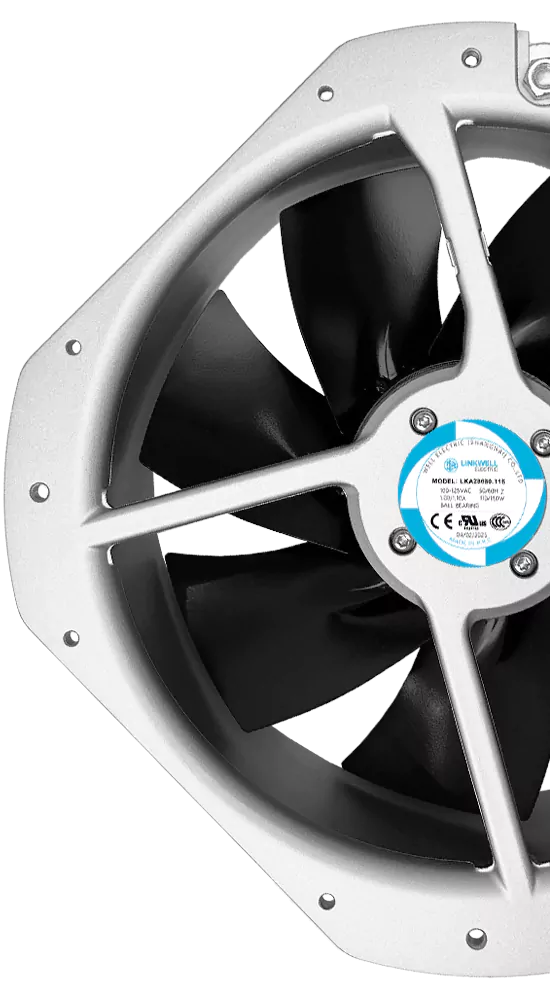
Energy efficiency in industrial cooling is no longer a side topic. For many OEM buyers and equipment manufacturers, it has become part of the core design discussion. The question is not only whether a fan can move enough air. The real question is whether the cooling system is using power intelligently over long operating hours, varying thermal loads, and real industrial conditions.
That is why EC fans are getting more attention. But this is also where the market gets noisy. Many suppliers present EC fans as if they are a universal shortcut to lower energy cost. The truth is more practical than that. An EC fan can deliver real efficiency gains, but only when the system is designed to use its strengths. If the control logic is poor or the fan runs like a fixed-speed unit all day, you may simply be paying more for technology that never gets to prove its value.
At LINKWELL, we look at EC fan efficiency from the project side, not just from the brochure side. In this article, we explain how EC fans improve energy efficiency in industrial cooling, where those gains usually come from, and what buyers should pay attention to before making a selection.
What Is an EC Fan
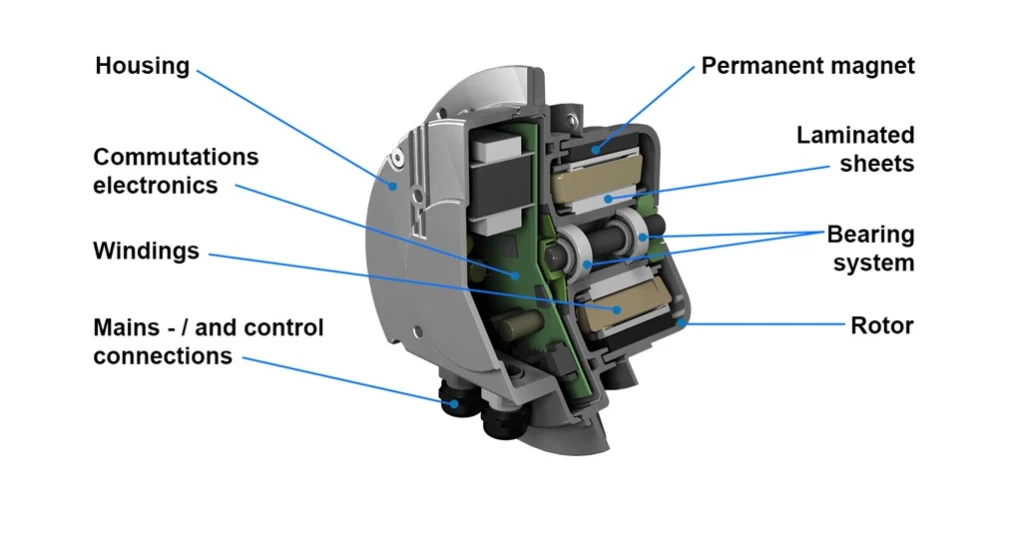
An EC fan uses an electronically commutated motor. In practical terms, it combines the input compatibility of AC-powered systems with the control advantages of a brushless motor design. This allows the fan to run with more precise speed regulation and better efficiency under many operating conditions.
That is the short definition. But for industrial buyers, the more useful way to think about EC fans is this: they are usually chosen when the cooling system needs more than just fixed airflow. If the project values speed control, part-load efficiency, and better matching between airflow demand and actual heat load, EC technology starts to make more sense.
This is why EC fans are often discussed in HVAC equipment, telecom cabinets, electrical enclosures, industrial ventilation systems, and other projects where operating hours are long and thermal demand is not always constant.
Why Energy Efficiency Matters More Than It Used To
In many industrial systems, fans run for long periods, sometimes continuously. Because the fan is only one part of the equipment, its energy use is often underestimated at the beginning of a project. But over time, the fan’s operating pattern can have a clear effect on total system cost.
More importantly, fan efficiency is not only about electricity bills. When airflow is poorly matched to the system, the result can be unnecessary noise, wasted power, unstable temperature behavior, and higher operating stress across the cooling system. In other words, inefficient fan operation does not just waste energy. It often creates side effects that make the overall equipment performance worse.
This is why buyers now ask more specific questions. They want to know not only how much air a fan can move, but also how well that fan behaves under real load, partial load, and changing operating conditions. That shift is one of the main reasons EC fans have become more relevant in industrial cooling conversations.
How EC Fans Improve Energy Efficiency
The first part of the answer is the motor itself. EC motors are generally more efficient than many traditional AC motor structures, especially when the application benefits from speed control and variable operation. Less electrical loss inside the motor means a larger share of input power becomes useful airflow instead of being lost as heat.
But that is only part of the story. The real efficiency advantage of EC fans usually comes from control.
In a conventional fixed-speed system, the fan often runs at the same speed whenever it is powered on, even if the equipment does not need maximum airflow all the time. That is a common source of waste in industrial cooling. The system may spend long periods moving more air than necessary simply because the fan has no practical way to respond.
EC fans improve this because they can be controlled more precisely. Depending on the design, that may involve 0-10V control, PWM control, or other integrated speed regulation strategies. This matters because airflow demand in industrial cooling is not always stable. Heat load rises and falls. Ambient conditions change. Equipment cycles change. When the fan can adjust with those conditions instead of fighting them, energy use becomes much more efficient.
There is another point that experienced engineers usually understand immediately: fan power does not fall in a simple one-to-one line with speed. In variable-speed systems, even a moderate speed reduction can produce a much larger drop in power consumption. This is one reason EC fans can show strong energy-saving potential in part-load operation. If the system is designed to make use of speed control, the efficiency gain becomes much more meaningful than a basic nameplate comparison would suggest.
So the real answer is not that EC fans are more efficient only because the motor is better. They are more efficient because the motor and control logic together allow the fan to work closer to what the system actually needs.
Better Control Is Often More Important Than Better Marketing
A lot of marketing around EC fans is technically true but commercially oversimplified. Buyers are told that EC technology automatically means major energy savings. What they are not always told is that the fan must be allowed to operate the way it was designed to operate.
If the fan is installed into a system with weak control logic, poor thermal feedback, or no meaningful speed variation, much of the advantage is lost. At that point, the project may still be buying a more advanced motor, but not necessarily a more efficient cooling strategy.
That is why we usually tell customers to evaluate EC fans at the system level, not only at the motor level. The fan must match the equipment architecture, the operating pattern, and the real cooling demand. If it does, the value can be strong. If it does not, the efficiency story may remain mostly theoretical.
Where EC Fans Create the Most Value
EC fans usually show the strongest efficiency benefit in systems where operating hours are long and airflow demand changes over time. This is where speed control and part-load performance begin to matter in a practical way.
Typical examples include HVAC units, AHU systems, telecom cabinets, electrical enclosures, industrial ventilation equipment, and some energy storage or power electronics applications. In these environments, cooling demand may shift based on internal load, ambient temperature, or operating mode. When airflow can be adjusted instead of fixed, the fan uses power more intelligently.
In some cases, a backward curved EC centrifugal fan can be especially valuable because it combines good pressure performance with more efficient control behavior. This is why buyers looking at EC backward curved centrifugal fan solutions often come from applications where static pressure and operating efficiency both matter. In other systems, an EC axial fan may be more suitable if the airflow path is more open and the cooling structure does not require the same pressure characteristics.
The common thread is simple: EC fans create the most value where the system is active enough, smart enough, or variable enough to use controlled airflow properly.
When EC Fans May Not Be the Best Choice
A reliable article should also say where EC technology is not the strongest answer.
If the system is simple, fixed, and does not need variable airflow behavior, the energy advantage of an EC fan may be smaller than expected. In some compact low-voltage equipment, a standard DC fan may still be the more direct solution. In projects where cost pressure is high and the system is not designed to benefit from advanced control, an EC fan can become a premium feature without a proportional return.
This is where buyers need to stay practical. Newer technology is not always the better investment. In many projects, the right fan is the one that fits the electrical architecture, the cooling target, and the operating pattern without adding unnecessary cost or complexity.
What We Look for Inside an EC Fan and What You Should Too
Not all EC fans are equal, and this part is often ignored in generic articles.
A low-cost EC fan may still use weaker internal components, lower-grade capacitors, less stable electronics, or a control section that struggles in high ambient temperature and electrically noisy environments. On paper, the label still says EC. In real industrial service, the difference appears later, usually as unstable behavior, shortened life, or premature failure.
At LINKWELL, we pay attention to more than whether the fan spins and responds to a speed signal. We look at whether the internal design can keep performing under real industrial conditions. That includes thermal behavior, electronic stability, bearing quality, component consistency, and expected long-term operation. For many OEM projects, this matters just as much as nominal efficiency.
A fan that saves energy for six months and then creates service issues is not an efficient decision. Real efficiency includes reliability.
Other Benefits Beyond Energy Saving
Energy efficiency is the main reason many buyers start looking at EC fans, but it is not the only advantage worth considering.
Because EC fans can adjust speed more precisely, they can often reduce unnecessary noise when full output is not needed. They can also improve airflow matching across different operating states, which may help support more stable internal temperatures. In more advanced equipment, EC fans can fit better into integrated control strategies where cooling behavior is part of the wider system logic.
These are not secondary benefits in every project. In some systems, they are part of the main value proposition.
How We Help Buyers Choose the Right EC Fan
At LINKWELL, we do not recommend EC fans simply because the market sees them as a premium option. We recommend them when the application can use what they offer.
When we review a project, we look first at the actual system. That includes voltage, installation space, airflow target, static pressure needs, operating temperature, duty cycle, and control requirement. If the project needs variable-speed behavior, better efficiency over long running hours, or a stronger EC motor cooling solution, we help evaluate the suitable direction. If a simpler fan type would do the job better, that matters too.
We support OEM buyers with model recommendation, technical data, and project-based customization according to application requirements. For industrial cooling, good selection usually saves more money than a low unit price ever will.
Conclusion
EC fans improve energy efficiency in industrial cooling because they combine better motor efficiency with better speed control and better system matching. Their value becomes most visible in applications with long operating hours, changing thermal load, or stronger control requirements.
But the biggest mistake is to treat EC technology like a magic answer. It is not. Its value depends on whether the system can actually use its strengths. When it can, the energy-saving benefit can be meaningful. When it cannot, the premium may be much easier to buy than to recover.
That is why selection matters. If you are comparing EC fan options for industrial cooling, the right question is not only how efficient the fan looks on paper. The better question is whether the fan will operate efficiently in your real project.
Need Help Selecting an EC Fan for Your Project
Send us your application, voltage, installation size, airflow requirement, operating environment, and control method. We can help recommend a suitable EC fan solution and provide technical data for review.