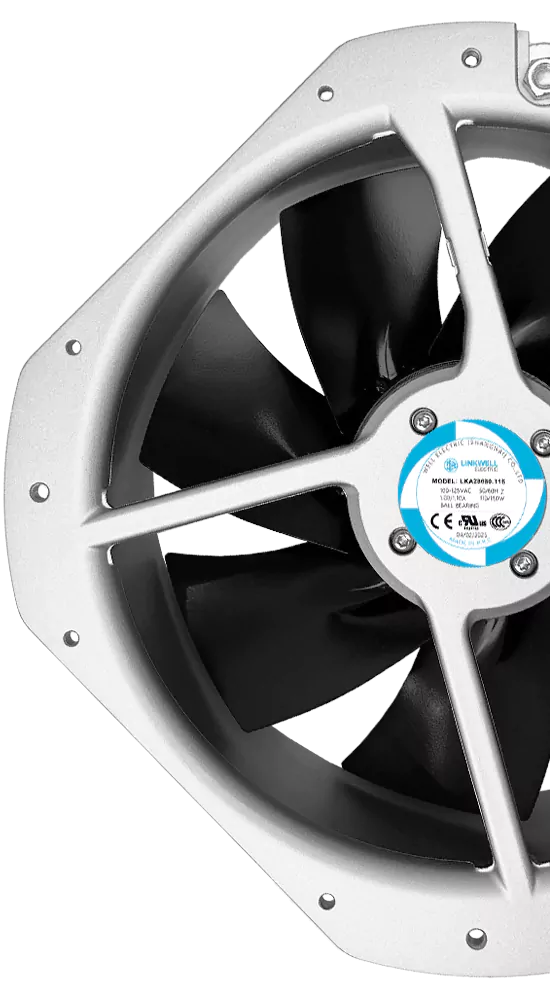
Match the exhaust fan’s CFM and static pressure to your enclosure’s thermal load and system resistance.
This guide provides a structured, engineering‑based approach for choosing exhaust fans used in:
- industrial control cabinets
- energy storage systems
- inverter stations
- telecom shelters
- ducted ventilation equipment
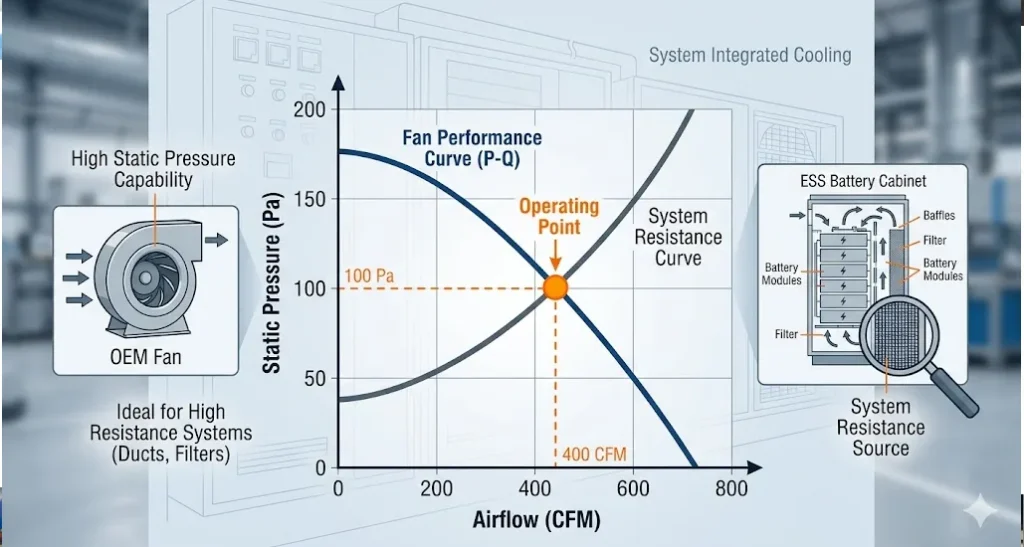
Key Takeaways (for OEM Engineers)
| Selection Criteria | Why It Matters |
|---|---|
| Static pressure capability | Maintains airflow under filter and duct resistance |
| CFM at operating pressure | Real performance, not free‑air spec |
| Motor type (AC / DC / EC) | Determines efficiency, control, and lifecycle cost |
| Environmental rating (IP) | Protects against dust, moisture, grease |
| Continuous operation duty | 60,000+ hours bearing life |
| Certifications | UL / CE / RoHS for global market access |
Step 1 – Define Enclosure Type and Operating Conditions
Before calculating airflow, answer these four questions:
| Question | Engineering Implication |
|---|---|
| Enclosed volume (liters / ft³) | Determines baseline airflow |
| Heat load (watts) | Drives required CFM |
| Internal resistance | Filters, louver, baffles increase static pressure |
| Operating hours | Continuous vs intermittent affects motor choice |
Typical OEM exhaust fan applications include:
- Control cabinets – moderate heat, moderate resistance
- Energy storage cabinets – high heat, compact space, high static pressure
- Inverter / power stations – heat‑sensitive components, continuous operation
- Duct fans – long ducts, multiple elbows, high static demand
Step 2 – Determine Required CFM and Static Pressure
2.1 Airflow (CFM)
For sealed or semi‑sealed enclosures, a simplified thermal method is:
CFM = (Heat load in watts) / (1.08 × ΔT in °F)
Where ΔT is the allowable temperature rise inside the enclosure.
If thermal data is not available, use application‑based reference ranges:
| Application | Typical CFM Range | Typical Static Pressure (Pa) |
|---|---|---|
| Small control cabinet | 80 – 200 | 40 – 80 |
| Medium industrial panel | 150 – 350 | 60 – 120 |
| Energy storage cabinet | 300 – 800 | 80 – 200 |
| Inverter / drive cabinet | 100 – 300 | 60 – 150 |
| Duct fan (short duct) | 400 – 1000 | 100 – 200 |
| Duct fan (long duct + filter) | 600 – 1500 | 150 – 300 |
Do not size by “1 CFM per square foot”. That method is for occupied rooms, not sealed equipment.
2.2 Static Pressure (Pa)
Static pressure is the resistance the fan must overcome. Common sources:
- intake / exhaust filters
- insect screens or louvers
- duct length and bends
- internal component layout
Rule of thumb for OEM exhaust systems:
| Resistance Level | Estimated Static Pressure | Recommended Fan Type |
|---|---|---|
| Minimal (no duct, no filter) | < 40 Pa | Axial or centrifugal |
| Moderate (short duct + one filter) | 40 – 100 Pa | Centrifugal |
| High (long duct + multiple filters) | 100 – 200 Pa | Centrifugal, backward‑curved |
| Very high (>200 Pa) | > 200 Pa | High‑pressure centrifugal |
Step 3 – Choose Motor Type: AC, DC, or EC
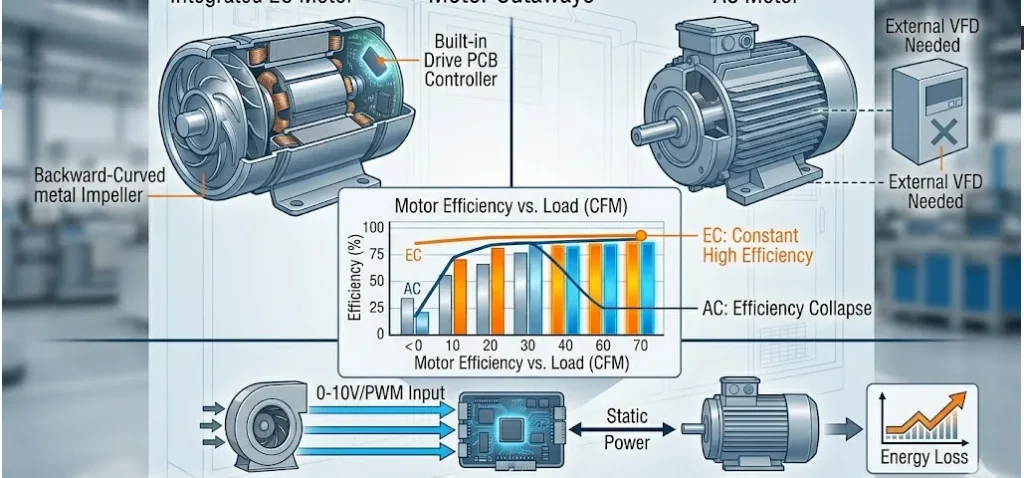
Motor selection directly impacts efficiency, speed control, and long‑term operating cost.
| Feature | AC Motor | DC Motor | EC Motor (Recommended) |
|---|---|---|---|
| Efficiency | 50–60% | 70–80% | >85% |
| Speed control | External VFD | PWM | Built‑in 0‑10V / PWM |
| Energy saving | baseline | moderate | up to 70% vs AC |
| Typical OEM use | Fixed‑speed exhaust | Battery‑fed systems | Smart / energy‑efficient equipment |
EC motors are strongly recommended for exhaust fans in energy storage, telecommunications, and continuous‑duty applications.
Step 4 – Evaluate Environmental and Mechanical Constraints
| Constraint | What to Check | Recommended Fan Feature |
|---|---|---|
| Dust | Control cabinet, outdoor | IP44 minimum |
| Moisture / washdown | Food, marine, outdoor | IP54 / IP56 |
| Grease | Kitchen exhaust | Sealed motor, coated PCB |
| High temperature | Inverter, solar | Temperature‑rated motor (‑20°C to +70°C) |
| Tight mounting space | Compact equipment | Custom bracket, low‑profile housing |
| Vibration | Mobile or industrial | Dual ball bearings, reinforced frame |
Always match fan IP rating and bearing type to the actual installation environment.
Step 5 – Validate Certifications, Life, and Customization
Certifications
For global OEM projects, the exhaust fan should meet:
| Certification | Meaning |
|---|---|
| UL | North American electrical safety |
| CE | EU compliance |
| RoHS | Restriction of hazardous substances |
| ISO9001 | Manufacturing quality system |
Service Life
For continuous‑duty exhaust applications, specify:
- L10 bearing life ≥ 60,000 hours at rated temperature
- MTBF data available from manufacturer
Customization for OEM Integration
OEM projects rarely use off‑the‑shelf fans. Common customizations include:
- custom voltage (12V / 24V / 48V DC, 110–380V AC)
- mounting flange / bracket modification
- IP rating upgrade
- connector and lead wire customization
- tacho signal (FG) or locked rotor alarm (RD)
Quick Selection Reference Table (OEM Exhaust Fans)
| OEM Application | Recommended Fan | Motor | CFM Range | Static Pressure (Pa) | Key Feature |
|---|---|---|---|---|---|
| Small control cabinet | 133.41 Series | AC / EC | 150–180 | 40–80 | Compact size |
| Medium industrial panel | 175.42 / 190.45 | EC | 180–360 | 60–120 | Good pressure/airflow |
| Energy storage cabinet | 220.44 / 225.63 | EC | 400–800 | 100–180 | High static, energy efficient |
| Inverter / drive cabinet | 250.56 / 280.51 | EC | 500–1200 | 120–200 | Continuous duty |
| Duct fan (challenging duct) | 315.101 / 355.95 | EC | 800–1700 | 150–250 | High pressure, backward curved |
Common Mistakes When Choosing Exhaust Fans for OEM Equipment
| Mistake | Consequence | Correct Approach |
|---|---|---|
| Sizing by “CFM per square foot” | Under‑performance in sealed enclosures | Use thermal load or application table |
| Ignoring static pressure | Airflow drops to near zero under load | Specify required Pa at operating point |
| Choosing AC when EC is needed | Higher energy cost, poor speed control | Evaluate 2‑year operating cost difference |
| Overlooking IP rating | Premature failure in humid/dusty environments | Match IP to actual installation |
| No customization planning | Mechanical mismatch, high installation cost | Discuss flange, voltage, connector early |
Conclusion
Choosing an exhaust fan for OEM equipment is an engineering decision based on:
- enclosure type and thermal load
- required CFM and static pressure
- motor efficiency and control
- environmental constraints
- certifications and customisation support
A properly selected exhaust fan improves system reliability, reduces energy cost, and protects sensitive components.
For OEM‑specific recommendations based on your actual enclosure design and thermal load, fan performance can be matched to your operating point using manufacturer fan curves and application data.
FAQ
What is the most common mistake when selecting an exhaust fan for equipment?
Sizing by CFM only, without considering static pressure. This leads to airflow collapse under real operating conditions.
When should I use an EC motor instead of AC?
When speed control, energy efficiency, or continuous operation is required. EC motors typically pay back their higher initial cost within 1–2 years through energy savings.
How do I know how much static pressure my system needs?
Estimate based on filter type, duct length, elbows, and internal obstructions. When uncertain, choose a centrifugal fan with at least 150 Pa capability.
Can you provide custom exhaust fans for my equipment?
Yes. OEM customization is available for voltage, mounting, IP rating, connectors, and control signals.
What certifications should I look for?
UL, CE, RoHS, and ISO9001 are standard for OEM projects targeting global markets.