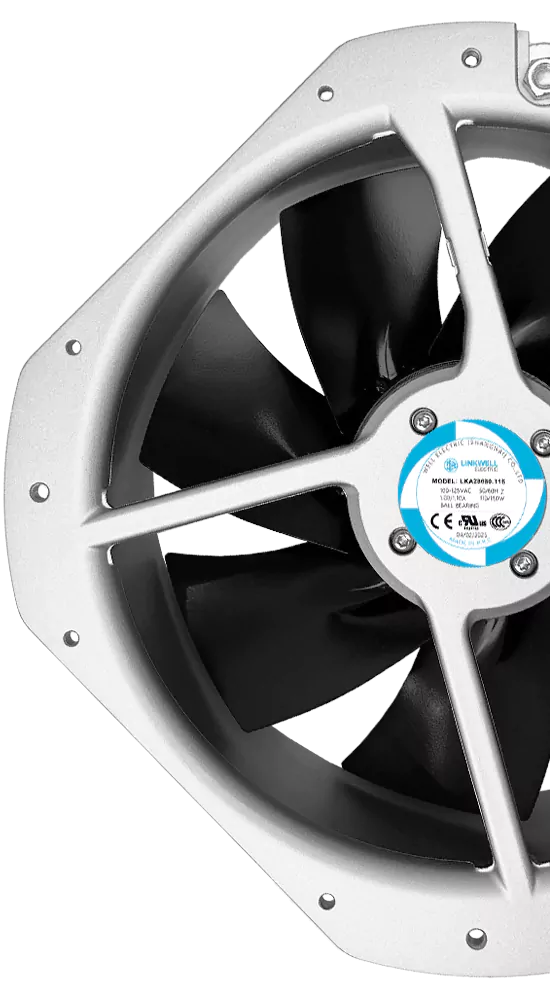
Measuring an industrial cooling fan sounds simple until a replacement fan arrives and does not fit. The frame may be correct, but the thickness is wrong. The mounting holes may be close, but not exact. The voltage may match, but the airflow or connector does not. In industrial cooling, “same size” should never mean only the outside dimension.
At FanACDC, we manufacture AC, DC, EC, axial, and centrifugal cooling fans for electrical cabinets, telecom enclosures, automation equipment, power supplies, battery systems, compact HVAC modules, and industrial electronics. In these applications, fan size affects more than installation. It also affects airflow, static pressure, noise, service life, and whether the fan can be integrated into the equipment without redesign.
This guide explains how to measure an industrial cooling fan size correctly before ordering a replacement fan, selecting a new model, or sending requirements for an OEM project.
Quick Answer
To measure an industrial cooling fan size, check the frame width, frame height, thickness, mounting hole distance, hole diameter, airflow direction, connector type, cable length, and fan label. For centrifugal fans, also measure the impeller diameter, housing width, outlet size, inlet position, and mounting structure.
For most industrial axial fans, the main size is written as:
Width x Height x Thickness
For example:
120 x 120 x 38 mm
That means the fan frame is 120 mm wide, 120 mm high, and 38 mm thick.
But this is only the starting point. For industrial equipment, buyers should also confirm voltage, airflow, static pressure, speed, bearing type, and environmental requirements before replacing or selecting a fan.
Why Fan Size Matters in Industrial Cooling
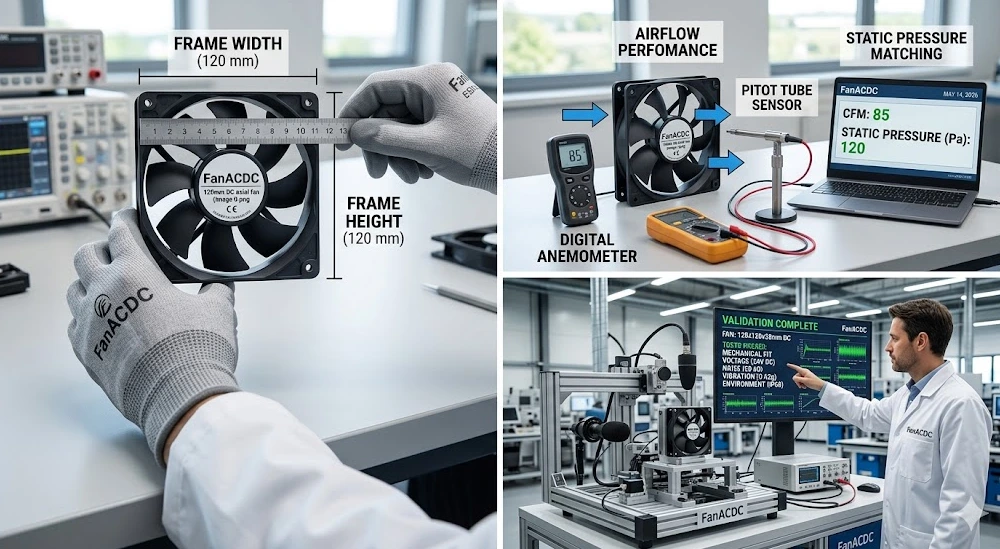
Fan size matters because industrial cooling systems are usually built around fixed mechanical space. A fan in an electrical cabinet, inverter, telecom enclosure, or automation system often sits inside a narrow mounting area. If the fan is too thick, the door may not close. If the mounting holes do not match, the bracket may need modification. If the airflow direction is wrong, the equipment may overheat even though the fan is spinning.
In OEM projects, size also affects production. A fan that requires extra drilling, rewiring, or bracket changes adds cost and slows assembly. For replacement projects, incorrect size selection can create downtime because the equipment may remain offline while another fan is sourced.
This is why accurate measurement should happen before purchasing, not after the fan arrives.
How to Measure an Axial Cooling Fan
Axial fans are common in electrical cabinets, control panels, telecom equipment, power supplies, compact electronics, and general enclosure ventilation. They are usually square or rectangular, and the most common measurement is the outer frame size.
Measure the Frame Width and Height
Place the fan on a flat surface and measure from one outside edge of the frame to the opposite outside edge.
For square fans, width and height are usually the same. Common industrial sizes include 80 mm, 92 mm, 120 mm, 172 mm, 200 mm, and larger formats depending on the application.
For rectangular or special-frame fans, measure both width and height separately.
Do not measure only the blade diameter. The blade tells you something about airflow design, but the equipment mounting space is based on the outer frame.
Measure the Thickness
Fan thickness is the depth of the fan body from front to back.
This matters a lot in compact industrial equipment. A 120 x 120 x 25 mm fan and a 120 x 120 x 38 mm fan may look similar from the front, but they are not the same mechanically. The thicker fan may provide different airflow or pressure, but it may not fit inside the enclosure.
Common thicknesses include 25 mm, 38 mm, 51 mm, and other sizes depending on the fan type.
Measure Mounting Hole Distance
Mounting hole distance is often where replacement mistakes happen.
Measure from the center of one mounting hole to the center of the opposite mounting hole. This is called center-to-center distance. Do not measure from edge to edge unless you later calculate the center position correctly.
For a square axial fan, check both horizontal and vertical hole spacing. They are usually the same, but not always.
Also measure the hole diameter, because screw size may differ between models.
Check Airflow Direction
Fan size is not complete without airflow direction.
Most axial fans have arrows on the frame showing airflow direction and blade rotation direction. If there is no arrow, check the existing installation before removal. In many cabinet cooling systems, one fan may be used for intake and another for exhaust. Installing the fan in the wrong direction can reduce cooling performance quickly.
In electrical cabinets, airflow direction should support the overall thermal design. A fan blowing against the intended path may create hot spots around drives, power modules, or control electronics.
How to Measure a Centrifugal Fan or Blower
Centrifugal fans are different from axial fans. They are often used when the airflow path has more resistance, such as filters, compact ducts, internal channels, or high-density electronics. FanACDC centrifugal fans are commonly used in cabinet cooling, telecom enclosures, automation equipment, HVAC modules, power systems, and compact industrial airflow units.
For centrifugal fans, measuring only the outside frame is not enough.
Measure the Impeller Diameter
The impeller diameter is one of the main size references for a centrifugal fan. Measure the outside diameter of the blower wheel if it is accessible. If the impeller is inside the housing and cannot be measured safely, use the model label or product drawing.
The impeller affects airflow and pressure performance, so it should not be guessed.
Measure the Housing Width
Measure the full width of the centrifugal fan housing. This determines whether the blower can fit into the equipment space.
For compact systems, housing width is often a critical dimension because the blower may sit close to circuit boards, ducts, panels, or brackets.
Measure the Outlet Size
The outlet size is important because it connects directly to the airflow path.
Measure the outlet width and height. If the outlet connects to a duct, grille, or molded airflow channel, even a small mismatch can affect installation and performance.
For OEM projects, outlet position and direction may be just as important as size.
Measure the Mounting Points
Centrifugal fans may use side mounting, base mounting, bracket mounting, or customized mounting structures. Measure the hole spacing, hole diameter, bracket position, and any clearance around the housing.
If the replacement blower is not mounted firmly, vibration and noise can increase.
Do Not Ignore the Fan Label
The fan label often contains the most important information.
Before removing an old fan, take a clear photo of the label. It may include:
- Model number
- Voltage
- Current
- Power
- Frequency for AC fans
- Speed
- Airflow
- Safety certification
- Manufacturer information
- Rotation or airflow information
A fan with the same physical size but different voltage is not a proper replacement. A fan with the same voltage but much lower airflow may also fail in the application.
For AC fans, confirm whether the rating is 110V, 115V, 120V, 220V, 230V, or 240V AC, and check whether it is 50Hz, 60Hz, or dual-frequency.
For DC fans, confirm whether it is 12V, 24V, 48V, or another voltage. Also check whether it uses two wires, three wires, four wires, PWM control, FG signal, RD signal, or alarm output.
For EC fans, confirm the control method and input range carefully.
Size Is Not the Same as Performance
One of the biggest mistakes in fan replacement is assuming that the same size means the same cooling effect.
Two fans can both be 120 x 120 x 38 mm, but one may have higher airflow, higher static pressure, different noise level, different bearing life, or different motor design.
In industrial cooling, performance depends on:
| Parameter | Description | Impact on Performance | Selection Guideline |
|---|---|---|---|
| Airflow | Volume of air moved per minute, measured in CFM or m³/h | Directly affects cooling capacity. Higher airflow removes more heat | Calculate required airflow based on equipment heat load. Note: Free-air vs installed airflow can differ significantly |
| Static Pressure | Fan‘s ability to overcome system resistance, measured in Pa or mmH₂O | Determines whether the fan works effectively with filters, ducts, or dense components | High system resistance (filters, long ducts) → choose high static pressure fan (typically centrifugal) |
| Speed | Fan rotation speed, measured in RPM | Affects airflow, static pressure, noise, and lifespan. Higher speed = more airflow but also more noise and vibration | Balance between airflow demand and noise limits. DC/EC fans support PWM speed control for optimization |
| Blade Design | Blade shape, count, angle, and material (plastic or metal) | Affects airflow efficiency, noise characteristics, static pressure capability, and cost | Forward-curved → lower noise, lower static pressure; Backward-curved → higher efficiency, higher static pressure; Metal blades → heat-resistant, durable |
| Motor Type | AC, DC, or EC motor technology | Determines power source, speed control flexibility, energy efficiency, and operating cost | AC → direct mains power, simple, cost-effective; DC → low voltage, PWM control; EC → energy-saving, intelligent control, lower long-term cost |
| Bearing Type | Sleeve bearing, dual ball bearing, or hydraulic bearing | Affects noise level, service life, operating temperature range, and mounting orientation flexibility | Sleeve → lower cost, quieter initially, shorter life; Dual ball → longer life (70,000 hrs), wider temp range, any orientation; Hydraulic → balanced option |
| Housing Structure | Frame material, thickness, inlet/outlet design, and mounting hole pattern | Affects mechanical strength, vibration transfer, installation fit, and airflow direction control | Reinforced housing for high-vibration environments; Compact housing for tight spaces; Ensure mounting hole pattern matches equipment |
| Voltage | Operating voltage: 12V, 24V, 48V DC or 110V, 220V, 230V AC | Determines electrical compatibility with system power supply | Match fan voltage to system power source. Confirm AC frequency (50Hz/60Hz) for AC fans. Wrong voltage can cause unstable operation or failure |
| Inlet & Outlet Conditions | Clearance, obstruction, grille design, and airflow path restrictions | Affects actual airflow, noise level, and vibration. Poor conditions can reduce performance by 30-50% | Maintain minimum clearance (typically 15-20mm) at inlet and outlet. Avoid sharp bends, cable bundles, or dense components near airflow path |
| Operating Temperature | Ambient temperature range where the fan runs, typically -10°C to +70°C | Affects bearing life, motor performance, and overall reliability. High temperature reduces lifespan | High-temperature environments → choose dual ball bearings and high-temp rated motors; Low-temperature → check startup capability |
| IP Protection | Ingress Protection rating: IP44, IP55, IP68, etc. | Determines resistance to dust and water ingress | IP44 → indoor, clean environment; IP55 → outdoor, rain, dust; IP68 → washdown, temporary submersion |
This matters especially in compact equipment. A fan may perform well in free air but lose airflow after being installed behind a filter or grille. If the application has resistance, a larger axial fan is not always the answer. A centrifugal blower may be a better fit.
Industrial Applications Where Accurate Fan Measurement Matters
Electrical Cabinets
Electrical cabinets often use axial fans or centrifugal blowers to remove heat from drives, PLCs, relays, and power modules. Incorrect fan size can cause poor sealing, weak airflow, vibration, or installation problems.
Telecom Enclosures
Telecom equipment may require low-voltage DC fans, high-reliability bearings, IP-rated protection, or controlled airflow paths. Size measurement should include connector, cable length, and airflow direction.
Automation Equipment
Automation systems often have compact internal layouts. Fan thickness and mounting position can be just as important as airflow.
Power Supplies and Inverters
Power electronics generate concentrated heat. A replacement fan must match both mechanical size and cooling performance.
Battery and Energy Storage Systems
Battery systems may require controlled airflow distribution. Fan size, airflow path, voltage, and long-term reliability should be checked together.
Compact HVAC Modules
Small airflow units and HVAC-related modules may use axial fans for open airflow or centrifugal fans for higher resistance. Measuring the outlet, mounting, and system space is important before choosing the fan type.
Industrial Cooling Fan Measurement Checklist
| What to Measure | Why It Matters |
|---|---|
| Frame width and height | Confirms basic fit |
| Thickness | Prevents interference inside equipment |
| Mounting hole distance | Ensures screw alignment |
| Hole diameter | Confirms hardware compatibility |
| Airflow direction | Prevents wrong installation |
| Voltage | Prevents electrical mismatch |
| Frequency | Important for AC fan performance |
| Cable length | Affects installation and assembly |
| Connector type | Prevents wiring changes |
| Bearing type | Affects noise and service life |
| Airflow and static pressure | Confirms cooling performance |
| IP rating | Important for dust, humidity, or outdoor use |
| Operating temperature | Affects motor and bearing life |
Case Example: Same Frame Size, Wrong Replacement
A customer needed to replace a cooling fan inside an industrial control cabinet. The original fan was a 120 x 120 x 38 mm AC axial fan. The buyer selected another 120 mm fan, assuming the size was enough.
Mechanically, the fan could be installed. But after replacement, the cabinet temperature increased during full-load operation.
The reason was not the frame size. The original fan had higher static pressure and was designed to push air through a filter and narrow internal path. The replacement fan had similar free-air airflow but weaker pressure performance. Once installed in the cabinet, the actual airflow dropped.
After reviewing the fan label, filter layout, voltage, and cabinet structure, the project moved back to a fan with suitable pressure performance and correct mounting depth. The cooling problem disappeared without changing the whole cabinet design.
This case shows why size measurement is only the first step. Industrial fan selection should always connect size with airflow, pressure, and application conditions.
How FanACDC Helps With Fan Size Matching
FanACDC supports AC, DC, EC, axial, and centrifugal cooling fan selection for industrial and OEM applications. If you are replacing an old fan or selecting a fan for new equipment, we can help review the key details before sampling.
| Item | Description |
|---|---|
| Fan photos | Clear image of the fan |
| Label photo | Voltage, current, model info |
| Frame size | Length x width (mm) |
| Thickness | Fan depth (mm) |
| Mounting hole distance | Center-to-center (mm) |
| Voltage | AC/DC and value (V) |
| Cable and connector | Type, length, pin count |
| Application type | Cabinet, telecom, etc. |
| Airflow path or equipment photo | Installation environment |
| Issue | Noise, vibration, or overheating |
This helps us determine whether a standard model is suitable or whether a custom fan solution is needed.
For OEM projects, FanACDC can also support voltage matching, connector customization, cable length changes, bearing selection, PWM/FG/RD signal options, IP-rated fans, and axial or centrifugal platform selection.
FAQ
How do I measure a cooling fan size?
Measure the outside frame width, frame height, and thickness. Then measure the mounting hole distance from center to center. For industrial replacement, also check voltage, airflow direction, connector, and fan label.
Is fan size measured by blade diameter?
Usually no. Industrial axial fan size is normally based on the outer frame dimension, not the blade diameter. For centrifugal fans, impeller diameter may be important, but housing and outlet size also matter.
What does 120 x 120 x 38 mm mean?
It means the fan frame is 120 mm wide, 120 mm high, and 38 mm thick. This is a common way to describe axial cooling fan size.
Can I replace a fan with another fan of the same size?
Not always. The replacement fan must also match voltage, airflow, static pressure, speed, connector, bearing type, and operating environment.
How do I measure a centrifugal blower size?
Measure the impeller diameter, housing width, outlet size, mounting points, and installation clearance. Also check the model label and airflow direction.
Can FanACDC help identify a replacement fan?
Yes. Send the fan label, photos, size, voltage, mounting details, and application information. FanACDC can help match an AC, DC, EC, axial, or centrifugal fan for industrial equipment.
Conclusion
Measuring an industrial cooling fan size is more than checking the outside frame. A correct measurement should include width, height, thickness, mounting holes, airflow direction, voltage, cable, connector, and performance requirements.
For axial fans, the basic size is usually width x height x thickness. For centrifugal fans, housing size, impeller diameter, outlet size, and mounting structure also need attention.
In electrical cabinets, telecom enclosures, automation equipment, power supplies, battery systems, compact HVAC modules, and industrial electronics, the wrong fan can create overheating, noise, vibration, or installation delays.
FanACDC helps industrial and OEM buyers select AC, DC, EC, axial, and centrifugal cooling fans that match both the mechanical space and the real cooling requirement. If you are not sure about the correct fan size, send us the fan label, photos, voltage, and application details. We can help you choose a replacement or OEM cooling fan solution that fits the equipment properly.