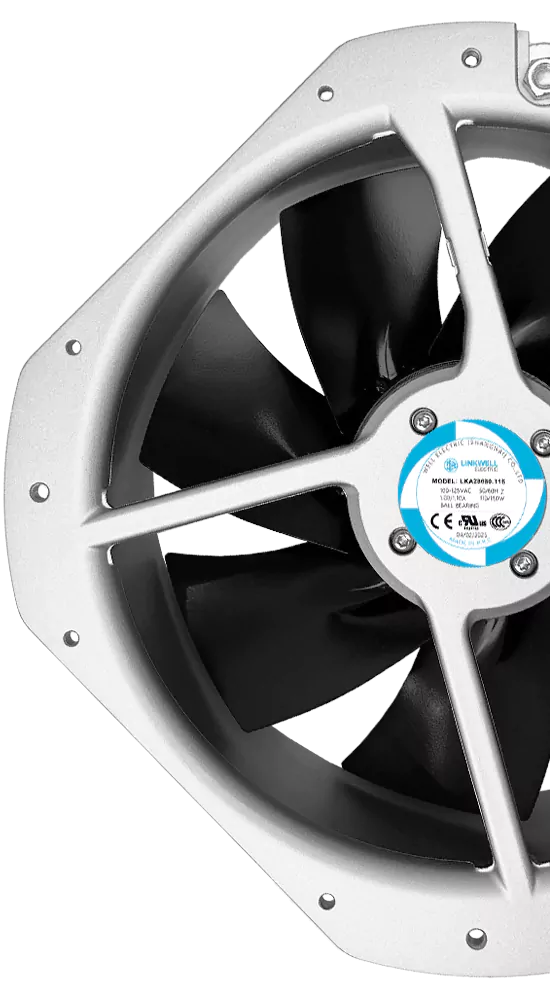
Vibration in an industrial cooling fan is not only a noise problem. In electrical cabinets, telecom enclosures, automation equipment, power supplies, battery systems, and compact industrial electronics, vibration can loosen mounting points, increase bearing wear, create unwanted noise, and shorten the service life of nearby components.
At FanACDC, we manufacture AC, DC, EC, axial, and centrifugal cooling fans for industrial and OEM applications. In real projects, vibration is rarely caused by one single detail. It can come from fan balance, bearing quality, installation structure, airflow resistance, mounting method, voltage mismatch, or choosing the wrong fan type for the application.
Reducing vibration starts with understanding where it comes from.
Quick Answer
To reduce vibration in industrial cooling fans, start by checking fan balance, mounting stability, bearing condition, airflow obstruction, voltage input, and whether the fan type matches the system resistance. For OEM equipment, vibration control should be considered during fan selection, not only after installation.
In most cases, the best results come from combining:
- A dynamically balanced fan rotor
- Proper bearing selection
- Stable mounting structure
- Correct voltage and speed control
- Suitable fan type for the airflow path
- Rubber pads, grommets, or vibration isolation where needed
- Clean air inlet and outlet design
- Reliable long-life fan construction
For compact industrial systems, the goal is not only “less shaking.” The real goal is stable cooling with lower noise, longer fan life, and fewer field failures.
Why Fan Vibration Matters in Industrial Equipment
A small amount of vibration may look harmless at first. The fan still spins. Air still moves. The equipment may pass a short test.
The problem appears later.
In a control cabinet, vibration can transfer into the sheet metal panel and make the whole enclosure louder. In telecom equipment, vibration can affect long-term reliability because fans often run continuously. In automation systems, vibration can loosen screws or connectors after long operating hours. In power electronics or battery systems, unstable airflow can turn into uneven cooling.
This matters especially for small and medium industrial fans because they are often installed close to sensitive components. A fan inside a cabinet or compact module is not isolated from the rest of the system. Any vibration can travel through the housing, bracket, screws, panel, or duct structure.
That is why fan vibration should be treated as part of thermal design, not as a small mechanical afterthought.
Common Causes of Cooling Fan Vibration
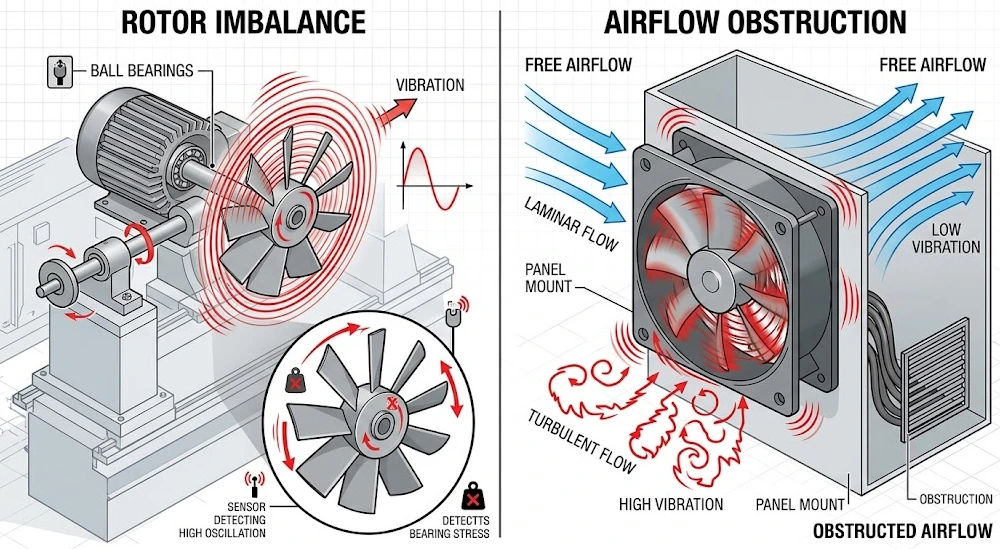
1. Rotor or Impeller Imbalance
The most direct cause is imbalance in the rotating part of the fan. If the blade, hub, or impeller is not balanced properly, the fan will create vibration as speed increases.
This applies to both axial fans and centrifugal blowers. In axial fans, imbalance often shows as visible shaking or humming at certain speeds. In centrifugal fans, imbalance can become more noticeable because the blower wheel rotates at high speed inside a housing.
For industrial use, dynamic balancing is important. A fan that looks acceptable at low speed may create strong vibration at full speed if balancing is poor.
2. Bearing Wear or Poor Bearing Selection
Bearings affect both noise and vibration. A worn bearing can create rough running, rattling, or unstable rotation. In continuous-duty equipment, bearing quality becomes even more important.
The right bearing also depends on operating conditions. Temperature, mounting orientation, dust exposure, and service life expectations all matter.
For example, a fan used in a telecom enclosure or power cabinet may run for thousands of hours with very little maintenance. In that situation, a long-life ball bearing design is often more suitable than a low-cost bearing choice that may become noisy or unstable over time.
3. Weak Mounting Structure
Sometimes the fan is not the main problem. The mounting structure is.
A fan mounted on a thin metal panel can transfer vibration into the cabinet body. If the panel is flexible, it can amplify the vibration and make the fan sound much louder than it actually is. Loose screws, uneven brackets, and poor alignment can make the problem worse.
This is common in electrical cabinets, compact ventilation modules, and OEM equipment where space is tight and the fan is mounted close to other components.
4. Airflow Obstruction
A fan working against a blocked inlet, narrow outlet, dirty filter, or poor airflow path can produce more vibration and noise.
When air cannot move smoothly, turbulence increases. That turbulence can create pressure fluctuation around the blades or blower wheel. The result may feel like mechanical vibration, even when the fan itself is properly balanced.
In high-resistance systems, choosing the wrong fan type can also cause problems. A standard axial fan may struggle in a restricted airflow path where a centrifugal blower would perform more steadily.
5. Incorrect Voltage or Speed Control
Voltage mismatch can also create unstable operation. If the fan receives the wrong input, it may run below or above its intended operating condition. That can affect speed, motor behavior, heat, noise, and vibration.
For DC and EC fans, poor PWM control can sometimes create unpleasant acoustic behavior or speed fluctuation. For AC fans, voltage and frequency should match the product rating.
This is why FanACDC always recommends confirming voltage, frequency, and control method before sample testing or mass production.
Quick Diagnostic Checklist
Before replacing the fan, check the installation first. In many industrial cooling projects, vibration comes from the way the fan works inside the equipment, not from the fan alone.
Ask these questions:
- Is the fan mounted on a thin or flexible metal panel?
- Is the air inlet partially blocked by cables, terminals, or nearby components?
- Does the airflow path include filters, dense electronics, ducts, or narrow outlet openings?
- Is the fan type matched to the system resistance?
- Is the voltage and frequency correct for the fan rating?
- Are the screws tightened evenly across the fan frame?
- Are rubber grommets, anti-vibration pads, or isolation washers used?
- Does the vibration become worse at higher speed or full load?
If the answer is “yes” to two or more of these questions, the vibration problem may require more than a simple fan replacement. The better approach is to review the fan, mounting structure, airflow path, and electrical input together.
For OEM equipment, this checklist is especially useful before mass production. A fan that looks acceptable in a short bench test may create noise, resonance, or long-term bearing stress after it is installed inside the final enclosure.
How to Reduce Vibration in Industrial Cooling Fans
Choose a Properly Balanced Fan
Good vibration control starts at the fan manufacturing stage. If the rotor, blade, or impeller is not balanced well, later fixes can only do so much.
For industrial cooling applications, ask whether the fan is dynamically balanced and suitable for long operating hours. This is especially important for centrifugal fans and blowers because the impeller structure has a strong effect on vibration behavior.
FanACDC’s industrial cooling fans are designed for stable operation in OEM equipment, electrical enclosures, telecom systems, automation equipment, and power electronics. For buyers, this means the fan should not only meet airflow requirements, but also run smoothly inside the final product.
Match the Fan Type to the Airflow Path
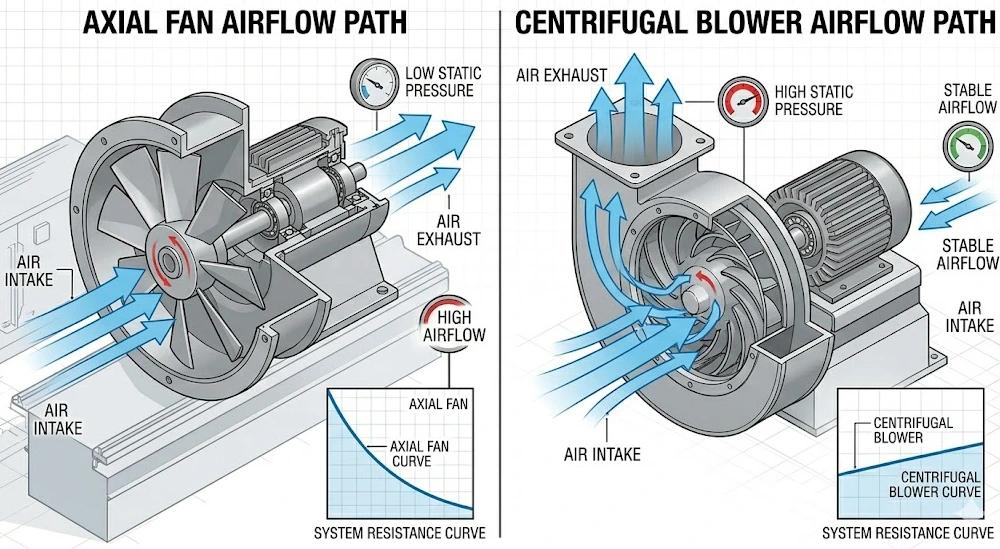
A common mistake is using an axial fan where the system really needs pressure.
Axial fans are a good choice when airflow is relatively open. They work well for cabinet ventilation, general enclosure cooling, and equipment where air can enter and leave without heavy resistance.
Centrifugal fans are usually better when the airflow path is restricted. They are more suitable for compact ducts, filters, dense electronics, and high static pressure conditions.
If an axial fan is forced to work in a high-resistance design, it may produce unstable airflow, extra noise, and vibration-like behavior. In that case, changing to a centrifugal blower may solve more than one problem at the same time.
| Application Condition | Better Fan Direction |
|---|---|
| Open cabinet ventilation | Axial fan |
| Compact electronics cooling | DC axial or small centrifugal fan |
| Filtered airflow path | Centrifugal blower |
| High static pressure requirement | Centrifugal fan |
| Energy-saving speed control | EC fan |
| Low-voltage OEM equipment | DC fan |
| Mains-powered industrial cabinet | AC fan |
Improve Mounting Stability
Mounting is one of the easiest places to overlook vibration.
A fan should be fixed evenly and firmly. Screws should not be over-tightened on one side and loose on another. The mounting surface should be flat enough to avoid twisting the fan frame. If the fan is mounted to a thin panel, vibration isolation may be needed.
Useful methods include:
- Rubber grommets
- Anti-vibration pads
- Flexible mounting washers
- Stronger brackets
- Reinforced panel structure
- Correct screw torque
- Avoiding direct contact with resonant metal panels
For OEM products, it is better to design the mounting structure around the fan early. Trying to solve vibration after tooling is finished is usually harder and more expensive.
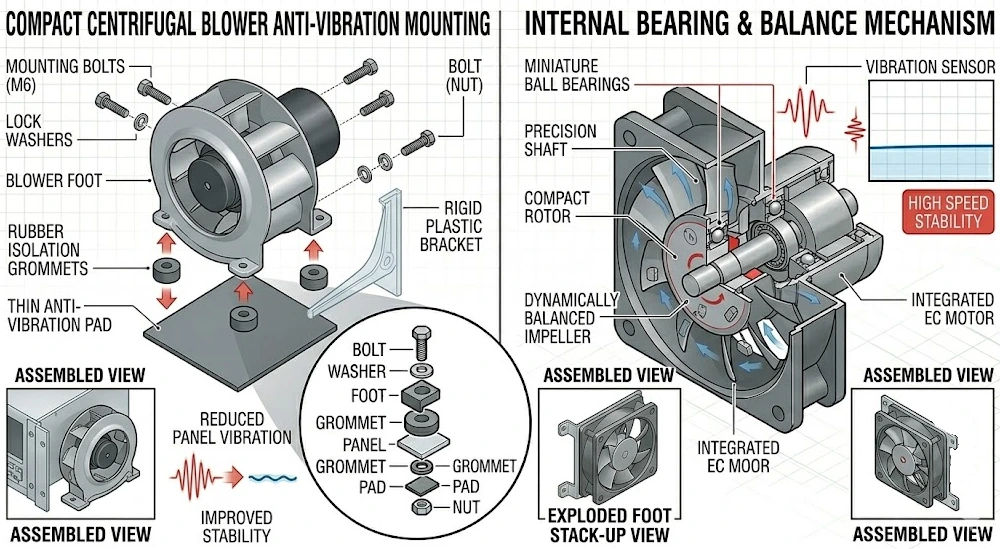
Check Bearing Type and Service Life
Bearing selection should match the actual working environment.
For equipment with long operating hours, high ambient temperature, or difficult service access, bearing quality is not a small detail. A low-grade bearing may reduce initial cost, but it can increase vibration and noise after aging.
FanACDC supports industrial fan selection where service life and reliability matter. For applications such as telecom enclosures, electrical cabinets, automation systems, and power supplies, long-life bearing selection can help reduce vibration risk over time.
When choosing a fan, buyers should confirm:
- Bearing type
- Expected service life
- Operating temperature range
- Mounting orientation
- Continuous operation requirement
- Dust or humidity exposure
Keep the Air Inlet and Outlet Clear
A fan needs space to breathe.
If the inlet is too close to a wall, filter, cable bundle, or internal component, airflow becomes uneven. If the outlet is blocked or sharply redirected, pressure fluctuation increases. Both conditions can create noise and vibration.
In cabinet cooling and compact HVAC modules, even small layout changes can improve fan behavior. Moving a cable bundle, increasing clearance, changing grille design, or switching from an axial fan to a blower can make the system more stable.
A simple rule: do not judge the fan only in free air. Judge it in the real enclosure.
Use Speed Control Carefully
Lower speed usually reduces vibration and noise, but only if the fan still delivers enough airflow.
For DC and EC fans, PWM control can be useful because the fan does not always need to run at full speed. In systems with variable heat load, speed control helps reduce unnecessary vibration during lower-load operation.
However, control quality matters. Poor PWM settings may create speed fluctuation or tonal noise. For OEM designs, the fan control method should be reviewed during sample testing.
FanACDC can support PWM, FG, RD, and alarm signal options depending on the fan platform and project requirement. These functions help equipment manufacturers monitor fan operation and build more reliable thermal control.
Avoid Voltage Mismatch
Voltage mismatch is one of the simplest problems to prevent.
An AC fan should match the correct voltage and frequency. A DC fan should match the system voltage and control method. If the electrical input is wrong, the fan may still spin, but it may not run as designed.
This can lead to:
- Abnormal speed
- Increased heat
- Unstable operation
- Higher noise
- Shorter bearing life
- Premature motor failure
Before ordering a replacement fan or selecting a fan for OEM production, confirm the fan label, machine documentation, and actual power supply.
Case Example: Vibration in a Compact Control Cabinet
A customer working on a compact control cabinet had a vibration problem during full-load testing. The cabinet used a standard axial fan mounted directly to a thin side panel. The fan airflow rating looked suitable on paper, but the cabinet became noticeably louder after installation.
The first assumption was that the fan was defective. After reviewing the setup, the issue was more complex.
The fan was mounted on a flexible metal panel, and the inlet was partially blocked by internal wiring. The airflow path also had more resistance than expected because air had to pass through a dense component area before reaching the outlet.
The solution was not simply replacing the fan with a stronger model. The project used a better-matched fan configuration, improved mounting support, and adjusted the cable layout near the inlet. For the next sample, vibration transfer into the panel was reduced, and airflow around the heat-generating section became more stable.
This is a typical industrial cooling issue. The fan is important, but the final result depends on the fan, mounting, airflow path, and electrical matching working together.
Where Vibration Control Matters Most
Vibration control is especially important in the industries FanACDC serves.
Electrical Cabinets
Fans in electrical cabinets often run for long hours. Vibration can transfer into the metal enclosure and become audible in the surrounding area. It can also loosen mounting hardware over time.
Telecom Enclosures
Telecom equipment requires stable cooling and long service life. Outdoor or semi-outdoor enclosures may face temperature changes, dust, and continuous operation. Low-vibration fan selection helps improve reliability.
Automation Equipment
Industrial automation systems often contain PLCs, drives, power modules, and control boards. Fan vibration should be controlled to protect long-term electrical stability and reduce maintenance problems.
Power Supplies and Inverters
Power electronics generate concentrated heat. Cooling fans must run reliably without adding unnecessary mechanical stress to the equipment.
Battery and Energy Storage Systems
Battery enclosures need stable airflow and controlled thermal distribution. Vibration reduction helps protect the structure and supports long operating life.
Compact Industrial Electronics
In compact equipment, the fan is close to everything. Small vibration problems can become bigger because there is less space to isolate the fan from the product housing.
FanACDC Support for Low-Vibration Cooling Fan Selection
FanACDC manufactures AC, DC, EC, axial, and centrifugal fans for industrial and OEM cooling applications. For vibration-sensitive projects, we help buyers look beyond simple fan size and airflow.
We can support:
- AC axial fan selection
- DC axial fan selection
- EC fan options
- Centrifugal blower selection
- Voltage matching
- Bearing selection
- Cable and connector customization
- PWM / FG / RD signal options
- High static pressure airflow matching
- Low-noise and low-vibration fan selection
- OEM sample review
For buyers, the most useful information to send is simple: fan size, voltage, airflow target, installation position, operating environment, noise requirement, and photos or drawings of the airflow path.
With that information, it becomes much easier to select a fan that runs smoothly inside the real equipment.
Sample Evaluation Before Mass Production
Not sure whether vibration will become a problem in your equipment?
For OEM projects, FanACDC can support sample evaluation before mass production. If you send the fan size, voltage, speed requirement, installation position, enclosure structure, and airflow path, our team can help review whether the fan selection is suitable for stable operation.
This is especially useful for electrical cabinets, telecom enclosures, automation equipment, power supplies, battery systems, and compact industrial electronics where the fan runs for long hours or is mounted close to sensitive components.
A sample test can help confirm:
- Whether the fan creates visible vibration after installation
- Whether the mounting panel amplifies noise
- Whether airflow resistance is forcing the fan to work harder than expected
- Whether a different fan type, bearing, speed, or mounting method would improve stability
Testing before mass production is usually much easier than solving vibration problems after the equipment has already shipped.
FAQ
What causes vibration in industrial cooling fans?
Common causes include rotor imbalance, bearing wear, weak mounting, airflow obstruction, voltage mismatch, poor speed control, and using the wrong fan type for the airflow resistance.
Can a better fan reduce vibration?
Yes, especially if the original fan has poor balance, weak bearings, or is not suitable for the application. But mounting structure and airflow path should also be checked.
Are centrifugal fans more stable than axial fans?
Not always. Centrifugal fans are often better for restricted airflow and high static pressure. Axial fans are suitable for open ventilation. The stable choice depends on the system.
How can I reduce fan vibration in an electrical cabinet?
Check the mounting panel, screw tightness, inlet clearance, outlet path, voltage, and fan type. Rubber grommets or reinforced mounting can also reduce vibration transfer.
Does fan speed affect vibration?
Yes. Higher speed can increase vibration and noise. DC and EC fans with proper speed control can help reduce vibration during lower-load operation.
Can FanACDC help select low-vibration fans for OEM equipment?
Yes. FanACDC supports industrial and OEM fan selection for cabinets, telecom enclosures, automation equipment, power electronics, battery systems, and compact airflow modules.
Conclusion
Reducing vibration in industrial cooling fans is not just a matter of replacing one fan with another. The fan must be balanced, correctly mounted, electrically matched, and suitable for the actual airflow path.
For electrical cabinets, telecom enclosures, automation equipment, power supplies, battery systems, and compact industrial electronics, vibration control helps improve noise performance, service life, and long-term equipment reliability.
FanACDC supports AC, DC, EC, axial, and centrifugal cooling fan solutions for industrial OEM applications. If your current fan creates vibration, noise, or unstable cooling, send us the voltage, size, airflow path, and application details. We can help select a fan solution that fits the equipment and supports stable long-term operation.