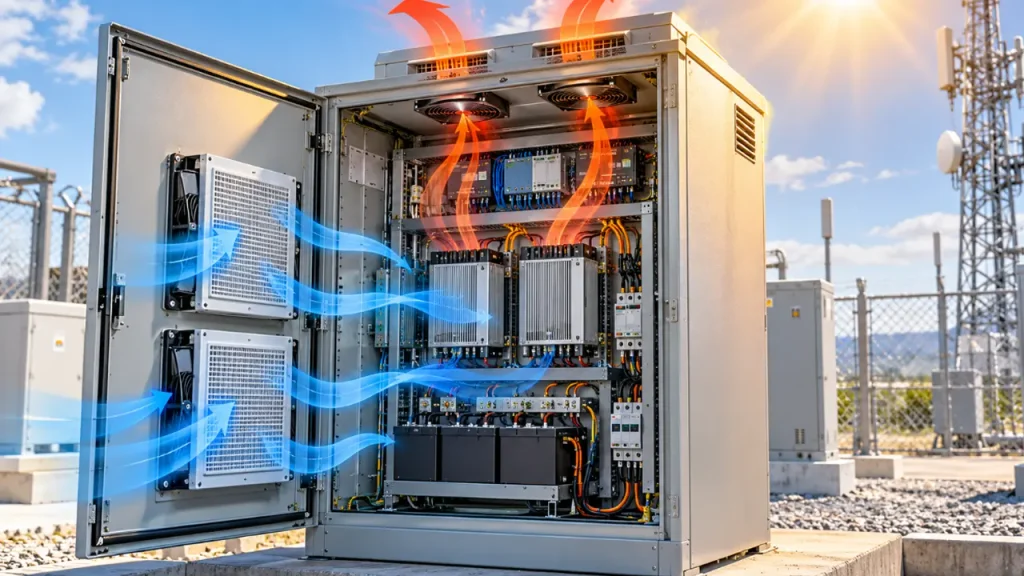
An outdoor cabinet that runs normally in the morning can overheat in the afternoon even when its electrical load has barely changed. Sunlight heats the enclosure, the cooling inlet receives warmer air, and the temperature margin available to the equipment becomes smaller.
Effective outdoor electrical cabinet cooling starts with three checks: how much heat the equipment generates, how much heat the environment adds, and where that combined heat can leave. A larger fan helps only when the air path and available cooling medium allow it to do useful work.
Why Outdoor Cabinets Overheat
Electrical components create internal losses. Solar radiation adds heat through exposed surfaces. High ambient temperature reduces the temperature difference available for passive cooling or ventilation. These effects can occur together, so a cabinet sized only from indoor equipment losses may have too little summer cooling capacity.
Other failures develop gradually. A filter loads with dust, insects obstruct a louver, a door seal deteriorates or a fan loses speed. The cabinet may still pass a brief inspection on a cool day while overheating during its actual peak load.
| Observed pattern | What to investigate first |
|---|---|
| Temperature rises mainly during afternoon sun | Solar exposure, shaded ambient and intake-air temperature |
| Temperature follows production or charging demand | Internal losses, duty cycle and cooling capacity |
| Cooling has worsened over several months | Filter loading, contamination, fan condition and blocked discharge |
| One module overheats while cabinet air remains acceptable | Local bypass, recirculation, spacing and heat-sink airflow |
Separate Solar Heat Gain From Ambient Temperature
A weather report describes air temperature, not the temperature of a sunlit steel door. The enclosure surface can become hotter than the surrounding air. The resulting heat transfer depends on orientation, exposure, surface properties, construction and the temperature inside.
Measure shaded ambient air, actual cooling-inlet air and representative cabinet surfaces separately. A sensor touching the sunlit enclosure is not an ambient-air measurement. Likewise, an inlet close to an exhaust, dark pavement or a hot wall may receive air warmer than the site’s general ambient.
Use a consistent enclosure heat-balance method. If solar exposure is already included through an adjusted surface condition or sizing tool, do not add an unrelated solar allowance that counts the same load twice. Avoid universal claims such as a fixed wattage of solar gain for every cabinet.
Build the Heat Balance Before Selecting a Fan
Use actual equipment dissipation at the intended duty. A power converter’s useful output does not all become heat inside the enclosure. Include auxiliary power supplies, drives, batteries and control electronics, then account for credible external heat gain.
A useful planning relationship is:
Required cooling = internal heat losses + external heat gain – passive heat rejection
All terms are in watts and must refer to the same design condition. Wall transfer can become heat gain when the surrounding surfaces or air are hotter than the intended cabinet interior. The enclosure supplier’s method should establish the effective surface area and heat-transfer assumptions.
Also define limits at the sensitive components. An acceptable average cabinet temperature does not prove that a drive inlet, battery module or power-board hot spot is within its limit.
When a Sun Shield Helps
A sun shield intercepts direct radiation before it reaches the equipment compartment. A ventilated gap between the shield and cabinet allows heat from the shield to escape instead of transferring directly into the cabinet wall.
Evaluate roof and side exposure, attachment points, wind loads, corrosion and service access. A shield pressed against the enclosure can conduct heat inward. A poorly positioned canopy can also trap hot air or obstruct the cooling unit’s discharge.
Tip: Review the sun shield with the cooling inlets and outlets shown on the same drawing. Keep the shield’s ventilation gap and the equipment’s cooling clearances open in the finished installation.
Shading reduces an external heat source. It does not remove the heat generated by equipment inside. Its benefit needs to be checked under the site’s sun angle, operating load and ambient conditions rather than expressed as a guaranteed temperature reduction.
When Filtered Ventilation Is Suitable
Ventilation can work when outside air is acceptable and sufficiently cooler than the permitted internal temperature. It exchanges heated cabinet air for cooler inlet air. As the temperature difference shrinks, more airflow is needed to carry the same heat.
Arrange intake and discharge so air crosses the equipment instead of taking a short route between nearby openings. Keep the exhaust from returning to the inlet. Rain hoods, insect screens, filters and guards all add resistance and must be included in the installed operating point.
The fan must provide the required flow against the loaded air path, not just with a new filter in free air. Review filter service access and define a maintenance trigger based on temperature, pressure drop or condition. See How to Read a Fan Curve for the airflow-pressure relationship.
When the Cabinet Must Remain Sealed
An internal circulation fan redistributes heat and can reduce hot spots, but heat still needs to cross the enclosure boundary. If outside contaminants cannot enter, compare passive wall cooling, an air-to-air exchanger, an air-to-water exchanger or an appropriately sized active cooler.
An air-to-air exchanger needs a useful temperature difference between inside and outside. It cannot provide below-ambient cooling. An air conditioner or suitable cold-water system can support a lower internal temperature, but condensation, drainage and external heat rejection become part of the design.
For this architecture decision, see Sealed Enclosure Cooling: What a Fan Can and Cannot Do. Cutting a fan opening into a sealed cabinet changes both its thermal architecture and its environmental protection.
Choosing AC, DC or EC Fans for an Outdoor Cabinet
Start with supply availability and the required operating point. AC fans may fit cabinets with a suitable mains supply. DC fans can integrate with low-voltage power and monitoring. EC options may provide suitable speed control, depending on the individual model and electrical interface.
Verify voltage range, startup demand, pressure-flow curve, operating temperature, dimensions, airflow direction and the actual PWM, FG or RD functions. These features vary by model. The fan temperature near an exhaust can exceed outdoor ambient because it is exposed to heated cabinet air.
Environmental requirements also belong on the fan and connector specification. A fan’s IP rating does not automatically establish the completed enclosure rating. IEC 60529 defines the IP Code for enclosure protection; installation details still matter at the equipment level.
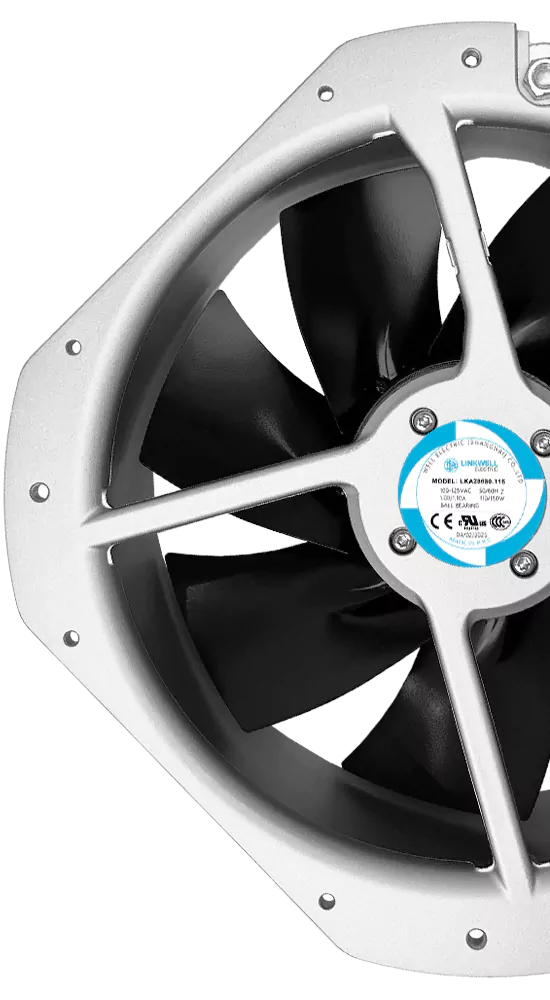
LINKWELL’s DC cooling fan range can be evaluated against the project’s electrical, airflow and installation requirements. Confirm model-specific environmental evidence before specifying protection or temperature claims.
A Practical Overheating Investigation
- Record the alarm, time of day, equipment load, weather and previous maintenance.
- Compare shaded ambient, intake air, internal air and critical-component temperatures.
- Inspect sun exposure and nearby hot surfaces or exhausts.
- Check filters, louvers, fan operation, airflow direction and recirculation.
- Compare the actual operating condition with the original heat balance and equipment limits.
- Test the selected correction with the cabinet closed at representative load.
Change one major variable at a time when diagnosing the cause. Opening the door may lower temperature temporarily, but it changes the air path and protection. It does not validate the permanent closed-cabinet solution.
Validate More Than a Cool-Day Test
Record sensor positions, loading, supply voltage, fan commands and stabilization criteria. Assess the worst credible combination of sunlight, ambient and equipment duty, together with a realistic filter condition. Where cooling availability is critical, check the response to a fan fault and the associated alarm.
If outdoor electronic cabinet cooling failures recur, compare event history against these conditions. A repeated afternoon trip may indicate inadequate solar allowance; random loss of cooling may point toward intermittent power, wiring or control. The repair should address the evidence.
Frequently Asked Questions
Will a larger fan stop an outdoor cabinet overheating?
Only if inadequate installed airflow is the limiting factor. A larger fan cannot cool below its inlet-air temperature or replace a missing heat-rejection path in a sealed cabinet.
Does a sun shield replace cabinet cooling?
No. It can reduce solar heat input, while internal equipment losses still need to leave through the walls, ventilation or a cooling device.
Can an IP-rated outdoor cabinet still overheat?
Yes. Environmental protection and thermal capacity are separate requirements. A well-sealed enclosure can retain excessive internal heat.
What should I provide for fan selection?
Provide heat losses, ambient and sun exposure, temperature limits, enclosure layout, filter or exchanger resistance, supply range, fan space and required monitoring or control functions.