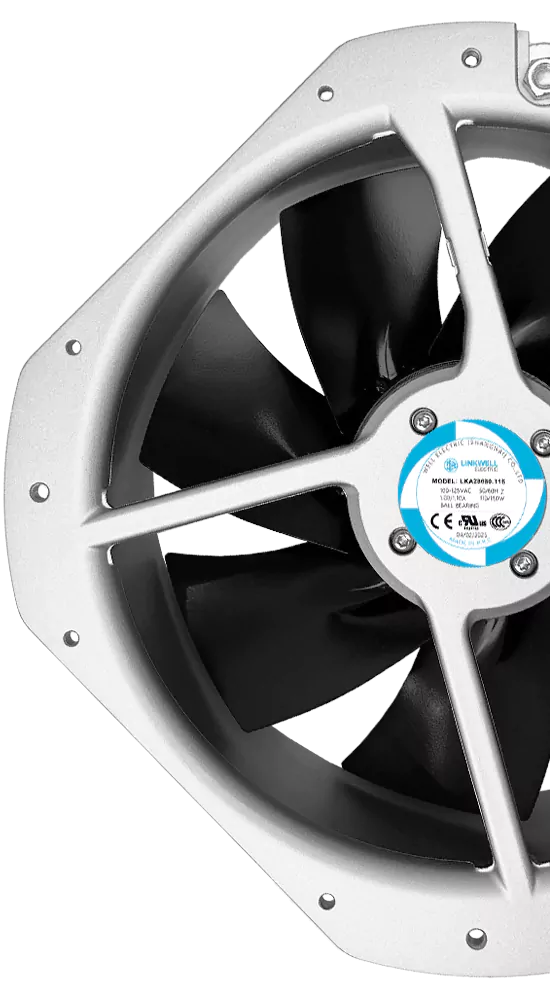
In today’s high-performance industrial, medical, and telecommunications landscapes, thermal management is not a luxury—it’s a critical necessity. As systems from industrial automation PLCs to renewable energy inverters become more powerful and compact, the heat they generate becomes a primary failure point. Traditional “on-off” or simple voltage-controlled fans are no longer sufficient. They are inefficient, noisy, and incapable of the precise modulation required by modern electronics.
This is where PWM technology revolutionizes thermal management. But what is a PWM fan, and how does it deliver the quiet, efficient, and intelligent cooling that critical systems demand? As a leading manufacturer of advanced cooling solutions, including AC, DC, and EC fans, we at LinkWell believe in empowering our partners with expert knowledge.
What Is PWM Fan?
A PWM fan, short for Pulse Width Modulation fan, is a type of DC cooling fan designed to provide precise speed control using a digital modulation signal. Instead of adjusting speed by changing the input voltage, a PWM fan receives a steady 12V power supply and uses a high-frequency square-wave signal to control the motor’s rotation speed. This approach makes PWM fans ideal for applications that require accurate thermal management, energy efficiency, and lower noise output.
PWM fans are widely used in both consumer electronics and industrial equipment due to their ability to maintain consistent performance even under varying temperature conditions. The fan includes a 4-pin connector, where the fourth pin delivers a dedicated PWM control signal. By adjusting this signal, the fan can smoothly shift between low-speed, medium-speed, and high-speed operation without the instability commonly found in traditional voltage-controlled fans.
From an engineering perspective, what makes PWM fans stand out is the internal driver circuit that interprets the PWM control signal. This built-in control system enables the fan to react in real time to changes in system temperature, load, or environmental conditions. As a result, PWM fans have become the preferred choice for sensitive equipment such as electrical enclosures, telecom base stations, renewable energy inverters, and medical devices.
How Do PWM Fans Work?

PWM fans operate based on a concept known as duty cycle. A duty cycle represents the percentage of time that the PWM signal stays in the “on” position during each cycle. For example, a 30% duty cycle keeps the signal on for one-third of each cycle, resulting in low fan speed. A 100% duty cycle keeps the signal on continuously, pushing the fan to maximum speed.
This modulation happens at a high frequency, typically 25 kHz or higher, which is beyond the audible range for humans. Because of this, the fan can accelerate or decelerate without noticeable noise spikes. The motor inside the fan interprets the PWM signal through its integrated controller, adjusting the coil energizing pattern accordingly. This results in stable and smooth transitions between different RPM levels.
In many applications, the PWM signal originates from a motherboard, industrial controller, or temperature-sensing device. When the equipment temperature rises, the controller increases the duty cycle to boost airflow. When the temperature drops, the controller lowers the duty cycle to reduce noise and power consumption. This dynamic regulation enables precise thermal control even in compact or heat-sensitive environments.
Benefits of PWM Fans
Precision Control
One of the most significant benefits of PWM fans is their precision. Unlike conventional DC fans, which rely on voltage changes, PWM fans maintain a stable input voltage while varying speed digitally. This ensures that the motor receives clean power, resulting in improved reliability and accuracy when responding to temperature fluctuations. Precision control is especially beneficial in medical equipment and telecommunications cabinets.
Enhanced Energy Efficiency
Another major advantage is energy efficiency. PWM technology allows systems to use exactly the amount of airflow required—nothing more. For example, reducing a fan’s speed by 20% can reduce power consumption by nearly 50%. In our internal testing, LinkWell’s industrial PWM models consumed up to 30% less energy under typical load conditions compared to their voltage-controlled DC counterparts. This targeted cooling is essential for renewable energy systems, battery cabinets, and greenhouses.
Reduced Operating Noise
Noise reduction is also a core reason engineers choose PWM fans. A standard DC fan at full speed might operate at 45 dBA, whereas a PWM fan at a 50% duty cycle can run as quietly as 22 dBA—roughly the sound level of a whisper. Because speed can be finely tuned, systems avoid sudden jumps between RPM levels, preventing abrupt acoustic spikes in laboratories, medical facilities, and industrial automation systems.
Extended Fan Lifespan
PWM fans also help increase overall fan lifespan. Running at lower, more stable speeds reduces wear on bearings and motor components. Many LinkWell PWM fans are rated for 70,000 hours (L10, at 40°C), offering a significantly longer operational life than standard fans often rated for 50,000 hours. Furthermore, many PWM fans feature a soft-start function, which minimizes mechanical stress during startup, reducing failures for mission-critical applications.
Applications of PWM Fans

PWM fans are commonly used in electrical enclosures where temperature control is essential for protecting circuit breakers, drives, PLCs, and power supplies. Enclosures that experience fluctuating ambient temperatures benefit greatly from PWM control because it ensures stable airflow while minimizing noise during low-load periods.
Telecommunications equipment such as base stations, routers, and 5G network hardware relies on PWM fans for consistent cooling. These systems operate around the clock and generate substantial heat. PWM fans offer precise airflow control, which helps maintain stable signal performance and extends the service life of sensitive components.
In renewable energy systems, particularly solar inverters and battery energy storage systems, PWM fans play a critical role in maintaining thermal stability. These systems often face wide temperature swings due to outdoor installations. PWM-controlled cooling ensures optimal performance while maximizing energy efficiency—an essential requirement for sustainable technology.
Medical equipment, including diagnostic machines and laboratory instruments, also uses PWM fans to prevent overheating of electronic components. Quiet operation is a high priority in medical environments, and PWM fans allow devices to run at minimal noise levels while still providing adequate airflow when required.
Comparing PWM and DC Fans
| Feature | PWM Fan (4-Pin) | Traditional DC Fan (3-Pin) |
| Control Method | Digital Signal (PWM Duty Cycle) | Analog Voltage |
| Input Voltage | Constant (e.g., 12V) | Variable (e.g., 5V – 12V) |
| Speed Range | Wide (e.g., 10% – 100%) | Narrow (May stall at low voltage) |
| Precision | Very High | Medium to Low |
| Energy Efficiency | Very High | Medium |
| Noise Profile | Very low, especially at low RPMs | Low (Can produce motor noise at low voltage) |
| Motor Lifespan | Longer (Less wear) | Standard |
The primary difference between PWM and traditional DC fans lies in the control method. DC fans adjust speed by changing the input voltage, while PWM fans maintain constant voltage and manipulate the duty cycle of a digital signal. This leads to more precise control and improved efficiency in PWM models, especially at lower speeds.
In terms of speed range, PWM fans offer a broader and more stable control spectrum. DC fans may stall or become unstable at very low voltages, whereas PWM fans maintain smooth rotation even at low duty cycles. This characteristic is vital for systems that require quiet, low-speed operation.
Noise levels also differ between the two technologies. PWM fans reduce noise by enabling gradual RPM adjustments, while DC fans often fluctuate more during voltage transitions. Additionally, PWM fans generally produce less audible electrical noise because high-frequency modulation occurs outside the human hearing range.
While PWM fans deliver superior performance, they may come at a slightly higher initial cost due to more complex internal circuitry. However, improved energy efficiency, longer lifespan, and more stable operation typically make PWM fans a cost-effective choice over the long term for industrial and commercial applications.
Are PWM Fans 3 or 4 Pin?

PWM fans traditionally use a 4-pin connector. The first three pins—power, ground, and tachometer—are identical to a standard 3-pin DC fan. The fourth pin carries the PWM signal, which controls the fan speed without altering the input voltage. While 3-pin fans rely solely on voltage regulation, only 4-pin fans support the full PWM function.
Many systems offer backward compatibility. A 4-pin PWM fan can operate on a 3-pin header, but it will behave like a regular DC fan without PWM functionality. Conversely, a 3-pin fan can be connected to a 4-pin header, but the system will control speed using voltage rather than digital modulation.
Conclusion
PWM fans have become the industry standard for modern thermal management due to their precise control, energy efficiency, low noise, and long operational life. Their ability to respond instantly to temperature changes makes them invaluable in demanding environments such as telecommunications, electrical enclosures, renewable energy systems, medical devices, and industrial automation.
For equipment manufacturers and system integrators, choosing PWM fans ensures better reliability and improved performance. As a professional cooling fan manufacturer, LinkWell offers high-quality PWM fans designed for durability and efficiency under challenging conditions. Browse our full range of industrial PWM fans or contact our engineering team to design a custom cooling solution for your specific application.