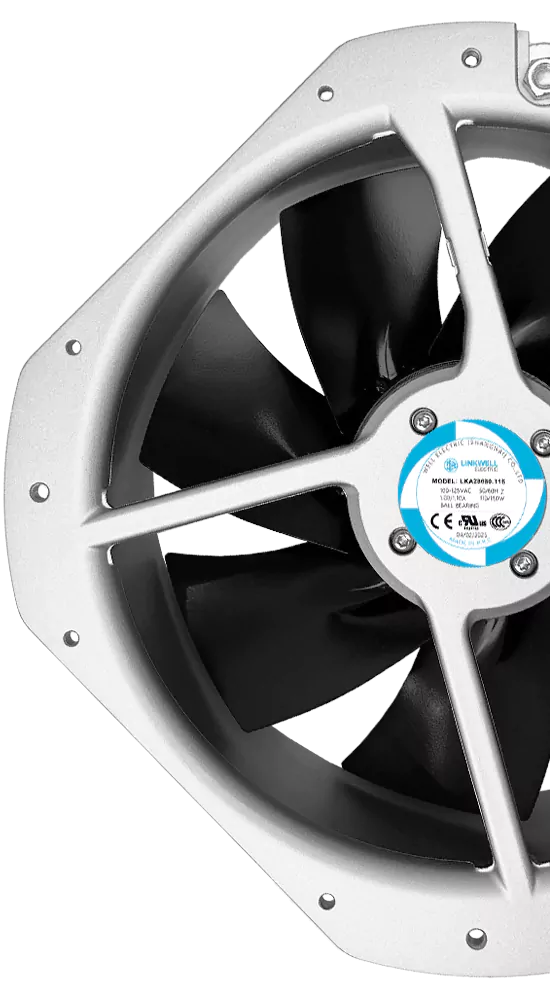
When people ask what voltage an alternating current fan uses, the short answer is simple: most AC fans are designed for standard regional mains power, so the common ratings are 100V, 110V, 115V, 120V, 220V, 230V, and 240V AC.
The longer answer is the one that actually matters in real projects, because the right voltage depends on where the equipment will be used, how the system is wired, and whether the fan is being selected for a new OEM design or as a replacement part.
This is one of those topics that sounds basic until it causes a real problem. A buyer may know the required fan size and airflow, but if the voltage is wrong, none of that helps. The fan may fail to start, run below its intended performance, overheat, or wear out much sooner than expected. In industrial cooling, that is not just a fan issue.
A voltage mismatch can affect the stability of the cabinet, control panel, telecom enclosure, or ventilation module the fan is supposed to protect.
For that reason, voltage is usually one of the first things engineers and purchasing teams confirm when evaluating an AC cooling fan. It is also one of the easiest details to get wrong when replacing an older fan, especially in export equipment or machines built for multiple regional markets.
This guide explains the most common AC fan voltages, how they differ by region, why frequency matters along with voltage, and how to choose the correct AC fan voltage for industrial applications.
The Short Answer
Most alternating current fans use standard mains voltage ranges rather than unusual custom voltages. In practical terms, that means buyers will most often see ratings such as 100V, 110V, 115V, 120V, 220V, 230V, or 240V AC. These ratings are tied to local electrical infrastructure.
North American systems often use 110V to 120V AC, while many European, Asian, Australian, and Middle Eastern systems use 220V to 240V AC. Japan is a special case where 100V AC is also common.
The correct fan voltage is not the one that sounds familiar. It is the one that matches the actual power input available to the equipment and the electrical design of the system. In some cases, a machine installed in a 230V region may still use an internal auxiliary circuit for a different fan voltage.
That is why the fan label, machine documentation, and wiring layout matter more than general assumptions about the country.
What an AC Fan Voltage Rating Actually Means
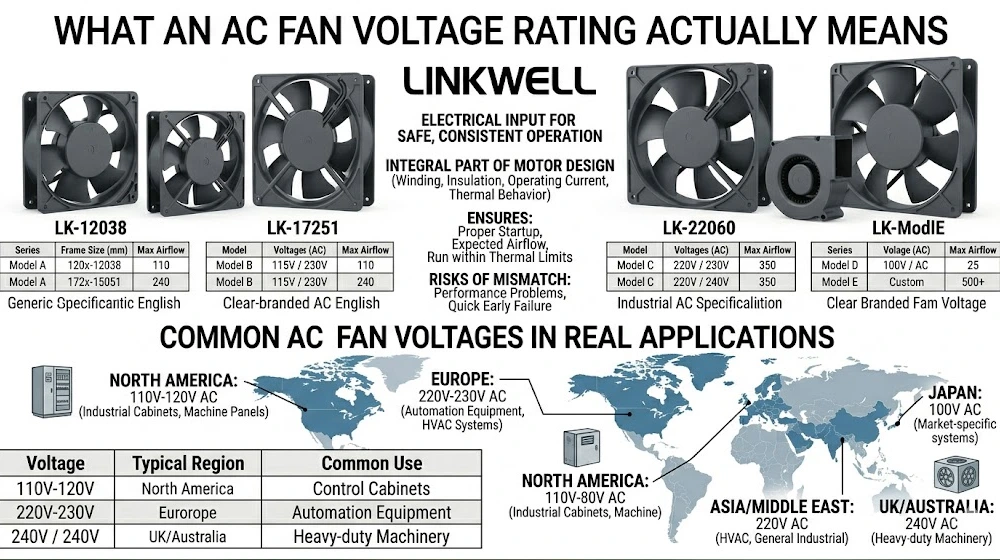
The voltage rating of an AC fan tells you the electrical input the fan motor is built to operate on safely and consistently. If a fan is rated for 115V AC, it is meant to receive approximately that input. If it is rated for 230V AC, it should be connected to a 230V system or a compatible range defined by the manufacturer.
This is not just a label for convenience. It is part of the motor design. The winding, insulation, operating current, and thermal behavior are all tied to the intended voltage.
If the fan is operated within its rated conditions, it should start properly, deliver the expected airflow, and run within its thermal limits. If it is operated outside those conditions, the risk of performance problems and early failure rises quickly.
For this reason, voltage selection affects more than simple electrical compatibility. It influences startup reliability, motor temperature, airflow consistency, noise, and long-term service life.
In replacement projects, a mismatch can be especially costly because the fan may appear physically compatible while still being electrically wrong.
Common AC Fan Voltages in Real Applications
In industrial and commercial cooling systems, the most common AC fan voltages are based on standard mains supplies. Buyers usually encounter the following ranges.
A 100V AC fan is most often associated with the Japanese market and equipment designed specifically for that electrical environment. It is not as globally common as 115V or 230V, but it is important in systems built for Japan.
A 110V AC fan appears in some North American applications and in legacy or loosely described product listings. In many real purchasing situations, 110V and 115V are used conversationally, but the exact rating should still be checked on the label.
A 115V AC fan is a very common industrial option. It is widely used in control cabinets, machine panels, telecom boxes, and general ventilation systems built around North American power architecture.
A 120V AC fan is also common, especially in commercial equipment, appliance cooling, and standard mains-powered systems in the United States and nearby markets.
A 220V AC fan is common in Asia and in many industrial systems outside North America. It is widely used for equipment ventilation, HVAC support, and enclosure cooling.
A 230V AC fan is one of the most common ratings in Europe and many export-oriented industrial applications. It is a standard and practical choice for many cabinet and equipment cooling systems.
A 240V AC fan is frequently seen in the UK, Australia, and some heavy-duty or region-specific electrical systems where 240V supply is standard.
The important point is not to memorize the numbers in isolation. The useful principle is that AC fan voltages follow the electrical standards of the equipment environment. A good fan selection process starts there.
| AC Fan Voltage | Typical Region | Common Use |
|---|---|---|
| 100V AC | Japan | Compact equipment and market-specific systems |
| 110V AC | North America, legacy equipment | Replacement fans and older electrical systems |
| 115V AC | North America | Industrial cabinets, control panels, enclosure cooling |
| 120V AC | North America | Commercial equipment, appliance cooling, ventilation |
| 220V AC | Asia, Middle East | HVAC, industrial cooling, cabinet fans |
| 230V AC | Europe, global export markets | Automation equipment, enclosures, industrial ventilation |
| 240V AC | UK, Australia | Industrial machinery and mains-powered cooling systems |
110V, 115V, and 120V AC Fans
These three values are often grouped together because they are all associated with North American electrical systems. In everyday conversation, people may treat them as interchangeable, but a careful buyer still checks the exact rating on the fan and the machine specification before ordering a replacement.
In industrial applications, 115V AC is especially common for cabinet fans, panel cooling, and equipment ventilation. It fits well with many standard power configurations used in machinery and control systems.
A 120V AC fan may be seen more often in commercial or general-purpose systems, but the distinction depends on the equipment maker and the intended application.
A 110V AC fan may appear in descriptions of older systems or in informal product language, but it is still important to verify the actual rated voltage. In practice, what matters most is whether the fan was designed for the voltage supplied to that particular machine.
For buyers working in North America, this usually means checking the fan label rather than assuming that any 110V, 115V, or 120V replacement will behave the same way. In many cases the difference may be manageable, but in critical cooling systems it is better to avoid guesswork.
Reference measured data: Under lab conditions, we tested the same 115V/60Hz rated AC axial fan on both 115V and 120V supply. The results:
- At 115V: 0.48A, 55W input power
- At 120V: 0.55A, 64W input power
This represents a current increase of approximately 15% and a power increase of about 16%. While the fan remained within short-term safe limits, the winding temperature rise was 9°C higher than under rated conditions.
If operated for extended periods (over 5,000 hours), this would significantly accelerate bearing grease aging and increase insulation breakdown risk.
Conclusion: 115V and 120V are not recommended for unconditional interchange in real-world engineering, especially in high-temperature, sealed cabinet environments.
220V, 230V, and 240V AC Fans
On the higher-voltage side, 220V, 230V, and 240V AC fans are common in Europe, Asia, Australia, the Middle East, and international industrial systems. These voltages are widely used in electrical cabinets, HVAC modules, automation equipment, and enclosure ventilation where direct mains-powered cooling is preferred.
A 220V AC fan is often found in Asia-based equipment and many general industrial applications. A 230V AC fan is especially common in Europe and in machines designed for broader export markets. A 240V AC fan is more typical in regions such as the UK and Australia or in systems built around those standards.
Again, the goal is not to decide that one is universally better. The key is to match the fan to the equipment’s actual electrical architecture.
A 230V fan may be ideal in one project and completely wrong in another, even if both projects are in the same country. That depends on how the equipment designer handled internal power distribution.
Is 110V Better Than 220V?
This is one of the most common buyer questions, and the honest answer is that neither voltage is inherently better.
A 110V or 120V AC fan is not a lower-grade product simply because the number is smaller. A 220V or 230V AC fan is not automatically more powerful because the voltage is higher. Fan performance depends on the design of the motor, the impeller, the airflow path, and the application. Voltage mainly determines compatibility with the power system.
The same cooling duty can often be handled by either a lower-voltage AC fan or a higher-voltage AC fan if the rest of the design is built around it. What changes is the electrical environment.
In general terms, lower-voltage systems draw more current for the same power, while higher-voltage systems draw less current. That affects wiring, protection, and integration, but it does not automatically tell you which fan will cool better.
For practical selection, buyers should think in terms of matching the local supply, the machine’s electrical design, and the intended maintenance environment. That is a much more useful approach than asking which voltage is better in the abstract.
How to Check What Voltage Your AC Fan Needs
In real projects, the correct voltage should be confirmed from the equipment rather than guessed from the region alone. There are several reliable ways to do this.
The most direct source is the fan label or nameplate. Most AC fans include the rated voltage, frequency, current, and model number on the housing. If the existing fan is still installed and readable, this is usually the fastest way to confirm the correct specification.
The equipment manual is another good source, especially for OEM systems and industrial machinery. It often lists the fan rating in the electrical section or in the spare parts documentation.
The wiring diagram can also be important. A machine may operate from one regional mains supply but step down or distribute power internally in a way that changes the fan’s required input. Looking at the wiring layout helps avoid replacing a fan based on assumptions about the building voltage.
If the original fan has a specific replacement part number, that part number should also be used as a cross-check. Even if the frame size looks standard, the electrical rating may not be.
Finally, the machine’s own power input specification can provide useful context, but it should not be the only source. A 230V system does not guarantee that every internal fan is 230V. Some systems use auxiliary circuits, transformers, or control supplies that result in a different fan voltage.
The safest approach is to verify the fan itself, the documentation, and the electrical layout together.
Why Frequency Matters Along With Voltage
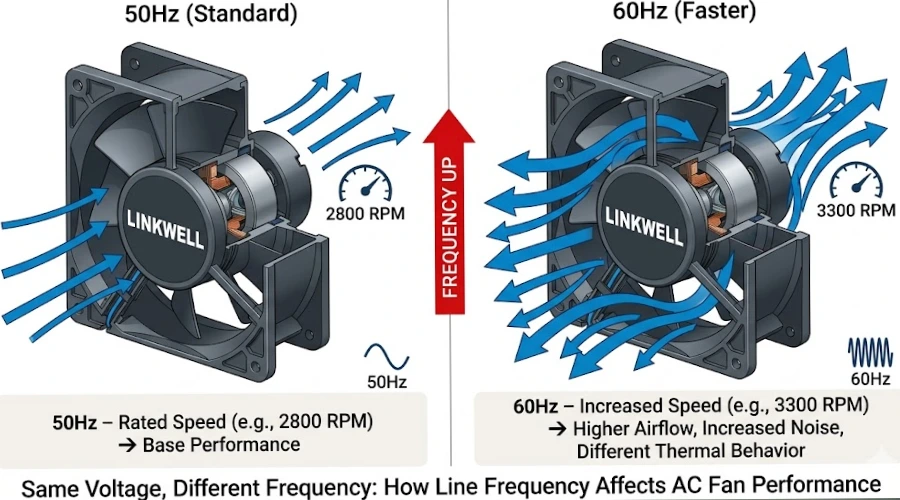
A correct voltage alone is not enough. Frequency also matters.
Most AC fans are designed for either 50Hz, 60Hz, or both. This affects how the motor behaves, particularly in fan designs where operating speed is influenced by line frequency. In many practical cases, a fan running on 60Hz may spin faster than the same fan on 50Hz. That can change airflow, noise, and thermal behavior.
For example, a fan that performs acceptably at 50Hz may produce different airflow and sound levels at 60Hz. Over time, those differences can also affect wear and service life.
A fan built and rated for both 50Hz and 60Hz is usually the safest choice when equipment may be used across multiple markets.
This is especially relevant in export projects. North America commonly uses 60Hz, while much of Europe uses 50Hz. A voltage match without a frequency match can still create performance problems. Buyers selecting replacement fans should always confirm both values before ordering.
What Happens When the Voltage Is Wrong
Real failure case: A seemingly normal 230V fan destroyed an entire control cabinet
Last year, a factory maintenance team encountered a classic problem. After replacing a 230V AC cabinet cooling fan, the new unit appeared to run normally — but actual measured speed was only 60% of the rated value. The VFD inside the cabinet triggered an overtemperature alarm and shut down after four hours of continuous operation.
Investigation revealed that a maintenance technician had mistakenly installed a 110V-rated fan from stock onto a 230V line. They were misled by the identical frame size and connector. The fan did spin, but its winding magnetic circuit was completely mismatched, resulting in severe torque deficiency and ultimately, cooling failure.
Post-failure disassembly showed carbonization marks on the fan’s insulation layer. If it had run for a few more days, a short circuit and fire were likely. This single mistake led to a six-hour production line shutdown — a loss far greater than the cost of a fan.
Voltage errors do not always look dramatic at first, but they often create avoidable reliability problems.
When the supply voltage is lower than the fan’s rated input, the motor may not start properly or may run below its intended performance level. The fan can appear to be operating, yet still deliver less airflow than the system requires. In cooling applications, that means the fan may continue turning while the protected components run hotter than expected.
When the supply voltage is too high, the risk is more immediate. The motor may draw excessive current, generate abnormal heat, and experience insulation stress that shortens its life very quickly. In some cases, the fan may fail soon after startup.
This is the more dangerous kind of mismatch because the damage can happen before the rest of the equipment operator realizes what is wrong.
Even small mismatches should not be dismissed too casually. A fan that seems to run under a near-but-not-correct voltage may still suffer from unstable airflow, increased noise, or reduced service life over time. In industrial cooling, the fan itself is usually inexpensive compared with the machine it protects, but a cooling failure can lead to much more expensive downtime. That is why voltage matching is worth treating as a serious engineering decision rather than a minor detail.
Choosing the Right AC Fan Voltage for Industrial Equipment
For industrial buyers, the most practical selection process begins with the application, not with a general voltage preference.
The first question is where the equipment will be used. Regional mains standards still matter, especially for export machines and replacement stock planning. North American projects often point toward 115V or 120V AC fans, while European and many Asian applications often point toward 220V to 240V ranges.
The second question is whether the fan is part of a new OEM build or a field replacement. In a new project, the fan can be chosen to fit the power architecture from the start. In a replacement project, matching the original rating is usually the safest path unless the entire system is being redesigned.
The third question is how the machine is powered internally. Cabinet ventilation fans, HVAC support fans, telecom cooling fans, and enclosure fans may all be AC-powered, but the correct rating still depends on the machine’s internal electrical layout.
Maintenance practice also plays a role. In some projects, buyers want a voltage that is easy to source locally and simple for service teams to replace.
In others, the fan is selected as part of a tightly controlled OEM assembly, and exact specification is more important than field convenience.
Finally, compliance and market expectations should be considered. Fans used in global projects often need to align with regional power standards, certification expectations, and replacement practices across more than one country.
AC Fan Voltage Selection and FanACDC
For most buyers, the value of this topic is not theoretical. They want to know which AC fan voltage fits their equipment and avoids problems in operation or replacement.
At FanACDC, AC cooling fan selection usually starts with a few core questions: what voltage is available, what frequency does the system use, how much airflow is required, how much installation space is available, and what kind of environment the fan will operate in.
Once those are confirmed, it becomes much easier to narrow the right AC fan for cabinet cooling, enclosure ventilation, automation systems, or other industrial uses.
That approach is more reliable than selecting by frame size alone. A fan can look mechanically correct but still be electrically wrong. Voltage, frequency, airflow requirement, and installation conditions all need to line up for the fan to perform as expected in the field.
FAQ
What voltage does an AC fan usually use?
Most AC fans use standard mains voltage ranges such as 100V, 110V, 115V, 120V, 220V, 230V, or 240V AC depending on the region and equipment design.
Can a 220V AC fan run on 110V?
Not properly. In most cases, it will not start correctly or it will run with very poor performance. The fan voltage should match the power source and the equipment specification.
Is a 120V AC fan the same as a 110V AC fan?
They are related to similar regional systems, but they are not identical specifications. The exact voltage on the fan label should always be confirmed before replacement.
Does 50Hz versus 60Hz matter for AC fans?
Yes. Frequency affects motor speed and can influence airflow, noise, and long-term reliability. Always check both voltage and frequency before selecting a replacement AC fan.
Are 230V and 240V AC fans interchangeable?
Sometimes they may be close in practice, but they should not be treated as automatically interchangeable without checking the product specification and operating conditions.
Conclusion
Most alternating current fans use common regional mains voltages such as 100V, 110V, 115V, 120V, 220V, 230V, or 240V AC. The correct choice depends on the actual equipment power input, the local electrical system, and the fan’s rated design.
The safest rule is straightforward: match the fan voltage and frequency to the machine’s real operating conditions. That protects the motor, maintains cooling performance, and reduces the risk of avoidable failures.
For industrial cooling projects, a correct AC fan choice starts with the basics. Confirm the voltage, verify the frequency, check the airflow requirement, and make sure the fan matches the installation environment. Once those details are clear, selecting the right AC fan becomes much more reliable.