You want to lower energy costs and boost reliability in your facility. Backward curved centrifugal fans help you do this because of their advanced blade design and strong operational benefits. These fans use less energy, perform better under high static pressures, and last longer than other types. The table below shows how backward curved designs compare to others:
| Feature | Backward Curved Fans | Other Fan Types |
|---|---|---|
| Energy Consumption | Lower energy consumption | Higher energy consumption |
| Durability | Improved durability | Varies by type |
| Lifespan | Extended fan lifespan | Shorter lifespan possible |
You see dramatic energy savings over time, with high static efficiency cutting costs and extending maintenance intervals. This is Why Are Backward Curved Centrifugal Fans More Efficient for your industrial needs.
Key Takeaways
- Backward curved centrifugal fans use advanced blade designs to reduce energy consumption and improve efficiency.
- These fans operate quietly and require less maintenance, leading to a more comfortable work environment.
- Choosing the right fan can significantly lower energy costs and enhance the reliability of your facility’s operations.
- Backward curved fans excel in high static pressure applications, making them ideal for demanding industrial settings.
- Investing in efficient fans pays off over time through lower energy bills and reduced maintenance needs.
Why Fan Efficiency Matters
Energy Costs and Industrial Impact
You see the impact of fan efficiency every day in your facility. Efficient fans help you lower utility bills and reduce operational costs. When you choose backward curved centrifugal fans, you benefit from advanced blade designs that optimize airflow and minimize power usage. The right fan technology reduces the workload on HVAC systems, which leads to significant energy savings. Companies report noticeable reductions in energy bills when they upgrade to energy-efficient centrifugal fans. The table below shows how fan efficiency affects energy consumption:
| Aspect | Impact on Energy Consumption |
|---|---|
| Energy-efficient fans | Offer considerable savings on utility bills. |
| Advanced fan technology | Reduces operational costs while enhancing efficiency. |
| Fan blade design | Optimizes airflow and reduces power usage. |
Continuous Operation Benefits
You rely on fans that run continuously in demanding environments. Backward curved centrifugal fans deliver stable performance and extended lifespan. These fans operate with less vibration and lower noise, which means fewer interruptions and less maintenance. You gain peace of mind knowing your equipment stays cool and your facility runs smoothly. Proper fan blade design is crucial for optimizing energy efficiency, especially when you need reliable airflow around the clock.
Choosing Efficient Fans
You make decisions that affect your facility’s bottom line. Selecting the right centrifugal fans is essential for maximizing energy savings and reducing long-term costs. Engineers and decision-makers prioritize backward curved centrifugal fans because they exceed baseline efficiency standards and deliver superior performance. Fans with a high Fan Energy Index (FEI) help you achieve greater efficiency and lower power requirements. You improve your facility’s sustainability and profitability by choosing fans that match your application needs.
Always consider fan blade design and efficiency ratings when selecting fans for industrial use. This ensures you get the best performance and energy savings.
What Is Centrifugal Fan Efficiency
Key Metrics: Airflow, Pressure, Power
When you evaluate centrifugal fans, you need to understand the main metrics that determine their efficiency. Airflow, measured in cubic feet per minute (CFM), tells you how much air the fan can move. This value is important because it shows the fan’s capacity to ventilate or cool your space. Static pressure measures the resistance the fan must overcome to push air through ducts or filters. If your system has high resistance, you need a fan that can maintain strong airflow under pressure. Power consumption shows how much energy the fan uses during operation. Lower power consumption means you spend less on electricity and reduce your facility’s environmental impact. By focusing on these three metrics, you can compare different centrifugal fans and choose the one that best fits your needs.
Efficiency Defined
You should know how industry standards define efficiency for centrifugal fans. Efficiency is the ratio of useful air output to the energy the fan consumes. A higher efficiency rating means the fan can move the same amount of air while using less energy. This helps you lower operational costs and supports your sustainability goals. When you look at efficiency, you should consider both static and total efficiency ratings. These ratings reflect how well the fan performs under different pressure conditions.
- Balancing static and dynamic pressures is crucial for optimal performance.
- Minimizing losses from friction and turbulence improves efficiency.
- Higher efficiency ratings mean better performance and lower energy bills.
You can use these definitions and metrics to make informed decisions when selecting centrifugal fans for your facility. Understanding efficiency helps you maximize performance and minimize costs over the long term.
How Blade Design Impacts Efficiency
Forward Curved vs Backward Curved vs Radial
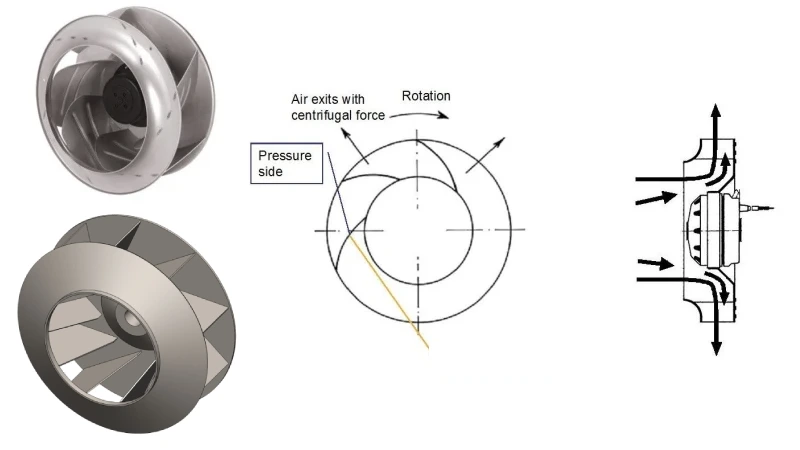
You need to understand how blade shape affects the performance of centrifugal fans. Each design offers unique benefits and drawbacks. Forward curved blades move large volumes of air but struggle with high pressure and energy efficiency. Radial blades work well in harsh environments and focus on strength and speed. The backward curved centrifugal fan stands out for its superior efficiency and pressure capability. You can see the differences in the table below:
| Fan Type | Efficiency Range | Pressure Capability | Energy Consumption | Noise Levels | Cost Comparison |
|---|---|---|---|---|---|
| Forward Curved | 55% – 65% | Lower | Higher | Higher | Lower initial purchase cost |
| Backward Curved | Up to 85% | Higher | Lower | Lower | Higher initial purchase cost |
| Radial | 60% – 70% | Moderate | Moderate | Moderate | Moderate |
You see that the backward curved centrifugal fan delivers the highest efficiency and lowest energy consumption. It also operates quietly and handles higher static pressure.
Airflow Path and Energy Loss
Blade design shapes the airflow path inside the fan. Forward curved blades create more turbulence and friction, which leads to energy loss. Radial blades focus on durability but do not optimize airflow. The backward curved centrifugal fan uses a special blade angle to guide air smoothly. This reduces turbulence and friction, so you get more efficient airflow and less wasted energy.
- Blade design influences aerodynamic efficiency, turbulence, and friction losses.
- Forward curved blades move high volumes of air but have poor static pressure rise.
- Backward curved centrifugal fan blades are more efficient for high-pressure applications.
You benefit from a smoother airflow path and lower energy loss when you choose a backward curved centrifugal fan.
Backward Curved Centrifugal Fan Advantages
You gain several advantages with the backward curved centrifugal fan. It generates higher static pressure than forward curved designs. You see better energy efficiency during operation, which lowers your power bills. The backward curved centrifugal fan also features non-overloading motor characteristics. This means the fan operates steadily without a stall point, even when airflow conditions change.
| Advantage | Description |
|---|---|
| Higher Static Pressure | Backward curved blades generate higher static pressure compared to forward curved blades. |
| Better Energy Efficiency | They maintain better energy efficiency during operation. |
| Non-Overloading Motor Characteristics | Their design provides stable operation without a stall point under varying airflow conditions. |
You can rely on the backward curved centrifugal fan for stable, efficient, and quiet performance. It is the best choice for demanding industrial applications where efficiency matters most.
Why Are Backward Curved Centrifugal Fans More Efficient
Reduced Turbulence and Smooth Flow
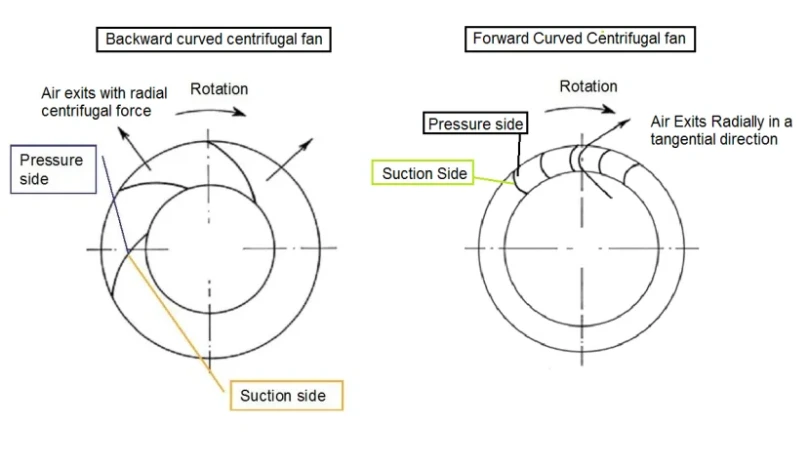
You notice smoother airflow when you use backward curved centrifugal fans. The backward curvature of the blades allows air to exit in a controlled way. This design minimizes turbulence and resistance. You get stable airflow and consistent performance. Industry data from AMCA shows that backward curved blades reduce turbulence inside the fan housing. You benefit from less vibration and lower noise.
- The backward curvature of the blades allows for a smooth, controlled exit of air.
- This design minimizes turbulence and resistance, contributing to stable airflow performance.
You see why are backward curved centrifugal fans more efficient in demanding environments. Smooth airflow means less energy wasted and more reliable cooling.
Non-Overloading Power Curve
You gain safety and efficiency with the non-overloading power curve. Backward curved centrifugal fans operate efficiently because their power demand decreases as airflow increases. You avoid sudden spikes in energy use. This feature protects your equipment and keeps your system stable. You do not need to worry about the fan overloading when conditions change. You see steady performance even when your application requires variable airflow. This is one reason why are backward curved centrifugal fans more efficient than other designs.
High Static Efficiency
You achieve high static efficiency with backward curved centrifugal fans. These fans excel in applications with long duct runs and restrictive systems. You get more airflow for less energy. Industry benchmarks show that backward curved fans deliver high efficiency and low noise. You can see the comparison in the table below:
| Fan Type | Efficiency | Noise Level | Static Pressure Capability | Typical Applications |
|---|---|---|---|---|
| Backward-Curve | High (70–85%) | Low to moderate | High – excels in long duct runs and restrictive systems | Industrial ventilation, exhaust systems, HVAC |
You see why are backward curved centrifugal fans more efficient for industrial ventilation and HVAC. High static efficiency means you get better performance and lower energy costs.
Lower Energy Use Over Time
You save energy over time with backward curved centrifugal fans. Their aerodynamic blade design reduces flow disturbances. You use less energy for the same airflow and pressure. Larger blades and curved design improve airflow control and reduce energy losses. You benefit from improved efficiency and lower energy use compared to forward-curved fans.
- Backward-curved centrifugal fans have higher efficiency than forward-curved fans.
- Their aerodynamic blade design reduces flow disturbances.
- This design leads to lower energy consumption for the same airflow and pressure.
- Backward-curved fans feature larger blades and a curved design.
- These features improve airflow control and reduce energy losses.
- The improved efficiency implies lower energy use over time compared to forward-curved fans.
You see why are backward curved centrifugal fans more efficient for long-term operation. Lower energy use means reduced costs and better sustainability.
Note: You can trust fanacdc centrifugal fans for reliable performance. These fans feature high-efficiency motor designs, aerodynamic impeller structures, and durable flame-retardant housings. You get certified quality with UL, ATEX, IECEx, and IP-rated protection. Custom sizing and performance options ensure you find the right solution for your needs.
| Certification/Feature | Description |
|---|---|
| ATEX | Ensures safety in explosive atmospheres. |
| IECEx | Validates reliability in hazardous environments. |
| UL | Certifies safety for use in various industrial applications. |
| High-efficiency motor design | Includes brushless and shaded-pole options for improved performance. |
| Aerodynamic impeller structure | Designed for balanced airflow, enhancing efficiency. |
| Durable, flame-retardant housings | Ensures longevity and safety in demanding conditions. |
| IP-rated protection | Provides reliability in harsh environments. |
| Custom sizing and performance options | Tailored solutions for specific industrial needs. |
You see why are backward curved centrifugal fans more efficient when you choose fanacdc. You get proven performance, certified safety, and long-lasting reliability.
Backward Curved vs Forward Curved vs Radial Fans
Efficiency and Energy Comparison
You want to choose fans that deliver the best performance for your facility. Backward curved, forward curved, and radial fans each offer different levels of efficiency and energy use. Studies show that backward curved impellers reach a maximum efficiency of 76%, while backward inclined airfoil fans can achieve up to 81%. These fans also handle high air volumes and static pressures, making them ideal for demanding environments.
| Fan Type | Maximum Efficiency | Air Volume | Static Pressure |
|---|---|---|---|
| Backward Inclined Airfoil | 81% | 30000 m³/Hr | -2000 Pa |
| Backward Curved Impeller | 76% | 37000 m³/Hr | -2400 Pa |
You see that backward curved designs outperform other types in both efficiency and pressure capability. This means you use less energy to move more air, which helps lower your operating costs.
Noise and Maintenance
You care about the comfort and reliability of your workspace. Backward curved fans run quieter and require less maintenance than forward curved fans. For example, a manufacturing facility reduced noise from 80 dB to 75 dB by switching from forward curved to backward curved fans. This change improved the work environment and cut down on maintenance needs.
| Feature | Forward Curved Fans | Backward Curved Fans |
|---|---|---|
| Noise Level (dB) | 80 | 75 |
| Maintenance | More frequent | Less frequent |
You benefit from quieter operation and fewer service interruptions when you select backward curved centrifugal fans.
Application Suitability
You need fans that fit your specific application. Backward curved centrifugal fans work best in systems that require low airflow and high pressure, such as panel ACs, air handling units, and clean rooms. They also perform well in both indoor and outdoor locations, including industries like marine, pharmaceuticals, and metal processing. These fans help control fumes, odors, and emissions in pollution control systems.
| Application Type | Description |
|---|---|
| Low Air Flow and High Pressure | Used in Panel ACs, Air Handling Units, Clean Rooms, Conveying, and Drying. |
| Indoor and Outdoor Locations | Suitable for fertilizer, metal and mineral processing, marine, and pharmaceutical industries. |
| Fume and Emissions Control | Ideal for fume-exhausting, odor control, oil mist, and pollution control. |
- Induced draft systems in large facilities
- Combustion air supply for boilers and burners
- Pollution control in dust collectors and scrubbers
You can rely on centrifugal fans to deliver efficient, quiet, and reliable performance across a wide range of industrial applications.
Applications of Backward Curved Centrifugal Fans
Industrial and HVAC Uses
You see backward curved centrifugal fans in many industrial and HVAC applications. These fans help you move air efficiently and handle high static pressure. You can use them in large buildings, factories, and power plants. The table below shows common uses and why these fans work well in each setting:
| Application | Description |
|---|---|
| HVAC Systems | Essential for air distribution in buildings, providing high static pressure and energy efficiency. |
| Industrial Drying Processes | Circulates hot air for uniform drying, improving throughput and reducing energy costs. |
| Flue Gas Handling | Used in power plants for efficient extraction of combustion byproducts, ensuring environmental compliance. |
| Chemical Fume Extraction | Removes toxic fumes in industrial settings, ensuring worker safety and system efficiency. |
You can rely on backward curved fans to keep air moving where you need it most. These fans help you maintain safe, comfortable, and efficient environments.
Control Cabinets and Equipment Cooling
You need to protect sensitive electronics from overheating. Backward curved centrifugal fans help you cool control cabinets and equipment by moving heat away from critical components. These fans provide steady airflow, which keeps temperatures low and prevents damage. You can trust these fans to maintain the performance and safety of your electronic systems. When you use backward curved fans, you extend the life of your equipment and reduce the risk of costly failures.
Regular cooling with efficient fans helps you avoid unexpected downtime and keeps your operations running smoothly.
Long-Term Savings in Operation
You want to save money over time. Backward curved centrifugal fans help you lower your energy bills and reduce maintenance costs. Here are some ways these fans support long-term savings:
- High energy efficiency reduces your power consumption.
- Direct-drive models improve efficiency by 10–15% compared to belt-drive fans.
- Variable Frequency Drives (VFDs) let you adjust fan speed, cutting energy use by up to 50% in variable-air-volume systems.
- You recover the higher initial cost of efficient fans within 2 to 3 years through energy and maintenance savings.
- Proper motor sizing ensures reliable operation and less downtime.
- Running the fan near its peak efficiency zone avoids unstable conditions and supports long-term savings.
You see real value when you choose backward curved centrifugal fans for your facility. These fans help you achieve lower costs, greater reliability, and better performance year after year.
Fanacdc Centrifugal Fan Advantages
High-Efficiency Design and Durability
You want fans that last and save energy. Fanacdc centrifugal fans use advanced engineering to give you both. The high-efficiency motor design cuts down on energy loss. Aerodynamic impeller blades keep airflow balanced and vibration low. Durable materials protect your fan, even in tough environments. You get steady performance and a long service life.
| Design Feature | Contribution to Efficiency and Durability |
|---|---|
| High-Efficiency Motor Design | Optimizes efficiency and reduces energy loss with brushless and shaded-pole motors. |
| Aerodynamic Impeller Structure | Delivers balanced airflow and low vibration for continuous operation. |
| Durable Materials & Protection | Ensures longevity with flame-retardant housings and sealed bearings. |
| Protection Against Harsh Environments | Enhances reliability with IP-rated designs and salt-spray resistance. |
Choosing a fan with these features means you spend less on repairs and replacements.
Certifications and Customization
You need fans that meet strict standards and fit your unique needs. Fanacdc centrifugal fans carry important certifications like RoHS and REACH. You can also customize your fan for your project. You get technical support, sales training, and after-sales help to make sure your fan works perfectly for your application.
| Customization Options | Certifications |
|---|---|
| Project customization | RoHS |
| Technical support | REACH |
| Sales training | |
| After-sales support |
Note: Certified fans give you peace of mind and help you meet industry requirements.
Support and Service
You want support at every step. Fanacdc gives you help from start to finish. You can work with experts to design the right fan for your project. You get guidance for installation and maintenance. Training programs help your team learn more. If you need help, you can reach out any time.
- Project customization service helps you match the fan to your needs.
- Technical support gives you advice and troubleshooting.
- Sales training builds your team’s knowledge.
- After-sales service offers 24/7 support and repair options.
You stay confident knowing fanacdc stands behind every fan you use.
Common Misconceptions About Fan Efficiency
Airflow vs Efficiency
You might think that a fan with higher airflow always means better efficiency. This is not true. Efficiency measures how well a fan converts electrical energy into useful air movement. A fan can move a lot of air but waste energy if the blade design causes turbulence or friction. Backward curved centrifugal fans use advanced blades to reduce energy loss and deliver high efficiency. You should check both airflow and efficiency ratings before making a decision.
| Metric | What It Means | Why It Matters |
|---|---|---|
| Airflow (CFM) | Volume of air moved | Needed for ventilation |
| Efficiency (%) | Energy converted to airflow | Impacts energy costs |
All Fans Are the Same
You may believe all fans work the same way. This is a common mistake. Different fans use unique blade designs and motor types. Backward curved centrifugal fans stand out because they handle high pressure and deliver stable performance. Forward curved and radial fans serve other purposes but do not match the efficiency of backward curved designs. You need to match the fan type to your application for the best results.
- Backward curved fans excel in high-pressure systems.
- Forward curved fans suit low-pressure, high-volume needs.
- Radial fans work well in harsh environments.
Note: Choosing the right fan type improves reliability and reduces maintenance.
Price Over Performance
You might focus only on the price when buying fans. This can lead to higher costs later. Cheaper fans often use less efficient motors and poor blade designs. You spend more on energy and repairs over time. Investing in efficient fans like backward curved centrifugal models gives you long-term savings and better reliability.
| Factor | Low Price Fan | Efficient Fan |
|---|---|---|
| Initial Cost | Lower | Higher |
| Energy Use | Higher | Lower |
| Maintenance | Frequent | Less frequent |
| Lifespan | Shorter | Longer |
Efficient fans pay for themselves through energy savings and reduced downtime.
You get the best efficiency with backward curved centrifugal fans. Their advanced blade design, low energy use, and stable operation set them apart:
| Benefit | Description |
|---|---|
| High Efficiency | Aerodynamic blades cut energy loss and lower costs. |
| Low Noise | Smooth airflow keeps your space quieter. |
| High Static Pressure | Handles tough ductwork without losing airflow. |
| Durability | Strong materials give you a long service life. |
| Low Maintenance | Direct-drive motors reduce downtime. |
When you choose fanacdc, you gain reliable, certified fans built for harsh conditions. You can customize size, speed, and control methods. You also get expert support for selection, installation, and long-term performance. Reach out to fanacdc for solutions that fit your needs and keep your systems running efficiently.
FAQ
What makes backward curved centrifugal fans more efficient than other types?
You get higher efficiency because the blades reduce turbulence and energy loss. The design allows for smooth airflow and lower power consumption. You save on energy costs and enjoy stable performance in demanding applications.
How do I choose the right centrifugal fan for my application?
You should consider airflow requirements, static pressure, available space, and noise limits. Check efficiency ratings and certifications. Fanacdc offers technical support to help you select the best fan for your needs.
Can backward curved centrifugal fans handle high static pressure systems?
Yes, you can use backward curved centrifugal fans in high static pressure systems. Their blade design generates strong pressure, making them ideal for long duct runs, filtration, and industrial ventilation.
Are fanacdc centrifugal fans certified for industrial use?
Yes! You get fans certified to UL, CE, and RoHS standards. These certifications ensure safety, reliability, and compliance for global industrial applications.