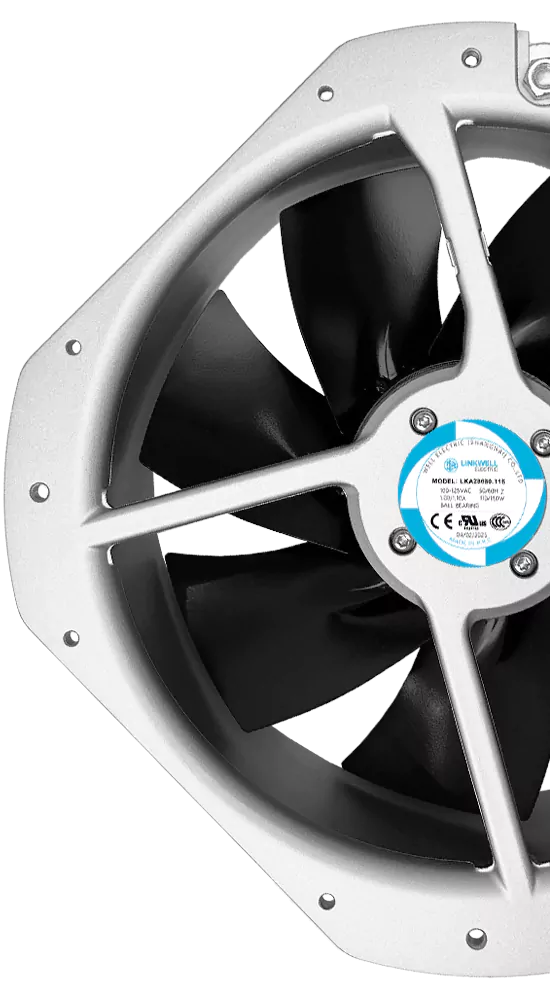
When comparing a 115V vs 230V AC fan, neither voltage is automatically better. The correct choice is the one that matches the voltage and frequency available at the fan terminals while delivering the required airflow and static pressure.
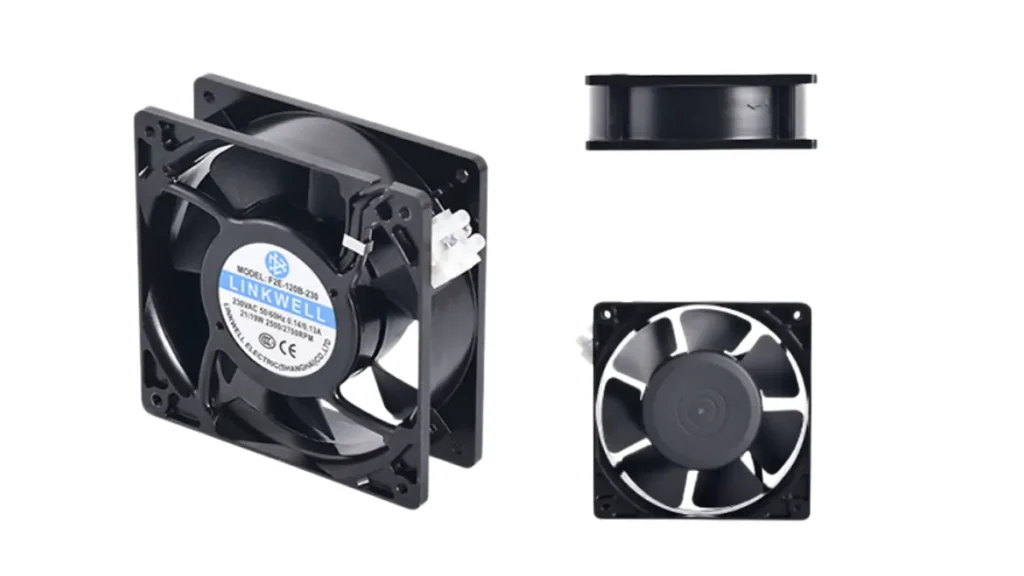
A 115V fan is common in equipment designed around North American power systems. A 230V fan is common in European and international industrial equipment. At a similar input power, a 230V version normally draws less line current, but it does not automatically move more air or use less energy.
This guide explains the practical differences so engineers, OEM buyers, and maintenance teams can select the correct AC cooling fan without creating a voltage, wiring, or performance mismatch.
Key Takeaways
- Choose the fan voltage that matches the equipment circuit, not the country alone.
- A 230V fan does not automatically produce more airflow than a 115V fan.
- Comparable 230V models usually draw less current because they operate at a higher voltage.
- Voltage alone does not determine energy consumption, efficiency, noise, or service life.
- Always confirm both voltage and frequency before ordering an AC fan.
- A 115V-rated motor may be intended for a nominal 120V system when the manufacturer specifies the correct tolerance.
- Never treat separate 115V and 230V models as interchangeable.
- A fan can use both voltages only when it is specifically designed and wired as a dual-voltage model.
- Replacement buyers should match the nameplate, wiring diagram, airflow, pressure, and mounting dimensions.
115V vs 230V AC Fan: Quick Comparison
| Selection factor | 115V AC fan | 230V AC fan |
|---|---|---|
| Common system environment | North American equipment and nominal 120V circuits | European, Asian, and international equipment using 220?240V circuits |
| Typical line current | Higher for a comparable input power | Lower for a comparable input power |
| Airflow | Determined by fan design, speed, frequency, and system resistance | Determined by fan design, speed, frequency, and system resistance |
| Energy use | Must be checked from input power and operating time | Must be checked from input power and operating time |
| Common frequency | Often 60Hz, although many fans support 50/60Hz | Often 50Hz, although many fans support 50/60Hz |
| Wiring | Must match the 115V model or approved dual-voltage diagram | Must match the 230V model or approved dual-voltage diagram |
| Best choice | Equipment that supplies the fan with the approved 115V range | Equipment that supplies the fan with the approved 230V range |
The table is a starting point, not a substitute for the fan datasheet. The final decision should be based on the exact voltage measured or specified at the fan connection.
What Is the Main Difference Between a 115V and 230V AC Fan?
The main difference is the motor winding and electrical input for which the fan is designed.
A 115V AC fan has a motor designed to produce the required magnetic field, torque, and speed at approximately 115V. A separate 230V version uses a different winding arrangement to operate at approximately twice that voltage.
For comparable models, the mechanical package may look identical. Frame size, mounting holes, impeller, connector style, and label position can all appear the same. That visual similarity does not make the two fans electrically interchangeable.
The rated voltage affects:
- Motor winding design
- Rated and starting current
- Insulation requirements
- Thermal behavior
- Wiring configuration
- Required overcurrent protection
- Compatibility with the equipment power circuit
The voltage number itself does not describe cooling performance. Airflow and pressure depend on the complete fan design and its operating speed.
Does a 230V Fan Move More Air Than a 115V Fan?
No. A 230V AC fan does not automatically move more air than a comparable 115V fan.
An official Bi-Sonic 119 ? 119 ? 38 mm AC fan series provides a useful example. Its 115V and 230V versions list the same speed, airflow, maximum pressure, and noise at the same frequency, while their current ratings differ.
| Published specification | 115V model | 230V model |
|---|---|---|
| Frequency | 50/60Hz | 50/60Hz |
| Input power | 24/22W | 22/21W |
| Rated current | 250/240mA | 140/130mA |
| Speed | 2650/3000 RPM | 2650/3000 RPM |
| Maximum airflow | 82.4/95.6 CFM | 82.4/95.6 CFM |
| Maximum pressure | 6.7/7.4 mmH?O | 6.7/7.4 mmH?O |
| Noise | 41/45 dB | 41/45 dB |
Source: Bi-Sonic AC 4E published specifications. Values are shown at 50/60Hz and are an example, not a universal rule for every fan.
This comparison shows why voltage should not be used as a shortcut for airflow. When evaluating two fans, compare their fan curves, speed, maximum airflow, static pressure, and test frequency. If these values are unfamiliar, start with our guide on how to read a fan curve.
Selection tip: Compare performance at the expected system resistance. Free-air CFM alone may not show how much cooling the fan will provide inside a cabinet, filter, or equipment enclosure.
Why Does a 230V Fan Usually Draw Less Current?
A comparable 230V fan normally draws less line current because it operates at a higher voltage.
For a single-phase AC load, real input power is influenced by voltage, current, and power factor. If two motor variants perform a similar mechanical job at a similar input power, the higher-voltage version can usually operate with lower current.
That does not mean the 230V fan automatically cuts energy consumption in half. Electricity use is based on real input power and operating time, not current alone. In the manufacturer example above, the current changes substantially while the published input power remains close.
Lower current can help the broader electrical design, particularly when a system contains multiple fans or long cable runs. However, small cooling fans often draw modest current, so voltage selection should still begin with circuit compatibility rather than a theoretical wiring advantage.
Is a 230V AC Fan More Efficient Than a 115V Fan?
Not necessarily. Voltage alone does not determine fan efficiency.
Efficiency depends on factors such as:
- Motor construction
- Impeller and blade geometry
- Motor losses
- Airflow path
- Operating point on the fan curve
- Input power at the required airflow
- Frequency
- Speed control method
Two voltage variants in the same product family can have nearly identical airflow and input power. A different 230V fan could also be more or less efficient depending on its design.
To compare efficiency, use equivalent operating conditions and review:
- Input power in watts
- Airflow at the required static pressure
- Fan speed
- Motor and fan efficiency data, if available
- Sound level
- Expected operating hours
Do not compare current values alone. A lower ampere rating at a higher voltage is not proof of lower energy consumption.
115V, 120V, 230V, and 240V: Rated Voltage vs System Voltage
Industrial buyers often see 115V fans used on nominal 120V systems and 230V fans used on nominal 240V systems. This can be normal when the fan has been designed and approved for the applicable voltage tolerance.
Oriental Motor explains that, under the referenced North American voltage standard, a motor rated at 115V is associated with a nominal 120V system, while a 230V-rated motor is associated with a nominal 240V system. The manufacturer still recommends using equipment within its approved specification.
This does not mean every product labeled 110V, 115V, or 120V can be exchanged without checking. The same caution applies to 220V, 230V, and 240V products.
Before connecting a fan, confirm:
- Rated voltage on the fan label
- Approved operating voltage range
- Nominal equipment supply
- Voltage tolerance under normal and abnormal conditions
- Required certification
- Manufacturer instructions
For a broader explanation of regional ratings, see our AC fan voltage guide.
Why 50Hz vs 60Hz Matters
Voltage is only half of the AC fan selection question. Frequency can affect fan speed, airflow, pressure, input power, and noise.
Many industrial AC fans are rated for both 50Hz and 60Hz, but their published performance may differ at each frequency. In the example table above, the same fan series lists a higher RPM and higher airflow at 60Hz than at 50Hz.
When comparing a 115V vs 230V AC fan, avoid assuming:
- Every 115V fan is 60Hz only.
- Every 230V fan is 50Hz only.
- A dual-frequency label guarantees identical performance at both frequencies.
Check the separate 50Hz and 60Hz values in the datasheet. An export machine may need a fan that supports both frequencies, but the thermal design must still tolerate the lower published airflow condition.
OEM tip: Validate the cooling system at the least favorable approved voltage and frequency condition, not only at the condition that produces the highest free-air CFM.
What Happens If You Connect the Wrong Voltage?
Connecting a fan to the wrong voltage can cause poor performance, overheating, motor damage, or an electrical safety hazard.
Connecting a 115V Fan to 230V
A 115V-only fan should not be connected to a 230V supply. The motor receives far more voltage than it is designed to handle. This can rapidly damage the winding, insulation, protection components, or connection system.
Disconnect power and verify the label before replacing a fan in equipment that contains multiple internal voltage rails.
Connecting a 230V Fan to 115V
A 230V-only fan connected to 115V may fail to start, run slowly, produce insufficient airflow, or operate outside its approved thermal condition. A spinning impeller is not proof that the fan is operating safely or delivering the required cooling.
In both cases, the solution is not to test the fan and see what happens. Match the supply to the nameplate and manufacturer specification before applying power.
Can One AC Fan Operate on Both 115V and 230V?
Yes, but only when the fan is specifically designed as a dual-voltage model.
Some dual-voltage AC axial fans use multiple color-coded leads and a manufacturer-supplied wiring diagram. The winding connections are configured differently for 115V and 230V operation. Mechatronics, for example, publishes AC fan options that can be wired for either voltage.
A fan with only ?115V? or ?230V? on its label should be treated as a single-voltage product unless its datasheet explicitly states otherwise.
Dual-voltage selection requires checking:
- Approved 115V and 230V ratings
- Lead colors and terminal positions
- Series or parallel winding connection
- Frequency range
- Wiring diagram
- Model-specific airflow and power data
- Required safety approvals
Safety note: Never invent a dual-voltage connection from wire colors alone. Wire identification varies by manufacturer and model.
When Should You Choose a 115V AC Fan?
Choose a 115V AC fan when the equipment provides an approved low-range AC supply and the fan meets the required cooling performance.
Typical applications include:
- Electrical cabinets designed for North American installations
- Control panels with a nominal 120V auxiliary circuit
- Commercial equipment using 115V-rated components
- Replacement projects with an existing 115V fan
- OEM machines intended primarily for the United States or Canada
A 115V fan can be the simplest choice when it connects directly to an existing approved circuit. It avoids adding a transformer or redesigning the auxiliary power system.
The final model must still meet airflow, static pressure, temperature, noise, protection, and service-life requirements.
When Should You Choose a 230V AC Fan?
Choose a 230V AC fan when the equipment provides an approved high-range AC supply and the application requires direct mains-powered cooling.
Typical applications include:
- European industrial equipment
- Machines designed for 220?240V electrical systems
- Control cabinets and automation systems
- HVAC and refrigeration equipment
- Export machinery using a 230V auxiliary circuit
- Replacement projects with an existing 230V fan
A 230V fan may draw less current than a comparable 115V model, but that should be treated as an electrical characteristic rather than a promise of higher airflow or lower operating cost.
How to Choose Between a 115V and 230V AC Fan
Use the following process for a new design or replacement project.
1. Identify the Voltage at the Fan Terminals
Check the equipment wiring diagram and the fan connection. Do not rely only on the building supply voltage. A machine connected to 230V may use a transformer or auxiliary circuit that supplies a different voltage to the fan.
2. Check the Existing Nameplate
For replacement projects, record:
- Manufacturer and model
- Rated voltage
- Frequency
- Current and input power
- Speed
- Airflow and pressure
- Bearing type
- Connection method
- Certification marks
A clear photo of the label and connector can prevent an incorrect replacement.
3. Confirm 50Hz or 60Hz Performance
Review the datasheet values for the actual operating frequency. If the product will be exported to multiple regions, confirm that the cooling design works across all approved conditions.
4. Compare Airflow at Static Pressure
The fan must move enough air after grilles, filters, heat sinks, and internal components create resistance. Compare the fan curve with the system resistance instead of selecting by maximum free-air CFM alone.
Learn more in our guide to fan static pressure.
5. Check Size, Wiring, and Protection
Confirm the frame dimensions, mounting-hole spacing, airflow direction, lead length, terminal type, motor protection, insulation, and environmental protection.
6. Test the Fan in the Real Equipment
A datasheet comparison is necessary, but final validation should take place in the actual enclosure. Measure temperature, airflow, noise, startup behavior, and current under expected operating conditions.
OEM Selection Checklist
Send the following information when requesting an AC fan recommendation or quotation:
| Required information | Example |
|---|---|
| Application | Control cabinet, HVAC module, UPS, refrigeration unit |
| Supply at the fan | 115V AC or 230V AC |
| Frequency | 50Hz, 60Hz, or both |
| Fan size | 120 ? 120 ? 38 mm |
| Target airflow | CFM or m?/h |
| Required static pressure | Pa, mmH?O, or inH?O |
| Connection | Lead wire, terminal, or connector |
| Airflow direction | Exhaust over struts or reverse flow |
| Operating temperature | Minimum and maximum |
| Environment | Indoor, dusty, humid, corrosive, or outdoor |
| Protection | Thermal, impedance, IP rating, coating, or encapsulation |
| Certification | UL, CE, T?V, RoHS, or project requirement |
| Quantity | Samples, production quantity, and annual demand |
As an industrial cooling fan manufacturer, LINKWELL supplies AC cooling fans for equipment and OEM projects. Available specifications depend on the fan series and can include 115V, 230V, 50/60Hz, multiple frame sizes, lead-wire or terminal connections, and application-specific options.
For a common frame-size example, see our 120mm AC fan range.
Frequently Asked Questions
Is a 230V fan better than a 115V fan?
No. A 230V fan is not automatically better. The correct fan is the one that matches the equipment supply and provides the required airflow, pressure, noise, and reliability.
Does a 230V fan use less electricity?
Not necessarily. A comparable 230V model usually draws less current, but electricity use depends on real input power and operating time. Compare watts, not amperes alone.
Can I replace a 115V fan with a 230V fan?
Only if the equipment circuit and the replacement design are intentionally changed and approved for 230V. A 230V-only fan is not a direct replacement for a 115V fan.
Can a 115V fan run on a 120V supply?
It may be correct when the manufacturer specifies a suitable operating range or confirms that the 115V rating is intended for a nominal 120V system. Always check the model datasheet and approval conditions.
Can a 230V fan run on a 240V supply?
Many 230V-rated motors are designed for nominal 240V systems within a defined tolerance, but this should be confirmed from the manufacturer?s voltage range and certification.
Does a 230V fan produce more CFM?
No. CFM depends on the fan design, motor speed, frequency, impeller, and system resistance. Equivalent 115V and 230V versions can publish the same airflow.
Can the same fan be wired for both 115V and 230V?
Only a documented dual-voltage fan can be wired for both supplies. Follow the exact manufacturer diagram for the selected model.
Should I choose the fan voltage according to the destination country?
The destination is useful context, but it is not enough. Confirm the voltage at the fan terminals because the equipment may contain a transformer or auxiliary power circuit.
Conclusion
The decision between a 115V vs 230V AC fan starts with electrical compatibility. Neither voltage guarantees better airflow, efficiency, or reliability.
Choose 115V when the equipment provides an approved 115/120V circuit. Choose 230V when the equipment provides an approved 220?240V circuit. Then verify frequency, current, fan-curve performance, wiring, protection, dimensions, and operating environment.
For a replacement, send LINKWELL the existing model number, fan label, connector photo, and application details. For a new OEM design, provide the supply voltage, frequency, airflow target, static pressure, installation space, and expected quantity through our contact form.