In many OEM cooling projects, the real question is not whether a fan can spin. Almost any 12V DC fan can move air in open space. The harder question is whether that air can still reach the heat source after it passes through a plastic housing, a narrow duct, a heat sink, a filter, or a small outlet.
This is where many cooling designs run into problems. A fan may look strong in the datasheet, but once it is installed inside the product, the actual cooling result is weaker than expected. The motor driver is still hot. The printed part still curls. The battery module still has uneven temperature. The air is moving, but not in the right direction or with enough pressure.
For this reason, OEM engineers often compare two common options: a 12V DC squirrel cage fan and a 12V DC axial fan. Both can run on the same voltage. Both can be used in compact equipment. But they are built for different airflow conditions.
A 12V DC axial fan is usually better for open ventilation. A 12V DC squirrel cage fan, also called a centrifugal blower fan, is usually better when airflow needs to be guided, concentrated, or pushed through resistance.
The Difference Is Airflow Structure, Not Voltage
One common misunderstanding is to compare “DC fan” and “axial fan” as if they were two opposite products. They are not.
DC describes the power supply. Axial describes the airflow structure. A fan can be both DC and axial. A fan can also be DC and centrifugal. So when we compare a 12V DC squirrel cage fan with a 12V DC axial fan, we are really comparing two different ways of moving air inside the same low-voltage system.
| Item | 12V DC Squirrel Cage Fan | 12V DC Axial Fan |
|---|---|---|
| Airflow path | Air enters the wheel and exits from a side outlet | Air moves straight through the fan |
| Best use | Directed cooling, ducts, air guides, heat sinks | Open ventilation, intake, exhaust |
| Static pressure | Better for resistance | Better in open air |
| Installation | Often installed inside the product housing | Often mounted on a panel or grille |
| Common buyer need | Cooling a specific hot spot | Cooling the whole enclosure |
| Typical applications | 3D printers, battery modules, projectors, compact electronics | Electrical cabinets, power supplies, control boxes, telecom devices |
For OEM design, this difference matters more than the fan name. The correct fan is the one that fits the real airflow path of the product.
When an Axial Fan Is the Better Choice
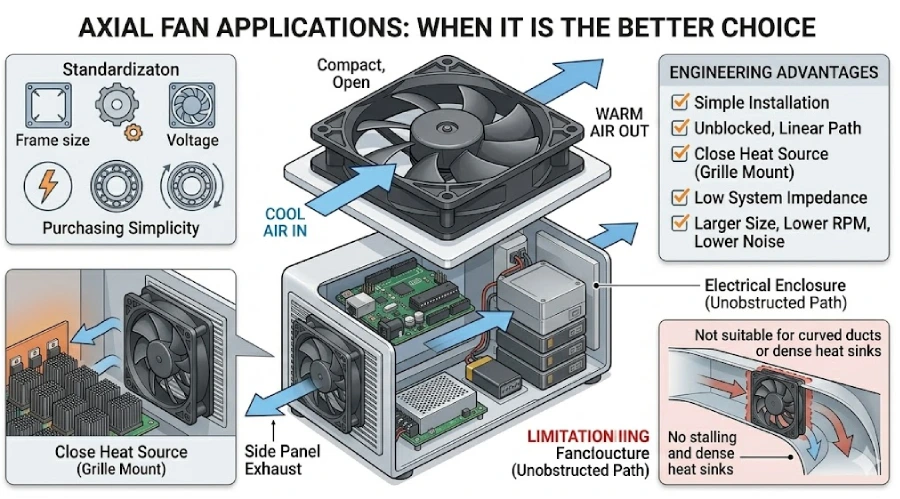
A 12V DC axial fan is often the first option for engineers because it is easy to install and available in many sizes. If the product has a clear inlet and outlet, and air can move in a straight line, an axial fan can be very effective.
This is common in electrical enclosures, small control panels, power supplies, chargers, telecom devices, and electronic cabinets. The fan may be mounted on a grille or side panel to pull cool air in or exhaust warm air out. In this type of design, the airflow does not need to travel through a long internal duct. It only needs to exchange air and reduce the general temperature inside the enclosure.
Axial fans also work well when the heat source is close to the fan and the surrounding space is not too crowded. A larger axial fan running at a lower speed can often provide good airflow with lower noise.
From a purchasing point of view, axial fans are usually easier to standardize. Frame size, thickness, voltage, connector, bearing type, airflow, and noise level are the main selection points. For many high-volume products, this simplicity is a real advantage.
However, axial fans become less suitable when the product housing blocks the airflow. If the fan must push air through a narrow outlet, a dense heat sink, a curved duct, or a small nozzle, the actual airflow can drop quickly. This is not always visible in a free-air CFM rating.
When a Squirrel Cage Fan Solves the Problem Better
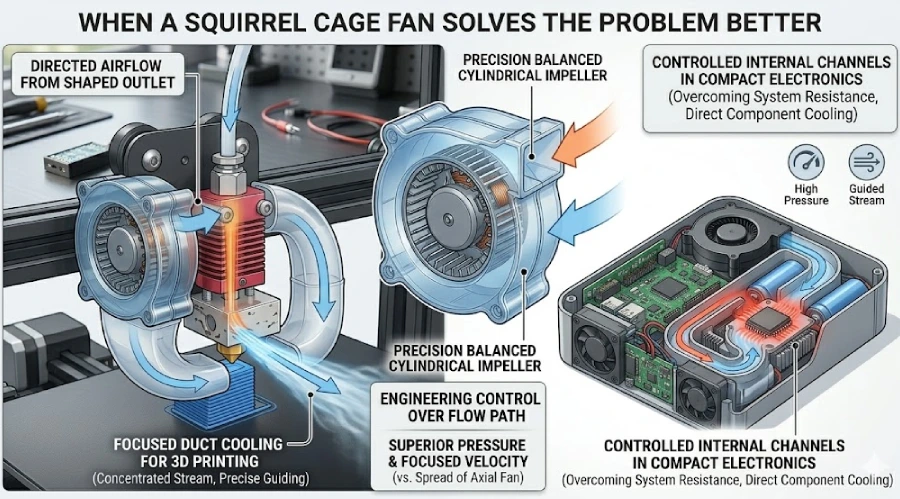
A 12V DC squirrel cage fan is usually selected when air needs to be delivered to a specific point. Instead of only moving air forward, it creates a more directed airflow from a shaped outlet.
This is useful in compact products where the fan cannot be placed directly in front of the hot component. The air may need to turn 90 degrees, pass through a plastic air channel, or blow across a small heat sink. In these situations, a blower-style fan gives the engineer more control over the airflow path.
We see this often in 3D printer cooling, compact electronic modules, battery-powered devices, projectors, small HVAC modules, and portable equipment. The cooling target is not always the whole enclosure. Sometimes it is one part, one board, one heat sink, or one small working area.
For example, in a 3D printer, a part cooling fan often needs to push air through a duct toward the printed layer. A normal axial fan may move air, but the air spreads too much or loses force before reaching the nozzle area. A small 12V DC squirrel cage fan can provide a more concentrated stream, which is easier to guide through the printed air duct.
In a battery pack or compact electronics housing, the situation is similar. The available space may be narrow, and the heat source may not be directly exposed. A squirrel cage blower can help move air through a controlled internal channel instead of simply stirring warm air inside the housing.
Why Static Pressure Matters More Than Many Buyers Expect
Many buyers start with airflow. They ask for a fan with a certain CFM value. That is reasonable, but it is not enough.
CFM is usually measured in low-resistance or free-air conditions. Real products are different. Once the fan is installed, airflow may need to pass through vents, filters, heat sinks, cables, PCB components, plastic walls, or outlet openings. All of these create resistance.
When resistance increases, an axial fan may lose much of its airflow. A squirrel cage fan is often better at keeping usable airflow under pressure. This is why static pressure should be considered together with airflow.
For OEM projects, we usually ask customers to describe the actual cooling structure before selecting a fan. Is there a duct? Is the outlet narrow? Is there a heat sink? Does the air need to turn? Is the fan used for general ventilation or point cooling?
These questions help avoid a common mistake: choosing a fan that looks strong on paper but cannot perform after installation.
Side Outlet Design Can Help Product Engineers
One of the practical advantages of a squirrel cage fan is the outlet direction. The side outlet allows the fan to sit in a compact space while sending air in another direction.
This matters when the product housing has limited height or when a straight-through axial fan cannot be mounted near the heat source. Instead of redesigning the entire housing around a fan, engineers can sometimes use a blower and a short air guide to reach the cooling area.
For OEM customers, this can reduce structural compromise. The fan can be placed where there is space, while the outlet sends air where it is needed.
Of course, this also means the outlet size and direction must be checked carefully. A poorly matched duct can create turbulence and noise. A narrow outlet may increase pressure but reduce airflow. A wide outlet may reduce air speed. The fan and air channel should be considered together, not separately.
Noise Is Not Only a Fan Specification
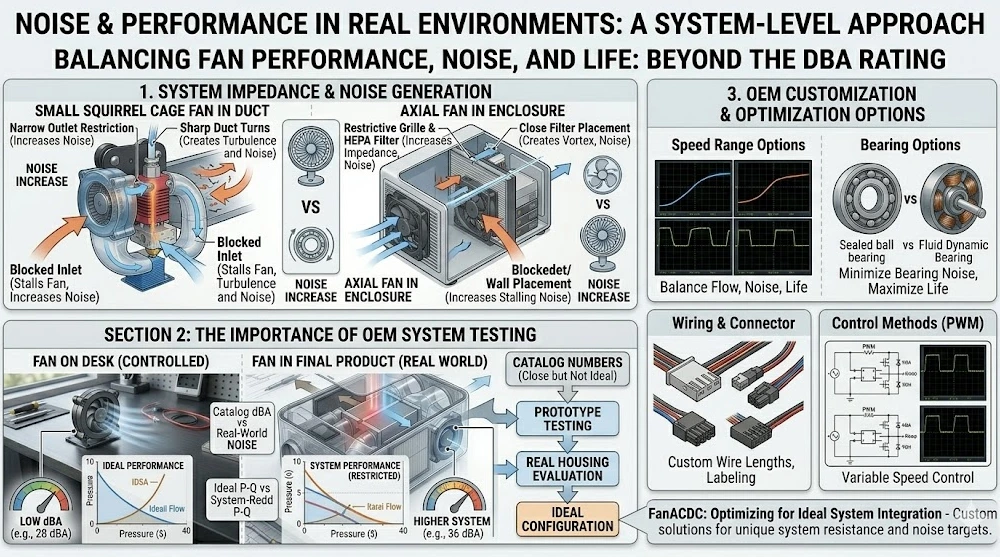
Noise is often listed as a simple dBA value, but in real equipment it depends on more than the fan itself.
A small squirrel cage fan may run at higher speed to create pressure. If the air outlet is too narrow or the duct has sharp turns, noise can increase. The fan may also sound louder if the inlet is blocked or placed too close to a wall.
An axial fan can be quieter in open space, especially when a larger size can be used. But if the axial fan is installed behind a restrictive grille or filter, it may also become noisier and less efficient.
This is why OEM testing is important. A fan that performs well on a desk may behave differently inside the final product. For production projects, sample testing in the real housing is much more useful than relying only on catalog numbers.
FanACDC can support different speed ranges, bearing options, wiring, and control methods to help customers balance airflow, noise, and service life.
Bearing, Lifespan, and Continuous Operation
For consumer hobby use, a low-cost fan may be enough. For OEM equipment, the expectation is different. The fan may need to run for long hours, operate in warmer environments, or survive vibration and repeated start-stop cycles.
Bearing choice becomes important here.
Ball bearing fans are usually preferred for continuous operation and higher reliability. They are suitable for equipment that runs daily or works in industrial environments. Sleeve bearing fans can be used in lighter-duty applications where cost is more sensitive, but they are not always the best option for long service life.
For a 12V DC squirrel cage fan, bearing quality is especially important because many compact blowers run at higher RPM. A stable bearing helps reduce noise growth over time and improves reliability in long-term use.
For OEM buyers, it is worth confirming expected operating hours, temperature range, mounting direction, and duty cycle before choosing the final fan model.
12V or 24V: Which Voltage Should You Choose?
This article focuses on 12V DC fans, but many OEM projects also consider 24V DC versions.
A 12V DC squirrel cage fan is common in 3D printers, portable devices, battery-powered products, small appliances, and compact electronic equipment. It is easy to integrate into low-voltage systems and widely used in small cooling modules.
A 24V DC fan is often chosen for industrial equipment, automation systems, control panels, larger cooling modules, and applications where the main system voltage is already 24V.
The airflow structure decision is separate from the voltage decision. You may need a 12V axial fan, a 24V axial fan, a 12V squirrel cage fan, or a 24V squirrel cage fan depending on the product design.
For customers who are not sure, we usually recommend confirming the system voltage first, then selecting the fan structure based on airflow path and pressure requirement.
Common OEM Applications
A 12V DC squirrel cage fan is suitable for products where air must be directed through a controlled outlet.
In 3D printers, it can be used for part cooling, nozzle area cooling, or compact ducted airflow. In electronic devices, it can cool local hot spots such as ICs, drivers, heat sinks, or power modules. In battery systems, it can help move air through limited internal space. In small HVAC or air delivery modules, it can provide airflow through a short duct or outlet.
A 12V DC axial fan is more suitable for general ventilation. It is often used in power supplies, electrical cabinets, control boxes, communication equipment, and other enclosures where air can move in and out more directly.
For many manufacturers, the final product may use both. An axial fan handles enclosure ventilation, while a squirrel cage fan cools one internal component that needs stronger directed airflow.
What Information Should Buyers Provide Before Sampling?
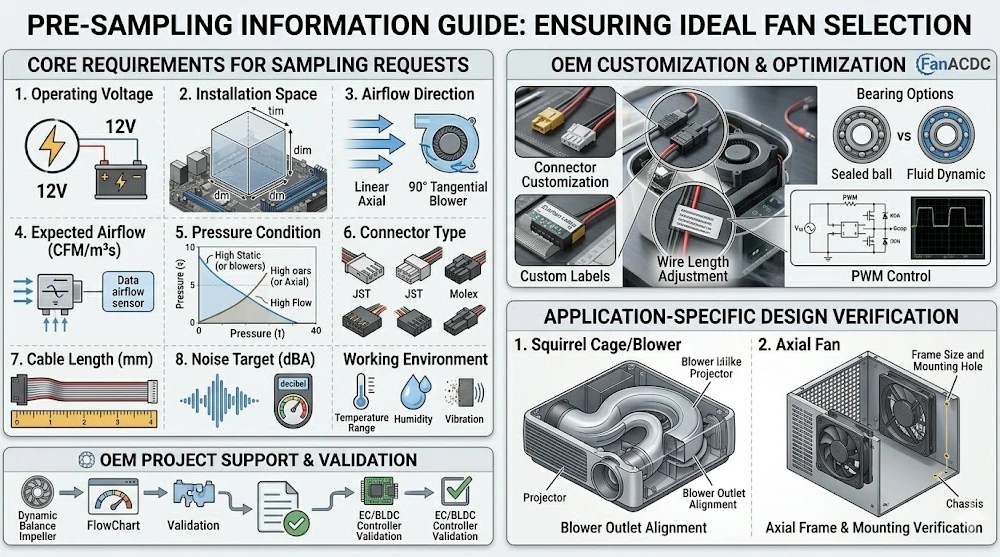
A good fan recommendation depends on the application details. Without those details, it is easy to choose a fan that is close but not ideal.
Before requesting samples, buyers should prepare the basic requirements: operating voltage, available installation space, airflow direction, expected airflow, pressure condition, connector type, cable length, noise target, and working environment.
If there is a drawing or product housing design, it is even better. The outlet direction of a squirrel cage fan must match the internal airflow route. For axial fans, frame size and mounting hole position are important. For both types, current limit and control method should be checked before production.
FanACDC can help customers compare axial fans and squirrel cage fans according to the product structure. For OEM projects, we can also support connector customization, wire length adjustment, label customization, speed selection, PWM control, and bearing options.
A Practical Selection Example
Suppose a customer is developing a compact electronic device. The PCB has one power module that becomes hot during operation. There is no space to place a fan directly above the module, but there is room on the side of the housing. The air needs to enter from one side and travel through a short plastic channel before reaching the heat sink.
In this case, an axial fan may not be the best choice. Even if it has good free-air airflow, much of that airflow may not reach the heat sink after passing through the channel. A 12V DC squirrel cage fan may be more suitable because the outlet can connect more naturally to the air guide.
Now consider a different product: a small control box with vents on both sides. The goal is to exchange hot internal air with cooler outside air. There is no narrow duct and no specific heat sink requiring concentrated airflow. In this case, a 12V DC axial fan is likely the better and simpler choice.
These two examples show why fan selection should follow the mechanical design, not only the airflow rating.
Which One Is Better for Your Product?
If your cooling path is open, simple, and straight, a 12V DC axial fan is usually the better starting point. It is easy to mount, cost-effective, and suitable for general ventilation.
If your cooling path is narrow, indirect, or pressure-sensitive, a 12V DC squirrel cage fan is usually worth testing. It gives better control over where the air goes and can perform better when airflow resistance is present.
The best choice is not always obvious from the product name. It depends on how the fan works inside the real equipment.
For OEM cooling design, the most reliable approach is to test the fan in the final housing or a realistic prototype. This helps confirm not only airflow, but also noise, temperature reduction, current, vibration, and installation fit.
Conclusion
A 12V DC squirrel cage fan and a 12V DC axial fan are both useful cooling solutions, but they are designed for different airflow problems.
An axial fan is the right choice when the product needs open ventilation and straight airflow. It is simple, widely available, and effective for many enclosures and electronic devices.
A squirrel cage fan is the better choice when airflow must be guided through a duct, pushed across a heat sink, or delivered to a specific cooling point. It is especially useful in compact products where static pressure and outlet direction matter.
As a cooling fan manufacturer, FanACDC focuses on helping OEM customers choose fans according to real application conditions. Whether the project needs a 12V DC squirrel cage fan, a 12V axial fan, or a customized low-voltage cooling solution, the final selection should be based on airflow path, pressure resistance, noise target, service life, and installation space.
For production projects, the most useful starting point is not only a fan model number. It is a clear description of the product structure and cooling goal. Once those details are known, the right fan type becomes much easier to choose.