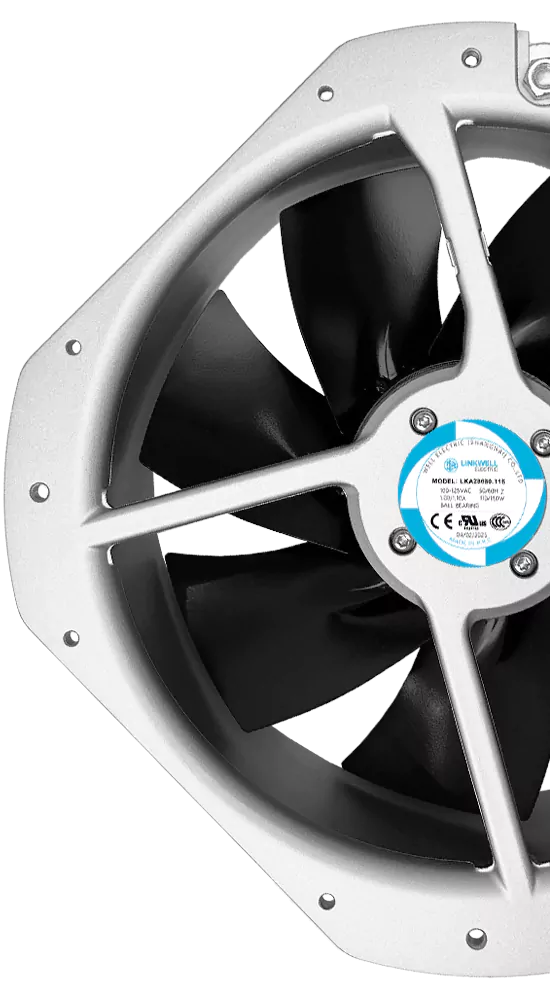
When you compare a 50Hz vs 60Hz cooling fan, frequency is not just a regional label. On many conventional AC fans, it changes motor speed and therefore affects airflow, static pressure, noise, current, and input power. A fan that keeps a cabinet cool on 60Hz may deliver less cooling when the same machine is installed on a 50Hz supply.
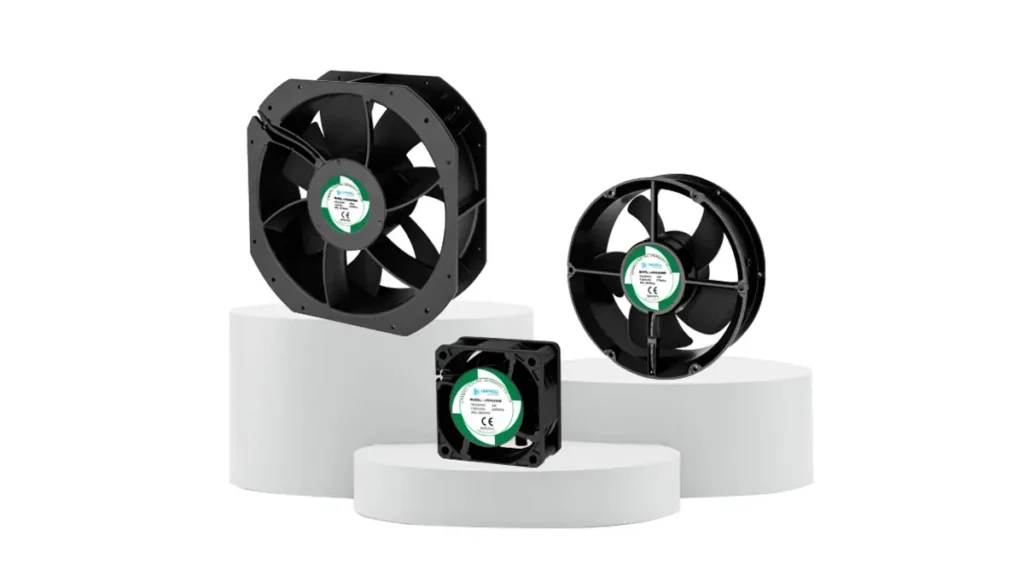
The useful short answer is this: a conventional AC fan often runs faster on 60Hz than on 50Hz, but the difference is not universal and is rarely captured by one simple percentage. Motor design, slip, voltage, capacitor selection, blade load, and the installed system resistance all matter. The paired 50/60Hz values in the manufacturer?s datasheet are more reliable than a rule of thumb.
When you select an AC cooling fan for export equipment, compare its 50Hz and 60Hz performance and design around the lower-airflow condition.
50Hz vs 60Hz Cooling Fan: Quick Answer
For a conventional induction or shaded-pole AC cooling fan, 60Hz operation often produces higher RPM, airflow, and static pressure than 50Hz operation. It may also increase aerodynamic noise and, depending on the motor, change current and power consumption. ?Often? is important: some dual-frequency fans are designed to keep nearly the same speed, while electronically commutated fans can provide the same performance at both frequencies.
| Parameter | Typical at 50Hz | Typical at 60Hz | What you should check |
|---|---|---|---|
| AC supply cycles | 50 cycles per second | 60 cycles per second | Fan nameplate and local supply |
| Conventional AC fan speed | Usually lower | Usually higher | Published RPM for the exact model |
| Maximum airflow | Often lower | Often higher | CFM or m?/min at each frequency |
| Maximum static pressure | Often lower | Often higher | Separate P-Q curves or pressure ratings |
| Noise | Often lower | Often higher | dB(A) at the same test condition |
| Current and power | Model-specific | Model-specific | Both rated values; do not infer from speed alone |
| Compatibility | Safe only within the fan?s rated voltage and frequency | A 50/60Hz mark does not mean every voltage is acceptable | |
If the label says 50/60Hz, the fan is intended for both frequencies within its stated voltage range. Performance can still differ. If the label lists only 50Hz or only 60Hz, treat the other frequency as unapproved until the manufacturer confirms it.
What 50Hz and 60Hz Mean for a Cooling Fan
Frequency tells you how many times the AC waveform completes a cycle each second. It does not mean the blade rotates 50 or 60 times per second. Fan RPM depends on the motor design, number of poles, electrical frequency, and slip between the rotating magnetic field and the rotor.
For an induction motor, synchronous speed is calculated as 120 ? frequency ? number of poles. The rotor normally runs below that theoretical speed because of slip.
| Motor pole count | Synchronous speed at 50Hz | Synchronous speed at 60Hz |
|---|---|---|
| 2 poles | 3,000 RPM | 3,600 RPM |
| 4 poles | 1,500 RPM | 1,800 RPM |
| 6 poles | 1,000 RPM | 1,200 RPM |
Small AC axial fans often use shaded-pole or capacitor-run motors, so their actual RPM can be well below these synchronous values. You should use the equation to understand the direction of change, not to replace the fan datasheet.
Frequency and voltage are separate ratings
A 230V/50Hz fan is not electrically equivalent to a 115V/60Hz fan. Frequency influences the magnetic field and speed; voltage influences winding current, magnetic flux, starting behavior, and insulation requirements. You must match both values at the fan terminals. Our AC fan voltage guide explains the common 100V, 115V, 120V, 220V, 230V, and 240V ratings.
A frequency converter also does not automatically solve a voltage mismatch. Any VFD or converter must be compatible with the motor type, voltage, current, frequency range, and required control method.
How to read paired 50/60Hz data
Manufacturers commonly write specifications in the order 50Hz/60Hz. A speed value of 2,250/2,700 RPM therefore means 2,250 RPM at 50Hz and 2,700 RPM at 60Hz. Use the same order for airflow, pressure, current, power, and noise unless the datasheet states otherwise.
How Frequency Changes Conventional AC Fan Performance
Speed
If the same conventional AC motor can operate at both frequencies, its speed will often rise as frequency rises. Moving from 50Hz to 60Hz is a 20% frequency increase, but actual fan-speed change may be smaller, equal to, or occasionally different from 20% because slip and motor design also change.
Airflow, pressure, and absorbed power
Fan laws describe how the same fan changes when its rotational speed changes under similar airflow conditions. If speed actually rises by a factor of 1.20, the ideal relationships predict the following:
| Performance value | Ideal speed relationship | 50Hz-to-60Hz illustration |
|---|---|---|
| Airflow | Proportional to speed | Approximately 1.20 ? |
| Static pressure | Proportional to speed squared | Approximately 1.44 ? |
| Fan power | Proportional to speed cubed | Approximately 1.73 ? |
These figures are engineering estimates, not a promise that every 50/60Hz cooling fan will follow them exactly. The motor may not reach a 20% higher speed, electrical input may limit the operating point, and efficiency can shift. Use the manufacturer?s 50Hz and 60Hz curves whenever they are available.
Installed airflow
Maximum CFM is measured near free-air conditions. Your enclosure, grille, filter, heat exchanger, and ductwork add resistance, so the actual airflow is where the fan curve intersects the system-resistance curve. A higher 60Hz maximum airflow does not tell you how much air will pass through a restrictive cabinet.
Compare the P-Q curve at the required frequency and find the operating point. If you need a refresher, see how to read a fan curve and our explanation of fan static pressure.
Noise, vibration, current, and temperature
Higher blade speed usually creates more aerodynamic noise, and it can expose an installation to vibration or resonance that was not apparent at 50Hz. Current and input power do not follow one universal rule; they depend on winding design, load, voltage, capacitor, and efficiency. Check the separate ratings instead of assuming that the faster condition always draws exactly 20% more power.
Motor temperature deserves the same attention. A frequency change alters the volts-per-hertz relationship as well as the mechanical fan load. Even when the fan starts and appears to run normally, it may operate outside its validated thermal condition.
Published 50Hz vs 60Hz Cooling Fan Data
Real product data shows why you should not convert a fan specification by frequency ratio alone. The SANYO DENKI San Ace 60 model 109-180 is rated at 100V and 50/60Hz. Its published values are:
| Published parameter | 50Hz | 60Hz | Observed difference |
|---|---|---|---|
| Rated speed | 2,250 RPM | 2,700 RPM | 20% higher at 60Hz |
| Maximum airflow | 9.5 CFM | 11.7 CFM | About 23% higher |
| Maximum static pressure | 11.8 Pa | 18.6 Pa | About 58% higher |
| Rated input | 5 W | 4 W | Lower at 60Hz for this model |
| Rated current | 0.06 A | 0.05 A | Lower at 60Hz for this model |
| Sound pressure level | 24 dB(A) | 26 dB(A) | 2 dB(A) higher |
Source: SANYO DENKI model 109-180 specifications. Values are shown in the manufacturer?s 50Hz/60Hz order.
A larger SUNON 120 ? 120 ? 25 mm dual-frequency AC fan provides another pattern: its published speed changes from 2,000 to 2,300 RPM, airflow from 64 to 78 CFM, static pressure from 0.13 to 0.16 inH?O, and noise from 43 to 46 dB(A), while rated power remains 19 W at both frequencies. See the SUNON DP201AT 2122HST.GN specifications.
The two examples reach the same practical conclusion: 60Hz often raises airflow and pressure on a conventional AC fan, but speed, power, and current do not change by one fixed formula across all models. Use the exact datasheet. If you are considering this common frame size, you can also review LINKWELL?s 120mm AC fan range.
Can You Run a 50Hz Fan on 60Hz, or a 60Hz Fan on 50Hz?
Do not decide by whether the plug fits or whether the fan starts. A frequency mismatch can change cooling performance and motor temperature without producing an immediate failure.
| Nameplate condition | Use on the other frequency? | Required action |
|---|---|---|
| Rated voltage matches and label states 50/60Hz | Normally yes | Use the paired performance values and design for the weaker cooling condition |
| Label states 50Hz only | Do not assume 60Hz is acceptable | Obtain manufacturer approval for speed, load, capacitor, temperature, noise, and mechanical limits |
| Label states 60Hz only | Do not assume 50Hz is acceptable | Confirm starting, motor heating, RPM, airflow, pressure, and volts-per-hertz suitability |
| Voltage is wrong even though frequency matches | No | Select the correct winding or use a properly engineered power-conversion solution |
| EC or AC-input electronically controlled fan | Only within its stated input range | Check whether the datasheet explicitly promises equal 50/60Hz performance |
Running a 50Hz-only fan on 60Hz
The magnetic field may rotate faster, but the voltage-to-frequency ratio becomes lower if voltage stays the same. Available torque can fall while the aerodynamic load rises rapidly with speed. Possible results include inadequate starting margin, excessive noise, vibration, overcurrent, motor heating, or mechanical overspeed. The fan might work, but that is not the same as being rated for reliable service.
Running a 60Hz-only fan on 50Hz
The fan will often run more slowly and deliver less airflow and pressure. At the same voltage, the higher volts-per-hertz ratio can increase magnetic flux and heating in a motor not designed for it. Reduced cooling performance may also raise the temperature of the equipment the fan is meant to protect.
Using a VFD or frequency converter
A VFD is not a universal adapter for every AC cooling fan. Many drives are intended for compatible three-phase induction motors. Some single-phase fan motors and their capacitors are not suitable for VFD output. Confirm the allowed control method, minimum and maximum frequency, voltage curve, cable requirements, and motor protection with both manufacturers.
Work on mains-powered equipment should be performed by qualified personnel using the applicable electrical and machine-safety requirements.
How to Select a 50Hz or 60Hz Cooling Fan
Your goal is not to choose the ?better? frequency. It is to make sure the fan is electrically compatible and still reaches the required operating point in the actual machine.
- Confirm the supply at the fan terminals. Record rated and allowable voltage, 50Hz or 60Hz, single-phase or three-phase supply, and any voltage variation. Do not rely only on the country name; export equipment may contain transformers, inverters, or internal power supplies.
- Read the complete fan label. Check model number, voltage, frequency, current, power, capacitor requirement, wiring, rotation, and certifications. For a replacement, photograph the label and connector before removing the old fan.
- Compare the 50Hz and 60Hz columns. Review RPM, airflow, static pressure, input power, current, and noise. Confirm which value appears first whenever the table uses paired numbers.
- Select at the installed operating point. Define the required airflow through the real grille, filter, enclosure, heat exchanger, or duct. Choose from the curve at the correct frequency rather than comparing free-air CFM alone.
- Design for the weaker thermal condition. For a dual-market machine, the limiting case is often 50Hz because conventional AC fan airflow is commonly lower. Ambient temperature, altitude, dirty filters, and voltage tolerance may create an even worse case.
- Check secondary effects. Confirm acoustic limits, current and power, starting behavior, motor temperature, bearing life, vibration, airflow direction, IP protection, and required UL, CE, RoHS, or other approvals.
- Validate the assembled equipment. Measure temperature rise and, where appropriate, fan current, RPM, airflow, and noise at both rated frequencies. A prototype test catches recirculation and local hot spots that a catalog value cannot predict.
Selection checklist for your supplier
| Information to provide | Why it matters |
|---|---|
| Destination countries | Identifies the expected mains voltages, frequencies, and approvals |
| Voltage, frequency, and phase | Defines winding and electrical compatibility |
| Available frame and thickness | Prevents a mechanical fit mismatch |
| Required airflow at static pressure | Defines the real cooling duty rather than free-air CFM |
| Ambient and internal temperature | Affects motor temperature, bearing life, and thermal margin |
| Noise and vibration limits | Higher-frequency operation can change both |
| Connector, lead length, and accessories | Ensures production-ready installation |
| Quantity and project stage | Supports sampling, customization, and production planning |
For equipment sold in both 50Hz and 60Hz markets
If you want one fan part number worldwide, specify a dual-frequency model and verify the machine at both operating conditions. Base the thermal design on the lower delivered airflow, not on the more attractive catalog number. If the difference is too large, consider an EC fan with frequency-independent performance or maintain separate regional fan variants.
What Changes for DC and EC Cooling Fans?
DC cooling fans
A DC fan is not driven directly by the 50Hz or 60Hz mains waveform. It receives a DC voltage from a power supply, and its electronic commutation controls the motor. The regional frequency matters to the upstream power supply, not directly to the fan RPM. Check that the power supply accepts the local AC input and still provides the fan?s required regulated DC voltage and startup current.
EC and AC-input electronically controlled fans
An EC fan rectifies AC input and drives a brushless motor electronically. A properly designed model can maintain the same fan speed and performance on 50Hz and 60Hz. That makes EC technology useful when one machine must deliver consistent cooling in several regions.
Frequency-independent operation must still be stated by the manufacturer. For example, Oriental Motor specifies the same 50/60Hz characteristics for its EMR Series EC axial fans, and SANYO DENKI describes its ACDC fan as providing stable cooling performance on either frequency. See Oriental Motor EMR Series and SANYO DENKI ACDC fan guidance.
EC fans can also add speed control and alarm functions, but you should compare cost, efficiency, EMC, control interface, power factor, and replacement strategy against a conventional AC fan. The best choice depends on the equipment, not on frequency alone.
Common 50Hz vs 60Hz Fan Selection Mistakes
- Assuming 60Hz always gives exactly 20% more airflow. Frequency may increase by 20%, but actual RPM, airflow, pressure, current, and power remain model-specific.
- Comparing maximum CFM at different test conditions. Use data at the same voltage, frequency, air density, and pressure point.
- Reading ?50/60Hz? as identical performance. It usually means approved operation at both frequencies, not necessarily the same output.
- Checking frequency but overlooking voltage. A dual-frequency fan can still have only one approved voltage range.
- Using a frequency converter as a universal fix. Motor type, phase, capacitor, voltage curve, and insulation must all be compatible.
- Sizing from free-air airflow. Filters, grilles, ducts, and dense internal components can move the operating point far from the maximum CFM rating.
- Skipping the worst-case thermal test. A machine that passes at 60Hz may run too hot on 50Hz after the filter loads with dust or ambient temperature rises.
LINKWELL Cooling Fans for 50Hz and 60Hz Equipment
LINKWELL supplies industrial AC axial fans for control cabinets, power electronics, automation equipment, telecom systems, HVAC assemblies, and other continuous-cooling applications. Available product configurations include multiple frame sizes, 110V and 220V classes, and model-specific 50/60Hz performance.
When you are comparing models, we can review the required airflow at static pressure, supply voltage and frequency, mounting space, noise target, ambient temperature, service-life expectation, connector, and certification needs. For a replacement, send the existing model number, a clear label photo, dimensions, and wiring details. For a new OEM design, include both 50Hz and 60Hz destinations so the lower-performance condition is considered from the beginning.
Explore our cooling fan manufacturing capabilities, or send your operating requirements through the LINKWELL contact form for a model recommendation and quotation.
50Hz vs 60Hz Cooling Fan FAQ
Is a 60Hz cooling fan better than a 50Hz fan?
No. A conventional AC fan may produce more airflow and pressure at 60Hz, but ?better? means matching your electrical supply and cooling requirement. A properly selected 50Hz fan is better for a 50Hz machine than an incompatible 60Hz model.
Does a cooling fan run faster on 60Hz?
Many conventional induction and shaded-pole AC fans do, because motor speed is influenced by supply frequency. The exact RPM change depends on motor design and slip. DC fans and some EC fans do not follow the same relationship.
Can a 50/60Hz fan run on either frequency?
Yes, if the applied voltage is also within the rated range. Check the separate RPM, airflow, pressure, current, power, and noise values because performance may differ between frequencies.
Can I use a 60Hz-only cooling fan on a 50Hz supply?
Not without manufacturer approval. The fan may run more slowly, produce less cooling, and experience an unfavorable volts-per-hertz condition that increases motor heating.
Does a 60Hz fan always use more power?
No. Higher fan speed can increase aerodynamic power demand, but electrical input also depends on the motor and winding design. Published dual-frequency models can show higher, equal, or lower input power at 60Hz. Compare the exact datasheet values.
Does mains frequency affect a DC cooling fan?
Not directly. A DC fan responds to the DC output of its power supply. The power supply must accept the local 50Hz or 60Hz AC input and provide the correct regulated DC voltage and current.
Which fan is best for equipment sold worldwide?
Use a dual-frequency AC fan whose 50Hz and 60Hz curves both meet your thermal requirement, or choose a suitably rated EC fan that provides consistent performance at both frequencies. Validate the assembled equipment under the worst expected voltage, frequency, temperature, altitude, and filter condition.