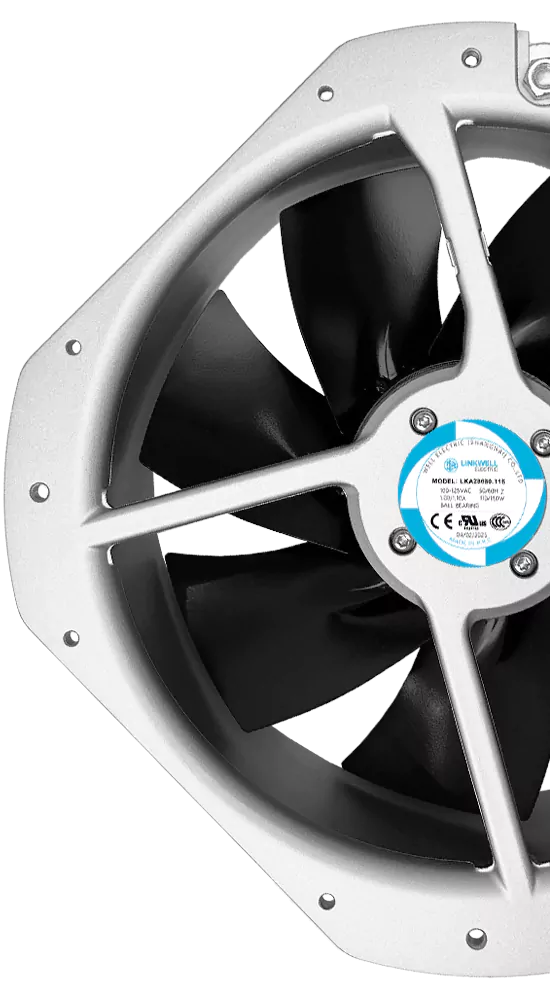
IP54 and IP55 filter fans have the same level of dust protection, but they are tested against different levels of water exposure. The first digit, 5, means the enclosure is dust-protected rather than completely dust-tight. The second digit is where the ratings separate: 4 addresses splashing water, while 5 addresses water jets.
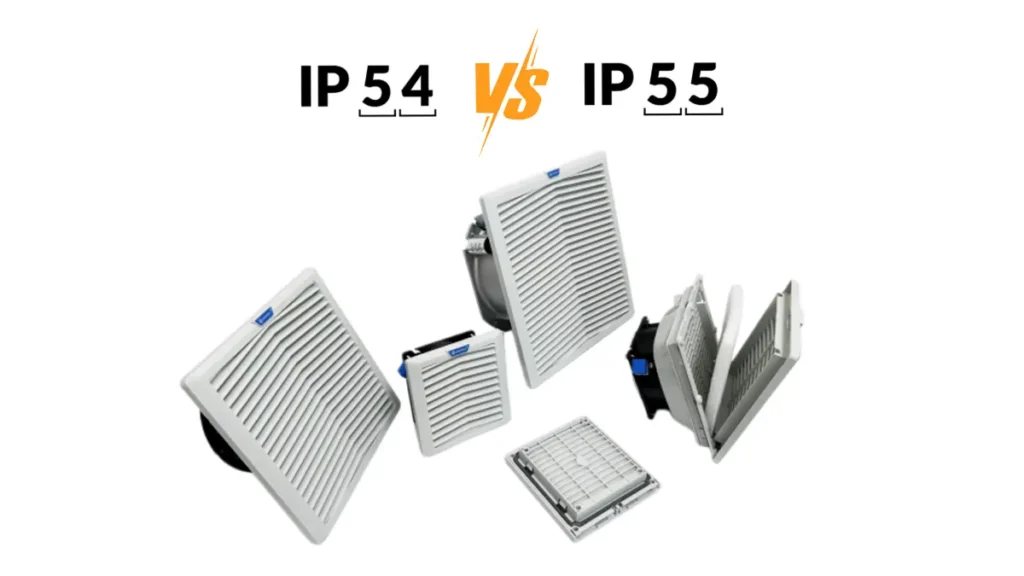
That difference matters, but it does not mean IP55 is automatically the right choice for every cabinet. You need to match the rating to the actual exposure, verify the rating of the complete installed assembly, and confirm that the selected fan filter still provides enough airflow through its filter media and outlet arrangement.
Key Takeaways
- IP54 and IP55 provide the same dust-protection classification; the difference is splash-water protection versus water-jet protection.
- IP55 is not a waterproof or washdown rating. High-pressure cleaning, steam, immersion, condensation, and corrosion require separate evaluation.
- The rating on a fan filter does not automatically become the rating of the completed cabinet. The cutout, gasket, exhaust filter, cable entries, door seals, and installation quality all matter.
- IP protection does not tell you filter efficiency, airflow, noise, service life, or chemical resistance. Specify those items separately.
- Compare airflow at the real operating point. Filter media, outlet resistance, and dust loading can matter more than the IP number alone.
- LINKWELL IP54 and customized IP55 availability is configuration-specific, so confirm the exact model and supporting documentation before design release.
IP54 and IP55 at a Glance
| Question | IP54 Filter Fan | IP55 Filter Fan |
|---|---|---|
| Protection against solids | Dust-protected; limited dust ingress may occur, but not enough to interfere with operation | Same first-digit dust protection as IP54 |
| Protection against water | Protection against splashing water from any direction | Protection against water jets from any direction under the defined test conditions |
| Typical selection | Indoor industrial areas with occasional splashes or routine cabinet cleaning that does not involve directed jets | Locations with a credible risk of directed water spray, subject to the complete installation and project requirement |
| What it does not mean | Not dust-tight, waterproof, or suitable for immersion | Not dust-tight, waterproof, or suitable for immersion |
| What you must verify | Model rating, gasket, cutout, mounting, exhaust opening, and other cabinet penetrations | The same checks, plus the project’s water-jet exposure and required test evidence |
What the Two Digits Actually Tell You
The IP code is an ingress-protection classification established through IEC standards. It describes protection provided by an enclosure against access to hazardous parts, solid foreign objects, and water. It is not a general quality score, and a larger number does not tell you anything about airflow, efficiency, noise, bearing life, or suitability for a particular chemical environment.
For both IP54 and IP55, the first digit is 5. The device is protected against dust to the level defined by the applicable test, but it is not classified as dust-tight. If your application requires dust-tight construction, you need to evaluate a higher solids-protection level and whether an open-loop filter fan is appropriate at all.
The second digit describes water protection. IP54 is designed around splashing water, whereas IP55 is designed around water jets. IP55 therefore addresses a more demanding water exposure, but it still does not cover high-pressure washing, steam cleaning, immersion, flooding, or every outdoor condition.
Why the Installed Cabinet May Not Keep the Component Rating
A filter fan introduces a large opening into the cabinet wall. The installed result depends on more than the label on the fan filter. Your panel cutout, gasket compression, mounting surface, cover engagement, fasteners, exhaust filter, cable entries, door seal, and unused holes all affect the enclosure’s final protection.
If the cutout is oversized or has sharp burrs, the frame may not sit flat. A damaged gasket can leave a leak path. An IP55 intake paired with an outlet or cable gland that does not meet the target can also limit the rating of the complete cabinet. Treat the component rating as one input to the enclosure design, not an automatic certification for the finished assembly.
For an OEM or exported cabinet, define whether you need a component rating, an installed assembly rating, or formal third-party evidence for the complete enclosure. The answer changes the documents and validation you should request.
Does IP55 Reduce Airflow?
You cannot answer that from the IP code alone. Water-protection performance may involve a different grille, filter structure, sealing arrangement, or airflow path, but the resulting pressure drop is specific to the design. One IP55 fan filter may outperform an IP54 unit of another size, while two variants in the same family may have different curves.
Compare airflow under the same test condition and with the intended outlet filter installed. Free-air CFM is especially misleading here because it excludes much of the resistance you will see in the cabinet. Ask for the pressure-airflow curve or installed-configuration airflow, then confirm that the operating point meets your calculated cooling requirement.
If your cabinet accumulates dust quickly, filter loading may have a larger effect on airflow than the initial difference between two protection options. Maintenance access and the availability of the correct replacement media therefore belong in the IP54-versus-IP55 decision.
When IP54 Is Usually the Practical Choice
IP54 can be appropriate for indoor automation cabinets, machine-tool panels, electrical rooms, and production areas where dust and occasional splashing are concerns but directed water jets are not part of normal operation. It may give you a simpler and more economical solution when the cabinet environment is controlled.
Do not choose it from the room description alone. Check nearby wash stations, leaking pipes, coolant spray, cleaning practices, open doors, and the direction from which water can reach the cabinet. A cabinet described as indoor can still face demanding water exposure.
When You Should Specify IP55
IP55 deserves consideration when directed water spray is a credible operating or cleaning condition and the project specification explicitly requires jet-water protection. Examples can include certain outdoor installations, food or beverage support areas outside direct hygienic washdown zones, exposed utility spaces, and cabinets near equipment that produces spray.
You still need to examine ultraviolet exposure, temperature, corrosion, chemicals, pressure washing, and condensation separately. IP55 does not certify resistance to those conditions. For corrosive dust, conductive particles, oil mist, or ambient temperatures above your internal target, a sealed cooling method may be safer than a filter fan.
How to Choose Between IP54 and IP55
Use the following order instead of selecting the larger number by default:
- Define the real dust and water exposure, including cleaning methods and spray direction.
- Confirm the enclosure-level requirement in the customer specification or applicable equipment standard.
- Determine whether open-loop filtered ventilation is acceptable for the contaminants present.
- Calculate the required airflow from heat load and allowable temperature rise.
- Compare airflow at the expected resistance, not free-air CFM alone.
- Check the rating and construction of both the intake fan filter and the exhaust opening.
- Verify cutout, gasket, mounting, filter maintenance, and service clearances.
- Request the applicable model datasheet and test or certification evidence before final approval.
LINKWELL IP54 and Custom IP55 Options
LINKWELL’s LK32, LK66, FK55, and FF fan filter range includes configurations with protection up to IP54, while IP55 can be customized for suitable project requirements. Availability is model-specific. Do not publish or purchase against a family-level statement alone; confirm the exact ordering configuration, airflow, voltage, material, filter media, cutout, and protection evidence.
You can review how these products fit into broader electrical enclosure cooling. If you are deciding between AC and DC power for the cabinet, compare the available AC fan and DC fan platforms before locking the electrical design.
Information to Include in Your RFQ
- Required IP rating and whether it applies to the component or completed cabinet
- Water source, spray direction, cleaning method, and exposure duration
- Dust type, particle loading, corrosion, oil mist, and outdoor exposure
- Required airflow and expected system resistance
- Supply voltage, frequency, and control requirement
- Cabinet drawing, panel thickness, cutout, and mounting orientation
- Filter-media requirement and planned maintenance interval
- Required test reports, declarations, and market certifications
- Sample quantity, annual demand, and customization needs
Send these conditions to LINKWELL so the rating and airflow can be checked together rather than as separate specifications.
IP Rating and Filter Efficiency Are Separate Specifications
An IP code tells you how an enclosure resists access, solid particles, and water under defined tests. It does not tell you the filter class, particle capture efficiency, pressure drop, airflow, noise, or service life. That distinction matters when you compare two filter fans that both carry an IP54 or IP55 claim. One may use a denser mat and deliver less airflow at the same system resistance; another may move more air but require more frequent filter changes in your dust environment.
For a defensible specification, keep four requirements separate: the protection level, the required airflow at the operating point, the filter medium, and the environmental conditions. You should also define the acceptable internal temperature. Our guide to electrical enclosure temperature control explains how these decisions work together.
Three Cabinet Scenarios and the Better Starting Point
| Application | Practical starting point | What you still need to verify |
| Indoor PLC or VFD cabinet with moderate airborne dust and no directed water | IP54 filter fan | Operating airflow, filter loading rate, temperature rise, and cleaning routine |
| Cabinet near occasional spray, splashing, or controlled cleaning | IP55 may be justified | Direction and pressure of water exposure, installed gasket and cutout, cable entries, and whole-enclosure validation |
| Wet, corrosive, outdoor, or very hot location | Review a sealed cooling method instead of assuming IP55 is sufficient | Ambient temperature, solar load, corrosion resistance, condensate, and whether filtered ambient air is acceptable |
These are starting points, not automatic selections. If ambient air can be hotter than your allowable cabinet temperature, a filter fan cannot cool the enclosure below ambient. In that case, compare the available options in enclosure fan vs air conditioner before you finalize the cutout.
How to Validate Protection After Installation
The most common mistake is to approve the fan filter as a component and never inspect the completed cabinet. Protection depends on the entire installation, including the panel cutout, flatness of the mounting surface, gasket compression, fasteners or clips, outlet filter, cable glands, door seal, and any unused holes.
- Confirm that the exact model and mounting orientation match the supplier drawing.
- Inspect the cut edge for burrs, distortion, paint buildup, or gaps that can prevent even gasket contact.
- Check that the intake and outlet create a real cross-cabinet path. A higher IP option will not correct short-circuit airflow. See cabinet fan airflow direction for layout guidance.
- Verify airflow and internal temperature under a representative heat load, with the filter fitted and the cabinet closed.
- If an enclosure IP declaration is required, follow the applicable enclosure standard and your test or certification plan. A component label alone is not evidence for the completed assembly.
Common IP54 vs IP55 Specification Mistakes
- Writing only “IP55 fan filter” on the RFQ. Add voltage, frequency, airflow requirement, cutout, mounting orientation, filter medium, ambient range, approvals, and expected quantity.
- Treating IP55 as waterproof. IP55 addresses water jets under a defined test; it is not an immersion or unlimited washdown rating.
- Ignoring airflow loss. Compare delivered airflow through the complete intake and exhaust path, not a free-air number for the fan alone.
- Using IP as a filter-efficiency grade. Ask for the medium specification and pressure-drop data separately.
- Skipping maintenance access. A protection level is of little value if the mat cannot be inspected and replaced without disrupting wiring or production.
If you are specifying an OEM cabinet, ask the supplier to identify which data applies to the standard IP54 version and which data applies to the custom IP55 construction. That keeps a general product-family statement from being mistaken for a tested value on every configuration.
Frequently Asked Questions
Is IP55 completely waterproof?
No. IP55 covers dust protection and water jets under defined test conditions. It does not mean the product is suitable for immersion, flooding, steam cleaning, or high-pressure washdown.
Is IP55 more dustproof than IP54?
No. Both ratings use 5 as the first digit, so they have the same dust-protection classification. Their difference is the second digit for water protection.
Can I replace an IP54 fan filter with an IP55 model?
Only after checking cutout, dimensions, voltage, airflow at the operating point, exhaust arrangement, mounting depth, and certification requirements. Matching the outside dimensions alone is not enough.
Does adding an IP55 fan filter make my enclosure IP55?
No. The complete enclosure and all penetrations must satisfy the target. Installation quality and the rating of the exhaust opening are part of that assessment.
Which rating is better for an outdoor cabinet?
Outdoor suitability cannot be decided from IP54 versus IP55 alone. You also need to consider rain direction, solar load, ultraviolet exposure, condensation, corrosion, temperature, wind-driven dust, and whether the complete cabinet has been validated for the site.