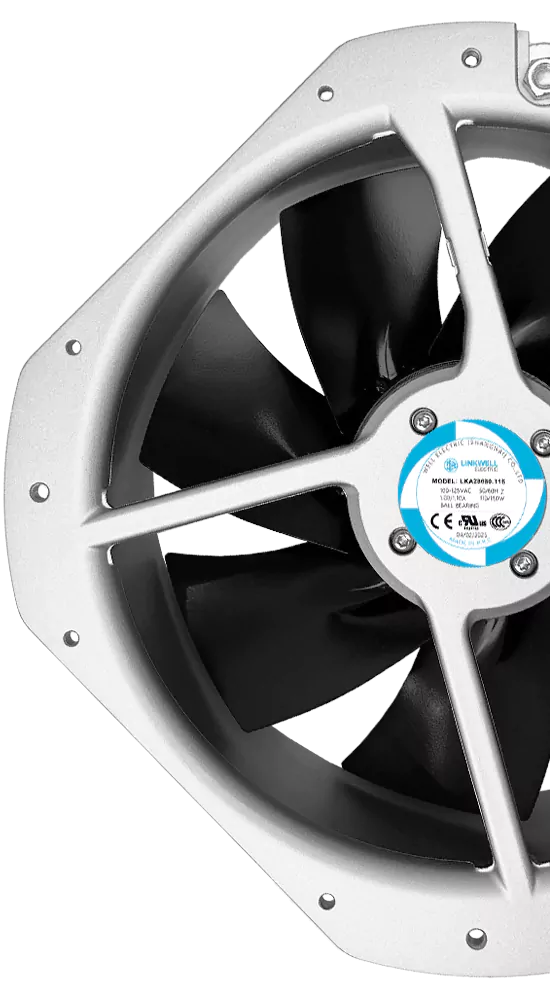
An electrical enclosure works comfortably during a factory test near sea level. The same design is installed at a mountain site, where the fan still spins at its expected RPM but internal temperatures rise. Replacing the fan with another model that has the same catalog CFM may not solve the problem.
The missing variable is air density. A fan moves volume, but cooling depends on the mass of air carrying heat away. At high altitude, each cubic meter of air contains less mass. Fan pressure capability also changes with density, while the enclosure resistance, control logic and component temperature limits still have to be satisfied.
High-altitude selection should therefore use the site elevation, temperature, required heat removal and actual system resistance. Catalog airflow at standard conditions is only the starting point.
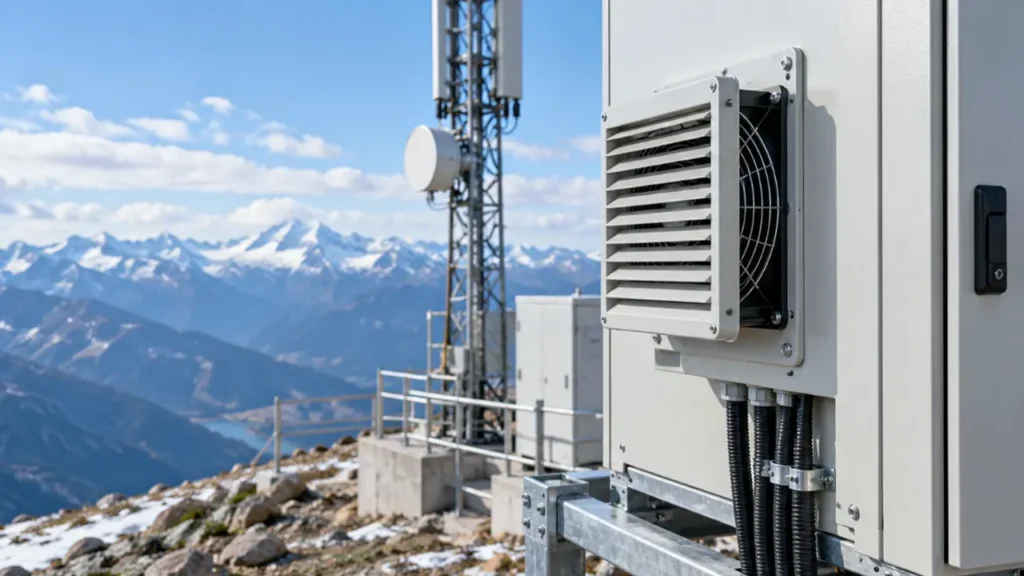
Why Does High Altitude Affect Cooling Fan Performance?
Atmospheric pressure decreases as elevation increases. At the same temperature, lower pressure means lower air density. Temperature also matters: warmer air is less dense than cooler air, so a high, hot installation can have a larger density reduction than elevation alone suggests.
For a fan running at the same speed and geometry, pressure rise is approximately proportional to air density. The fan may continue to move a similar volume in a geometrically similar airflow system, yet each unit of volume contains less mass and carries less heat. The real operating point can also shift when filters, heat sinks, ducts or control algorithms behave differently from the simple model.
This is why the symptom can be confusing. RPM appears normal, the tachometer signal is present, and an anemometer may still show airflow. The equipment runs hotter because the thermal result depends on more than rotational speed or free-air CFM.
Note: High-altitude derating is a system problem, not evidence that the fan is defective. Verify density, operating point and component temperatures before changing the fan.
Volume Airflow vs Mass Airflow
Fan datasheets commonly report volume airflow in CFM or m3/h. Volume airflow tells you how much space the moving air occupies per unit time. Mass airflow tells you how much air mass passes through the equipment per unit time.
A simplified sensible-heat relationship is:
Q = Pheat / (rho x cp x DeltaT)
Here, Q is required volume airflow, Pheat is the heat transferred to the air, rho is air density, cp is the specific heat of air, and DeltaT is the permitted air-temperature rise. If heat load and permitted temperature rise stay the same while density decreases, the required volume airflow increases.
This equation is useful for an early thermal estimate, but it does not select the fan by itself. The fan must deliver that airflow against the pressure loss created by filters, grilles, heat sinks and internal passages. Heat transfer at component surfaces and uneven air distribution also affect the final temperature.
The LINKWELL enclosure cooling fan calculation guide explains the basic airflow estimate. For high altitude, replace the assumed standard density with a value representing the worst site condition.
How Air Density Changes a Fan Curve
A published fan curve relates airflow and pressure under stated test conditions. When air density decreases at the same fan speed, the pressure available at a given volumetric flow decreases approximately in proportion to density. Input power associated with aerodynamic load also changes.
Do not move only the fan curve and forget the system. Pressure loss through many passive restrictions also depends on density and velocity. In a simple fixed-resistance air path, both fan pressure and system pressure can scale in a similar direction, so volumetric airflow may remain closer to the original value than expected. Cooling capacity can still fall because mass airflow is lower.
Real electronic equipment is rarely a perfect similarity case. Filters load with dust, louvers have local losses, heat sinks can receive uneven flow, and EC or DC fans may regulate speed or power. A controller that holds RPM does not hold mass flow. A controller that reacts to temperature may increase speed until it reaches its command, power or acoustic limit.
Use the fan curve guide to find the operating point, then apply the density and thermal corrections appropriate to the installation.
What Information Is Needed for High-Altitude Fan Selection?
| Input | Why it matters | Common mistake |
|---|---|---|
| Site elevation | Helps determine barometric pressure and density | Using the factory location instead of the final installation |
| Maximum inlet temperature | Warm air further reduces density and thermal margin | Using yearly average temperature |
| Heat load | Defines the heat that the airflow must remove | Using equipment input power without checking actual losses |
| Allowable temperature rise | Sets the required cooling-air capacity | Using enclosure air temperature while ignoring component limits |
| System resistance | Determines the fan operating point | Selecting from free-air CFM alone |
| Fan control limit | Defines available speed, voltage and power margin | Assuming the controller can always add more speed |
| Environmental exposure | Filters, dust and sealing can add pressure loss | Applying altitude correction to a clean bench setup only |
How to Select a Cooling Fan for High Altitude
- Define the worst combined condition. Use maximum site elevation and the relevant maximum inlet-air temperature, not separate convenient cases.
- Calculate or obtain site air density. Use an approved engineering method or project environmental data.
- Recalculate the required volume airflow. Account for the lower mass of air available to carry the heat load.
- Establish the installed resistance curve. Include filters, guards, louvers, ducts, heat sinks and service-condition contamination.
- Correct or obtain the fan curve for density. Do not assume the standard-condition pressure curve is unchanged.
- Check motor and controller limits. Confirm voltage, current, power, maximum speed, noise and operating temperature.
- Validate the complete equipment. Measure component temperatures and fan behavior under a representative worst-case condition.
A simple percentage added to CFM can be useful only when its assumptions are known. It should not replace the corrected operating point or thermal validation. The required margin differs between an open enclosure, a filtered control cabinet and a dense power-electronics assembly.
AC, DC and EC Fan Considerations at Altitude
AC cooling fans
An AC fan’s speed and torque behavior depend on motor design, supply voltage and frequency. Check whether the selected model has enough pressure margin at the corrected density and whether the site voltage and frequency match the approved rating. Do not compensate for altitude by applying voltage above the permitted range.
DC cooling fans
A DC fan may provide fixed speed, voltage control or a separate PWM input. If additional speed is required, confirm the model’s allowable control range, input current and acoustic limit. The power source must also support startup and maximum-speed demand at the fan terminals.
EC cooling fans
An EC fan can make variable-speed control easier, but the controller still needs a valid target. A temperature loop may compensate for part of the reduced cooling automatically, yet it can saturate at maximum command. Log command, RPM and temperature during validation so a lack of cooling is not mistaken for a control-signal fault.
Common High-Altitude Cooling Mistakes
Checking RPM instead of cooling. Correct RPM confirms rotation, not heat-removal capacity.
Using sea-level free-air CFM. The installed fan operates against resistance, and high-altitude thermal capacity depends on mass flow.
Correcting elevation but not temperature. A hot mountain enclosure can have a more severe density condition than elevation alone indicates.
Increasing speed without checking noise and power. Additional RPM changes pressure, power, sound and bearing duty.
Testing with a clean filter only. A filter near its service limit may move the fan to a different operating point.
Ignoring solar load. Outdoor cabinets can receive substantial heat from sunlight in addition to internal electrical losses.
How to Validate the Design
The strongest validation is a complete equipment test at representative density, temperature, voltage and filter condition. When an altitude chamber is not available, an engineering test plan may combine corrected fan data, controlled restriction, thermal modeling and margin testing. Document what the test reproduces and what remains analytical.
Measure inlet temperature, critical component temperatures, fan terminal voltage, current, command and RPM. If possible, measure pressure or airflow using a method suitable for the installed geometry. A single air-velocity reading near a grille can be misleading when the flow is non-uniform.
LINKWELL can review AC, DC and EC fan candidates when the project provides elevation, inlet temperature, heat load, required airflow, system resistance, available size, supply and control method. Final performance should be confirmed for the exact model and equipment configuration.
Frequently Asked Questions
Does a fan move less CFM at high altitude?
Not always by the amount people expect. At constant speed in a similar system, volumetric airflow may remain relatively close while pressure and mass airflow decrease. The actual operating point depends on the fan, system curve and control behavior.
Why does equipment run hotter if fan RPM is normal?
Lower-density air carries less heat per unit volume. Normal RPM therefore does not guarantee the same mass flow or cooling result.
Should I simply select a larger fan?
A larger fan may help, but selection still needs the corrected duty point, space, power, noise and resistance. Increasing frame size without fixing recirculation or restriction can leave the underlying problem unchanged.
Can PWM compensate for altitude?
PWM can command more speed if the fan and controller have available margin. It cannot create unlimited pressure or cooling and should be validated against maximum speed, power, noise and temperature limits.
Does humidity affect air density?
Yes, but altitude and temperature are usually the first variables considered. Use the project’s actual environmental design data when accurate correction is required.
What should I send LINKWELL for high-altitude selection?
Provide elevation, maximum inlet temperature, heat load, allowable component temperatures, airflow resistance, filter condition, fan size, voltage, control method and acoustic limit.