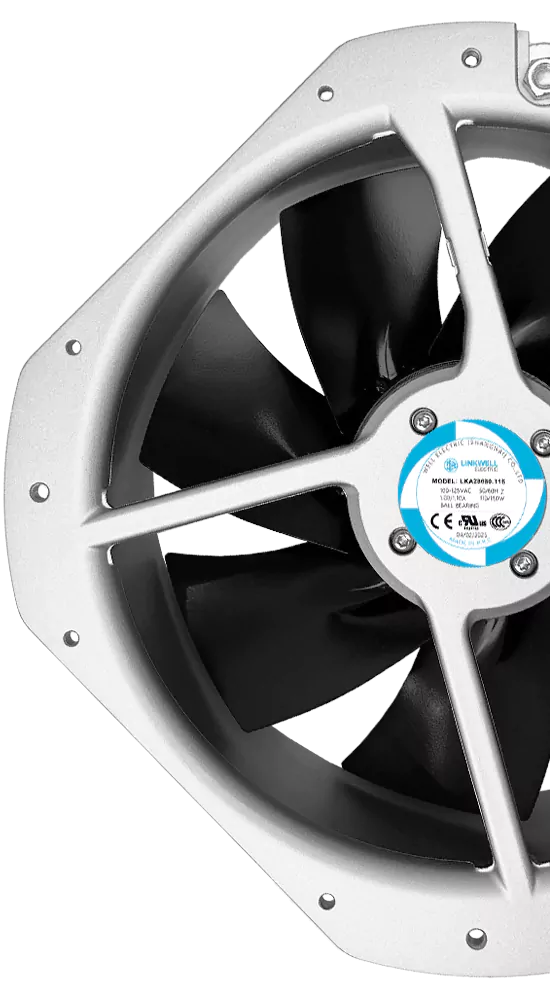
The biggest advantage of a centrifugal fan is not simply that it can move air. It can keep useful airflow when the system pushes back.
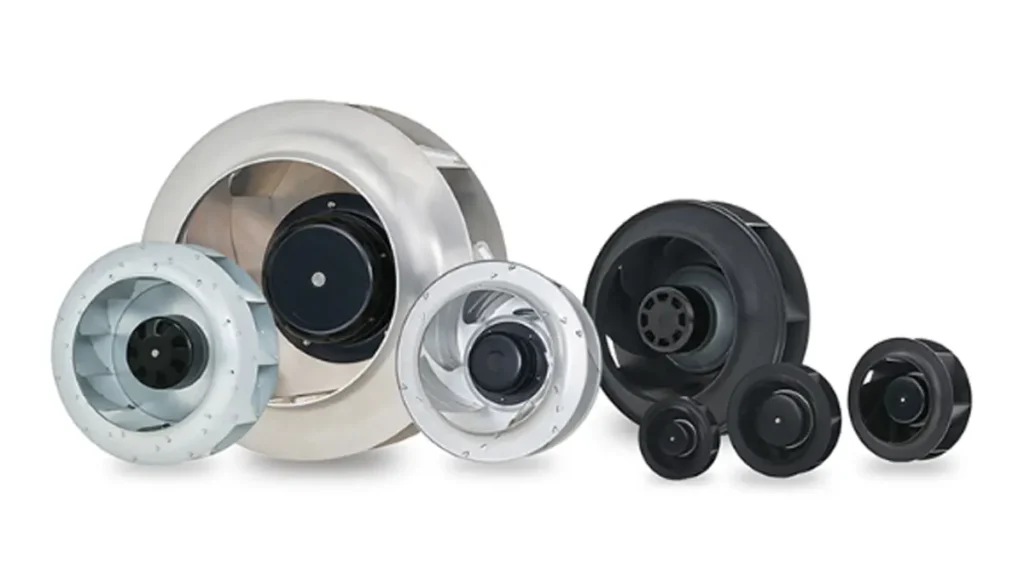
Filters, compact heat exchangers, long ducts, tight bends and dense equipment layouts all create resistance. In those conditions, a centrifugal fan often gives you more pressure capability and more control over the discharge direction than a similar-purpose axial fan. That makes it a strong choice for enclosed industrial cooling, air handling and equipment ventilation.
It is not automatically the best fan. A centrifugal design can need more installation depth, may cost more than a simple axial fan, and can perform poorly when its inlet or operating point is wrong. The practical decision is to match the fan curve, wheel design and physical layout to your real duty point.
Centrifugal fan advantages at a glance
| Advantage | Why it matters in a real system |
|---|---|
| Higher pressure capability | Helps maintain airflow through filters, heat exchangers, ducts and narrow internal passages |
| Controlled discharge direction | Air enters near the axis and leaves radially, often through a 90-degree outlet |
| Several wheel geometries | Forward-curved, backward-curved and radial designs suit different pressure, efficiency and airstream needs |
| Good fit for packaged equipment | Motorized impellers and blowers can integrate into compact cooling modules and enclosures |
| Useful speed control range | EC or controllable DC designs can adjust airflow to thermal demand when properly selected |
| Potential for efficient operation | A well-matched backward-curved design can operate efficiently near its intended duty point |
Every benefit depends on selection. ?Centrifugal? describes a fan family, not one universal performance level.
Why a centrifugal fan behaves differently
Air approaches the impeller near its axis. The rotating wheel accelerates that air outward, and the housing or surrounding flow path converts part of the velocity into pressure before directing the discharge. This change in direction is the source of the familiar blower shape: inlet on one face, outlet around the circumference or through a scroll.
The design is valuable when air must pass through resistance. A free-air airflow number is measured near zero static pressure. Your equipment almost never operates there. The useful result is the airflow at the point where the fan curve meets the system curve. If you are new to that relationship, see How to Read a Fan Curve.
Main advantages of centrifugal fans
1. Stronger performance against system resistance
Centrifugal fans are widely selected for duties that need more static pressure than an open, low-resistance axial fan installation. The difference becomes important when you add a filter, heat exchanger, duct, louver, guard or dense component layout.
Higher pressure capability does not mean airflow stays constant as resistance rises. Every fan loses airflow as the duty point moves. The advantage is that an appropriate centrifugal curve can retain more useful flow in a restrictive path. Compare fans at the required pressure, not at free air.
2. A discharge direction that can simplify equipment layout
Many centrifugal blowers accept air from the side and discharge it roughly 90 degrees from the inlet. That lets you draw air through one face of a cabinet and send it into a duct, heat sink channel or another part of the machine without adding a sharp external elbow.
The geometry can solve a packaging problem, but it also creates one: you need room for the wheel, housing and outlet. Check the complete envelope, cable exit and service clearance before choosing the fan type.
3. Several wheel designs for different jobs
Centrifugal fans are available with forward-curved, backward-curved or inclined, radial and other wheel geometries. Blade form changes the pressure curve, power behavior, efficiency, noise and tolerance of particles. This gives a designer more ways to match the fan to the application than the word ?blower? suggests.
The choice still has to be deliberate. A wheel optimized for clean-air efficiency may not be the right choice for a dirty or abrasive airstream. A compact forward-curved blower may meet a low-to-medium pressure duty at low speed, but its power curve and operating range need careful review.
4. Useful integration options for industrial equipment
Compact centrifugal fans can combine the motor, impeller and supporting structure into one assembly. Housed blowers add a defined outlet. Open motorized impellers give the equipment designer more freedom to shape the surrounding plenum. Both approaches can work well, but the surrounding inlet and outlet geometry becomes part of the aerodynamic design.
Direct-drive construction also removes belts from many small and medium cooling applications. That can reduce routine drive maintenance and simplify speed control. You still need to account for bearing life, motor cooling, mounting stiffness and access for replacement.
5. Speed control can match cooling to demand
When the motor and electronics support it, changing fan speed lets the system respond to temperature, load or process demand. This can reduce unnecessary noise and input power during light-load operation. EC centrifugal fans are especially useful where built-in electronics and a control signal suit the project.
Do not assume any fan can be slowed over any range. Confirm the permitted control method, minimum stable speed, feedback signal and thermal behavior. The system must still maintain the minimum cooling airflow at its worst combination of ambient temperature and resistance.
6. Good efficiency is possible at the right operating point
Backward-curved and airfoil industrial designs can achieve strong efficiency when selected near their intended region. That is a potential advantage, not a blanket promise. Wheel diameter, width, blade geometry, motor efficiency, inlet conditions and duty point all matter.
A smaller fan running very fast is not necessarily the lowest-cost choice over its life. Compare input power, noise, control range and expected operating hours at the actual duty. The U.S. Department of Energy also recommends evaluating the fan as part of the full system rather than treating the component efficiency as the only target.
How blade type changes the advantage
| Wheel type | Typical strength | Important limitation | Often considered for |
|---|---|---|---|
| Forward-curved | Compact package and useful airflow at relatively low wheel speed | Power can rise toward high airflow; operating range and motor sizing need care | Clean-air HVAC modules and compact equipment blowers |
| Backward-curved or backward-inclined | Good efficiency potential and favorable non-overloading behavior in many designs | Inlet conditions and contamination can reduce the expected benefit | Clean-air systems, filtration and efficient industrial cooling |
| Radial blade | Robust geometry and better tolerance for some particulate duties | Often lower efficiency or higher noise than a clean-air optimized wheel | Material handling and harsher airstreams where the fan is designed for them |
These are family-level tendencies. Use the manufacturer?s curve, power data, material limits and application guidance for the exact wheel. Never substitute a blade-label rule for a duty-point check.
Centrifugal fan limitations you should not ignore
More depth and a different airflow path
An axial fan can sit directly in a panel and move air straight through. A centrifugal fan often needs a side inlet, radial outlet, scroll or plenum. In a shallow cabinet, that extra depth may outweigh the pressure advantage. Model the full assembly before the mechanical layout is frozen.
Inlet conditions can change performance
A wall, screen, bend or support placed too close to the inlet can create swirl and uneven velocity across the impeller. The fan may then deliver less airflow, more noise and higher vibration than the catalog curve suggests. Provide a clean approach path or use an inlet arrangement validated by the manufacturer.
Noise is not automatically lower
Some centrifugal selections run more quietly than a high-speed axial alternative, especially when pressure is required. Others produce strong blade-pass tones, motor noise or turbulence at the outlet. Sound depends on speed, wheel design, duty point, housing and installation. Compare sound data under comparable test conditions and test the finished equipment.
Efficiency depends on the wheel and duty point
A centrifugal fan can be efficient, but it can also waste power if it is oversized, throttled heavily or operated far from its intended region. Do not choose a fan only because its maximum efficiency looks high. Check efficiency and input power at your airflow and pressure.
Contamination changes the answer
Dust buildup changes blade shape and mass distribution. Abrasive particles can erode the impeller, while sticky material may accumulate unevenly and cause vibration. Select the wheel, material and cleaning plan for the airstream. A clean-air backward-curved blower should not be treated as a general material-handling fan.
Cost and service access may be higher
A housing, larger impeller, control electronics or custom outlet can add cost. The fan may also be harder to reach inside a tightly packaged machine. Compare acquisition price with energy, downtime, filter loading, expected life and replacement access. A less expensive fan is not a saving if it misses the operating point.
Centrifugal fan vs axial fan: a practical decision table
| Decision factor | Centrifugal fan often fits better when… | Axial fan often fits better when… |
|---|---|---|
| System resistance | Filters, ducts or dense internal passages create meaningful pressure demand | The airflow path is open and resistance is low |
| Airflow direction | You need a side inlet and directed radial or 90-degree discharge | Straight-through flow simplifies the equipment |
| Installation depth | There is room for the wheel and outlet geometry | The fan must fit in a shallow panel opening |
| Pressure at duty | Useful airflow must be maintained at a higher static pressure | High free-air volume is more important than pressure |
| Airstream | The selected wheel and construction match the contamination | Clean, low-pressure ventilation is the main task |
| Cost and integration | Pressure performance and controlled discharge justify the package | Simple mounting and lower initial cost dominate |
For a fuller comparison, see Axial vs Centrifugal Fan.
When should you choose a centrifugal fan?
A centrifugal fan deserves serious consideration when the system has a defined pressure requirement, not just an airflow target. Common examples include:
- Electrical or telecom cabinets with filtered air inlets.
- Power electronics with dense heat sinks or guided cooling channels.
- Heat exchangers that create a measurable pressure drop.
- Equipment that must pull air from one face and discharge it in another direction.
- Ducted cooling modules and compact air-handling units.
- Industrial machines where speed control must follow changing thermal load.
You may be better served by an axial fan when the path is open, the pressure demand is low, panel depth is limited and straight-through airflow is convenient. Choose the simplest design that meets the complete duty reliably.
How to select a centrifugal fan without losing the advantage
Define airflow and pressure together
Calculate or measure the airflow needed to hold the equipment below its temperature limit. Then estimate the total system resistance at that flow, including clean and loaded filters, guards, heat exchangers, ducts and outlet restrictions.
Use the exact fan curve
Check the curve for the planned voltage, frequency, speed and air density. Locate the intersection with the system curve and confirm that it sits in a stable, efficient region. The article on centrifugal fan static pressure covers this pressure requirement in more detail.
Check power and control behavior
Verify input power and current at the duty point and across any expected system variation. Confirm PWM, analog, tachometer or alarm interfaces rather than assuming all controllable fans use the same signals.
Review inlet, outlet and installation space
Provide enough inlet clearance, avoid abrupt blockage, and confirm the outlet matches the plenum or duct. Include the connector, mounting hardware and service path in the envelope drawing.
Match materials to the airstream
State air temperature, humidity, dust, oil, corrosive gases and particle loading. These conditions can change the appropriate wheel geometry, material, bearing system and protection level.
Prototype the real assembly
Measure the temperature of critical components or the actual airflow under the worst operating condition. Catalog curves are essential for selection, but they do not capture every inlet disturbance, leakage path or recirculation zone in your equipment.
Common specification mistakes
- Comparing only maximum airflow at zero static pressure.
- Assuming every centrifugal fan is more efficient or quieter than every axial fan.
- Ignoring the extra depth and the direction of the outlet.
- Using a clean-air wheel in a contaminated airstream without review.
- Placing a wall or grille too close to the inlet.
- Sizing from the current clean filter and forgetting the loaded condition.
- Oversizing the fan, then wasting energy in throttling.
- Leaving voltage, control signal and alarm logic until after mechanical selection.
What to send with your RFQ
For a useful recommendation, send the duty point and installation information together:
- Required airflow and static or total pressure, with units.
- System curve or pressure-drop data where available.
- Air temperature, density and contamination.
- Supply voltage, AC frequency, allowable current and control interface.
- Maximum installation envelope, inlet clearance and outlet direction.
- Noise target and measurement condition.
- Expected operating hours, speed range and life requirement.
- Annual quantity, approvals and OEM customization needs.
LINKWELL offers centrifugal cooling fan solutions for industrial equipment. Providing the real duty point lets us review more than a nominal CFM number and suggest a fan configuration that fits the system.
FAQ
What is the main advantage of a centrifugal fan?
Its main advantage is the ability to deliver useful airflow against higher system resistance. That makes it well suited to filters, heat exchangers, ducts and enclosed cooling paths where free-air airflow is not enough.
Are centrifugal fans more efficient than axial fans?
Not automatically. Efficiency depends on the exact fan, motor, wheel geometry and operating point. A well-selected centrifugal fan can be efficient in a restrictive system, while an axial fan may be the more efficient and simpler choice in an open low-pressure path.
Are centrifugal fans quieter?
Sometimes, but fan type alone does not decide sound. Speed, blade-pass frequency, inlet turbulence, outlet geometry, motor noise and mounting all contribute. Compare sound data at similar duty points and test the installed equipment.
Can a centrifugal fan handle dust?
Some radial and industrial designs are built for particulate service, while many compact backward-curved or forward-curved blowers are intended for clean air. State the particle type, concentration and abrasiveness before selecting the wheel and material.
Why does my centrifugal fan deliver less airflow after installation?
The installed system may have more resistance than expected, or the inlet may be blocked or distorted. Incorrect voltage, reverse rotation, leakage and a restrictive outlet can also reduce performance. Measure pressure and verify the operating point before changing fan size.
Is a centrifugal fan suitable for a filtered electrical cabinet?
Often yes, especially when the filter and internal layout create enough pressure drop to reduce an axial fan?s useful airflow. You still need the clean- and loaded-filter resistance, the required airflow and an installed thermal test.