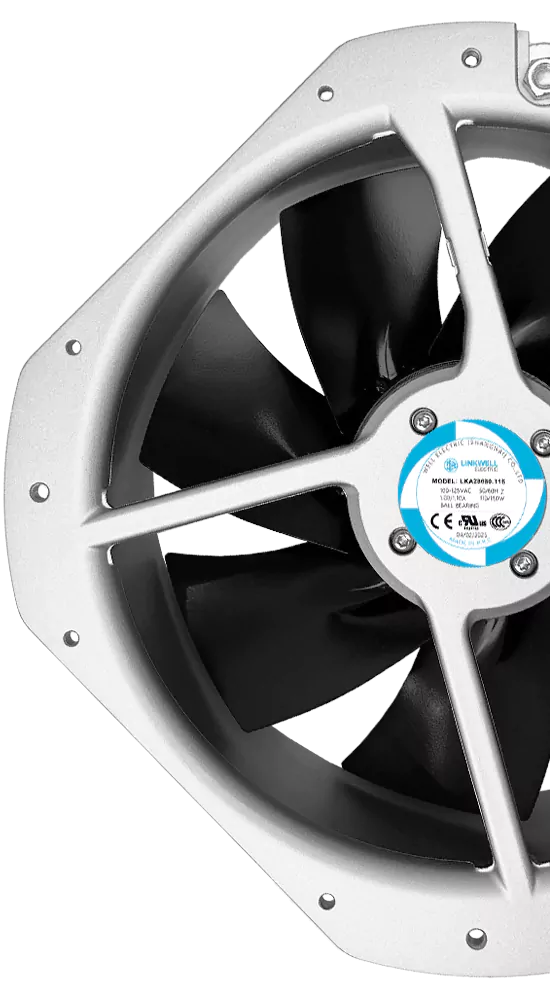
As energy storage systems continue to scale—from commercial installations to grid-level projects—cooling is no longer a secondary consideration. It sits right at the center of system reliability.
Heat builds up quickly inside battery systems. And unlike many other industrial setups, the consequences here are not just reduced efficiency. They can affect lifespan, safety, and overall project returns.
That’s why, in real-world engineering, cooling design is treated as part of the system—not an add-on.
Why Cooling Can’t Be Overlooked
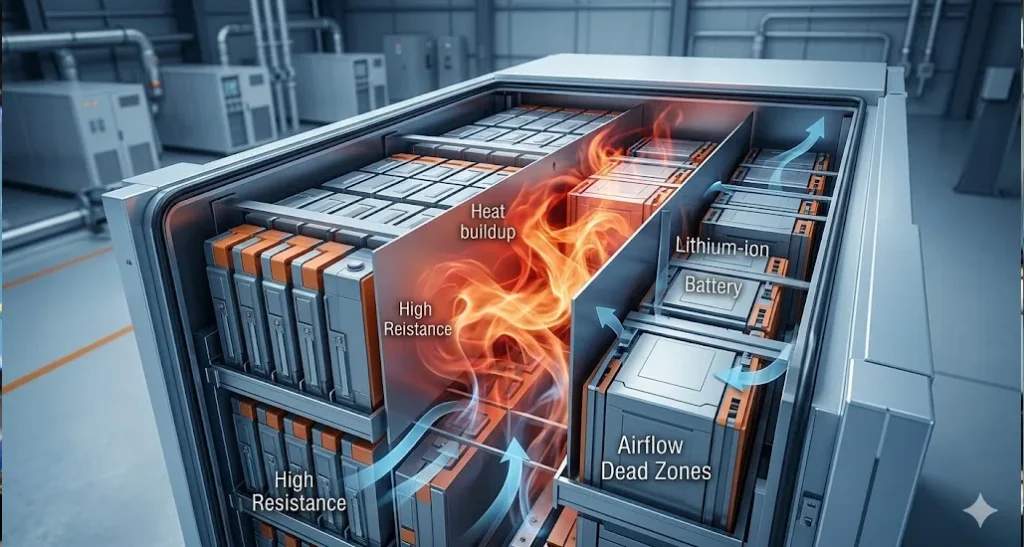
Every charge and discharge cycle generates heat. In compact battery configurations, that heat has nowhere to go unless the system is designed to move it out efficiently.
When cooling falls short, a few things tend to happen:
- Battery performance becomes unstable
- Degradation speeds up
- Internal temperatures become uneven
- In extreme cases, safety risks increase
On the other hand, a well-designed cooling strategy keeps temperatures controlled and predictable. That translates directly into longer service life and more consistent output.
Air Cooling vs Liquid Cooling: What Most Systems Actually Use
There’s a lot of discussion around liquid cooling, especially in high-density, utility-scale storage. And it does have clear advantages in those scenarios.
But in most commercial and industrial (C&I) systems, air cooling remains the more practical choice.
It’s simpler to design, easier to maintain, and more cost-effective to deploy at scale.
The real challenge isn’t choosing air over liquid. It’s making air cooling work properly inside a compact, high-resistance environment.
Where Cooling Gets Difficult: Inside the Cabinet
On paper, moving air sounds straightforward. In practice, it rarely is.
Inside an energy storage cabinet, airflow has to navigate:
- tightly packed battery modules
- structural barriers
- filters and protective components
- limited space for air channels
This creates resistance. And that resistance is exactly where many cooling designs struggle.
You might have enough airflow on paper—but not where it actually matters.
Why Centrifugal Fans Make a Difference
This is where fan selection becomes critical.
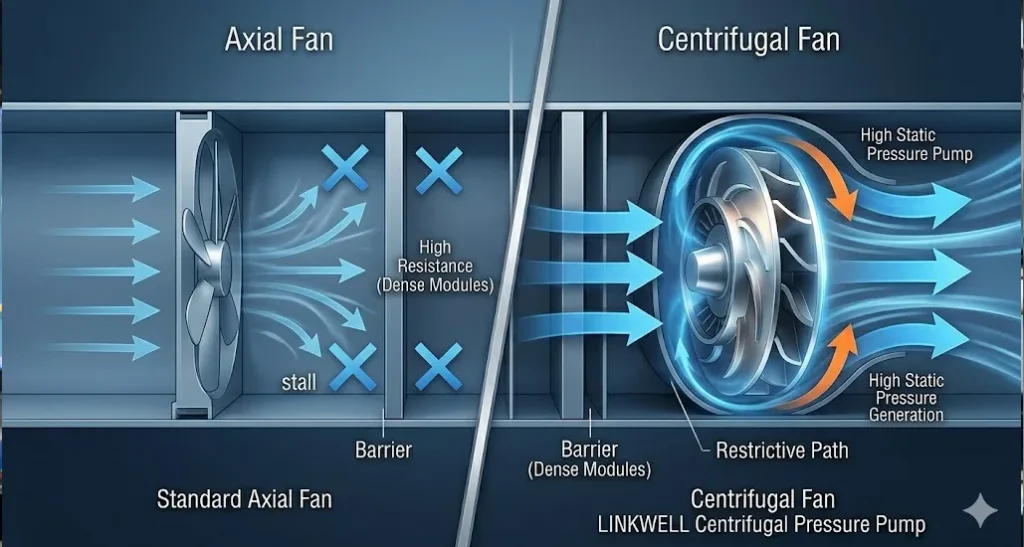
You can think of a centrifugal fan as a “pressure pump” rather than just a blower.
In a dense battery cabinet, airflow resistance behaves almost like a barrier. Standard axial fans tend to lose effectiveness as resistance increases. They move air well in open space, but struggle once the path becomes restrictive.
Centrifugal fans are built for a different job. They generate the pressure needed to push air through narrow, obstructed paths and keep it moving where it’s needed.
That difference shows up in real performance:
- more stable airflow under load
- better distribution across battery modules
- fewer hot spots inside the system
What Engineers Actually Look At When Selecting a Fan
In real projects, fan selection is rarely based on a single parameter. It’s a balance.
A few factors tend to matter most:
Airflow (CFM)
How much air the system can move. This needs to match the heat load.
Static Pressure (Pa)
How well the fan can overcome internal resistance. This is often underestimated.
Noise
Especially important in indoor or commercial installations.
Size Constraints
Cabinet space is limited, and integration matters.
Reliability
These systems run continuously. The fan has to keep up.
Ignoring any one of these usually leads to performance gaps later on.
| Parameter | Typical Range | Why It Matters |
|---|---|---|
| Airflow (CFM) | 200 – 2000+ | Determines total heat removal capacity |
| Static Pressure (Pa) | 100 – 1000+ | Overcomes resistance inside dense cabinets |
| Voltage | 12V / 24V / 48V / 110V / 220V | Matches system power architecture |
| Speed Control | PWM / 0–10V / Modbus | Enables dynamic cooling and energy saving |
| Operating Life | 30,000 – 70,000 hrs | Ensures long-term reliability in 24/7 systems |
AC vs DC vs EC Fans: What Changes in ESS Applications
Motor type also plays a role, especially as systems become more advanced.
AC fans are still widely used. They’re simple and cost-effective, especially in fixed-speed setups.
DC fans offer better efficiency and are easier to integrate into compact systems.
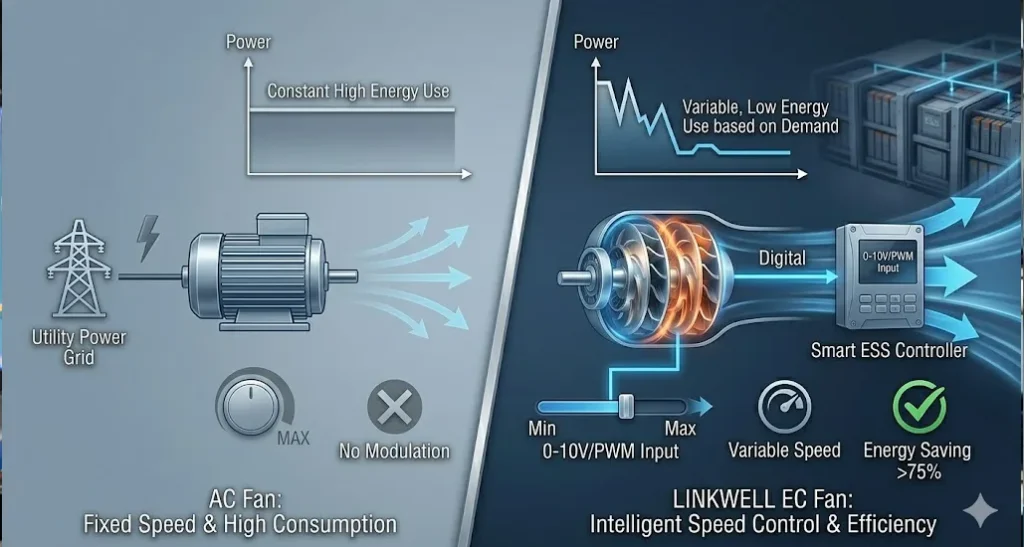
But in newer energy storage projects, EC fans are becoming the preferred option.
Not just because they are more efficient—but because they give you more control.
They support variable speed operation, respond to system conditions, and integrate more easily into smart control environments.
The Hidden Cost: Auxiliary Power Consumption
One detail that often gets overlooked is how much energy the cooling system itself consumes.
Fans don’t run occasionally. They run all the time.
Over months and years, that energy use adds up—and it directly affects the overall efficiency of the storage system.
In large installations, this becomes part of the project economics.
EC fans help reduce that load. By adjusting speed based on demand, they avoid unnecessary energy use and keep auxiliary consumption under control.
It’s a small change at the component level, but it has a noticeable impact on long-term operating cost.
From System Cooling to Cabinet-Level Solutions
In most real applications, cooling challenges come down to what happens inside the cabinet.
That’s where airflow paths are tight, resistance is highest, and heat tends to concentrate.
A practical cooling solution usually includes:
- high static pressure centrifugal fans
- well-defined airflow direction
- controlled air intake and exhaust
- speed adjustment based on temperature
Getting these elements right makes the difference between theoretical performance and actual performance.
Working With the Right Fan Supplier
At this stage, component selection and system design start to overlap.
A reliable fan supplier doesn’t just provide a product. They help match the fan to the system.
That can include:
- airflow and pressure matching
- size and installation adjustments
- AC, DC, or EC configuration options
- support during prototyping and testing
For OEMs, this kind of support often shortens development time and reduces trial-and-error.
FAQ
What is the best cooling method for energy storage systems?
Air cooling is the most widely used solution for commercial and industrial energy storage systems due to its simplicity, lower cost, and ease of maintenance. Liquid cooling is typically used in high-density, utility-scale applications.
Why are centrifugal fans used in energy storage systems?
Centrifugal fans provide higher static pressure, allowing them to maintain stable airflow inside dense battery cabinets where resistance is high. This makes them more reliable than axial fans in real ESS environments.
How do I choose the right fan for a battery cabinet?
You should evaluate airflow (CFM), static pressure (Pa), voltage, noise level, and control method. In most cases, high static pressure centrifugal fans with variable speed control are recommended.
Are EC fans worth the higher cost in ESS applications?
Yes. EC fans reduce energy consumption over time, especially in systems running continuously. This lowers auxiliary power usage and improves overall system efficiency and ROI.
Can fans run continuously in energy storage systems?
Yes, but they must be designed for continuous duty. Industrial-grade centrifugal fans are built to operate 24/7 with stable performance and long service life.
Do you support custom fan solutions for energy storage projects?
Yes. Manufacturers typically provide customized airflow, voltage, size, and control options to match specific cabinet designs and system requirements.
Conclusion
Cooling in energy storage systems isn’t about adding more airflow. It’s about making airflow work under real constraints.
Air cooling remains a practical and scalable solution for most systems—but only when the fan is selected with pressure, control, and long-term operation in mind.
In that context, centrifugal fans—especially EC variants—are not just components. They’re part of how the system performs over time.