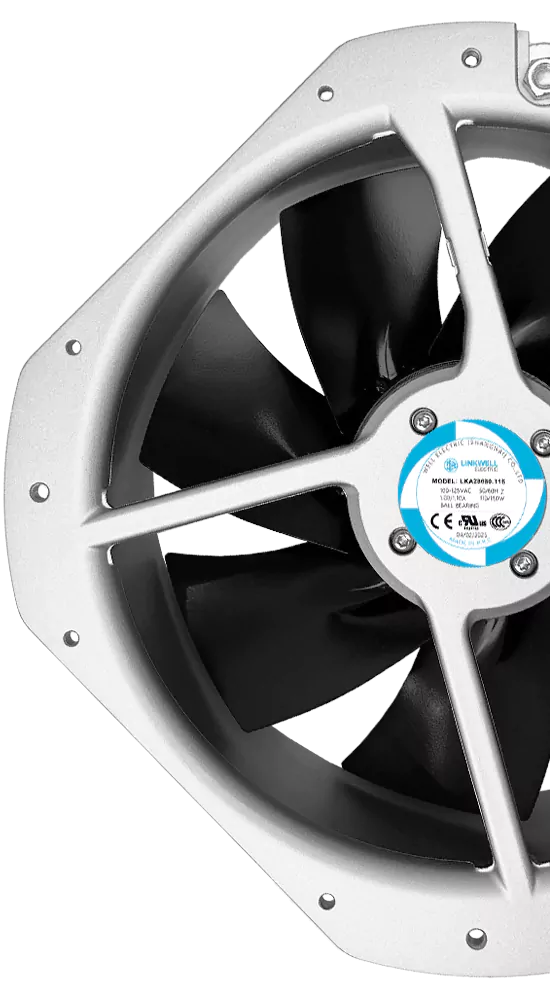
Unplanned downtime in a 24/7 manufacturing line is often a direct result of thermal mismanagement. c
Air cooling uses fans, like those from fanacdc and Industrial Cooling Fan, to move heat away from components. Water cooling uses liquid for high heat transfer, while evaporative and hybrid systems boost energy efficiency in hot climates.
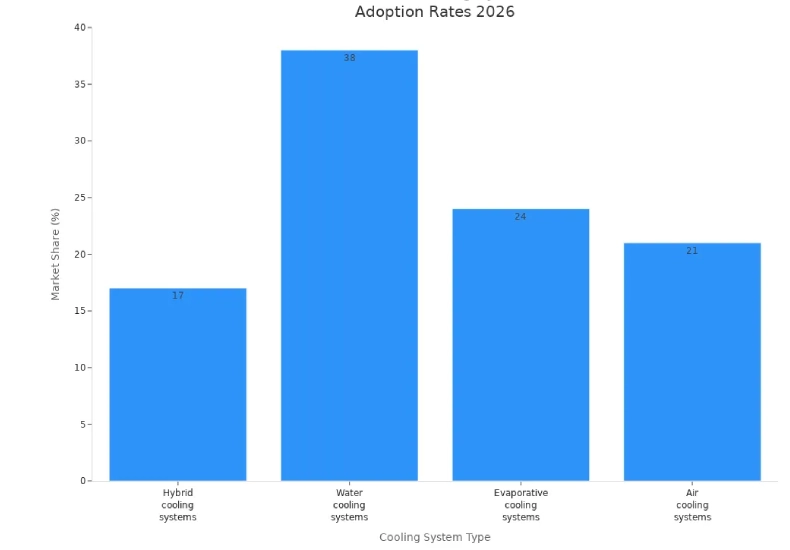
| Cooling System Type | Market Share (%) | Key Features |
|---|---|---|
| Hybrid cooling systems | 17% | Combines air and water cooling, reduces water consumption, flexible cooling modes. |
| Water cooling systems | 38% | High efficiency, suitable for large operations, superior heat transfer performance. |
| Evaporative cooling systems | 24% | Energy-efficient, effective in hot climates, uses natural evaporation for cooling. |
| Air cooling systems | 21% | Water-free solution, ideal for water-scarce regions, lower maintenance requirements. |
Effective cooling reduces wear, prevents overheating, and avoids costly downtime.
Fans are the heart of most cooling methods because they offer a cost-effective and flexible approach for many industries.
Key Takeaways
- Industrial cooling systems are essential for keeping equipment safe and efficient, with options like air cooling, water cooling, and hybrid systems available.
- Air cooling systems are simple and low-maintenance, making them ideal for many industries, but they may not be as effective in high heat situations.
- Water cooling systems offer high efficiency and lower energy use, but they require careful management of water resources to avoid shortages.
- Evaporative and hybrid cooling systems improve energy efficiency, especially in hot climates, by using natural processes to cool air.
- Choosing the right cooling system depends on factors like climate, maintenance needs, and the specific requirements of your industry.
Overview of Industrial Cooling Systems
Overview of Industrial Cooling Systems Industrial cooling systems keep your equipment safe and efficient. In 2026, the industry has shifted toward AI-driven predictive maintenance and Digital Twin technology, allowing operators to simulate cooling loads in real-time.
There is also a significant move toward natural refrigerants (like $CO_2$ or Ammonia) and low-GWP (Global Warming Potential) fluids to meet stricter environmental ESG mandates while cutting energy costs.
Air Cooling Systems
Air cooling systems use fans to move heat away from equipment.
The popularity of air cooling stems from its mechanical simplicity. For operators in water-scarce regions or high-altitude manufacturing, it eliminates the infrastructure costs associated with complex plumbing and chemical water treatment.
The structure is straightforward, so you do not need a lot of parts or complicated setups.
You can use air cooling for process cooling in manufacturing, food storage, and even medical equipment.
| Advantages | Disadvantages |
|---|---|
| Simple structure: easy to design | Relatively low heat dissipation efficiency |
| Easy maintenance: fewer parts | High noise levels from fan operation |
| High safety: no risk of liquid leaks | Greatly affected by environmental conditions |
| Wide range of applications |
You often see air cooling systems in enclosure cooling systems, where fans like those from fanacdc and Industrial Cooling Fan keep control cabinets and server racks at safe temperatures.
These fans help you manage airflow and prevent overheating. When you choose air cooling, you look at performance metrics like Energy Efficiency Ratio (EER) and Coefficient of Performance (COP).
You also need to consider how ambient temperature and altitude affect efficiency.
Water Cooling Systems
Water cooling systems, sometimes called liquid cooling systems, use water to absorb and carry away heat. These systems work well for large operations that need high efficiency.
You see them in power plants, data centers, and heavy manufacturing. Water cooling systems have a lower environmental footprint than air cooling systems.
They use less energy, which means you save on power and reduce greenhouse gas emissions.
However, you need to think about water scarcity. Nearly 37% of industrial regions face water shortages, which can make traditional water cooling systems less practical. You also need to treat the water to prevent scaling and contamination.
Despite these challenges, liquid cooling systems remain popular because they offer reliable performance and help you meet strict environmental standards.
Evaporative, Hybrid, and Adiabatic Cooling
Evaporative cooling works best in dry climates, but Adiabatic Cooling is the breakthrough of 2026. It uses pre-cooling pads to lower the temperature of the air before it hits the heat exchanger.
Hybrid systems now feature “Smart Mode Switching,” automatically toggling between dry cooling (saving water) and evaporative cooling (maximizing heat rejection) based on ambient wet-bulb temperatures.
This flexibility is critical for data centers and semiconductor manufacturing where uptime is non-negotiable.
| Industry Sector | Effectiveness of Cooling Systems |
|---|---|
| Data Centers | Use 1-2 billion gallons of water per year; focus on water conservation and sustainability. |
| Industrial Facilities | Rely on evaporative towers for cooling; modern dry coolers and hybrids reduce water consumption. |
| Healthcare | Require efficient cooling solutions to maintain operational reliability and compliance. |
| Food Processing | Need effective cooling to ensure product safety and quality. |
| Semiconductor Manufacturing | Critical for maintaining optimal temperatures in high-tech environments. |
You can also use hybrid cooling in enclosure cooling systems, where you need to balance energy use and temperature control.
Cooling Towers and Their Types
Cooling towers are large structures that help you remove heat from water used in industrial processes. You see them in power plants, chemical factories, and big manufacturing sites. Cooling towers work by circulating heated water to the top of the tower.
The water spreads over fill material, and fans force air across the surface. Some of the water evaporates, which cools the rest. The cooled water then goes back into the system.
| System Type | Characteristics | Operational Principles |
|---|---|---|
| Cooling Towers | Large structures with fans, used in industrial facilities and power plants. | 1. Water circulation: Heated liquid is pumped to the tower. 2. Heat exchange: Hot liquid is sprayed onto fill material. 3. Evaporation: Air is forced across the liquid surface, cooling it. 4. Cooling effect: Cooled water is recirculated. 5. Heat dissipation: Heat is released into the atmosphere. |
| Evaporative | Relies on outdoor air conditions for effective heat transfer. | Open loop design where fluid is exposed to air for evaporation. |
| Closed Loop | Does not expose heat transfer fluid to air, often less efficient. | Uses a heat exchanger, recovering only sensible heat. |
| Crossflow | Air moves horizontally across the downward flow of water. | Maximizes contact between air and water for cooling. |
| Counterflow | Air moves vertically against the downward flow of water. | Enhances heat exchange efficiency by opposing flow directions. |
| Hybrid | Combines features of both crossflow and counterflow designs. | Optimizes performance and energy efficiency by balancing both designs. |
You can choose from open-loop evaporative cooling towers, closed-loop systems, and chilled water system designs. Open-loop systems are simple and cost-effective, but they can face freezing and contamination in cold climates.
Closed-loop systems keep the coolant clean and need less maintenance. Chilled water system setups give you lower temperatures but cost more and need special care.
In 2026, you see new trends in cooling towers. Smart sensors let you monitor performance in real time. Advanced materials cut energy use by up to 30%. Closed-loop designs help you save water. Smart technology also helps you predict maintenance needs and avoid breakdowns.
When you select a cooling tower, think about your climate, water availability, and maintenance resources. The right choice helps you save money and protect the environment.
You can use cooling towers as part of larger liquid cooling systems or enclosure cooling systems, depending on your needs. They also work well with refrigeration cooling and chilled water system setups for high-demand environments.
The Role of Fans in Industrial Cooling
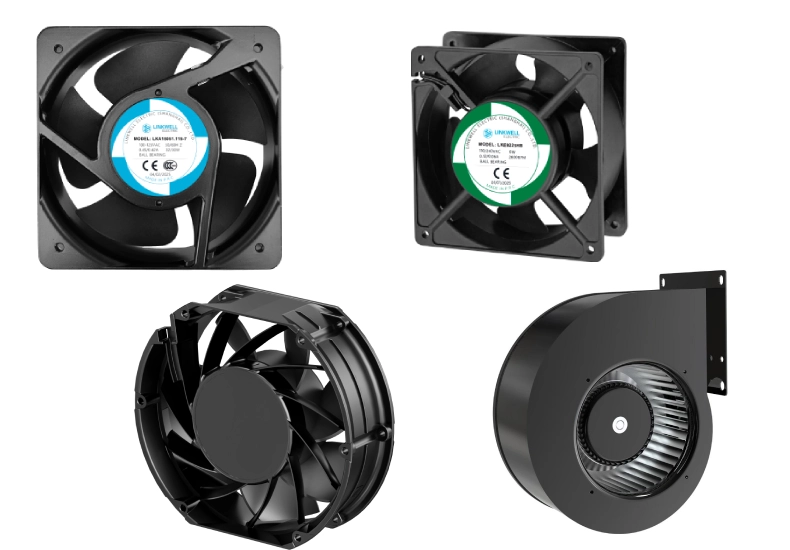
Fans sit at the heart of almost every industrial cooling system. You rely on them to move air, control temperature, and keep your equipment safe. Let’s break down how fans work for you in different roles.
The Role of Fans in Industrial Cooling
Fans are the heart of these systems. Beyond simple airflow (CFM), 2026 industrial standards emphasize Static Pressure capabilities. In densely packed control cabinets or server racks, air resistance is high.
fanacdc’s latest generation of high-static pressure fans is specifically designed to tackle the high-impedance environments of 2026’s ultra-slim server racks, where airflow resistance often leads to thermal throttling.
- Axial Fans: Best for high airflow in low-resistance environments.
- Centrifugal Fans: Ideal for ducted systems or high-pressure enclosures where air must be “pushed” through tight spaces.
- PWM Control: Modern fans now use Pulse Width Modulation to adjust speed dynamically, reducing noise and energy waste by up to 40%.
Direct Equipment Cooling
You often see fans mounted right on or near hot components. This setup pushes heat away from electronics, motors, or power supplies. When you use an industrial cooling fan, you get controlled airflow that helps prevent overheating and keeps your machines running longer.
“Air-cooled systems rely on airflow, typically through internal fans or external blowers, to maintain operational temperature.”
You’ll find this approach in electronics cooling, automation lines, and even renewable energy systems. If you match the right fan type and bearing to your application, you boost efficiency and reduce downtime.
Cabinet and System Ventilation
Fans do more than just cool single parts. You use them to ventilate control cabinets, server racks, and entire enclosures. This keeps sensitive electronics at safe temperatures and removes dust or contaminants.
“An industrial cooling fan is a mechanical device that generates controlled airflow to dissipate heat, remove contaminants, or regulate temperature in industrial equipment and environments.”
For best results, you should install fans correctly, clean blades, and check bearings often. Smart sensors can help you monitor performance and spot problems early. In factories, offices, and data centers, proper ventilation means fewer breakdowns and safer operations.
Fan Technologies: AC, DC, EC, Centrifugal
You have several fan technologies to choose from. Each one fits different needs:
| Fan Type | Energy Efficiency | Industrial Suitability |
|---|---|---|
| EC Fans | Up to 70% energy savings compared to AC fans | Quiet operation, adjustable airflow, data centers, telecom |
| AC Fans | Less efficient, higher long-term costs | Reliable, cost-effective for basic applications |
| DC Fans | High efficiency, precise speed control | Electronics, automation, battery-powered systems |
| Centrifugal Fans | High static pressure, robust airflow | HVAC, filtration, ducted systems, harsh environments |
You’ll see axial fans in server racks and electronics, centrifugal fans in HVAC and filtration, and EC fans in places where energy savings matter most. If you want a deeper dive, check out this comprehensive fan comparison article.
Fans are essential, but they have limits. In extreme heat or high-density setups, you might need liquid cooling or hybrid systems. Always consider your environment and cooling needs before choosing a solution.
By understanding these roles and technologies, you can pick the right fan for your system and keep your operations cool and reliable.
Industrial Cooling Towers
Industrial cooling towers are classified by their airflow mechanics and circuit design. Choosing the right configuration is critical for balancing water conservation with thermal efficiency.
1. Airflow Dynamics: Natural vs. Mechanical
- Natural Draft: Uses tall hyperbolic chimneys to create a “chimney effect” via natural convection.
- Best for: Power plants and heavy chemical sites with massive heat loads and ample space.
- Mechanical Draft: Relies on high-performance fans to regulate airflow.
- Forced Draft: Fans at the base push air in; ideal for high-resistance (static pressure) setups.
- Induced Draft: Fans at the top pull air through; offers superior thermal performance and prevents heat recirculation.
2. Internal Flow: Crossflow vs. Counterflow
- Crossflow: Air moves horizontally across falling water. It features easy access to distribution basins, simplifying maintenance during operation.
- Counterflow: Air moves vertically upward against downward spray. This provides maximum temperature differential in a more compact footprint, though it may require higher pump head.
3. Circuit Logic: Open vs. Closed
- Open-Loop: Process water is exposed directly to air for evaporative cooling. Cost-effective but requires intensive water treatment to prevent scaling and biofouling.
- Closed-Loop (Fluid Coolers): The process fluid stays sealed in a heat exchanger coil.
- 2026 Trend: Now the standard for Data Centers, Pharma, and Microelectronics to ensure zero contamination and reduced water loss.
System Integration Matrix
Modern efficiency depends on component synergy. High-static pressure fans from fanacdc are often paired with PWM-controlled sensors to optimize these systems:
| Industry Sector | Recommended Tower | Key Driver |
| Data Centers / Semi | Closed-Loop | Uptime & Purity |
| Power Plants | Natural Draft | Energy Savings at Scale |
| Pharma / Healthcare | Closed-Loop | Regulatory Compliance |
| Food Processing | Open-Loop | High Evaporative Load |
Summary: In 2026, the trend is shifting toward Hybrid and Adiabatic systems that utilize “Smart Mode Switching.” By integrating fanacdc’s EC fan technology, operators can overcome system impedance in compact designs, ensuring reliable thermal management even in water-scarce regions.
Choosing the Right Cooling System
Key Selection Criteria
You want your industrial cooling systems to match your process needs and environment. Start by looking at the types of cooling systems available. Each system fits a different demand. For example, chilled water systems work well for large facilities, while RTUs suit smaller spaces.
Think about air quality and ventilation. High-efficiency filtration and local exhaust ventilation help keep your workspace safe. Humidity and temperature control matter in industries like food processing and electronics manufacturing.
Energy efficiency is a big deal. Systems with heat recovery and variable speed drives save energy and lower costs. Make sure your system follows EPA and ASHRAE standards. Easy maintenance and redundancy help you avoid downtime.
| Criteria | Description |
|---|---|
| System Type Selection | Choose types of cooling systems based on your process and facility size. |
| Ventilation and Air Quality | Use filtration and exhaust for clean air. |
| Humidity and Temperature Control | Match cooling to your product needs. |
| Energy Efficiency and Heat Recovery | Pick systems that save energy and recover heat. |
| Compliance with Regulations | Follow safety and environmental rules. |
| Maintenance Accessibility | Make sure you can service your system easily. |
You can also count on fanacdc for technical support and custom solutions. They offer temperature sensors, PWM speed control, and strong quality control. Their production capacity means you get reliable cooling for any project.
When to Use Fans, Water Cooling, or Cooling Towers
You need to decide which types of cooling systems fit your operation. Fans are great for moderate heat loads, low ambient temperatures, and when noise or energy isn’t a big concern.
If your equipment sits in sealed cabinets or faces extreme power density, fans alone may not be enough. Water cooling works well for high ambient temperatures and when you need quiet operation. Cooling towers handle large-scale heat removal and save energy in big facilities.
Think about these factors:
- Efficiency: More efficient systems save energy and money.
- Space: Air cooling needs more room. Liquid systems are more compact.
- Maintenance: Air systems need less upkeep. Liquid systems require regular checks.
- Noise Level: Liquid cooling is quieter.
- Cost: Weigh upfront costs against long-term energy savings.
If you want to select a fan, follow these steps:
- Calculate the airflow your system needs.
- Check system impedance to see how much resistance the air faces.
- Choose the right voltage for your equipment.
- Consider environmental factors like temperature and humidity.
Common Mistakes to Avoid
You can run into trouble if you rush your cooling system choice. Here are some mistakes to watch for:
- Believing that faster coolant flow always means better cooling. Too much flow can cause overheating.
- Ignoring coolant flow restriction. Keep it low to avoid pump issues.
- Letting air get trapped in your cooling system. Air pockets reduce cooling performance.
- Forgetting to match fan size and speed to your heat load.
- Overlooking maintenance needs. Regular checks keep your system running smoothly.
Always review your cooling needs and check for hidden issues. Custom solutions and technical support from fanacdc can help you avoid common pitfalls and get the best performance from your types of cooling systems.
Comparison Summary of Cooling Systems
Pros and Cons Table
You want a quick way to see how each cooling system stacks up. Here’s a table that lays out the main pros and cons for each type. This should help you compare options at a glance:
| Type of Cooling System | Pros | Cons |
|---|---|---|
| Mechanical Draft Cooling | Delivers strong cooling through evaporation; keeps production running. | Needs tough materials and regular maintenance; size can vary a lot. |
| Packaged Towers | Installs quickly; modular for easy expansion; lower assembly risk. | Smaller and less powerful than field-erected types. |
| Field Erection Types | Handles large industrial jobs; offers more power. | Costs more and takes longer to build on-site. |
| Water Cooling Systems | Saves money; gives you colder water for cooling. | Uses more water, which can be a concern in dry areas. |
| Dry Cooling Systems | No water loss; uses air-cooled heat exchangers. | Cold water is warmer; less efficient than water cooling. |
| Fluid Coil Cooling Systems | Customizable; great when you need to save water. | Usually smaller; may not cool as well in every situation. |
Always match your cooling system to your facility’s needs and local resources. For example, cooling towers work best in places where water is available and space allows for larger installations.
Quick Reference Guide
When you pick a cooling system, you need to think about more than just the type. Here’s a handy checklist to guide your decision:
- Climate and Site: Look at your local weather, sunlight, and altitude.
- Indoor Conditions: Check humidity, temperature, and how much heat your equipment makes.
- Maintenance: Plan for regular checks and repairs to keep things running smoothly.
- Safety: Make sure your system is safe, especially if you work in hazardous areas.
- Application: Match the system to your industry—different jobs need different solutions.
- Size and Location: Choose the right size and place for your equipment.
- Temperature Control: Pick a system that keeps your process at the right temperature.
- Cooling Fluid: Think about which fluid works best for your setup.
| Industry/Application | Typical Scenario | Recommended Fan Type | Key Requirements |
|---|---|---|---|
| Control Cabinets | Electronics cooling | DC/EC Axial Fan | Low noise, precise speed control |
| Telecom Equipment | High-density racks | EC Axial Fan | Energy efficiency, reliability |
| 3D Printers | Component cooling | DC Axial Fan | Compact size, stable airflow |
| Automation Systems | Enclosure ventilation | Centrifugal Fan | High static pressure, durability |
| EV Charging Stations | Power electronics cooling | AC/EC Axial Fan | Long life, IP protection |
Note: Fans form the backbone of most cooling systems. Sometimes, you may need to combine fans with liquid or hybrid solutions for the best results. Always review your needs before making a final choice.
Fans form the backbone of most industrial applications, but sometimes you need more than just airflow. Choosing the right cooling system, whether you use fans, water cooling, or cooling towers, can boost energy efficiency and save money. Take a look at how your choices impact your operation:
| Benefit | Impact on Your Facility |
|---|---|
| Energy Efficiency | Cuts power use by up to 50% |
| Equipment Longevity | Extends machine life |
| Cost Savings | Lowers utility bills |
| Air Quality | Reduces mold and improves comfort |
| Productivity | Keeps employees happy and productive |
To get the best results, follow these steps:
- Gather data on your current setup.
- Adjust airflow and close gaps.
- Match cooling units to your needs.
- Slowly raise intake temperatures.
- Track and review your results.
You can always reach out to fanacdc for expert advice, tools, and custom support. Visit the fanacdc website for more information or technical help.
FAQ
What is the main purpose of industrial cooling fans?
You use industrial cooling fans to move heat away from equipment. This keeps machines safe and running longer. Fans help prevent overheating and reduce the risk of breakdowns.
How do I choose the right cooling system for my facility?
Start by checking your heat load, space, and noise limits. Think about energy use and maintenance. If you need help, ask an expert or use online tools to compare options.
Are fans enough for all industrial cooling needs?
Fans work well for many setups. In high-density or extreme heat environments, you may need water cooling or hybrid systems. Always match your cooling method to your equipment’s demands.
What maintenance do industrial cooling fans require?
You should clean fan blades, check for dust, and inspect bearings often. Replace worn parts quickly. Regular checks keep airflow strong and extend fan life.
Can I upgrade my cooling system with new fan technology?
Yes! You can switch to EC fans for better energy savings or add smart controls for remote monitoring. Modular designs make upgrades easy. Ask your supplier about the best options for your setup.