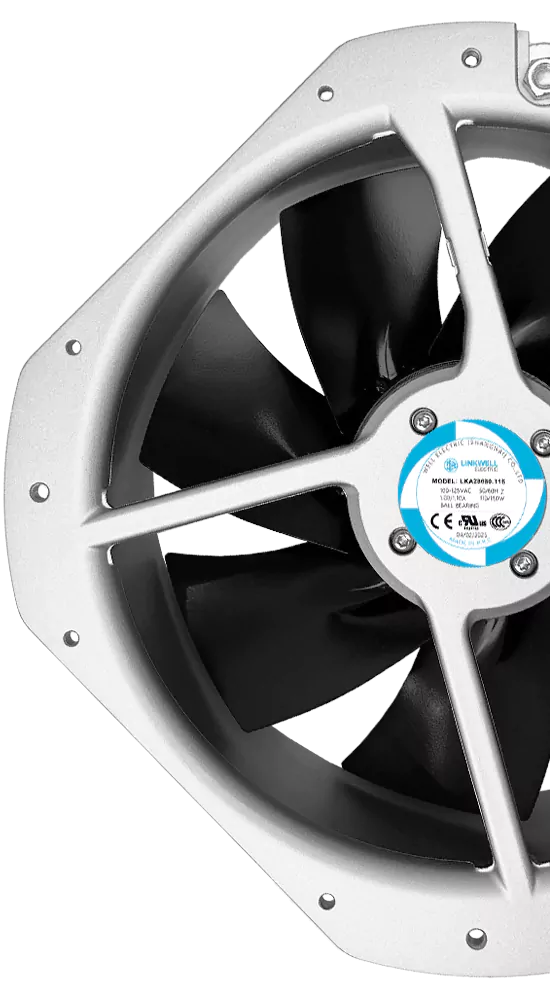
The IP rating of a cooling fan looks like a small detail until the fan is installed in the wrong environment.
A standard fan can run perfectly well on a clean bench, pass a short electrical check, and still fail early once it is installed in a dusty cabinet, a humid telecom enclosure, or equipment exposed to condensation. In many industrial projects, the question is not only whether the fan can move enough air. The question is whether the fan can keep doing that while dust, moisture, vibration, temperature changes, and installation limits are working against it.
That is where IP ratings become important.
For industrial cooling fans, common protection levels include IP44, IP55, and IP68. These ratings do not describe airflow or motor power. They describe how well the product is protected against solid particles and water. In practical terms, they help buyers decide whether a cooling fan is suitable for an indoor control cabinet, a dusty enclosure, an outdoor telecom box, a battery system, or a more demanding waterproof application.
The mistake many buyers make is assuming that the highest IP rating is always the best choice. It is not that simple. A fan with stronger sealing may cost more, may affect airflow design, and may not be necessary for every application. At the same time, choosing too low a rating can shorten service life and create maintenance problems that cost far more than the fan itself.
A better approach is to match the IP rating to the real operating environment.
What an IP Rating Actually Means
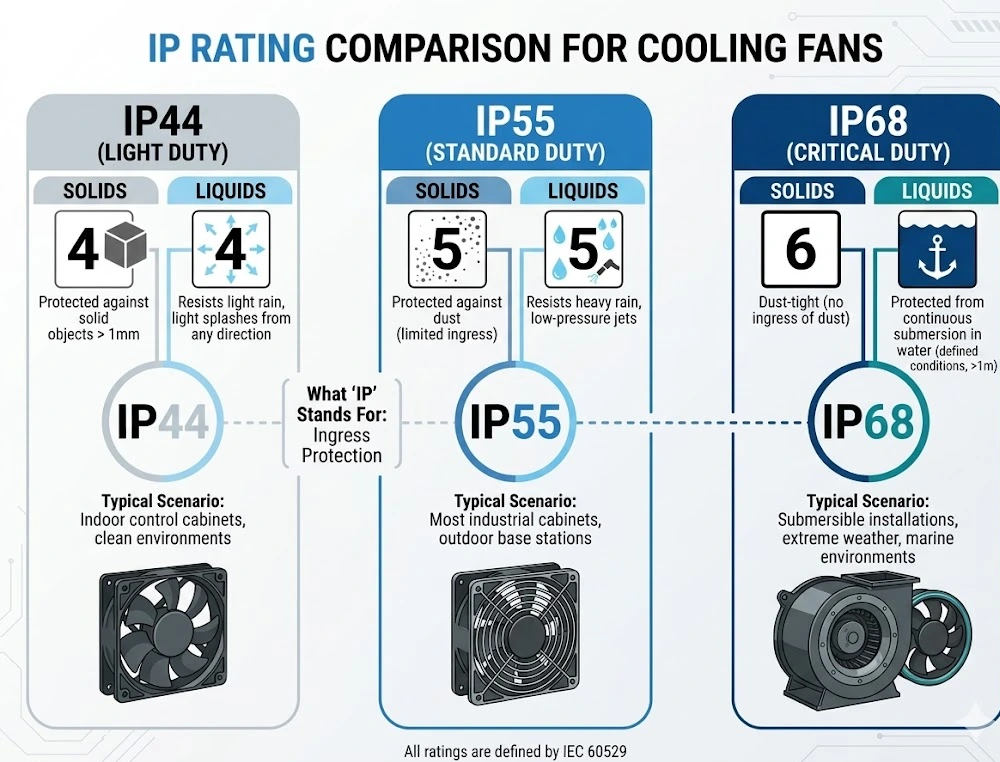
IP stands for Ingress Protection. The rating normally includes two numbers. The first number describes protection against solid objects such as dust or particles. The second number describes protection against water.
For example, in an IP55 rating, the first 5 refers to dust protection, and the second 5 refers to water protection. The rating does not mean the fan is indestructible. It means the fan has been designed or tested to resist certain forms of ingress under defined conditions.
This matters because cooling fans are not isolated components. They are often installed in systems that pull air through an enclosure. That airflow can carry dust, moisture, oil mist, fibers, or other contaminants depending on the application. If the fan is not protected properly, those contaminants can affect the motor, bearing system, PCB, winding insulation, or internal electrical parts over time.
In clean indoor equipment, this may not be a serious concern. In industrial environments, it often is.
IP44 Cooling Fans: Suitable for Cleaner Indoor Equipment
An IP44 cooling fan provides basic protection against solid objects larger than 1 mm and water splashing from different directions. In practical industrial use, IP44 is often suitable for relatively clean indoor applications where the fan is protected by the equipment structure and is not directly exposed to heavy dust or water.
This type of protection can make sense in control cabinets, light automation equipment, indoor electronics, power supplies, and general ventilation assemblies where the environment is controlled. If the equipment is installed in a clean electrical room, a laboratory area, an indoor panel, or a protected machine compartment, IP44 may be enough.
The advantage of IP44 is that it can keep the fan practical, cost-effective, and easier to integrate. There is usually less need for heavy sealing, which can help preserve airflow efficiency and simplify the product structure. For many OEM buyers, this is the right balance when the system does not require stronger environmental protection.
The limitation is clear: IP44 should not be treated as a waterproof or dust-heavy solution. It is not the right choice for equipment that faces direct water spray, outdoor rain exposure, washdown cleaning, or high dust loading. If the cabinet is installed in a factory area with airborne particles, or if moisture is likely to reach the fan, a higher protection level should be considered.
In other words, IP44 is useful when the application is controlled and the protection need is moderate. It is not a universal industrial rating.
IP55 Cooling Fans: A Practical Choice for Dust and Water Spray
IP55 is one of the more practical protection levels for many industrial cooling fan applications. It provides better dust protection than IP44 and resists water jets from different directions under defined test conditions.
For buyers, the value of IP55 is that it fits many real-world environments without moving immediately to a fully waterproof design. It is often considered for telecom enclosures, outdoor cabinets with some shielding, industrial control boxes, automation equipment, charging equipment, power systems, and other applications where dust and moisture are present but full immersion protection is not required.
This rating is especially relevant when the fan is part of an enclosure that may be exposed to rain splash, humidity, dust, or occasional cleaning. In those conditions, an ordinary fan may run for a while but gradually suffer from contamination or moisture-related stress. IP55 helps reduce that risk.
That said, IP55 does not mean the fan can be submerged or used in every outdoor condition without thought. The full equipment design still matters. Cable exits, connectors, mounting surfaces, airflow openings, and enclosure layout can all affect the final protection level of the system. A fan may have an IP55 design, but if it is installed poorly, the assembly may still allow water or dust to enter where it should not.
For many OEM projects, IP55 is the point where environmental protection becomes serious without overengineering the product. It is often a good middle ground for outdoor-adjacent or industrial indoor applications.
IP68 Cooling Fans: For Waterproof and Harsh Environments
IP68 cooling fans are designed for much stronger protection against dust and water ingress. The first 6 means dust-tight protection. The second 8 means protection against continuous immersion under conditions defined by the manufacturer.
In real projects, IP68 is used when the fan or motor assembly may face heavy moisture, direct water exposure, outdoor equipment risk, washdown conditions, or environments where failure from water ingress would be unacceptable. This may include certain outdoor telecom systems, battery equipment, transportation-related electronics, marine-adjacent systems, exposed power modules, or specialized industrial devices.
The advantage is obvious: IP68 gives much stronger protection than IP44 or IP55. But it should not be selected casually. Strong sealing can influence cost, product structure, thermal behavior, and sometimes airflow design. It may also require more careful attention to cable exits, connector type, potting, sealing materials, and long-term aging of protective structures.
This is why IP68 is usually chosen for specific environmental reasons, not simply because it sounds better. If a fan is installed in a clean indoor cabinet, IP68 may add cost without adding real value. If a fan is installed in a humid outdoor enclosure, however, under-protecting it may create field failures that are far more expensive than choosing a stronger rating from the beginning.
IP68 is best understood as a targeted protection choice for demanding environments.
IP44 vs IP55 vs IP68: Practical Comparison
The right IP rating depends on where the fan will operate and how much exposure it will face.
| IP Rating | Protection Level | Common Fit | Typical Applications |
|---|---|---|---|
| IP44 | Basic splash and particle protection | Cleaner indoor equipment | Control cabinets, indoor electronics, protected automation equipment |
| IP55 | Better dust and water jet protection | Industrial and outdoor-adjacent use | Telecom enclosures, outdoor cabinets, automation systems, power equipment |
| IP68 | Dust-tight and waterproof protection | Harsh or water-exposed environments | Outdoor electronics, battery systems, exposed industrial devices, waterproof OEM projects |
The table is useful as a starting point, but it should not replace application review. Two projects may both be described as “outdoor,” yet one is sheltered inside a cabinet and the other faces direct exposure. Those two cases may require different fan designs.
Why the Whole System Matters, Not Just the Fan Rating
A fan’s IP rating is important, but it is not the whole system.
This is one of the points that often gets overlooked in OEM projects. The fan may have a suitable rating, but the final equipment can still fail if the enclosure, connector, cable route, gasket, mounting hole, or airflow opening is poorly designed. Protection has to be considered at the system level.
For example, a telecom enclosure may use an IP55 fan, but if the cable exit is not sealed correctly or the fan is mounted on a surface that allows water to pool, the final protection is weaker than expected. A battery enclosure may use a higher-rated fan, but if condensation forms internally and cannot drain or evaporate properly, the system may still face reliability issues.
The same applies to dust. A fan may resist dust better than a basic model, but if the equipment pulls in unfiltered air continuously in a very dusty environment, maintenance planning and airflow design still matter.
A proper protection strategy looks at the fan, the enclosure, the air path, the connector, and the operating environment together.
How IP Rating Affects Fan Selection
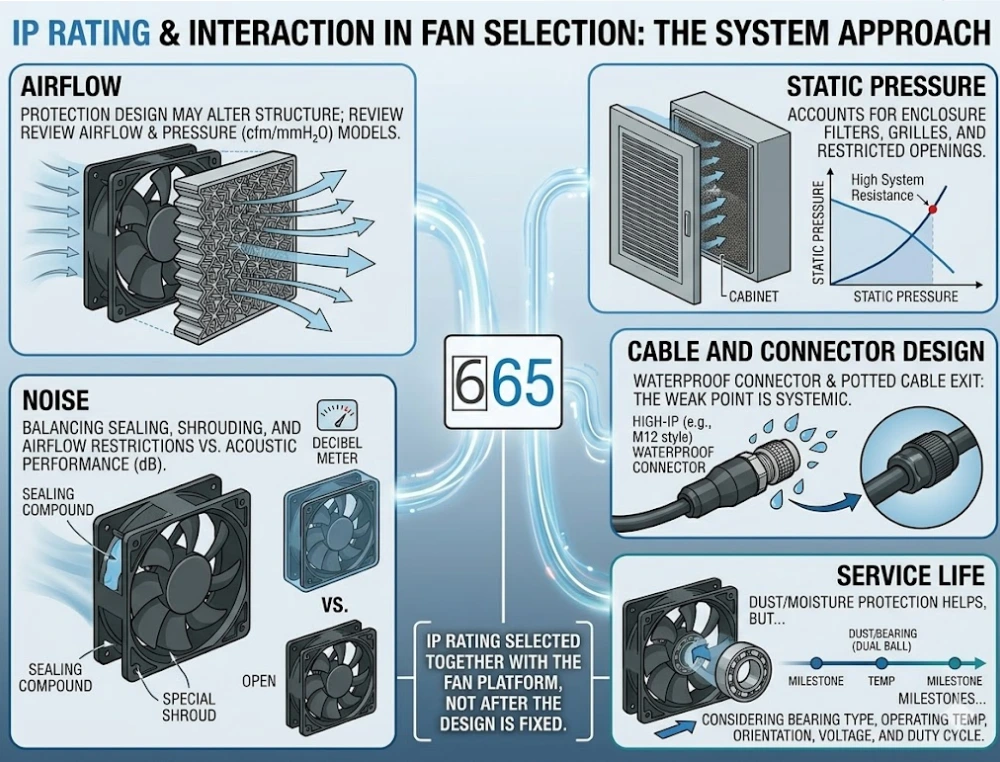
IP rating is only one part of fan selection, but it interacts with several other decisions.
The first is airflow. A more protected fan still has to move enough air for the equipment. If the protection design changes the fan structure, airflow and pressure should be reviewed rather than assumed.
The second is static pressure. Many IP-rated fan applications are installed in enclosures with filters, grilles, restricted openings, or protective structures. These create resistance. If the fan cannot overcome that resistance, the equipment may still overheat even if the protection level is correct.
The third is noise. Sealing, enclosure structure, and airflow restriction can all affect sound. In indoor or operator-facing equipment, buyers may need to balance protection with acoustic performance.
The fourth is cable and connector design. For higher protection levels, the cable exit and connector choice become more important. A waterproof fan with a poorly matched connector can still become the weak point in the system.
The fifth is service life. Dust and moisture protection helps, but bearing type, operating temperature, orientation, voltage stability, and duty cycle still affect long-term performance.
This is why IP rating should be selected together with the fan platform, not after the rest of the design is already fixed.
Application Examples
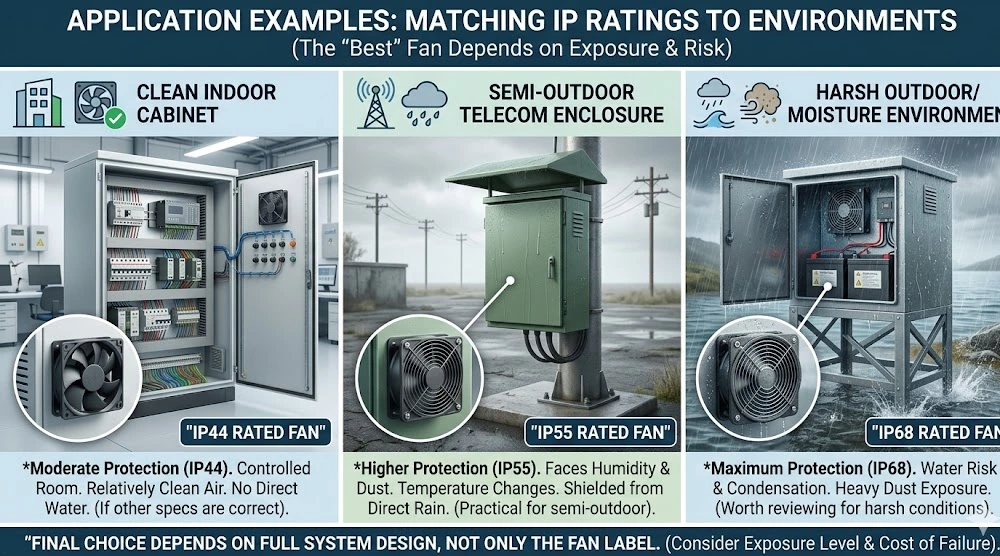
In a clean indoor control cabinet, the fan may only need moderate protection. The cabinet is installed in a controlled room, the air is relatively clean, and the fan is not exposed to direct water. In this case, IP44 may be suitable if airflow, voltage, noise, and installation conditions are otherwise correct.
A telecom enclosure installed in a semi-outdoor location is different. The equipment may face humidity, dust, and temperature changes. It may be shielded from direct rain, but the environment is still not as controlled as an indoor cabinet. In this type of case, IP55 is often a more practical direction.
A battery enclosure used in a harsher outdoor or moisture-prone environment may require stronger protection. If the fan area is exposed to water risk, condensation, or heavy dust, IP68 may be worth reviewing. The final choice should still consider the full system design, not only the fan label.
These examples show why there is no single “best” IP rating. The right choice depends on the exposure level and the cost of failure.
Case Analysis: Outdoor Telecom Cabinet With Moisture Risk
A telecom cabinet project gives a useful example.
The original cooling design used a standard fan selected mainly by size and voltage. During early operation, airflow was acceptable, but the cabinet was installed in an environment with frequent humidity changes and occasional wind-driven moisture. The fan continued running, but after extended use the customer began to see increased noise and unstable operation.
The issue was not only fan quality. The protection level was not matched to the installation environment.
After reviewing the enclosure layout, airflow opening, and cable routing, the solution moved toward a higher-protection fan configuration with better environmental resistance and more careful integration around the mounting area. The goal was not simply to choose the highest IP rating available. It was to reduce moisture-related risk while keeping enough airflow through the cabinet.
That kind of project is common in industrial cooling. The fan must be selected for both thermal performance and environmental exposure. If either side is ignored, reliability suffers.
How FanACDC Supports IP-Rated Cooling Fan Projects
From a manufacturer’s point of view, IP-rated cooling fan selection should begin with the application. The same rating does not mean the same result in every system.
FanACDC supports industrial cooling fan projects where protection level, voltage, airflow, static pressure, cable design, and installation space must be considered together. Depending on the application, the solution may involve AC axial fans, DC axial fans, EC fans, or centrifugal fan platforms.
For OEM buyers, useful information includes the equipment type, voltage, fan size, airflow target, static pressure requirement, operating environment, and whether the system faces dust, humidity, water spray, or possible direct exposure. With those details, it becomes much easier to decide whether IP44, IP55, IP68, or another protection level is appropriate.
This is especially important for electrical cabinets, telecom enclosures, automation equipment, battery systems, power electronics, and compact industrial devices. In these applications, the fan is often small compared with the equipment it protects, but a poor protection choice can create a much larger reliability problem.
What Buyers Should Confirm Before Choosing an IP-Rated Fan
Before selecting an IP-rated cooling fan, buyers should confirm the real exposure conditions rather than choosing from the rating alone.
| What to Confirm | Why It Matters |
|---|---|
| Indoor or outdoor use | Determines the baseline protection level |
| Dust level | Affects motor, bearing, and airflow reliability |
| Water exposure | Helps decide between splash, jet, or waterproof protection |
| Airflow path | Shows whether resistance will reduce cooling performance |
| Voltage and control | Must match the equipment power system |
| Cable and connector design | Often becomes the weak point in protected systems |
| Operating temperature | Influences bearing life and sealing material behavior |
| Maintenance access | Affects whether stronger protection is worth the cost |
A short conversation about these points is usually more useful than choosing IP68 by default.
FAQ
What is the difference between IP44, IP55, and IP68 cooling fans?
IP44 provides basic splash and particle protection. IP55 offers stronger dust protection and resistance to water jets. IP68 provides dust-tight protection and waterproof performance under defined immersion conditions.
Is IP68 always better than IP55?
Not always. IP68 provides stronger protection, but it may not be necessary for clean indoor equipment. The best rating depends on the environment, cost target, airflow requirement, and system design.
Can an IP55 fan be used outdoors?
An IP55 fan may be suitable for some outdoor-adjacent or protected outdoor applications, but the final decision depends on exposure level, enclosure design, cable sealing, and installation conditions.
Are waterproof fans harder to cool with?
Not automatically, but stronger protection can affect product structure. Airflow and static pressure should still be reviewed to make sure the fan cools the equipment properly.
What IP rating is best for electrical cabinets?
For clean indoor electrical cabinets, IP44 may be enough. For dusty or moisture-prone cabinets, IP55 or a higher rating may be more appropriate.
What information should I send before choosing an IP-rated fan?
Send the application, voltage, fan size, airflow requirement, operating environment, dust or water exposure level, and any cable or connector requirements.
Conclusion
IP44, IP55, and IP68 cooling fans are not simply good, better, and best. They are different protection levels for different operating environments.
IP44 can be a practical choice for cleaner indoor equipment. IP55 is often a balanced option for industrial and outdoor-adjacent applications. IP68 is reserved for harsher environments where dust-tight and waterproof protection are required.
For industrial buyers, the safest approach is to match the IP rating to the real application rather than choosing by rating alone. The fan still has to deliver airflow, handle system resistance, fit the installation space, and work with the cable and connector design. When protection, airflow, and integration are reviewed together, the cooling system is much more likely to remain stable in the field.