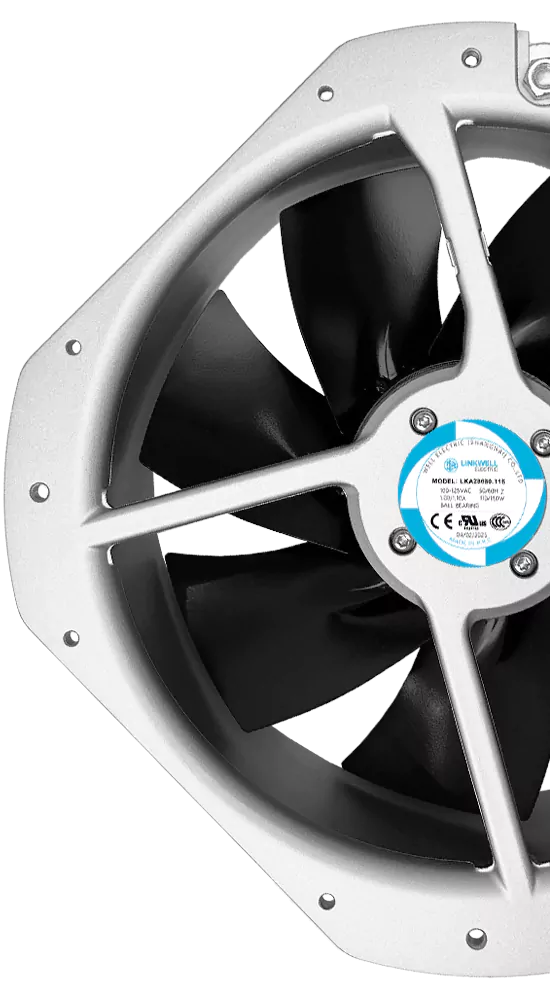
The UPS cooling fan price can range from a few dollars for a standard axial fan purchased in bulk to $60 or more for a brand-specific replacement part. Custom industrial fans with high static pressure, special connectors, speed feedback, or environmental protection are normally quoted according to project requirements.
Why is the price range so wide? A cooling fan for a UPS is selected by more than frame size. Voltage, airflow at the real operating pressure, bearing system, expected life, control signal, connector, certification, and order quantity can all change the final cost.
This guide explains typical market price levels, the main cost factors, and the information an OEM buyer should prepare before requesting a quotation.
Price note: The figures below are general market references observed in July 2026. They are not a LINKWELL quotation. Actual pricing depends on the confirmed model, specification, quantity, delivery terms, and customization requirements.
How Much Does a UPS Cooling Fan Cost?
The following table provides a practical starting point for budget planning.
| Purchase situation | Typical market reference | What the price usually represents |
| Standard 24V DC axial fan in bulk | About US$4-12 per unit | Standard frame, basic wiring, larger order quantity |
| Industrial AC or DC fan in small quantities | About US$15-30 per unit | Low-volume purchase or distributor stock |
| Brand-specific UPS replacement fan | About US$30-65 or more | Replacement inventory, model compatibility, and reseller margin |
| Customized OEM cooling fan | Quotation required | Custom airflow, connector, cable, signal, IP rating, or certification |
Price should never be compared by frame size alone. Two 120 x 120 x 38 mm fans may look identical but have different voltage ranges, speed, airflow, static pressure, noise, bearing life, and signal outputs. These differences can produce a large price gap.
Why UPS Cooling Fan Prices Vary
1. Fan Type: DC, AC, EC, or Centrifugal
The motor and airflow design are major cost factors.
- DC axial fans are widely used in power electronics because they support low-voltage operation, compact installation, and optional speed control. Common input options include 12V, 24V, and 48V.
- AC axial fans can be suitable when the system provides an AC supply and requires a simple, durable cooling solution.
- EC fans combine AC input with electronically controlled motor technology. They generally cost more initially but can provide better speed control and energy efficiency.
- Centrifugal fans are used when the airflow path has higher resistance or requires a directional outlet. Their structure is more complex, so the price may be higher than a comparable axial fan.
Buyers should select the fan type according to the UPS electrical architecture and airflow path-not according to the lowest catalog price.
2. Frame Size and Thickness
Common cooling fan sizes for power equipment include 80 mm, 92 mm, 120 mm, and 172 mm. The required size depends on the available mounting space and cooling load.
A thicker fan can often produce more static pressure than a thin fan of the same width. For example, an 80 x 80 x 38 mm fan may perform better in a restrictive enclosure than an 80 x 80 x 25 mm model. However, thickness, motor power, and speed also affect noise and price.
Large fans normally use more material and a larger motor, but size is not the only price driver. A compact high-speed fan with advanced control electronics can cost more than a larger standard fan.
3. Airflow and Static Pressure
Free-air CFM does not tell the whole story. A UPS enclosure may contain heat sinks, transformers, power modules, cables, grilles, and filters. These components create resistance, so the fan must maintain airflow against static pressure.
A low-cost fan may show acceptable free-air airflow but deliver insufficient cooling after installation. High-static-pressure designs require optimized blades, a stronger motor, tighter balancing, and additional performance validation. These features can increase the UPS fan price, but they also reduce the risk of overheating in the final system.
Before buying, compare the fan curve with the enclosure resistance. Our guide to static pressure explains why the operating point matters.
4. Voltage and Electrical Performance
Voltage must match the UPS control board or auxiliary power supply. A 24V fan cannot be replaced with a 12V model simply because the frame dimensions are identical.
Common variables include:
- Rated voltage and operating voltage range
- Current and power consumption
- Startup current
- Locked-rotor protection
- Reverse-polarity protection
- Insulation and dielectric strength
Standard voltage configurations are normally more economical. A non-standard voltage range or special electrical protection may require a customized design and validation process.
5. Bearing Type and Expected Life
Bearing selection affects both purchase price and total cost of ownership.
Sleeve-bearing fans can be economical for moderate operating conditions. Ball-bearing fans generally cost more, but they are better suited to continuous operation, elevated temperature, and installations where replacement is difficult.
For mission-critical power equipment, buyers should review the stated life under a defined temperature and operating condition. A life figure without test conditions is difficult to compare. Learn more in our ball bearing vs sleeve bearing fan guide.
6. PWM, FG, RD, and Alarm Functions
A basic two-wire fan only needs power and ground. More advanced UPS designs may require additional control or monitoring signals:
- PWM: Allows the controller to adjust fan speed according to thermal load.
- FG or tachometer output: Reports fan speed to the UPS control board.
- RD or alarm output: Indicates a locked or failed fan.
- Temperature control: Changes fan speed according to a temperature sensor or control logic.
These functions add electronics, wiring, and testing, so they usually increase the price. They can also reduce noise, save energy, and provide early warning of a cooling failure. See what a PWM fan is for additional details.
7. Connector, Wire Length, and Pin Definition
Replacement problems often occur because the new fan has the right size and voltage but the wrong connector or pin sequence.
An OEM quotation may need to specify:
- Wire length and wire gauge
- Two-, three-, or four-wire configuration
- Connector manufacturer and part number
- Pin sequence
- Terminal type
- Cable sleeve or insulation requirement
- Label and model identification
A standard lead wire is usually less expensive. Custom connectors and cable assemblies increase labor and material cost, especially for small orders.
8. Temperature and Environmental Protection
UPS systems installed in factories, outdoor cabinets, telecom sites, or dusty equipment rooms may need additional protection.
Possible requirements include:
- Extended operating temperature
- Dust and moisture protection
- Conformal coating or motor encapsulation
- Corrosion resistance
- Salt-spray resistance
- Higher IP rating
- Vibration resistance
These specifications can raise the unit price, but they may prevent premature failure in harsh environments. Buyers should not pay for the highest protection level automatically; the correct rating should come from the real installation conditions.
9. Certification and Documentation
UL, CE, RoHS, TÜV, and project-specific documentation can affect the quotation. Existing certified models are usually more cost-effective than a new customized model that requires additional testing.
When comparing suppliers, confirm whether certification applies to the exact model being quoted. A general factory certificate is not always the same as a product-level approval.
10. Order Quantity and Customization
Quantity has a direct effect on UPS cooling fan price. Bulk orders distribute setup, inspection, packaging, and production costs across more units. Samples and small orders have a higher cost per fan.
Customization may include:
- Special voltage or speed
- Custom PWM curve
- FG or RD signal
- Unique wire and connector
- Private label and packaging
- Special bearing or lubricant
- IP protection
- Application-specific performance targets
For an OEM project, the lowest unit price may not be available until the specification, annual demand, and production schedule are confirmed.
Replacement Price vs OEM Project Price
It is important to separate two different buying situations.
Brand-Specific Replacement
A maintenance buyer may need one fan for an existing UPS. The replacement must match the original voltage, current, airflow, connector, pin definition, mounting size, and alarm signal. The price is often higher because the buyer is paying for low-volume availability and model compatibility.
Do not replace an original fan with a quieter computer fan based only on size. If the replacement produces less airflow or sends the wrong speed signal, the UPS may overheat or trigger a fan alarm.
OEM or Batch Purchase
An OEM buyer normally purchases fans for new UPS production. The unit price may be lower, but the project requires sample approval, technical validation, stable batch quality, and production planning.
In this situation, the supplier needs to evaluate the operating point, service life, control signals, environmental conditions, certification, and annual quantity. The final quotation may include sample, tooling, testing, or documentation costs.
How to Estimate the Airflow Needed for a UPS
Required airflow should be calculated from the actual internal heat loss-not from the UPS kVA rating alone.
A simplified air-cooling estimate is:
Required airflow (CFM) approximately 1.76 x heat loss (W) ÷ allowable temperature rise (°C)
For example, if internal components release 500 W of heat and the allowable air-temperature rise is 10°C:
Required airflow approximately 1.76 x 500 ÷ 10 = 88 CFM
This is only a starting point. Filters, heat sinks, grilles, altitude, recirculation, fan aging, and enclosure resistance reduce real airflow. Engineering designs normally add a safety margin and validate the result through thermal and airflow testing.
How to Get an Accurate UPS Cooling Fan Price
Send the supplier as much of the following information as possible:
| Required information | Example |
| Application | Online UPS, industrial UPS, telecom power cabinet |
| Fan type | DC axial, AC axial, EC, or centrifugal |
| Frame size | 80 x 80 x 38 mm |
| Voltage | 24V DC |
| Airflow target | 100 CFM at the required pressure |
| Static pressure or fan curve | Pa or inch H2O |
| Speed and noise target | RPM and dB(A) |
| Bearing requirement | Ball bearing or project requirement |
| Signal output | PWM, FG, RD, or no signal |
| Wire and connector | Length, connector model, and pin definition |
| Operating temperature | Minimum and maximum ambient temperature |
| Protection and certification | IP rating, UL, CE, RoHS, or other |
| Quantity | Sample quantity and estimated annual demand |
If this information is not available, provide a clear photo of the original fan label, connector, and installation area. A drawing or existing datasheet is even more helpful.
How to Reduce Cost Without Increasing Cooling Risk
- Use a standard frame and voltage when possible. Standard configurations usually have lower development and production costs.
- Provide complete specifications before asking for a quote. This reduces repeated sampling and incorrect quotations.
- Compare airflow at the required static pressure. Do not compare free-air CFM alone.
- Select only the functions the UPS controller needs. Unused sensors or excessive environmental protection add cost without adding value.
- Combine projected demand into planned production batches. Stable forecasts can improve pricing and lead time.
- Evaluate expected life and failure cost. A slightly higher fan price may be economical if it reduces maintenance and UPS downtime.
LINKWELL Cooling Fans for Power Equipment Projects
LINKWELL manufactures DC cooling fans, AC axial fans, EC fans, and centrifugal fans for industrial cooling applications.
The current DC fan range includes 12V, 24V, and 48V options in multiple frame sizes. OEM and ODM support is available for voltage, speed, wire length, connector, signal output, label, and protection requirements. Final suitability for a UPS project should be confirmed against the real thermal load, system resistance, electrical interface, and operating environment.
To receive an accurate recommendation, send LINKWELL the existing fan specification, application conditions, and required quantity through the contact form.
Conclusion
The UPS cooling fan price depends on the complete technical specification and purchasing situation. A low-cost bulk axial fan, a brand-specific replacement, and a customized OEM cooling solution should not be compared as if they were the same product.
Start with the real heat load, airflow resistance, voltage, control interface, expected life, and operating environment. Then compare suppliers using the same specification. This approach produces a more accurate quotation and reduces the risk of overheating, fan alarms, premature failure, and expensive UPS downtime.
Frequently Asked Questions
What is the average UPS cooling fan price?
Standard industrial axial fans can cost roughly US$4-12 per unit in bulk, while small-quantity or brand-specific replacement fans may cost US$15-65 or more. Custom OEM fans require a project quotation.
Why are original UPS replacement fans expensive?
The buyer is paying for more than the physical fan. Brand-specific replacements may include low-volume inventory, verified compatibility, a special connector or pin definition, speed feedback, and reseller support.
Is a 48V UPS fan more expensive than a 24V fan?
Not always. Voltage is only one cost factor. Frame size, speed, motor power, bearing, airflow, static pressure, signal output, and order quantity can have a larger effect on price.
Can I use a computer fan to replace a UPS fan?
Only if all essential specifications match. Check voltage, current, airflow, static pressure, dimensions, connector, pin definition, speed signal, alarm logic, and operating temperature. A physically compatible fan can still be electrically or thermally unsuitable.
Does higher CFM always mean a higher price?
No. Free-air CFM does not show how the fan performs inside a restrictive enclosure. A fan with a better pressure curve may provide more useful cooling even if its free-air CFM appears lower.
What affects a custom UPS fan quotation most?
The main factors are frame size, voltage, airflow at the required pressure, motor power, bearing, control signals, connector, environmental protection, certification, sample requirements, and production quantity.
What should I send when requesting a UPS cooling fan quote?
Send the fan size, voltage, current, airflow, static pressure, speed, connector, wire definition, control signal, temperature range, protection requirements, quantity, and a photo or datasheet of the existing fan if available.