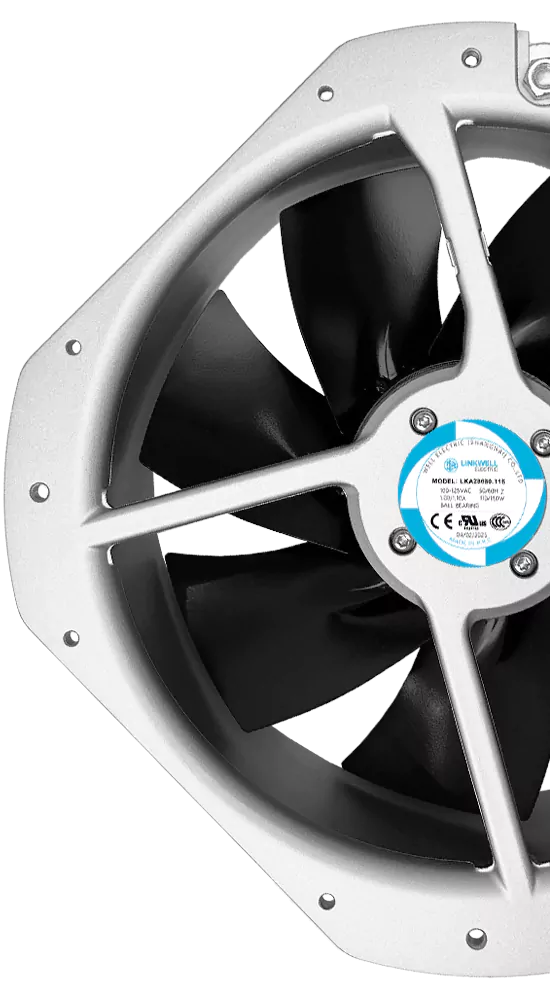
In ventilation system design, the difference between a ventilation fan and an exhaust fan extends beyond airflow direction. It directly influences airflow efficiency, pressure capability, and long-term system reliability.
Although both are essential components, they serve distinct roles within a system. Understanding how internal fan design interacts with real operating conditions is critical for proper selection.
Key Takeaways
- Ventilation fans support air exchange and circulation within a system
- Exhaust fans remove heat, moisture, or contaminants from enclosed spaces
- The primary difference lies in system role, airflow direction, and pressure demand
- Centrifugal fan design is critical in high-resistance environments
- Motor type (AC, DC, EC) determines efficiency, control, and lifecycle cost
Ventilation Fan vs Exhaust Fan: Quick Comparison
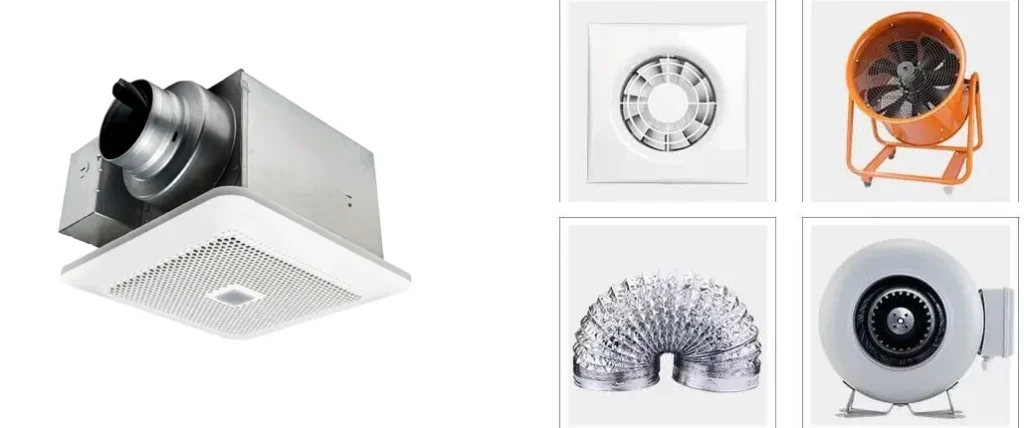
What Is a Ventilation Fan
A ventilation fan is designed to introduce fresh air or maintain continuous air circulation within a system. It plays a key role in stabilizing indoor environmental conditions, particularly in enclosed or high-density installations.
Ventilation fans are commonly used in:
- HVAC systems (AHU, ERV/HRV)
- Commercial and industrial buildings
- Data centers and equipment rooms
Rather than simply moving air, these fans enable controlled air exchange, supporting temperature regulation, humidity control, and filtration integration.
What Is an Exhaust Fan
An exhaust fan is designed to remove unwanted air from a system. This includes heat, moisture, airborne particles, or process-related contaminants.
Typical applications include:
- industrial exhaust systems
- kitchen and process ventilation
- equipment enclosures
- battery and power systems
Exhaust fans operate with a one-directional objective: maintaining reliable extraction performance under varying resistance conditions.
Key Differences at a Glance (Engineering Perspective)
| Parameter | Ventilation Fan | Exhaust Fan |
|---|---|---|
| Airflow Direction | Supply / circulation / balanced airflow | One-way extraction |
| System Role | Air exchange and environmental control | Contaminant removal |
| Static Pressure Requirement | Medium to high | Medium to very high |
| Typical Fan Type | Centrifugal / EC fans | Centrifugal dominant |
| Application Level | System-level airflow design | Localized or system exhaust |
The distinction is not only functional—it is defined by how the fan performs under real system resistance.
Technical Differences in Fan Design
Axial vs Centrifugal Fans
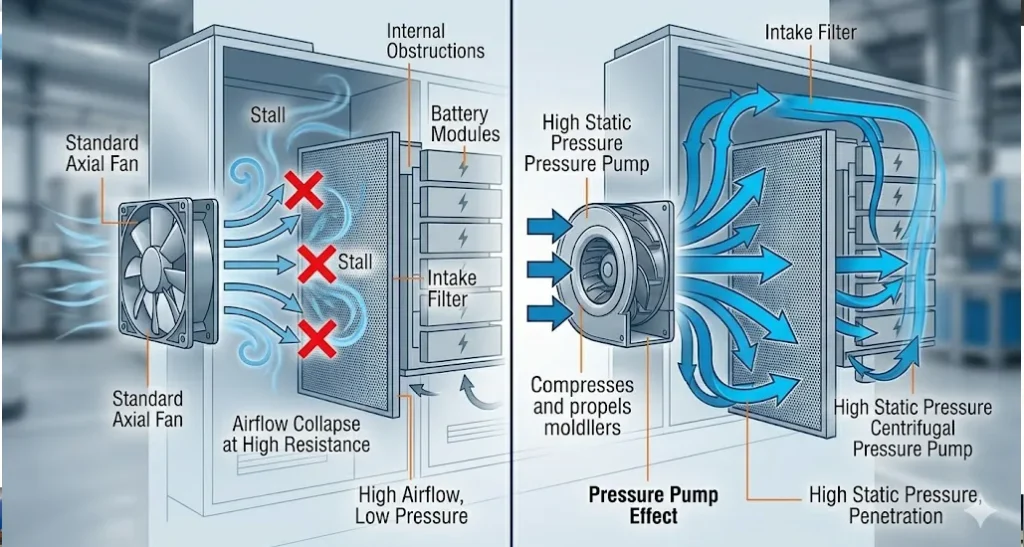
Axial and centrifugal fans behave differently under load conditions.
Axial fans move air along the axis of rotation, making them suitable for high airflow in low-resistance environments.
Centrifugal fans redirect airflow radially, generating pressure that allows them to maintain performance in ducted or restricted systems.
| Feature | Axial Fans | Centrifugal Fans |
|---|---|---|
| Airflow | High (low resistance) | Stable under resistance |
| Static Pressure | Low | High |
| Application | Open airflow environments | Ducted / enclosed systems |
| Noise Behavior | Increases under load | More stable |
Unlike axial fans, centrifugal fans are pressure-generating devices, not purely air movers.
This makes them more suitable for systems where airflow must overcome resistance from filters, ducts, or compact layouts.
Motor Types: AC vs DC vs EC
Motor selection affects not only performance, but also long-term operating cost and system integration.
| Factor | AC Motor | DC Motor | EC Motor |
|---|---|---|---|
| Efficiency | Medium | High | Very high |
| Speed Control | Limited | Flexible | Integrated |
| Energy Consumption | Higher | Lower | Lowest |
| Control Integration | Basic | Moderate | Advanced |
EC motors are increasingly preferred due to their combination of:
- high efficiency
- integrated control
- reduced lifecycle cost
Why Design Matters for Performance
In practical systems, airflow is rarely unrestricted.
Once filters, ducts, and compact enclosures are introduced, resistance becomes a defining factor.
When a fan cannot maintain sufficient pressure, airflow decreases at critical locations. This often leads to uneven cooling, localized heat buildup, or reduced system efficiency.
For this reason, fan selection must consider:
- pressure capability
- efficiency under load
- control flexibility
How to Choose Between Ventilation and Exhaust Fans
Selection should be based on system requirements rather than naming conventions.
Key parameters:
- Airflow requirement (CFM)
- Static pressure (Pa)
- Duct length and layout
- Filtration level
- Continuous operation requirements
- Energy efficiency targets
General guideline:
- Ventilation fans are used for controlled air exchange and circulation
- Exhaust fans are used for removal of heat, moisture, or contaminants
In many systems, both functions are combined to achieve balanced airflow.
Application Scenarios
Different applications impose different constraints on airflow design.
- Commercial buildings → air quality and comfort control
- Industrial facilities → heat and contaminant removal
- Data centers → thermal management and equipment protection
- Energy storage systems → high-density cooling within confined spaces
Fan selection directly impacts system stability, efficiency, and maintenance requirements.
Typical Application Configurations (Quick Reference)
| Application | Recommended Configuration |
|---|---|
| Control cabinet (no filter) | Axial or centrifugal, AC or EC |
| Control cabinet (with filter) | Centrifugal, EC |
| Energy storage cabinet | Centrifugal, EC, 150–800 CFM |
| Duct fan (long run, elbows) | Centrifugal, AC or EC, >200 Pa |
| Inverter cooling | Centrifugal, DC 24/48V or EC |
This type of mapping helps align system conditions with appropriate fan configurations.
The Hidden Cost: Auxiliary Energy Consumption
Cooling systems operate continuously, making their energy consumption a significant part of total system load.
In applications such as:
- energy storage systems
- HVAC installations
- industrial processes
auxiliary power consumption directly affects overall efficiency.
High-efficiency solutions, particularly EC fans, reduce unnecessary energy use by adjusting output based on system demand. This contributes to improved system performance and lower operating cost over time.
From System Design to Real-World Solutions
Effective airflow design requires more than selecting a fan with sufficient airflow.
Reliable system performance typically depends on:
- high static pressure capability
- stable airflow under resistance
- adaptable speed control
- long operational lifespan
Manufacturers increasingly require solutions that integrate seamlessly into system design, including customization for airflow, voltage, and control methods.
Conclusion
The difference between ventilation fans and exhaust fans is defined by their role within the system and their ability to perform under real operating conditions.
In modern applications—especially those involving ducts, filters, or compact enclosures—fan performance is closely tied to pressure capability and control.
Centrifugal fans, combined with efficient motor technologies, provide a practical and reliable solution for maintaining stable airflow in these environments.
FAQ
What is the main difference between a ventilation fan and an exhaust fan?
A ventilation fan supports air exchange and circulation, while an exhaust fan removes unwanted air from a system.
Why are centrifugal fans widely used in ventilation systems?
Because they can maintain airflow under resistance, making them suitable for ducted or high-density environments.
How is the correct fan selected for an application?
Selection is based on airflow, static pressure, system layout, and operating conditions rather than product naming.
Are EC fans suitable for industrial applications?
Yes. They offer high efficiency, integrated control, and reduced operating cost over long-term use.
Can both ventilation and exhaust functions be used in one system?
Yes. Many systems combine both to achieve balanced airflow and stable environmental conditions.