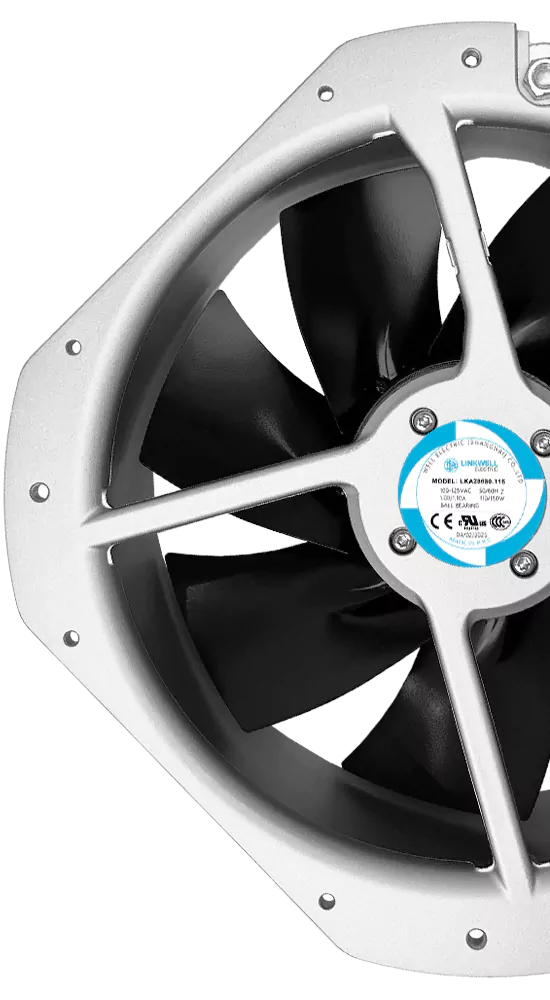
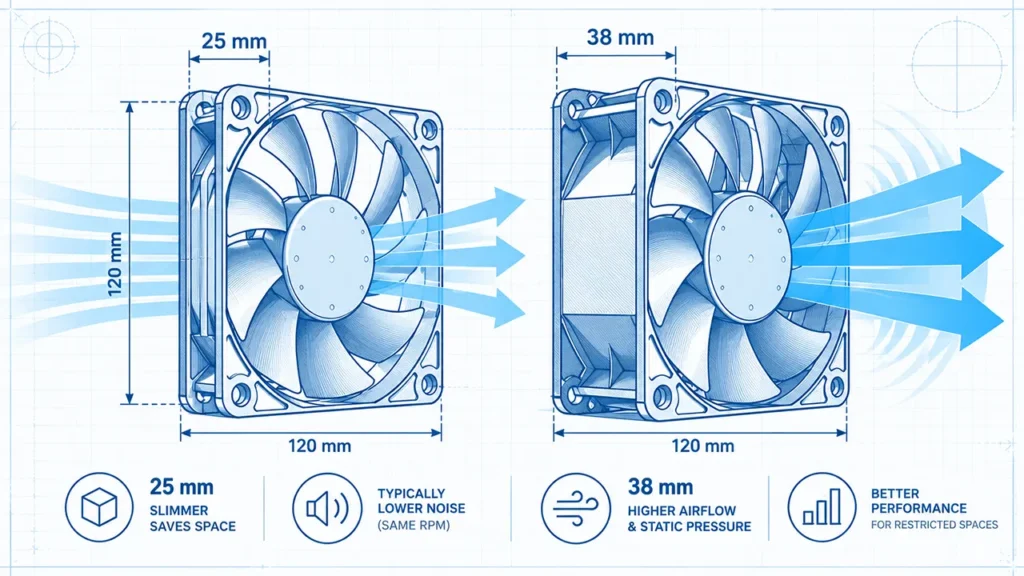
A 120 x 120 x 25 mm fan and a 120 x 120 x 38 mm fan fit the same panel opening, so the thicker version can look like an easy performance upgrade. Sometimes it is. The extra depth can support a larger motor, deeper blade geometry and a more capable pressure-flow curve.
Thickness alone, however, does not guarantee more airflow, less noise or better efficiency. A well-designed 25 mm fan can outperform a weak 38 mm model at the operating point that matters. Compare complete model data and the available installation depth before changing the fan.
What Does 25 mm or 38 mm Mean?
The number describes the fan frame depth in the airflow direction. For a “12025” fan, the nominal frame is about 120 x 120 x 25 mm. A “12038” fan is about 120 x 120 x 38 mm. Naming conventions can vary, so the approved dimension drawing remains the source of truth.
The front mounting-hole pattern may be similar, but the deeper fan extends farther into or outside the equipment. Screw length, guard position, connector clearance and nearby components may all need to change.
25 mm vs 38 mm Cooling Fan at a Glance
| Design factor | 25 mm fan | 38 mm fan |
|---|---|---|
| Installation depth | Better for shallow enclosures | Needs about 13 mm more depth for the same nominal face size |
| Pressure potential | Can be sufficient for low to moderate restriction | Often offers more design space for higher-pressure models |
| Airflow | Model-dependent | Model-dependent; not automatically higher |
| Power and current | Often lower for comparable low-duty models | High-output versions may require more current |
| Noise | Depends on speed, blade design and operating point | Can be quieter or louder; thickness alone does not decide |
| Mechanical fit | Easier where depth is limited | Check intrusion, screws, guards and service access |
Does a 38 mm Fan Move More Air?
It may, but compare the curve rather than the frame. Maximum airflow is measured near zero static pressure. An enclosure with a filter, dense heat sink or narrow grille operates away from that free-air point.
The deeper frame gives the designer more room for motor and aerodynamic features, so many 38 mm industrial fans are built for higher output. But RPM, blade angle, hub size, motor power and control strategy can outweigh thickness. A high-speed 25 mm model may have more free-air airflow than a low-speed 38 mm model, while the 38 mm model may retain more flow against restriction.
Use the fan curve and system operating point. Do not choose by CFM or thickness alone.
Which Thickness Is Better for Static Pressure?
A 38 mm frame often provides more pressure potential, which can help with filters, heat exchangers, dense electronics and long airflow paths. “Often” is important: static pressure belongs to the exact model, not the thickness category.
Compare the airflow each fan delivers at the calculated system pressure. The maximum static-pressure number is measured at or near zero airflow and is not the normal cooling point. The useful model is the one whose curve crosses the system curve at the required airflow with reasonable margin.
Tip: Ask for the pressure-airflow curve of both candidate models and mark your estimated system resistance on each curve. The better fan is the one that meets the operating point, not the one with the thicker frame.
How Do Power, Current and Startup Change?
A higher-output 38 mm fan may use a larger motor and draw more running current. Its startup or inrush behavior can also be different. Check the power supply, connector, wire size and switching device; do not assume that a drop-in mechanical fit is an electrical fit.
Some AC and EC models add frequency or control requirements. Some DC models provide PWM, FG or RD wires that the old fan did not use. Review the rated voltage, operating range, locked-rotor behavior and startup current of the exact part.
The fan power-supply sizing guide explains why normal running current alone may not be enough for supply selection.
Is a 38 mm Fan Louder Than a 25 mm Fan?
Not necessarily. Noise depends strongly on RPM, blade loading, motor commutation, bearing, guard, restriction and the measurement condition. A deeper fan operating at lower speed may achieve the required pressure with acceptable noise. A high-speed 38 mm model may be much louder than a moderate 25 mm model.
Compare acoustic data at the same operating requirement, not only at each model’s maximum speed. Then test the fan in the real panel. A close grille or wall can add turbulence, and a thicker fan may place its inlet closer to an internal obstruction.
Mechanical and Installation Checks
The extra 13 mm of nominal depth can interfere with a PCB, terminal block, heat sink or door. Allow space for the connector and cable bend, not only the plastic frame. Confirm screw length so the fastener engages correctly without entering the fan too far.
Check the airflow and rotation arrows, guard position, finger-access requirement and service-removal path. If the fan moves closer to an obstruction, revisit inlet clearance and outlet clearance. A thicker, stronger fan can still deliver poor installed airflow if the air path is blocked.
When a 25 mm Fan Is Usually the Better Starting Point
Choose the 25 mm format first when enclosure depth is tight, system resistance is modest, power is limited or an existing mechanical design is already validated around that depth. It can also be a good choice when a larger face size at lower speed is available, because face area may help airflow without using more depth.
This is not a recommendation to accept low pressure. The selected 25 mm model must still meet the required operating point at worst-case voltage, temperature and filter condition.
When a 38 mm Fan Is Usually Worth Evaluating
Evaluate the 38 mm format when restriction is high, the panel opening cannot become larger, or the design needs more pressure and motor capability in the same face size. Typical examples include dense power electronics, telecom equipment, UPS systems, filtered industrial cabinets and compact heat exchangers.
Confirm that the increased current, depth, mass and acoustic output fit the equipment. In some applications, improving the grille or filter path produces a better result than moving to a more powerful fan.
How to Choose Between 25 mm and 38 mm
- Define required airflow from the heat load and allowable temperature rise.
- Estimate pressure drop through filters, guards, heat sinks and openings.
- Compare complete fan curves at the required operating point.
- Check voltage, running current, startup current and control signals.
- Verify depth, screw, guard, connector and service clearances.
- Compare noise at the intended speed and restriction.
- Test component temperature in the production-intent enclosure.
LINKWELL supplies AC, DC and EC cooling fan options in different sizes and depths. For a model recommendation, provide the face size, maximum depth, voltage, airflow, static pressure, noise target, connector and control requirements.
Frequently Asked Questions
Can I replace a 120 x 120 x 25 mm fan with a 120 x 120 x 38 mm fan?
Only after checking depth, mounting, screw length, voltage, current, connector, airflow direction and the system operating point.
Is a 38 mm fan always better for a radiator or filter?
No. It often offers higher-pressure options, but the exact pressure-airflow curve and noise at the required operating point decide the result.
Does a thicker fan always draw more power?
No, but many high-output 38 mm models do. Compare rated and startup current for the exact candidates.
Why can a 38 mm fan produce less free-air CFM than a 25 mm fan?
It may run at a lower speed or use a design optimized for pressure, efficiency or noise. Thickness is only one design variable.
Should I compare maximum static pressure?
Use it as one endpoint, not as the selection point. Compare airflow at the pressure where the equipment will actually operate.