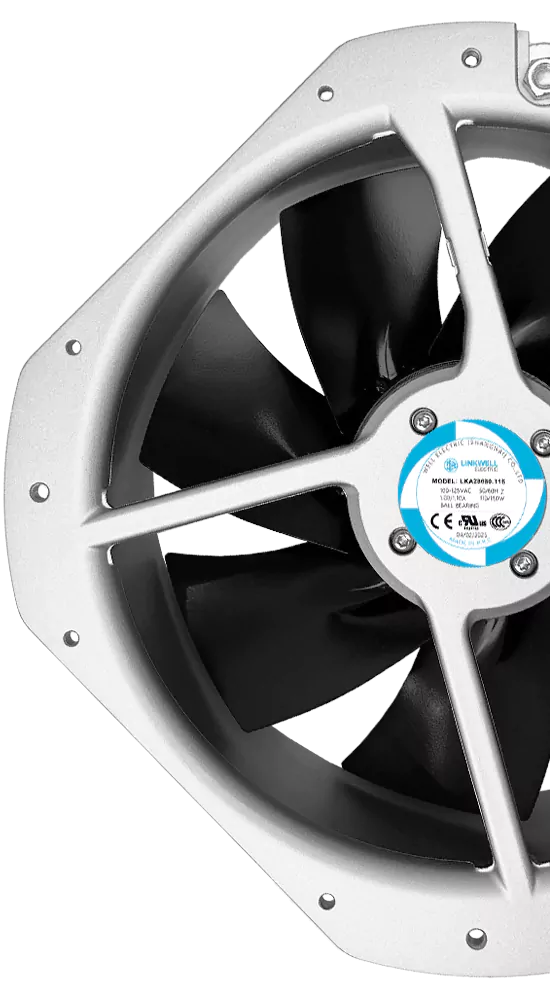
A fan that runs quietly on a vertical test bench may behave differently when installed flat in the roof of a cabinet. Gravity has not changed the airflow requirement, but it has changed the direction of load through the shaft and bearing system. Whether that matters depends on the exact bearing construction, lubricant and fan design.
There is no safe universal rule that every ball-bearing fan can be mounted in any position or that every sleeve-bearing fan must remain vertical. The correct answer comes from the model specification and, for demanding equipment, an installed-life test.
What Is Cooling Fan Mounting Orientation?
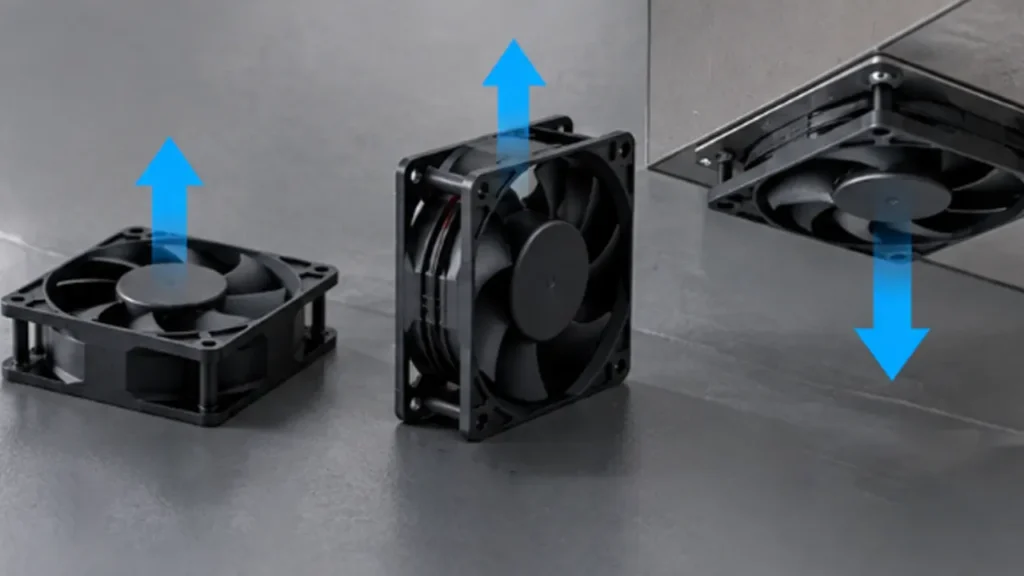
Mounting orientation describes the position of the fan shaft relative to gravity. With a vertical panel-mounted fan, the shaft is usually horizontal. With a fan installed in the top or bottom panel, the shaft is usually vertical. Angled installations place a combination of axial and radial load on the bearing.
Orientation is separate from airflow direction. Turning a fan so the label side faces the other way normally reverses which side of the enclosure receives the airflow, but it may leave the shaft in the same gravitational orientation. When reviewing a drawing, mark both the shaft position and the intended intake-to-exhaust direction.
Why Can Orientation Affect Bearing Life?
The rotor and impeller create loads that must be supported by the bearing. Gravity changes how those loads are distributed. In sliding or sleeve-type systems, the lubricant reservoir, oil return path, shaft contact zone and retaining structure can be sensitive to position. A design that maintains a stable lubricant film in one orientation may not behave identically in another.
Rolling-element bearings generally tolerate a wider range of orientations, but they are not immune to installation conditions. Grease life, preload, axial load, contamination, vibration and temperature can still control service life. A warped mounting panel or uneven screw torque may distort the fan frame and add a load that was not present in the life test.
Note: Bearing-family names are not life guarantees. Confirm the exact fan model, permitted orientation, temperature and test basis before making a service-life claim.
Sleeve, Ball and Enhanced Bearing Systems
| Bearing system | Typical orientation question | What to verify |
|---|---|---|
| Sleeve or sliding bearing | Will shaft position change lubricant distribution or wear? | Approved orientation, temperature and life statement |
| Ball bearing | Are axial load, grease and preload acceptable in the installed position? | Model drawing, life condition and vibration limits |
| Hydrodynamic or enhanced sleeve design | Does its internal oil-return design support the required position? | Manufacturer-specific construction and qualification |
Terms such as hydraulic, fluid, long-life and maintenance-free are used differently across the market. Do not select by the marketing name alone. Ask what the bearing structure is designed to tolerate and whether the published life applies to the proposed installation.
For a broader comparison, see ball-bearing versus sleeve-bearing fans. The bearing choice should also consider temperature, duty cycle, shock, vibration and replacement access.
Temperature Often Matters More Than Orientation Alone
Lubricant deterioration accelerates as bearing temperature rises. A roof-mounted exhaust fan may be exposed to the hottest air in the enclosure, so a life problem blamed on “horizontal mounting” may actually be the combined result of orientation and higher operating temperature.
Measure the local inlet-air temperature at the fan, not only the room temperature. Heat from a power supply, drive or transformer can create a hot layer near the top panel. Compare that temperature with the fan’s rated operating range and with the conditions used for its life statement.
Installation Problems That Look Like Orientation Problems
Frame distortion. Tightening one corner fully before the others can twist a plastic frame. Use a flat mounting surface and an even tightening sequence. Do not force a fan into an opening that is out of square.
Blocked inlet or outlet. A close wall, cable bundle, guard or filter changes pressure and noise. The problem follows the installation position, so it can be mistaken for a bearing issue. Check fan inlet clearance and outlet clearance before comparing sound.
Vibration transfer. A horizontal sheet-metal roof may resonate differently from a vertical side panel. The fan may be mechanically healthy while the panel amplifies a blade-pass tone. Stiffening, gasket selection or mounting isolation may be more effective than changing the bearing.
Cable or guard contact. Gravity can move a loose wire into the impeller in one position. Confirm clearance through transport shock and the full temperature range.
How to Check Whether a Fan Can Be Mounted Horizontally
- Identify the exact model and bearing option; do not rely only on frame size.
- Check the dimension drawing for airflow and rotation arrows.
- Ask whether shaft-horizontal, shaft-up and shaft-down positions are approved.
- Confirm the temperature and duty cycle used for the life statement.
- Review vibration, shock and panel-flatness requirements.
- Validate noise, startup and current in the real mounting position.
If the datasheet is silent, treat orientation as an open engineering item. A short bench run can reveal rubbing or noise, but it cannot prove multi-year bearing life. Long-duration or accelerated evidence is needed when orientation is a reliability driver.
How to Validate the Installed Fan
Test the fan in the production enclosure with its normal guard, filter, screws and cable routing. Record startup behavior at the minimum supply voltage and lowest expected temperature, because cold lubricant increases starting torque. At the hot condition, record RPM, current, vibration, sound and component temperature after the system reaches thermal equilibrium.
For equipment that operates continuously, repeat measurements after a defined endurance period. Look for increasing bearing noise, slower startup, higher current or a change in tachometer stability. If the fan is part of a redundant system, test one-fan-failed operation in the same orientation.
Selecting a LINKWELL Fan for the Required Orientation
Provide the fan size, voltage, shaft position, airflow direction, operating temperature, duty cycle, vibration environment and required life target. LINKWELL can then match the request to an AC, DC or EC fan model and bearing option whose documented conditions fit the installation.
A replacement should be checked again even when the frame and connector match. A different impeller, motor or bearing construction can change orientation capability, startup current and acoustic behavior.
Frequently Asked Questions
Can a cooling fan be mounted horizontally?
Many can, but the answer is model-specific. Confirm the permitted shaft orientation and life conditions in the approved specification.
Are ball-bearing fans safe in every orientation?
They often support more positions than simple sleeve designs, but “every orientation” is too broad without model evidence. Axial load, grease, temperature and mounting distortion still matter.
Does mounting orientation change airflow?
Gravity normally has little direct effect on the rated airflow of a healthy compact fan. Installation restrictions, panel geometry and reversed airflow direction usually have a larger effect.
Why is a top-mounted fan noisier?
Possible causes include a different bearing load, a resonant roof panel, frame distortion, hot operating air or an obstruction close to the inlet or outlet.
Can I prove bearing life with a short test?
No. A short test can find immediate installation faults, but life claims need model-specific qualification or a suitable endurance test.