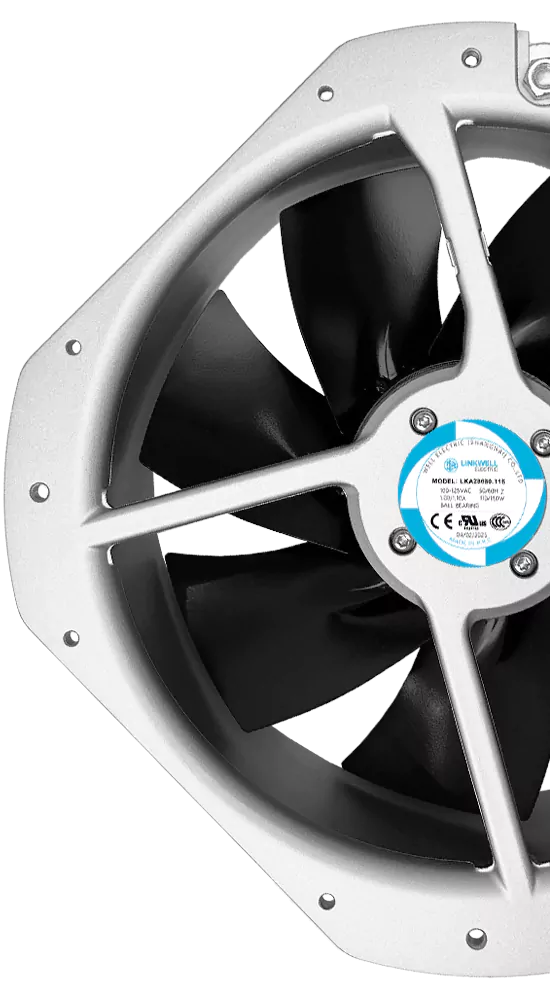
A fan is marked 24 V, so it is easy to assume that any supply close to 24 V will work. The real equipment may be less tidy. The power rail can sag during startup, rise during charging, lose voltage through a long cable, or share a supply with other loads. A fan that runs on the bench may then fail to start in a cold enclosure or may not deliver the expected airflow at the installed terminals.
The fan operating voltage range tells you the supply window approved for the exact model. It is not the same as rated voltage, minimum starting voltage, speed-control range, or a general promise that performance stays unchanged at every voltage. Keeping those terms separate prevents many selection and troubleshooting mistakes.
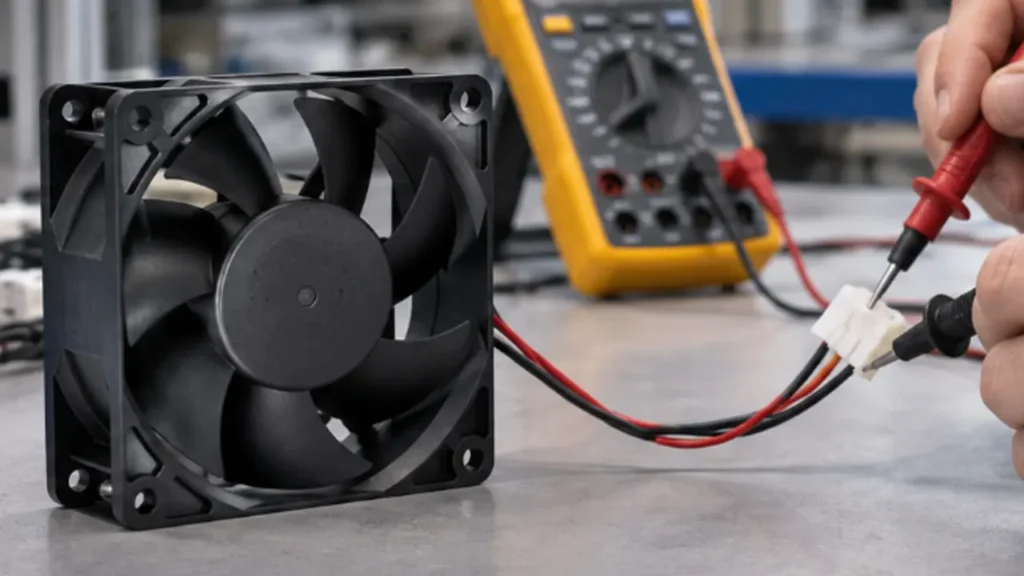
What Is a Fan Operating Voltage Range?
A fan operating voltage range is the minimum-to-maximum supply range within which a specific fan model is approved to operate under stated conditions. For a DC fan, that value normally applies at the fan input terminals. For an AC fan, voltage and frequency must both be considered. For an EC fan, the mains or DC power input must be separated from the low-voltage speed-control input.
The range belongs to the exact model and option. Two fans with the same rated voltage can use different motor windings, drivers, power levels and protection thresholds, so they can have different permitted ranges. A family-level statement should not replace the approved specification for the part number being purchased.
Operation within the range also does not mean identical performance at every point. Speed, airflow, static pressure, current, input power, noise and starting margin can change with supply voltage. Published performance curves are often based on rated voltage unless the datasheet states otherwise.
Note: Read the voltage at the fan terminals under load. A power supply can be within specification while cable resistance, connectors or shared loads pull the voltage at the fan below its approved range.
Rated Voltage vs Operating Voltage Range
The four terms below are related, but they should not be used as substitutes for one another.
| Term | Meaning | What to check |
|---|---|---|
| Rated voltage | The nominal voltage used to identify the fan and normally used for rated performance data | Whether airflow, speed, current and noise values are specified at this voltage |
| Operating voltage range | The approved supply window for normal operation under stated conditions | Minimum and maximum terminal voltage, temperature, frequency and control conditions |
| Starting voltage | The voltage required for reliable startup from rest under a stated test condition | Whether the value is guaranteed or typical and how the voltage is applied |
| Voltage tolerance | The acceptable variation around an intended supply condition | Whether it describes the fan, the power source or the complete equipment design |
A 24 V rated fan is designed around a nominal 24 V supply, but the approved operating range may extend below and above that point. The exact limits cannot be inferred from the “24 V” label. Likewise, a fan that starts at one lower voltage during a room-temperature bench test has not automatically been qualified to operate at that voltage across temperature, aging and production variation.
The rated voltage is often the reference point for catalog performance. If your equipment runs near one edge of the operating range, ask how speed, airflow, input current and protection behavior change there rather than assuming the rated values still apply.
What Is the Minimum Starting Voltage of a Fan?
Fan minimum starting voltage is the lowest supply condition at which the fan is expected to begin rotating from rest under a defined test method. It is a startup requirement, not a universal low-speed setting.
The test conditions matter. A specification may use a step application of voltage at a defined ambient temperature with a free-spinning fan. Your equipment may instead ramp the supply slowly, start at a low PWM command, operate in cold lubricant, or place the fan behind a restrictive filter. Those differences can change the practical starting margin.
When the datasheet lists starting voltage, check whether it is a guaranteed maximum or only a typical result. If it is not listed, do not estimate it from another fan of the same rated voltage. Ask the supplier for the value and test method, then validate samples at the worst expected terminal voltage and temperature.
Minimum starting voltage is also different from startup current. The voltage must remain high enough while the source supplies the transient current needed by the fan electronics and motor. The cooling fan startup current guide explains why a rail that measures correctly with no load can still collapse during starting.
Why Can a Fan Run at a Voltage Where It Cannot Start?
A stationary rotor has to overcome bearing friction, lubricant drag, rotor position, blade inertia and the motor driver’s startup sequence. Once the fan is rotating, commutation is established and the motor may need less drive to keep moving at a lower speed. That is why a fan can sometimes continue to run after voltage is reduced to a point where the same fan will not start from rest.
This creates a hysteresis-like gap between startup and run-down behavior. If you lower the voltage slowly while the fan is spinning, you may find a low point at which it still turns. That result is not a valid starting-voltage specification. After a power cycle, the rotor may remain stopped at the same voltage.
Some controllers solve this with a startup boost: they command full or higher drive for a short period, verify rotation, then reduce speed. The boost level and duration must be compatible with the fan. A controller should not assume that any brief pulse will guarantee starting across every fan, temperature and supply condition.
For equipment that must restart after a brownout or thermal command, test from a true stopped condition. A successful transition from high speed to low speed does not prove reliable cold starting at the low setting.
What Affects Fan Starting Voltage?
Starting voltage is not controlled by the nameplate alone. Several parts of the fan and the equipment can move the practical start point.
| Factor | Why it can affect starting | What to verify |
|---|---|---|
| Motor and driver design | Winding, commutation method, current control and startup logic determine the available starting drive | Exact model specification and control method |
| Fan size and rotating assembly | Rotor inertia and blade design affect acceleration from rest | Do not transfer a value between frame sizes or speed variants |
| Bearing and lubricant condition | Friction and lubricant viscosity can change with temperature, wear and storage | Cold-start requirement, mounting orientation and service condition |
| Supply stability | Cable drop, converter current limit or a shared load can reduce terminal voltage during startup | Voltage at the fan connector with adequate time resolution |
| Control input | A low PWM duty cycle, missing enable or low analog command can prevent the driver from producing a valid start | Power input and command input as separate signals |
| Air path and mechanical interference | A blocked blade, damaged guard or contamination can raise the required starting effort or stop rotation | Final assembly, filters, cable routing and clearances |
| Production variation and aging | One new sample may start below the guaranteed limit without representing the full population | Supplier limits, sample spread and validation margin |
Static pressure is usually much more important to running airflow than to the no-flow instant at startup, but the installed assembly still matters. A rubbing seal, deformed housing, ice, contamination or cable contact is a mechanical problem, not a reason to raise the voltage beyond the approved maximum.
What Is Fan Voltage Tolerance?
Fan voltage tolerance describes how much the applied voltage may vary from an intended value while the fan and equipment still meet their requirements. The phrase is incomplete unless it identifies whose tolerance is being discussed.
A 24 V power supply may have its own regulation tolerance. The cable and connector add voltage drop. A battery bus can move with state of charge and charging. The fan then has its own operating range. These limits must overlap under every relevant condition.
A simple DC check is:
Vfan = Vsupply – Vcable – Vconnector
For the low-voltage case, use the minimum supply output and the maximum expected wiring drop at startup. For the high-voltage case, include the maximum regulated or charging voltage and relevant transients. Compare both results with the exact fan’s approved input limits.
Do not use a generic percentage around rated voltage unless the fan specification actually gives that tolerance. “24 V nominal” does not automatically mean that every 24 V fan accepts the same upper and lower limits.
Tip: Build a voltage budget from source to fan connector. It is more reliable than adding an arbitrary safety percentage to the number on the label.
Why Is the Operating Voltage Range Important?
The range affects more than whether the blade turns. It connects the electrical design to the cooling result.
Reliable startup. The lowest terminal voltage must still allow the fan to start after power-up, brownout recovery and a low-speed command under the worst approved temperature.
Stable speed and airflow. A lower supply can reduce speed on a voltage-controlled DC fan, which reduces airflow and pressure. The equipment may stay powered while its thermal margin disappears.
Predictable electronics behavior. Integrated drivers can have undervoltage, overvoltage, restart and fault thresholds. Operation near a threshold may look like intermittent fan failure rather than a simple speed change.
System compatibility. A fan must match the actual DC bus, AC mains and frequency, converter output, connector, control interface and grounding arrangement. Matching only the nominal number leaves important conditions unchecked.
Valid performance and qualification. Published airflow, current, noise, life or certification data apply under stated conditions. Running outside the approved range can move the product beyond those conditions even if it appears to operate.
What Happens If Fan Voltage Is Too Low?
Low voltage can produce several different symptoms, depending on the fan electronics and the way the supply falls.
- The fan may not start, may twitch, or may repeatedly attempt to start.
- It may start after a light push or after the voltage rises, which indicates inadequate starting margin rather than acceptable operation.
- A voltage-controlled DC fan may run more slowly and deliver less airflow and pressure.
- An electronic driver may enter undervoltage lockout, reset, or cycle between on and off.
- The power supply may current-limit, causing the fan and rail to restart together.
- The cooled equipment may overheat even though the fan has not suffered immediate electrical damage.
Can low voltage damage a fan? There is no universal yes-or-no answer. A properly designed brushless fan may simply stop or enter protection, while another design can experience repeated startup stress or poor self-cooling. The more immediate system risk is often inadequate airflow. Operation below the published range should therefore be treated as unapproved, not as a harmless low-speed mode.
Measure during the event. A handheld meter can average a fast voltage dip and make the rail look normal. If the fan clicks, pulses, or restarts, capture terminal voltage, current and control input with suitable test equipment.
What Happens If Fan Voltage Is Too High?
Excess voltage can stress the motor windings, switching devices, capacitors, insulation and protection components. On some voltage-dependent fans it can also increase speed, current, input power, noise and bearing load. An electronically regulated fan may hold speed for part of the range, but that does not make unlimited input voltage acceptable.
A continuous overvoltage and a short transient are different requirements. The operating range normally describes steady input conditions. Surge, load dump, reverse polarity, electrical fast transient and other disturbances require their own ratings or system-level protection. Do not assume that a maximum operating voltage is also a transient withstand value.
If the fan is connected to a battery or charging system, compare the specification with the highest charging voltage, not only the nominal battery label. For an adjustable power supply, include setting accuracy and overshoot. For a shared industrial DC bus, include regeneration or switching events if they can reach the fan.
Do not test the upper limit by gradually increasing voltage until the fan fails. Use documented limits and a controlled validation plan. A fan that survives one brief overvoltage event has not been qualified for continuous operation there.
DC Fan Operating Voltage Range
DC cooling fans are commonly identified by nominal values such as 5 V, 12 V, 24 V or 48 V. That label helps match the product family to the equipment bus, but it is not the complete voltage specification.
A fan marked 24 V does not automatically mean that every voltage near 24 V is acceptable. Always check the operating voltage range specified for the individual model. Also check whether starting voltage, rated current and performance data are stated at room temperature, rated voltage or another condition.
Two-wire and three-wire DC fans may use supply-voltage variation for speed control only when the model permits it. A four-wire PWM fan normally keeps its power input within the approved range and receives speed commands on a separate control lead. The power rail, tachometer output and PWM input each have different electrical limits.
At the fan connector, check both ends of the range:
- Minimum source voltage after converter tolerance and wiring drop
- Startup sag when one fan or several fans start together
- Maximum regulated or battery-charging voltage
- Voltage ripple and relevant transients
- Polarity, connector rating and return-path drop
The fan power supply sizing guide provides a fuller method for checking current capacity, simultaneous startup and cable loss.
AC Fan Operating Voltage Considerations
An AC fan must be matched to both RMS voltage and frequency. A model intended for one mains family may use a different winding, capacitor or motor design from a fan intended for another. The label, approved drawing and datasheet should state the permitted voltage and frequency combination.
Running speed and input current can respond differently at 50 Hz and 60 Hz. The performance data may therefore list separate values for each frequency. A wide voltage marking does not automatically mean that every frequency within that range is accepted.
For mains-powered fans, also confirm insulation class, protective earth or double-insulation requirements, connector or terminal rating, applicable approvals and the equipment’s overcurrent protection. These are safety requirements, not just airflow settings.
A series resistor, generic dimmer or unverified triac controller is not a universal way to reduce AC fan speed. It can change motor heating, torque, noise and starting reliability. Use a fan and controller combination whose compatibility is documented. The AC fan voltage guide covers regional voltage, frequency and model selection in more detail.
Note: Mains-voltage tests require qualified personnel, suitable protection and rated test equipment. Do not treat an AC fan like a low-voltage bench load.
EC Fan Operating Voltage Considerations
An EC fan includes electronic commutation and power conversion, so its input specification may look broader than that of a traditional fixed-voltage fan. Some models accept low-voltage DC, some accept mains AC, and some cover a wide input family. The exact range still belongs to the specific model.
Keep the power input separate from the command input. A mains-powered EC fan can receive full approved supply voltage while a 0-10 V, PWM, potentiometer or digital command requests speed. Reducing the supply below its approved range is not a substitute for sending a lower speed command.
Check the EC fan documentation for:
- Power input voltage and frequency
- Control-input type, reference terminal and electrical limits
- Enable and stop behavior
- Minimum command and minimum stable speed
- Response to missing control signal
- Undervoltage, overvoltage, fault and restart behavior
A fan may have enough power at its input and still remain stopped because the enable or speed command is missing. The reverse is also possible: the controller may request full speed while the supply at the fan terminals is too low to start. The EC fan speed control guide explains how to separate power, command and feedback during commissioning.
Can You Reduce Fan Speed by Lowering Voltage?
Sometimes, but only when the fan documentation permits supply-voltage control. Reducing the voltage of a compatible DC fan can lower speed, airflow and noise, yet the usable range is limited by starting reliability, stable commutation and the equipment’s cooling requirement.
The main trap is proving the setting while the fan is already spinning. A low-voltage setting may hold rotation but fail after a power cycle, brownout or cold start. If voltage control is used, the controller should provide adequate starting drive and the design should verify that the fan restarts from every expected state.
A dedicated PWM fan usually receives a steady supply within its approved range and uses a separate signal to request speed. This avoids using undervoltage as the control method and often provides a more predictable low-speed range. It does not remove the need to check minimum duty cycle, stop behavior and restart logic. See what a PWM fan is for the interface basics.
For an EC fan, use the documented 0-10 V, PWM, potentiometer or digital interface when available. For an AC fan, do not reduce voltage with a generic controller unless the motor and controller are approved to work together.
Speed control is successful only when the final airflow and component temperatures remain acceptable. A quieter fan that no longer starts reliably or cannot overcome the system resistance is not a valid operating point.
How to Read Fan Voltage Specifications
A useful fan datasheet should let you separate power compatibility, startup behavior, rated performance and control behavior. Check each field instead of relying on the voltage printed in the product name.
| Specification | How to read it | Common mistake |
|---|---|---|
| Rated voltage | Nominal reference voltage for the model and usually for catalog performance | Treating it as the full permitted range |
| Operating voltage range | Approved minimum and maximum supply under stated conditions | Assuming performance is constant across the range |
| Starting voltage | Voltage needed to start from rest using the stated method | Using the run-down or stall voltage instead |
| Rated current and input power | Values measured at a defined voltage, speed and condition | Sizing the source without startup and tolerance margin |
| Speed, airflow and static pressure | Performance at the stated voltage and test condition | Applying rated data unchanged at minimum voltage |
| Frequency | Required for AC or mains-powered EC models | Matching voltage but ignoring 50 Hz or 60 Hz behavior |
| Control input | PWM, analog, enable or digital-command electrical limits | Confusing control voltage with fan power voltage |
| Protection and restart | Undervoltage, overvoltage, locked-rotor and recovery behavior | Assuming every fault clears automatically |
| Test conditions | Ambient temperature, free-air or system setup, tolerance and value type | Comparing a typical value with a guaranteed limit |
Look for words such as minimum, maximum, typical and guaranteed. A typical starting voltage describes a representative result, while a maximum starting-voltage limit can be used to design the minimum supply condition when the test method matches your application. If those words are missing, ask for clarification before freezing the power design.
How to Select the Correct Fan Voltage
Choose the fan voltage from the actual electrical and thermal conditions, not from the nearest nominal label.
- Define the source. Record nominal, minimum and maximum voltage, AC frequency where applicable, regulation accuracy, ripple, charging condition and relevant transients.
- Calculate voltage at the fan. Include cable, connector, switch, transistor and return-path drop at startup and high load.
- Confirm reliable starting. Compare the worst low terminal voltage with the model’s starting requirement, then test cold start, hot restart and brownout recovery.
- Confirm the upper limit. Include maximum charger or converter output and make sure transients are handled by a separately documented rating or protection circuit.
- Match the control method. Decide whether speed is fixed, supply-voltage controlled, PWM controlled, analog controlled or digitally commanded. Keep command limits separate from power-input limits.
- Check cooling at the real operating point. Validate airflow, pressure, noise and component temperatures with filters, guards and enclosure panels installed.
- Approve the exact configuration. Record the part number, voltage range, wire and connector, control option, feedback signal and revision in the purchasing specification.
When requesting a fan recommendation, provide the rated supply, minimum and maximum terminal voltage, AC frequency if relevant, fan size, required airflow and static pressure, temperature range, speed-control method, startup sequence and the number of fans that start together. These details allow the voltage requirement to be checked against the cooling duty instead of selecting from voltage alone.
For LINKWELL DC, AC and EC fan selection, voltage ranges and starting behavior must be confirmed for the proposed model and option. Share the equipment power conditions and control interface so the fan, wiring and supply can be reviewed as one system.
Frequently Asked Questions
What is the operating voltage range of a fan?
It is the minimum-to-maximum supply range approved for a specific fan model under stated conditions. The value must come from the model datasheet or approved specification; it cannot be derived from rated voltage alone.
What is the difference between rated voltage and operating voltage?
Rated voltage is the nominal reference value, often used for performance data. The operating voltage range gives the permitted input window. A fan may operate across a range but deliver its rated speed, airflow, current and noise data only at the rated condition.
What is the minimum starting voltage of a fan?
It is the lowest supply condition at which the fan is expected to start from rest using a defined test method. It may be higher than the voltage at which an already-running fan can continue to turn.
What does fan voltage tolerance mean?
It means the acceptable voltage variation around the intended supply condition. Confirm whether the tolerance refers to the power supply, the voltage at the fan terminals, or the fan’s own approved operating range.
Can a 24 V fan run at a lower voltage?
Possibly, if the exact 24 V model’s operating range includes that voltage. It must also start reliably and provide enough airflow. The “24 V” label by itself does not define the lower limit.
Can low voltage damage a cooling fan?
It depends on the design. Some brushless fans stop or enter protection, while others may repeatedly restart or operate with inadequate self-cooling. Even when the fan survives, the equipment can overheat because airflow is too low. Stay within the published range.
Does fan speed change with voltage?
It often does on voltage-controlled DC fans, but the relationship is not universally linear. A regulated or PWM-controlled fan may respond differently. Use measured performance data for the actual model and control method.
Does PWM affect fan starting?
It can. A dedicated PWM fan may use its own minimum-duty and startup logic while receiving a constant supply. A fan controlled by switching its power may require a startup boost. Confirm PWM frequency, duty-cycle limits, start behavior and the difference between a zero command and a fault.