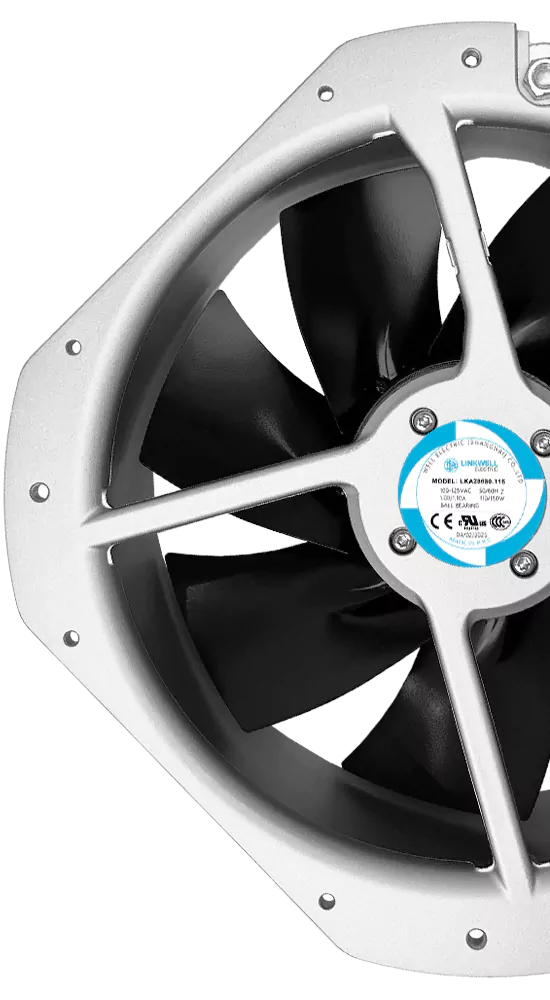
A fan inside a sealed electronics enclosure can reduce hot spots, improve airflow across heat sinks and make the internal temperature more uniform. It cannot remove heat from the enclosure by itself. At steady state, every watt generated inside the cabinet must cross the enclosure wall or pass through a closed-loop cooling device.
This is the central rule of sealed enclosure cooling. Internal air movement improves the path from a component to the wall, heat exchanger or cooling unit. It does not create an external heat-rejection path. If the cabinet still overheats after an internal fan is added, the problem may be insufficient wall area, high ambient temperature, solar gain or an undersized cooling device rather than a lack of circulation.
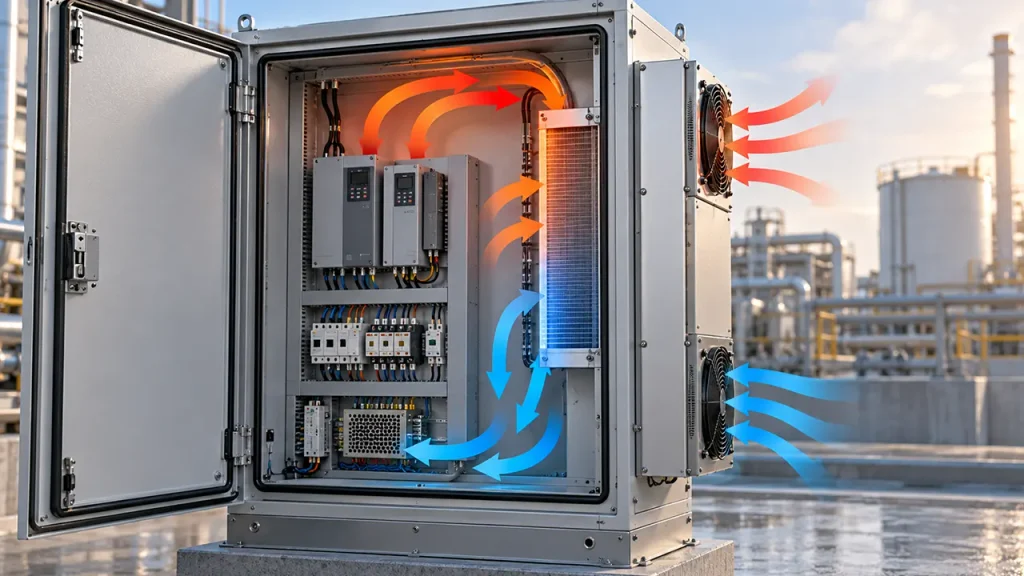
What Does “Sealed Enclosure” Mean?
In a thermal design, sealed normally means there is no intended exchange between the cabinet’s internal air and the surrounding air. The enclosure may not be gas-tight, but dust, moisture or corrosive air is not deliberately pulled through it for cooling.
A sealed system can still use several fans. One fan may circulate internal air across components and the warm side of a heat exchanger. Another may move outside air across the external side. The two air streams remain separated by a wall, coil or heat-exchanger core.
If a fan is installed through a cutout and moves room or outdoor air directly into the cabinet, the cooling system is no longer sealed in this thermal sense. That may be a valid design change, but the engineer must reassess dust, water, corrosion, pressure balance and the protection of the completed enclosure.
Where Does the Heat Go?
Electrical losses from power supplies, drives, controllers, batteries, displays and communication equipment become heat inside the cabinet. An internal fan moves that heat, but the final path must cross the cabinet boundary.
There are three practical heat paths:
- Passive transfer through the enclosure walls
- A closed-loop heat exchanger that keeps internal and external air separate
- An active cooling system such as an enclosure air conditioner, air-to-water heat exchanger or thermoelectric cooler
A simple heat balance helps organize the decision:
Net cooling required = internal heat load + external heat gain – passive heat loss
All terms are expressed in watts. Internal heat load is the actual heat dissipated inside the enclosure, not automatically the sum of every nameplate input rating. External heat gain can include solar radiation, nearby hot equipment or a process surface. Passive heat loss depends on the enclosure material, exposed surface area, mounting arrangement and the temperature difference between the cabinet and its surroundings.
This relationship is a selection framework, not a substitute for the calculation method required by the enclosure or cooling-equipment supplier. It does, however, prevent a common mistake: sizing a fan before defining how the heat will leave.
What an Internal Circulation Fan Can Do
Natural convection often creates a warm upper region, stagnant corners and weak airflow through component heat sinks. A correctly positioned internal fan can reduce these local problems.
It can move cooler internal air toward a high-loss component, increase airflow through heat-sink fins, mix warm and cool layers, and improve convection at the inside surface of the enclosure. It can also distribute conditioned air from a heat exchanger or air conditioner more evenly.
This can lower a component temperature even when the average cabinet-air temperature changes only slightly. The benefit comes from reducing the local thermal resistance between the component and the available heat-rejection surface.
Fan placement matters. Air should pass through the hot region and continue toward the wall or cooling device. If the fan draws its own discharge back into its inlet, or if air bypasses the heat sink through a large open gap, higher fan speed may add noise without improving the critical temperature.
For internal air-path details, see Cooling Fan Shroud Design, Fan Inlet Clearance and Fan System Effect.
What an Internal Fan Cannot Do
If the fan and all of its airflow remain inside the sealed volume, the fan cannot create a new route for heat to escape. It also adds its own electrical loss to the cabinet. That loss is usually smaller than the equipment load, but it still belongs in the heat balance.
Suppose the enclosure walls and cooling hardware can reject 100 W under the actual ambient condition. Better circulation may help the cabinet use that 100 W capacity more evenly. It cannot turn it into 300 W of heat rejection.
An internal fan also cannot:
- Cool the enclosure below ambient without an active cold source
- Compensate for a heat exchanger that is undersized at the real temperature difference
- Remove solar heat entering an outdoor cabinet unless the boundary can reject the combined load
- Preserve an enclosure rating after an uncontrolled cutout or accessory installation
- Eliminate condensation caused by surfaces operating below the dew point
Note: A single sensor can hide the problem. After adding an internal fan, one hot spot may become cooler while another component or enclosure wall becomes warmer. Validate every temperature-critical location.
Choose the Heat-Rejection Method
| Cooling method | Keeps air streams separate? | Can cool below ambient? | Best fit |
|---|---|---|---|
| Passive wall cooling | Yes | No | Low heat load, sufficient surface area and acceptable temperature rise |
| Internal circulation fan only | Yes | No | Hot-spot reduction and better use of an existing wall or cooler |
| Air-to-air heat exchanger | Yes | No | Ambient is cooler than the target cabinet temperature and contaminants must remain outside |
| Air-to-water heat exchanger | Yes | Potentially | High heat density where suitable cooling water and leak controls are available |
| Enclosure air conditioner | Yes, when correctly installed | Yes | Target temperature is below ambient or the heat load exceeds passive capacity |
| Thermoelectric cooler | Yes | Yes | Smaller loads where compact solid-state cooling has an application advantage |
| Filtered ventilation fan | No | No | Outside air is acceptable and a sealed air path is not required |
The correct method depends first on heat load, ambient temperature and environmental protection. Fan size comes later. A large internal fan cannot correct a cooling architecture that has no adequate path across the enclosure boundary.
When Passive Wall Cooling Is Enough
Every enclosure transfers some heat through its walls. Passive cooling may be sufficient when the internal loss is modest, enough wall area is exposed and the surrounding air remains cooler than the permitted internal temperature.
Cabinet material, wall thickness, surface finish, mounting and external clearance influence the result. A metal enclosure mounted freely in moving room air does not behave like the same enclosure recessed into a wall, placed in direct sun or packed tightly between other cabinets. Internal circulation can improve convection at the inside surface, but it cannot overcome a hot external environment.
Passive cooling becomes less effective as the internal temperature approaches ambient because the temperature difference driving heat transfer becomes smaller. If the target component temperature leaves little margin above the worst-case ambient, another cooling method may be necessary even when the calculated heat load appears moderate.
When to Use an Air-to-Air Heat Exchanger
An air-to-air heat exchanger suits applications that must keep internal and external air separated while the surrounding air is cooler than the desired cabinet temperature. Internal and external fans move air across opposite sides of a core, allowing heat to cross without intentionally bringing outside dust or humidity into the enclosure.
Its capacity depends strongly on the temperature difference between the two air streams. As the internal temperature approaches ambient, available heat transfer falls. Always compare the required cooling capacity with the exchanger rating at the project’s real internal and external temperatures—not only at a favorable catalog condition.
Both air circuits also have resistance. Guards, ducts, filters and the exchanger core change the operating point of each fan. A fan with a large free-air CFM value may still deliver insufficient flow through the installed core.
When Active Cooling Is Necessary
Consider an enclosure air conditioner, air-to-water heat exchanger or thermoelectric system when the allowable cabinet temperature is below the worst-case ambient, the internal heat density is too high for the available wall area, or solar and process heat push the external surface above the intended limit.
Active cooling brings additional design questions. An air conditioner needs external heat-rejection clearance and condensate management. A water circuit needs defined temperature, flow, water quality and leak response. A thermoelectric cooler must reject both the enclosure heat and its own input power at the hot side.
Size the complete system for the worst credible combination of internal load, ambient temperature and external heat gain. Do not size it from room temperature during a prototype test if the final product will operate outdoors or beside hot machinery.
How to Select an Internal Cooling Fan
The enclosure heat load alone does not determine the required internal fan airflow. The fan’s purpose is to reduce the thermal resistance between particular components and the available wall, heat exchanger or active cooler. Start by identifying the hot component, the target surface and the path between them.
Then confirm:
- Required airflow through the component heat sink or cooling passage
- Static pressure created by heat-sink fins, grilles, ducts and tight internal geometry
- Available fan size, mounting direction and inlet clearance
- Supply voltage and permitted operating range
- Operating temperature at the actual fan location
- Noise and vibration limits
- Need for PWM control, FG speed feedback or RD alarm output
- Expected service access and replacement method
Select from the fan curve at the expected system resistance rather than using free-air airflow alone. A deeper fan or centrifugal blower may be appropriate when the internal path is restrictive, while an axial fan can be effective when air moves through a relatively open path.
The fan should not be mounted so close to a wall, PCB or cable bundle that part of the inlet is blocked. Check cable routing and guards as part of the air path, not as details added after fan selection.
Can You Put a Fan Through a Sealed Enclosure Wall?
You can mount a fan or cooling assembly through an enclosure wall, but the result depends on what the assembly does. A closed-loop heat exchanger or enclosure air conditioner can preserve separation between the two air circuits when installed as an approved system. A standard fan that blows outside air through an open cutout cannot.
If direct ventilation is acceptable, treat the design as an open-loop enclosure. Define the intake filter, exhaust area, cabinet pressure, filter-loading condition and maintenance interval. The article Positive vs Negative Pressure in Electrical Enclosures explains the pressure decision for ventilated cabinets.
Why the Fan’s IP Rating Is Not Enough
An IP-rated fan describes protection associated with the fan under defined test conditions. The finished cabinet also includes the cutout, gasket, screws, cable entry, guard, connector, drain path and installation workmanship.
IEC 60529 defines degrees of protection provided by enclosures under the IP Code. It does not mean that mounting one component with a matching IP number automatically certifies the complete assembly. Likewise, the published NEMA 250 scope notes that its enclosure requirements do not cover every internal concern, including condensation and thermal damage.
Follow the enclosure and accessory installation requirements and verify the completed configuration. If the rating is safety- or compliance-critical, use the appropriate assessment or certification process instead of making an assumption from component labels.
Tip: Put the environmental protection requirement on the complete cooling-system specification. That keeps the cutout, gasket, wiring and installation method in the engineering review.
Condensation Can Become the Limiting Risk
Below-ambient cooling can bring a coil, duct or component below the dew point. Moisture already trapped inside the cabinet—or humid air entering during service—can then condense on cold surfaces.
Review the expected humidity and dew point, the temperature setpoint, control hysteresis, door-opening frequency, condensate drainage and the location of cold surfaces relative to sensitive electronics. Shutdown and rapid weather changes also matter because an enclosure can cool before its internal moisture has escaped.
Sealing the cabinet does not eliminate moisture already inside it. IP or NEMA protection is not a substitute for condensation analysis. The IP-Rated Fans guide explains why component protection and completed-equipment protection must be reviewed separately.
Validate the Cooling System in the Closed Cabinet
A bench test proves that the fan runs. It does not prove that the sealed enclosure remains within its thermal limits. Test the final cabinet with doors and covers closed, the intended filters or cooling core installed, and a representative electrical load.
Measure ambient temperature, internal air temperature and the temperature of every critical component. Include the warmest plausible room or outdoor condition, supply-voltage variation and the normal control sequence. If the design uses redundant fans or fault monitoring, repeat the test with one fan stopped and verify both temperature response and alarm behavior.
Allow enough time to approach thermal equilibrium. A short test can look successful because the enclosure walls and internal metal are still absorbing heat. Record sensor positions so the result can be repeated after a design, component or fan change.
Practical Selection Checklist
- List the actual internal heat losses at maximum expected duty.
- Add credible solar, radiant or process heat entering from outside.
- Define the maximum ambient temperature and altitude.
- Set temperature limits at the critical components, not only for average cabinet air.
- Confirm the required IP degree or NEMA Type for the completed equipment.
- Decide whether outside air may enter the enclosure.
- Estimate the passive heat transfer available through the exposed walls.
- Select a closed-loop heat exchanger or active cooler if passive transfer is insufficient.
- Use internal fans where they improve the path from components to the heat-rejection surface.
- Check condensation, control signals, alarms, maintenance and failure behavior.
- Validate the complete system under representative worst-case conditions.
For the broader architecture decision, see Enclosure Temperature Control. LINKWELL can evaluate AC, DC and EC cooling fans for internal circulation and appropriately engineered cooling assemblies. Final fan selection requires the heat load, airflow path, system resistance, voltage, temperature range, available space and control requirements.
Frequently Asked Questions
Does a fan cool a sealed enclosure?
An internal fan can cool local components, reduce hot spots and make cabinet temperature more uniform. It cannot remove heat outside the enclosure by itself. The heat must still cross the enclosure wall or a closed-loop cooling device.
Can a sealed enclosure be cooled below ambient?
Yes, but not with passive wall cooling, an internal circulation fan or an air-to-air heat exchanger alone. Use an active cooling method with sufficient capacity and a plan for condensation.
Is an internal fan useful if the enclosure has no vents?
Yes, when it improves airflow through heat sinks, removes stagnant zones or moves heat toward the enclosure wall or cooler. It is not useful as a substitute for adequate external heat rejection.
Does installing an IP-rated fan preserve the cabinet’s IP rating?
Not automatically. The completed cutout, gasket, hardware, wiring and accessory assembly must meet the required protection and be installed according to the applicable instructions.
Is an air-to-air heat exchanger better than a filter fan?
It is appropriate when internal and external air must remain separated and ambient is cooler than the target cabinet temperature. A filter fan is simpler when outside air can safely enter. The two products serve different enclosure architectures.
How do I size the internal fan?
Define which components require airflow, the heat-sink or duct resistance, the path to the wall or cooling device, the fan operating temperature and the electrical interface. Select the fan at the expected airflow and static-pressure operating point, not from free-air CFM alone.